
The demand curve any monopolist uses in making output decisions is:
a. the same as the demand curve facing a perfectly competitive firm.
b. vertical, because there are no close substitutes for its product.
c. horizontal, because there are no close substitutes for its product.
d. the same as the market demand curve.
e. perfectly inelastic.
The economies of most less-developed countries (LDCs) are based on:
a. agriculture. c. services.
b. manufacturing. d. oil.
If the wage rate is fixed at a certain level, the:
a. labor supply curve is horizontal.
b. labor supply is a straight upward sloping line.
c. MP must be constant.
d. labor supply will increase at an increasing rate.
e. labor supply will increase at a decreasing rate.

A demand curve that has constant price elasticity of demand coefficient equals to one at
all points is a(n):
a. rectangular hyperbola. c. upward-sloping straight line.
b. downward-sloping straight line. d. none of these.
Assuming that hamburger is an inferior good, an increase in consumer income, other
things being equal, will cause a(n):
a. upward movement along the demand curve for hamburger.
b. rightward shift in the demand curve for hamburger.
c. downward movement along the demand curve for hamburger.
d. leftward shift in the demand curve for hamburger.
Which of the following statements is true?
a. The law of diminishing returns states that beyond some point the marginal product of
a variable resource continues to rise.
b. The marginal product is the change in total output by adding one additional unit of a
fixed input.
c. Fixed costs are costs which vary with the output level.
d. When marginal productivity of a variable input is falling then marginal costs of
production must be rising.
e. When marginal cost is below average cost, average cost rises; when marginal cost is
above average cost, average cost falls.

When costs that vary with the level of output are divided by the output, you have
calculated:
a. total changing cost.
b. total fixed cost.
c. average fixed cost.
d. average variable cost.
If 80 percent of the population receives 75 percent of the income,
a. the richest quintile receives 20 percent of the income.
b. the Lorenz curve is the diagonal.
c. income is not perfectly evenly distributed.
d. the poorest quintile receives more than 20 percent of income.
e. people in the middle quintile have the highest incomes.
Many student government candidates at colleges and universities propose rent controls
on local rental housing as a way to help students afford rental housing. Economic
theory suggests that this policy would harm students as a whole despite the fact that
some students who are able to find housing at the reduced price would benefit. Which

of the following are some of the offsetting secondary effects of the rent controls that
would work to the disadvantage of students?
a. There would be a shortage of rental housing, making it very difficult for students to
find places to rent and causing increased discrimination in the rental housing market.
b. There would be a reduction in the quality of rental housing.
c. There would be a reduction in the future supply of rental housing.
d. All of these would be secondary effects of the rent controls.
In economics, the demand for a good refers to the amount of the good people:
a. would like to have if the good were free.
b. are willing to buy at various prices.
c. need to achieve a minimum standard of living.
d. will buy at alternative income levels.
Price ceilings are imposed if the government believes:
a. the market will not achieve an equilibrium price.
b. the market equilibrium price is too low.
c. an excess supply of the product exists.
d. the market equilibrium price is too high.
e. the demand will be less than the supply of the product.
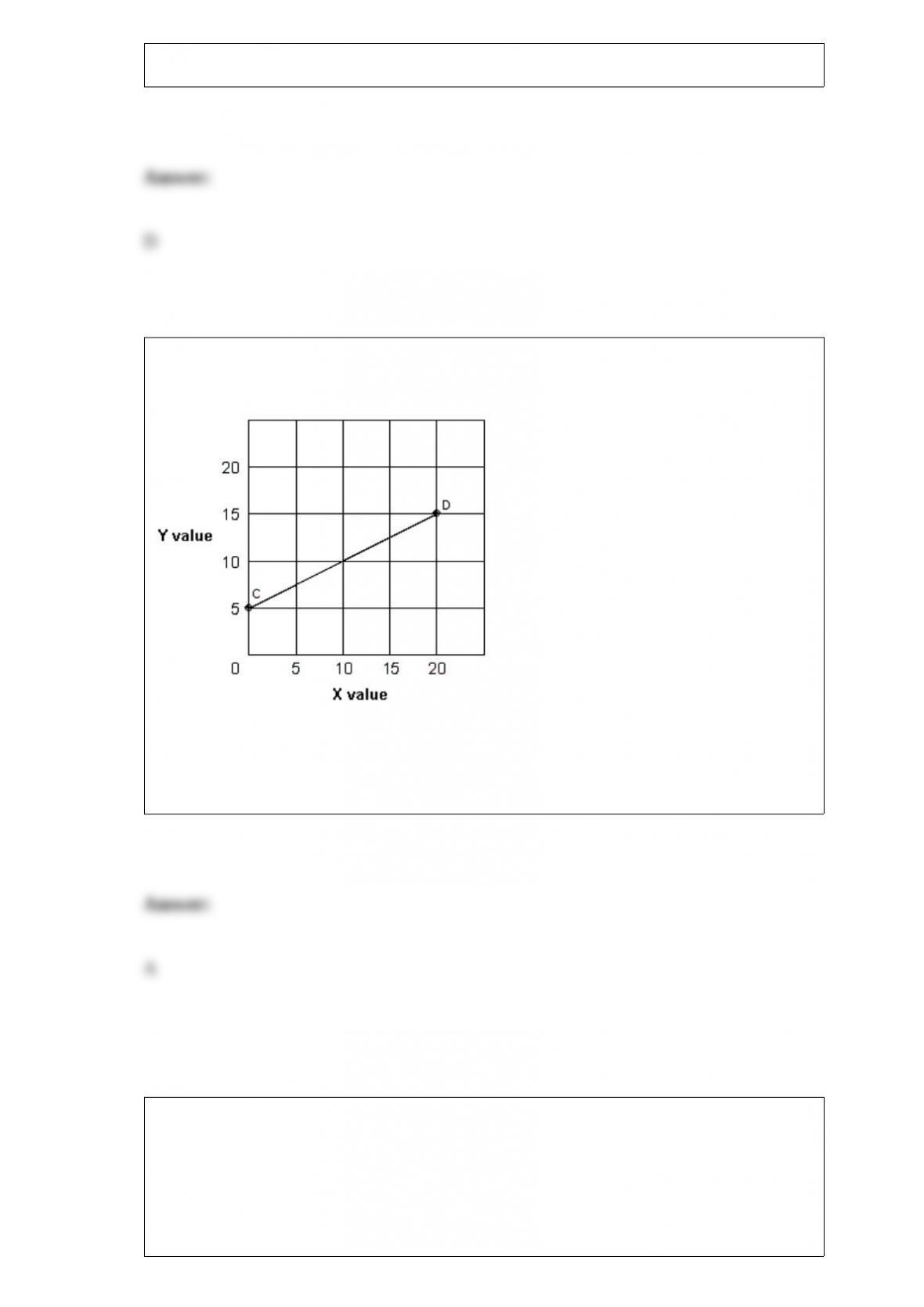
Exhibit 1A-2 Straight line
In Exhibit 1A-2, as X increases along the horizontal axis, corresponding to points C-D
on the line, the Y values increase. The relationship between the X and Y variables is:
a. direct. c. independent.
b. inverse. d. variable.
Economies of scale can be caused by all of the following except:
a. price discounts for large scale purchases.
b. labor specialization.
c. use of more productive equipment.
d. increases in the firm’s average total cost.
e. more cost-efficient methods of marketing.
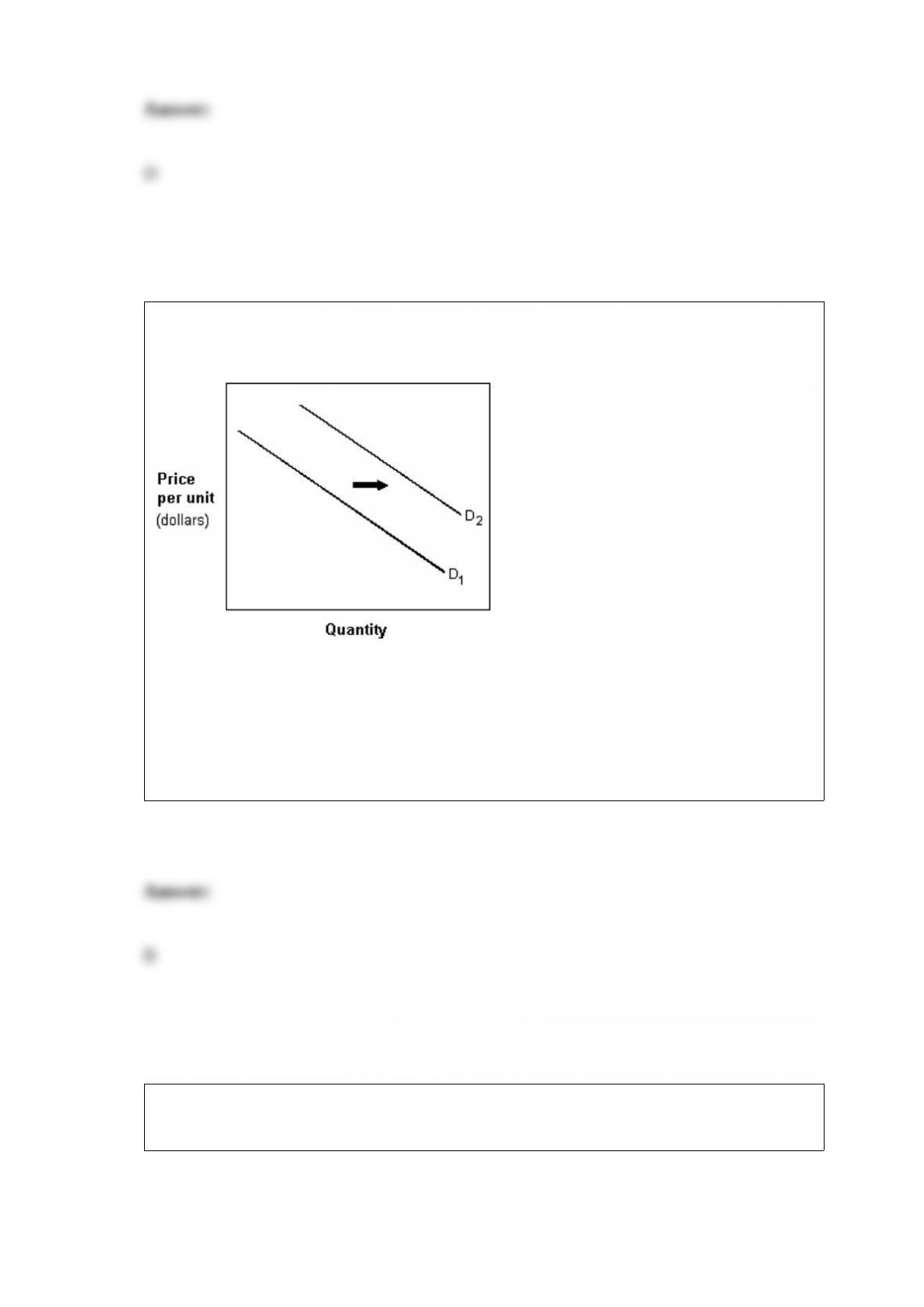
Exhibit 3-2 Demand curves
In Exhibit 3-2, the shift in the demand curve from D1 to D2 could have been caused by
which of the following?
a. Decrease in price.
b. Increase in expected future prices.
c. Increase in the price of a complement.
d. Decrease in income if it is a normal good.
Exhibit 13-3 A monopolist
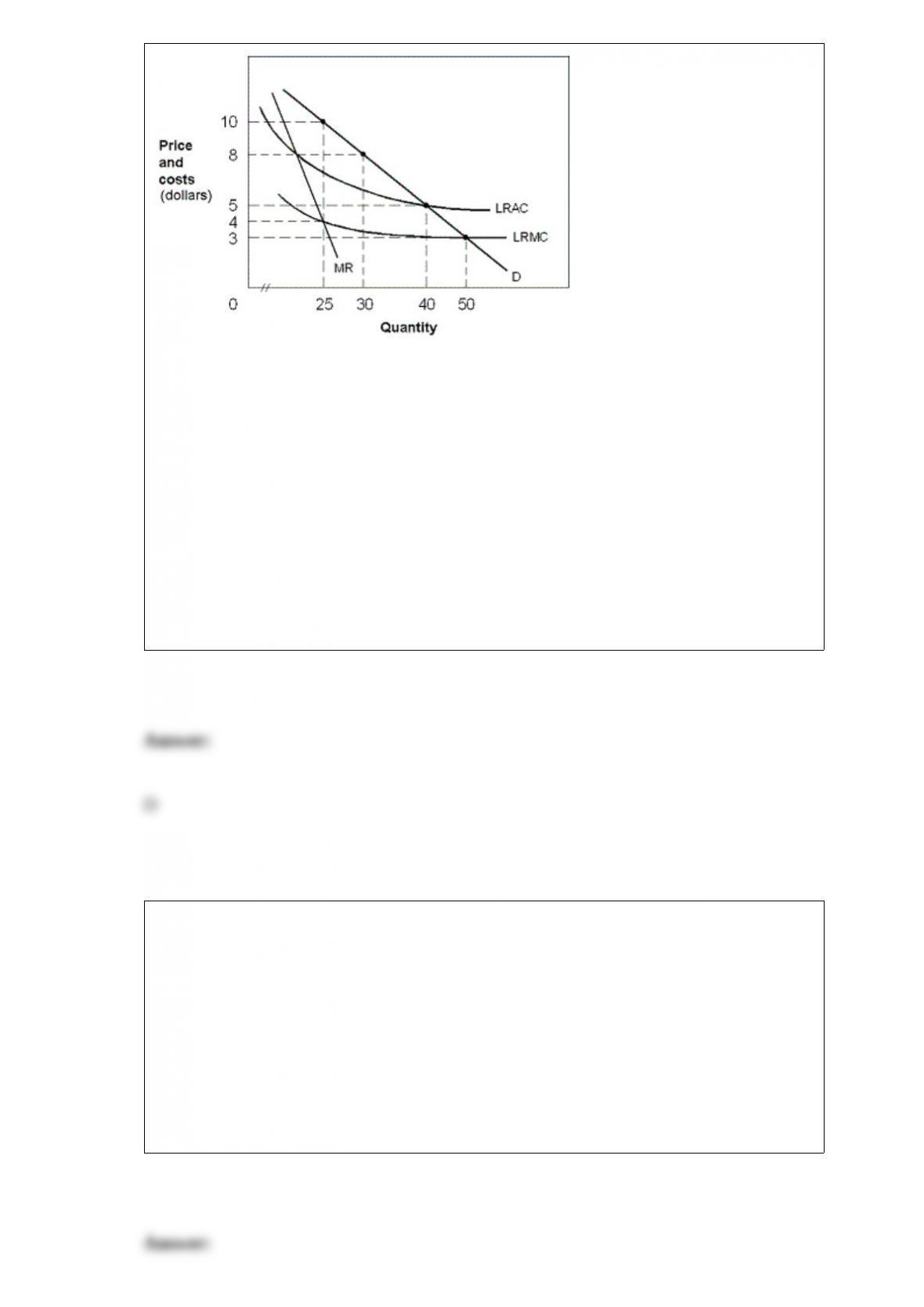
In Exhibit 13-3, if this industry is regulated and the regulatory commission sets price
equal to average total cost, then:
a. this firm would earn excess profit.
b. total revenue would equal marginal revenue.
c. the firm would suffer losses.
d. revenue would just be sufficient to cover costs.
e. revenue would just be sufficient to cover marginal cost.
A decrease in consumer income decreases the demand for compact discs. As a result of
the change to a new equilibrium, there is a(n):
a. leftward shift of the supply curve.
b. rightward shift of the supply curve.
c. upward movement along the supply curve.
d. downward movement along the supply curve.