
If a 1 percent decrease in the price of product A brings about a 3 percent increase in the
sales of product B, then:
a. products A and B are complementary.
b. the cross elasticity of demand between these two products is positive.
c. products A and B are substitutes.
d. the demand for these products is inelastic.
e. the total revenue earned from product A will decrease.
A perfectly elastic demand curve has a price elasticity of demand coefficient of:
a. zero.
b. 1.
c. greater than 1, but less than infinity.
d. less than 1, but greater than zero.
e. infinity.
In the long run, firms in many industries often experience a falling average total cost
curve as a result of:
a. gains through trade.
b. increasing marginal returns.
c. economies of scale.
d. lower fixed costs.

Which of the following U.S. antitrust laws prohibits mergers through the acquisition of
a firm’s assets if the merger would lessen competition?
a. Clayton Act. c. Celler-Kefauver Act.
b. Robinson-Patman Act. d. Sherman Antitrust Act.
According to the kinked demand theory, when one firm raises its price, other firms will:
a. also raise their prices.
b. refuse to follow.
c. increase their advertising expenditures.
d. exit the industry.
When economists say the demand for a product has increased, they mean the:
a. demand curve has shifted to the right.
b. price of the product has fallen, and consequently, consumers are buying more of it.
c. cost of producing the product has risen.
d. amount of the product that consumers are willing to purchase at various prices has
decreased.

Carla is spending all her income on only two goods: apples and bananas. The price of
an apple is $2 and the price of a banana is $1. If Carla’s marginal utility of an apple is 4
and her marginal utility of a banana is 3, she should consume:
a. more apples and fewer bananas to maximize total utility.
b. more bananas and fewer apples to maximize total utility.
c. more apples and more bananas to maximize total utility.
d. fewer apples and fewer bananas to maximize total utility.
e. her current amounts of apples and bananas to maximize total utility.
A point outside the production possibilities curve represents a combination of goods
that is:
a. inefficient. c. unattainable.
b. efficient. d. attainable.
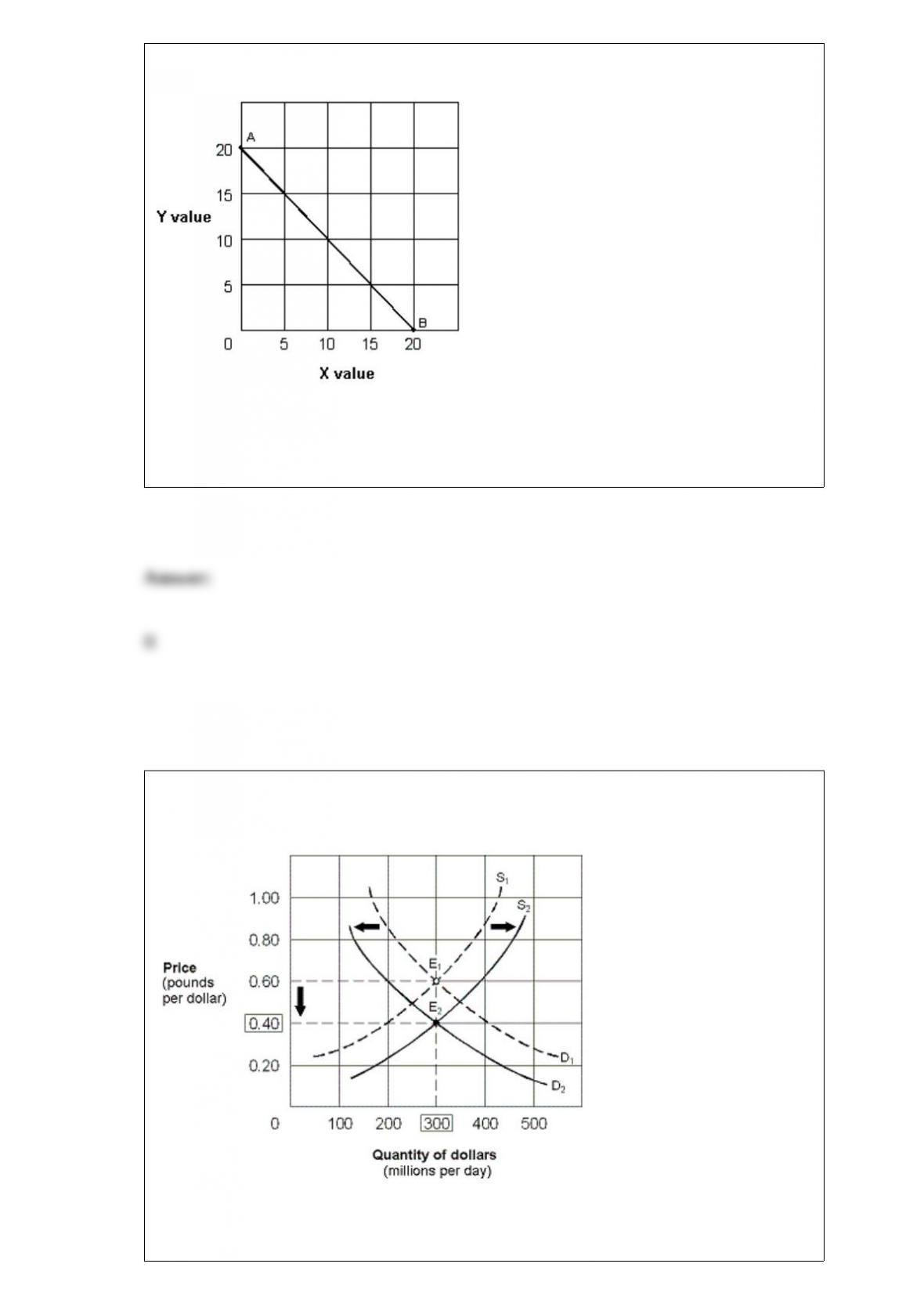
Exhibit 1A-3 Straight line
In Exhibit 1A-3, as X increases along the horizontal axis, corresponding to points A-B
on the line, the Y values decrease. The relationship between the X and Y variables is:
a. direct. c. independent.
b. inverse. d. variable.
Exhibit 15-7 Foreign exchange market for U.S. dollars and British pounds
Which of the following could cause the dollar-pound exchange rates to change as
shown in Exhibit 15-7?
a. American goods become more popular in Great Britain.

b. British incomes rise, while U.S. incomes remain unchanged.
c. The U.S. price level rises, while the British price level remains unchanged.
d. The U.S. real interest rate rises, while the British real interest rate remains
unchanged.
Bonnie gets her hair cut at her usual salon and is very happy with the results. Later that
afternoon, she goes to the mall and sees that a hair salon is giving away free haircuts
only on that day. If Bonnie does not take advantage of the giveaway, it is because the:
a. marginal utility of the next haircut would be zero or negative.
b. marginal utility of the next haircut would increase.
c. marginal utility of the next haircut would be zero or positive.
d. total utility of both haircuts would be zero or negative.
e. total utility of both haircuts would be higher than just one haircut.
Which of the following is a characteristic of an indifference curve?
a. Positive slope.
b. Concave shape.
c. Negative slope.
d. Zero slope.

Who would benefit if the exchange rate with yen (in U.S. dollars) increased?
a. c and e.
b. Japanese tourists.
c. U.S. consumers.
d. U.S. exporters.
e. Japanese exporters.
The utility of a good is:
a. different for different consumers.
b. the same for all consumers.
c. constant no matter how much is consumed.
d. related to the cost of producing it.
e. easily measured.
Which of the following transactions would be recorded as a credit in the U.S. current
account?
a. A Japanese bank’s purchase of IBM stock.
b. A Japanese consumer’s purchase of an Apple computer.
c. An American tourist’s payment to a Japanese hotel.
d. An American consumer’s purchase of a Toshiba VCR.

Compared to monopoly, the market results with monopolistic competition are usually
expected to be:
a. worse because consumers get fewer choices.
b. worse because consumers pay a higher price.
c. the same.
d. better because consumers get less output.
e. better because consumers pay a lower price.
The number of workers hired by a firm at a particular wage rate can be calculated if you
know which of the following?
a. c and d.
b. Product supply curve.
c. Marginal product of labor.
d. Marginal factor cost.
e. Marginal revenue product of labor.
When the price of a normal good falls, then:
a. both the income and substitution effects combine to cause the quantity demanded to
increase.

b. the substitution effect will cause people to buy more because the good is relatively
less expensive.
c. the income effect will cause people to buy more because of the increased purchasing
power associated with the lower price.
d. all of these.
If the quantity supplied exceeds the quantity demanded in a market, then the result is
which of the following?
a. Deadweight loss c. Overproduction
b. Inefficiency d. Each of these are true.
Exhibit 9-1 Monopolist’s demand curve

In Exhibit 9-1, the marginal revenue curve corresponding to the monopolist’s demand
curve would be a straight line drawn between points:
a. A to B.
b. A to C.
c. A to D.
d. C to B.
e. C to D.
A good that provides external benefits to society has:
a. too few resources devoted to its production.
b. too many resources devoted to its production.
c. the optimal resources devoted to its production.
d. not provided profits to producers of the good.
Which of the following is an example of a fixed cost for a fishing company?
a. The cost of hiring a fishing crew.
b. The fuel costs of running the boat.
c. The monthly loan payment on the boat.
d. The supply of nets, hooks, and fishing lines.
e. Bait.
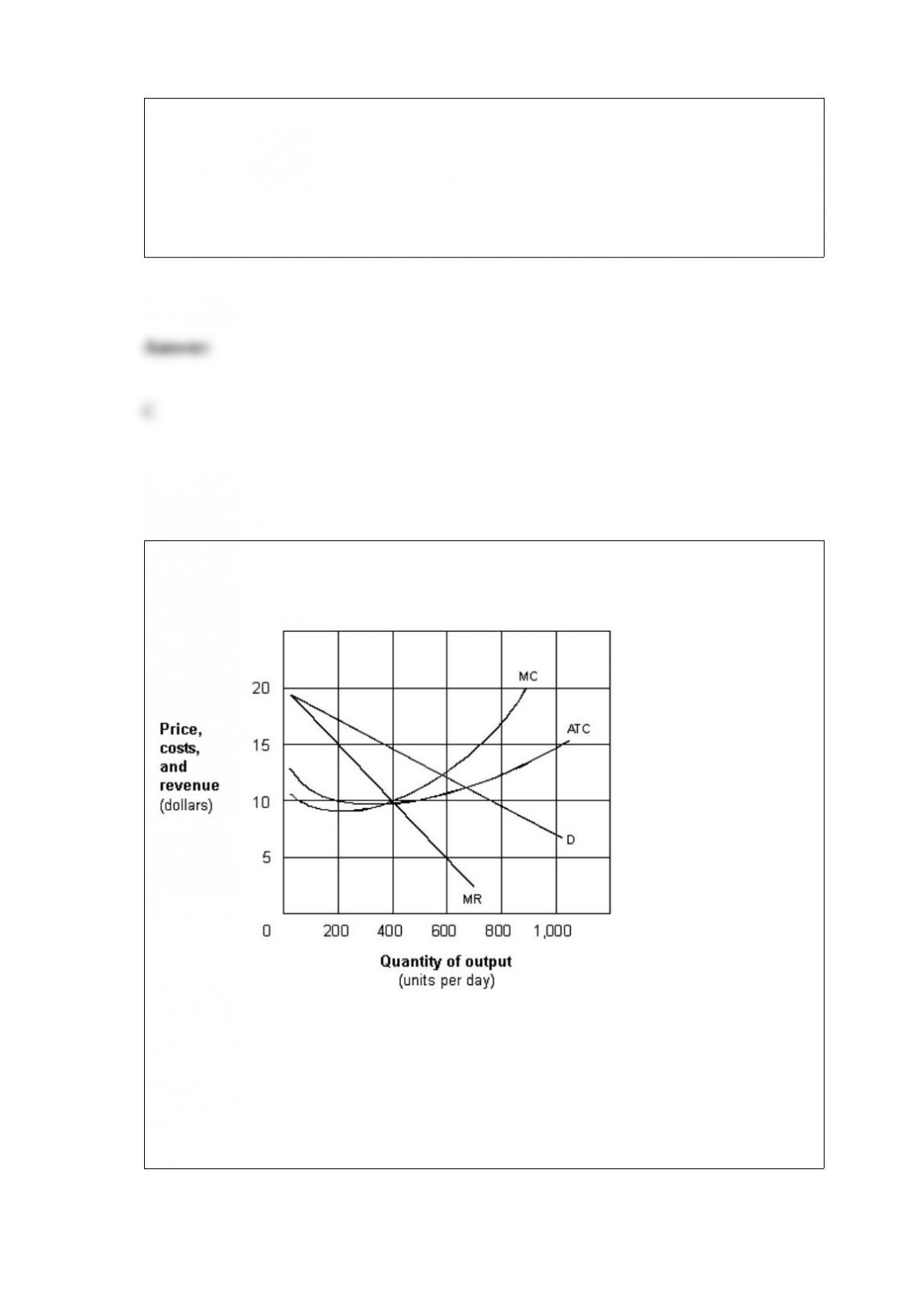
Exhibit 10-1 A monopolistic competitive firm
As represented in Exhibit 10-1, the maximum long-run economic profit earned by this
monopolistic competitive firm is:
a. zero. c. $1,000 per day.
b. $200 per day. d. $20,000 per day.

A positive economic statement simply describes what is.
Consumer equilibrium requires that the marginal utility per dollar spent be unequal for
all goods.
Requiring cars in Los Angeles to reduce pollution by the same amount as cars in
Topeka is inefficient.
A natural monopoly maximizes profits at the point at which price equals minimum

average total cost.
In the short run, the profit maximizing (or minimizing) quantity of output for any firm
to produce exists at that output level at which marginal revenue equals marginal cost.
A country can develop without a large natural resource base.
If demand for a good is price elastic, it must also be income elastic.

What role does population growth play in economic development?
A country cannot develop without a large natural resource base.
The points along the demand curve represent the maximum willingness of consumers to
purchase a product.