
Competitive firms X, Y, and Z meet in secret and agree to charge the same price. The
U.S. Justice Department discovers this agreement and would most likely file charges
under the:
a. Clayton Act.
b. Federal Trade Commission Act.
c. Sherman Act.
d. Tying Contracts Act.
The law of increasing opportunity costs causes the production possibilities curve to:
a. be a straight line. c. have a bowed-out shape.
b. slope upwards. d. shift inward.
If a 10 percent cut in price causes a 15 percent increase in sales, then:
a. total revenue will decrease.
b. demand is price inelastic in this range.
c. demand is price elastic in this range.
d. demand is unit elastic in this range.
e. total revenue will remain the same.

Bill is an accountant for a small machine shop. His boss has asked him to calculate the
shop’s total fixed cost. Which method will get Bill the correct answer?
a. c and d.
b. Calculating the product of average total cost and quantity
c. Determining what the shop would pay for if they produced zero output
d. Subtracting the total variable costs from the total costs
e. Subtracting total variable costs from total revenue
The cross elasticity between two goods, X and Y, is positive. From this, we can
conclude that goods X and Y are:
a. substitute goods.
b. complementary goods.
c. unrelated goods.
d. inferior goods.
e. normal goods.
Which of the following is true of the production possibilities curve?
a. It assumes a fixed level of technology.
b. It assumes resources are fixed.

c. It assumes resources are fully employed.
d. All of these are correct.
An economics textbook is an example of:
a. capital. c. a natural resource.
b. labor. d. entrepreneurship.
If a steel company and an ice cream company decide to merge, this merger would be
classified as:
a. a horizontal merger.
b. a vertical merger.
c. a conglomerate merger.
d. either a horizontal or vertical merger, depending on the nationality of the companies.
e. either a horizontal or vertical merger, depending on the market shares of the two
companies.

Which of the following will not cause a shift in the demand curve for good X?
a. A change in the price of a complementary good.
b. A change in the price of good X.
c. A change in consumer tastes and preferences for good X.
d. An increase in consumer income.
Firms that place their assets in the custody of a board of trustees is called a(n):
a. utility. c. trust.
b. oligopoly. d. all of these.
Exhibit 11-9 A labor market

If the labor market shown in Exhibit 11-9 is competitive, the wage rate and number of
workers employed will be determined at point:
a. A.
b. Y.
c. C.
d. Z.
e. X.
Using a production possibilities curve, a technological advance that increases the
amount of output for the same amount of inputs would be illustrated as a(n):
a. flattening of the curve.
b. movement from one point to another point along the curve.
c. outward shift of the curve.
d. movement from a point on the curve to a point inside the curve.

A monopolistically competitive market is characterized by:
a. many small sellers selling a differentiated product.
b. a single seller of a product that has few suitable substitutes.
c. very strong barriers to entry.
d. mutual interdependence in pricing decisions.
Which of the following is not a reason why marketable permits may fail to achieve
efficiency?
a. Some firms can reduce emissions at a lower cost than other firms.
b. A market with a small number of buyers and sellers.
c. Imperfect information exists on the value of a permit.
d. There are concerns about the value of permits in the future.
Schleppsi, a soft drink maker, is a monopsonist in the county where it manufactures all
of the Diet Schleppsi it produces. Suppose the current daily labor cost to the firm is
$35,000 with 99 workers and the total wage cost with 100 workers would be $36,000.
What will the market wage be if Schleppsi hires the 100th worker?
a. $35.
b. $36.

c. $100.
d. $350.
e. $360.
If a perfectly competitive industry’s long-run supply curve is downward sloping, we can
conclude that input prices will:
a. increase as industry output increases.
b. decrease as industry output increases.
c. remain constant as industry output increases.
d. none of these conclusions can be drawn.
Without trade, the consumption possibilities for two nations are:
a. outside their production possibilities curve.
b. inside their production possibilities curve.
c. along their production possibilities curve.
d. at a point equal to the world production possibilities curve.

Which of the following is considered to be a fixed cost of operating an automobile?
a. Gasoline.
b. Tires.
c. Oil change.
d. Maintenance.
e. Registration fees.
The demand curve for a monopolist is:
a. the demand curve for the industry.
b. less than the market demand curve.
c. below the marginal revenue curve.
d. nonexistent.
e. the sum of the demand curves of the perfectly competitive firms in the industry.
If Japan has a current account surplus, then it must:
a. have an offsetting capital account deficit.
b. also have a surplus in its capital account.
c. import more goods than it exports.
d. have a positive balance of payments.
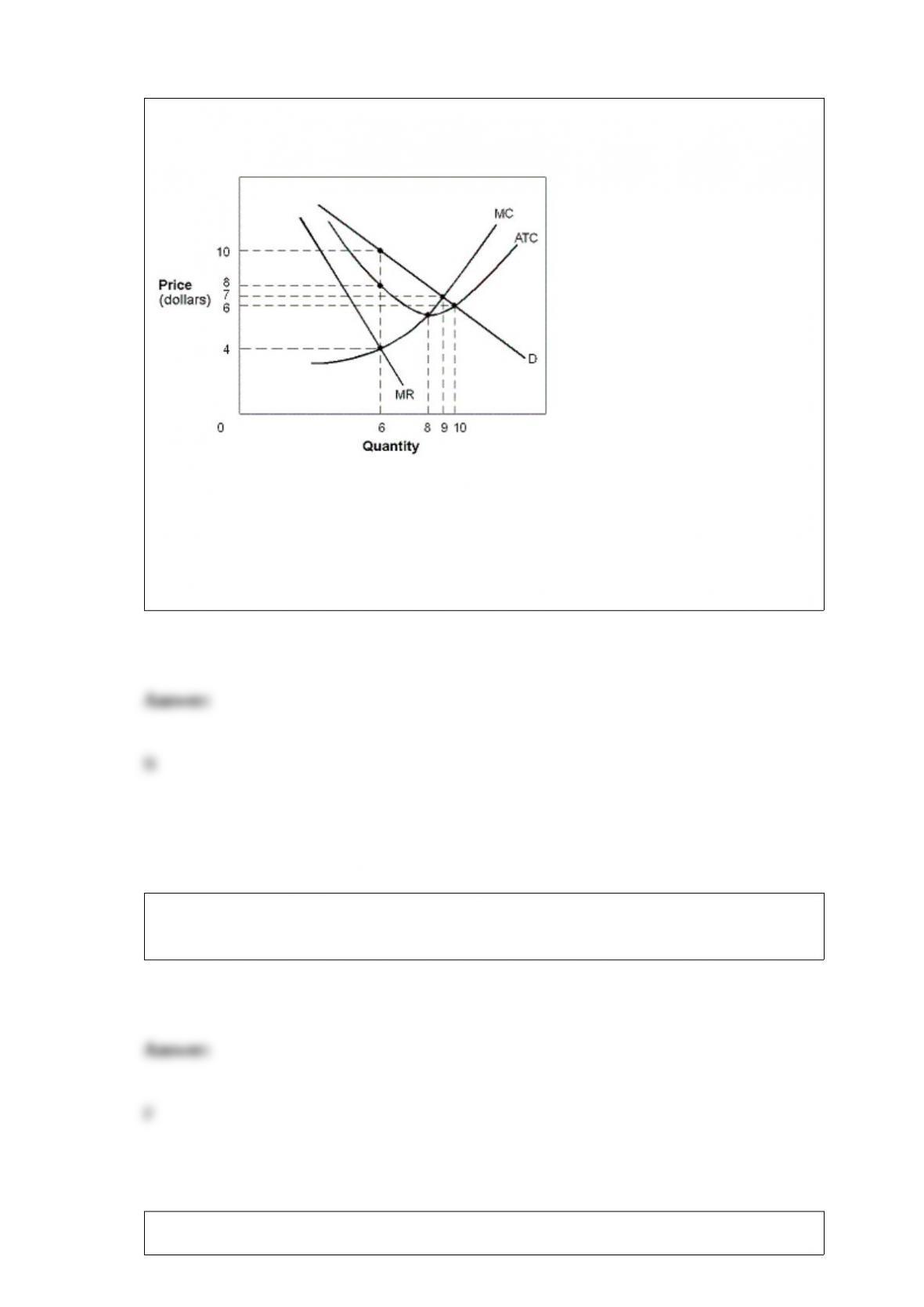
Exhibit 9-6 Monopoly
Exhibit 9-6 indicates that a monopolist maximizes profits at output equal to:
a. 0.
b. 6.
c. 8.
d. 9.
e. 10.
Assume no price floor exists and a market has a given equilibrium. Then a price floor is
established, which is above the market equilibrium. A shortage would result.
Surpluses cause prices to rise while shortages cause prices to fall.

Either an increase in demand with the supply curve held constant or a decrease in
supply with the demand curve held constant will raise a market’s equilibrium price.
An upward-sloping straight line exhibits a direct relationship between two variables.
A mixed economy cannot exist without a politically free society.