Along the elastic range of a demand curve, a decrease in price causes:
a. no change in total revenue.
b. a decrease in total revenue.
c. an increase in total revenue.
d. an unpredictable change in total revenue.
The price-taker firm should discontinue production immediately if:
a. the market price exceeds the firm’s average total costs.
b. the market price is less than the firm’s average variable costs.
c. the market price is less than the firm’s average total costs, but greater than its average
variable cost.
d. its accounting statement indicates that it is suffering losses.
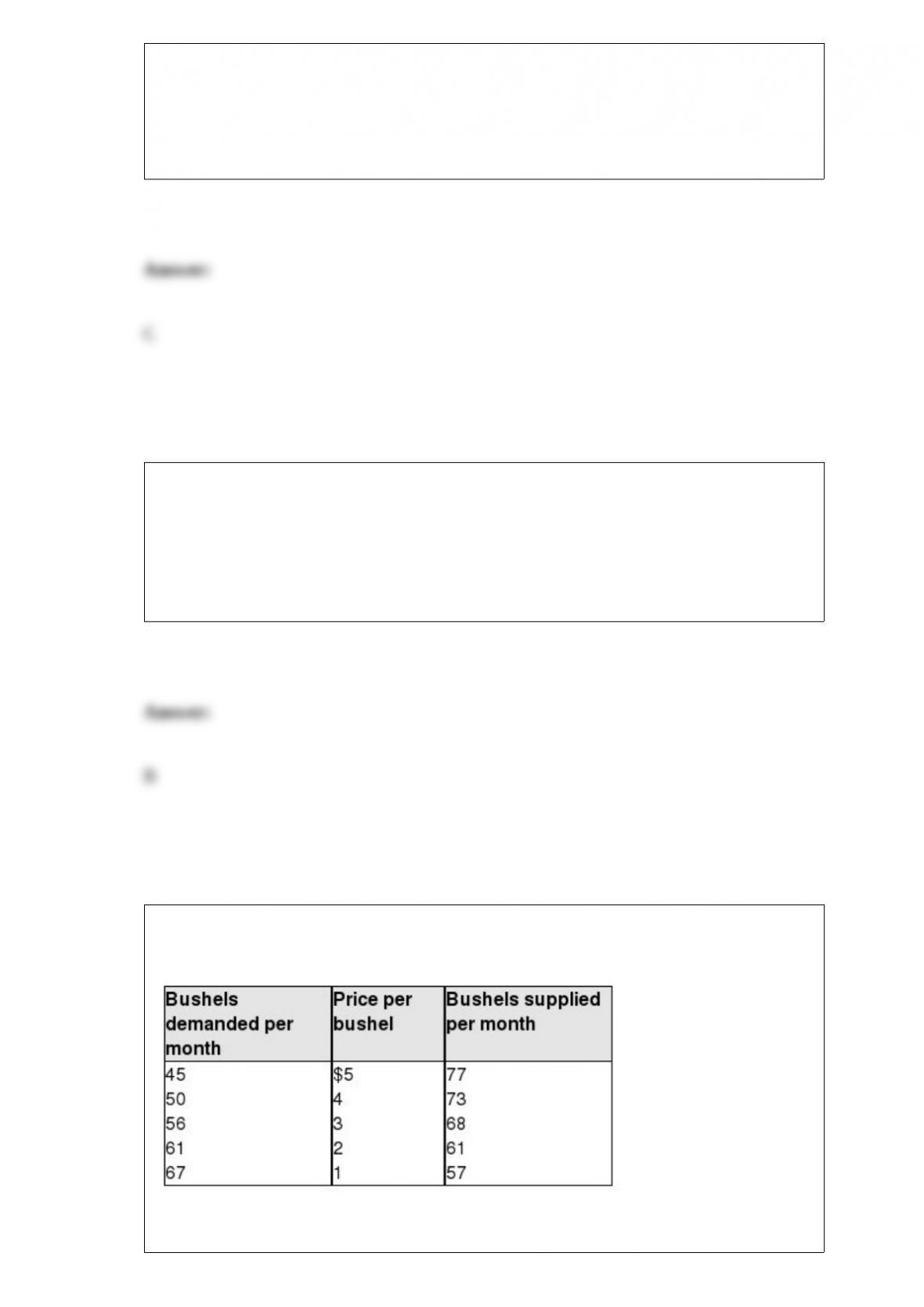
Exhibit 4-11 Data on supply and demand
In Exhibit 4-11, the equilibrium price per bushel of wheat is:
a. $1. c. $3.
b. $2. d. $4.
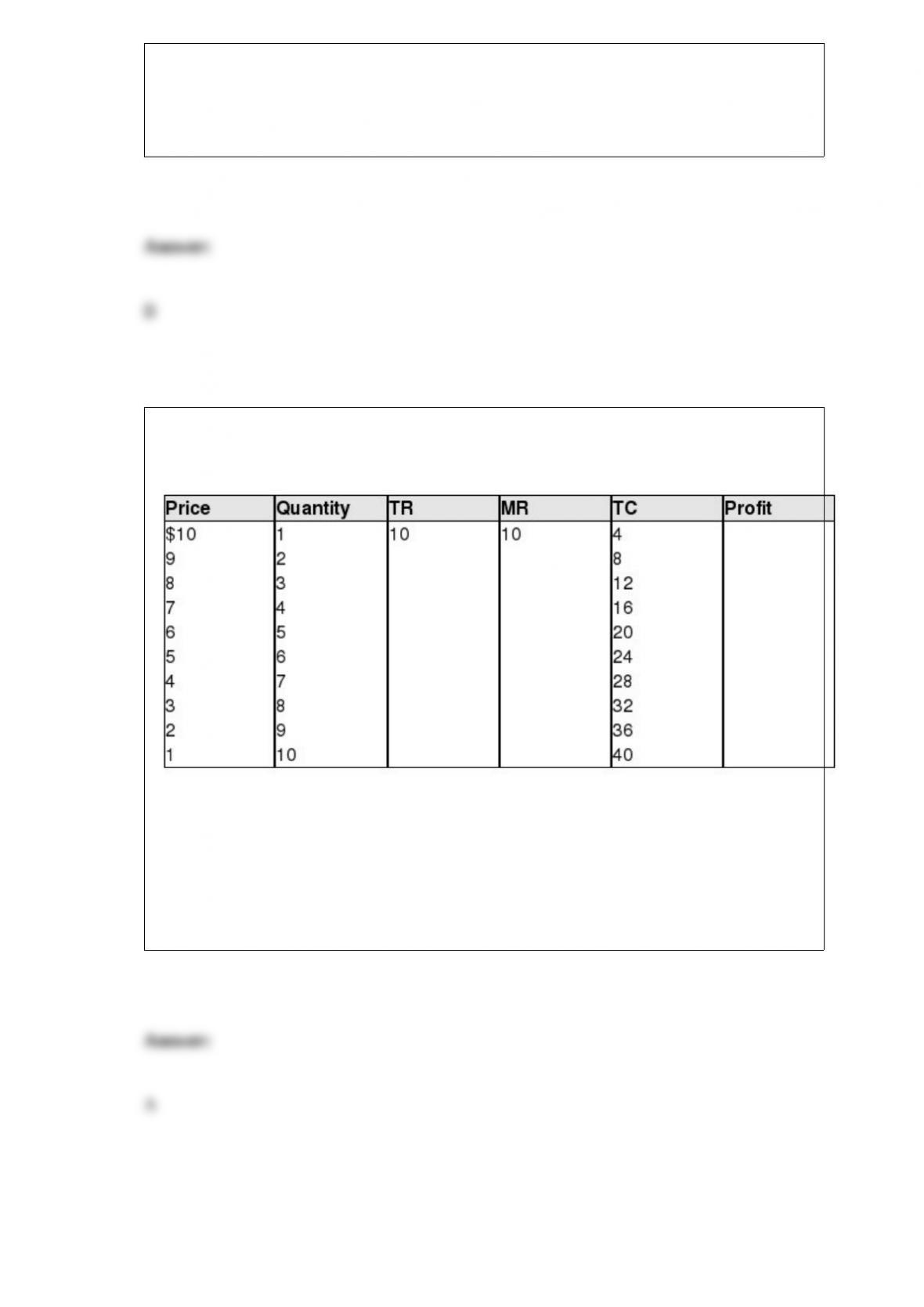
Exhibit 9-5 Demand and cost data for a monopolist
By calculating the data provided in Exhibit 9-5, how much is the profit if the firm
decides to produce 7 units?
a. 0.
b. 24.
c. 16.
d. 12.
e. 6.

According to the law of demand, when will higher corn prices reduce the quantity
demanded of corn?
a. Always.
b. When the supply of corn is fixed.
c. When nonprice determinants, like income and the number of buyers, are unchanged.
d. When there are no shortages or surpluses of corn.
Which of the following is an example of a fixed input?
a. The acreage of a farmer’s land.
b. Machinery.
c. The size of a firm’s plant.
d. All of these.
The marginal utilities associated with the first 5 units of consumption of good Y are 15,
15, 10, 7, and 3, respectively. What is the total utility associated with those 5 units?
a. 5.
b. 12.
c. 12.
d. 35.
e. 50.

Suppose that a small business takes in monthly revenue of $100,000. Labor, rental,
energy, and other purchased input costs are $70,000. The owner/entrepreneur could earn
$5,000 per month in another job, and the owner/entrepreneur could get a return of
$5,000 each month if she sold her business and invested the net proceeds in a financial
asset, such as a treasury bond. Which of the following correctly describes her monthly
economic profit?
a. $100,000.
b. $90,000.
c. $70,000.
d. $30,000.
e. $20,000.
According to the substitution effect, a decrease in the price of a product leads to an
increase in the quantity demanded because buyers:
a. purchase more complementary goods.
b. purchase more substitute goods.
c. purchase fewer substitute goods.
d. have more real income.
Exhibit 8-18 A typical firm in a perfectly competitive market
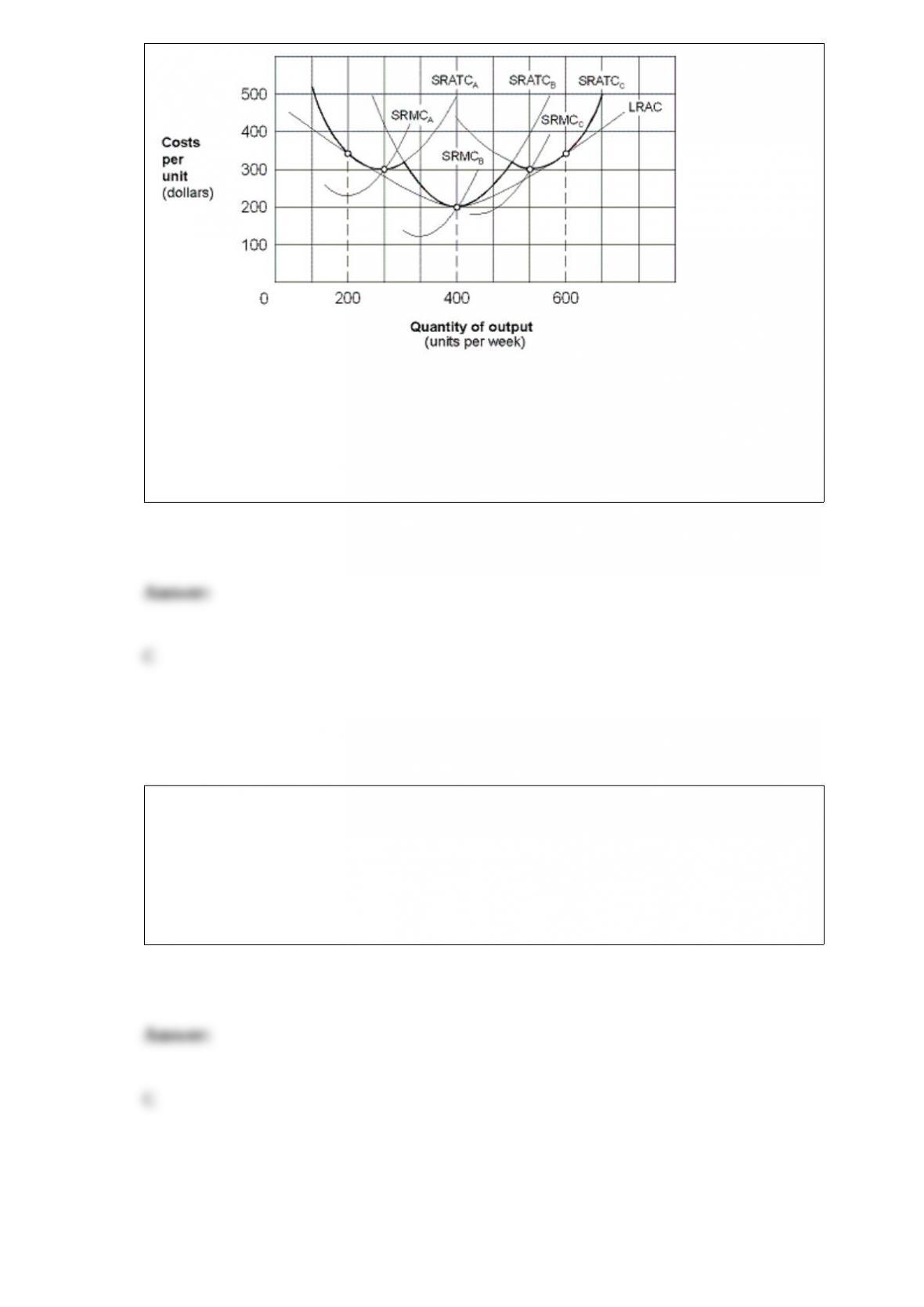
As shown in Exhibit 8-18, the perfectly competitive firm is in long-run equilibrium at
an output of:
a. zero units per week.
b. 200 units per week.
c. 400 units per week.
d. 600 units per week.
An increase in the demand for a product will shift the demand for labor used to produce
the product:
a. downward.
b. leftward.
c. rightward.
d. none of these, the curve will not shift.

A monopolistic competitive firm is inefficient because the firm:
a. is not maximizing its profit.
b. is producing at an output where average total cost is not minimum.
c. earns positive economic profit in the long run.
d. none of these.
A farm is able to produce 9,000 pints of strawberries per season on 10 acres. It adds one
more acre and is able to produce 12,000 pints per season. The marginal product of land
for this farm is:
a. 900 pints per acre per year.
b. 1,000 pints per acre per year.
c. 3,000 pints per acre per year.
d. 12,000 pints per acre per year.
If bus travel is an inferior good, then its income elasticity of demand will be:
a. strictly greater than one. c. equal to zero.
b. positive. d. negative.

If a town has a monopsony, this means:
a. there is only one employer.
b. price discrimination takes place.
c. goods are priced too high.
d. no unions can exist.
e. excess profits are being made
What famous economist said, “By pursuing his own interest he (an individual)
frequently promotes that of the society more effectually than when he really intends to
promote it?”
a. Alfred Marshall. c. Karl Marx.
b. Adam Smith. d. Robert L. Heilbroner.
Exhibit 2-1 Production possibilities curve data

In Exhibit 2-1, the opportunity cost of producing the fourth unit of capital is:
a. 0.
b. 1 unit of consumption goods.
c. 2 units of consumption goods.
d. 4 units of consumption goods.
e. there is not enough information to estimate the opportunity cost.
If a good is inferior in an economic sense, income elasticity will:
a. be less than one.
b. exceed one.
c. be zero.
d. be inelastic.
e. be negative.

If the demand curve over a certain range is “price elastic,” this implies that the:
a. percentage change in the quantity demanded exceeds one.
b. percentage change in the quantity demanded exceeds the percentage change in
product price.
c. percentage change in price exceeds the percentage change in quantity demanded.
d. product is non-reactive.
e. product has no good substitute.
When choosing the production level for tomorrow you find that at an output of 100
units, the total variable costs are $20,000 and the average fixed cost is only $50. If the
market price is $200, you should:
a. b or e.
b. shut down.
c. produce more than 100 units.
d. produce fewer than 100 units.
e. produce where MC = MR.
With the benefits of international trade:
a. there can be increased consumption for all.
b. global production will be increased.
c. world resources will be used more efficiently.
d. all of these are true.

A conspiracy among firms to fix prices was outlawed by the Sherman Antitrust Act.
Suppose A and B are substitute goods. Other things being equal, the demand curve for A
will shift to the right when the price of B goes down.
Effluent taxes are the most common approach used to control pollutants in the United
States.
The monopolist faces the market demand curve.

Incentive-based regulations tend to be more efficient than command-and-control
regulations.
Marginal analysis examines the effects of additions to or subtractions from a current
situation.