
Exhibit 11-14 Labor cost data for a monopsonist
In Exhibit 11-14, the monopsonist will maximize profits by hiring how many workers?
a. 10.
b. 20.
c. 30.
d. 40.
e. Unable to determine from the information given.
From society’s point of view, the amount of air and water pollution that currently exists
is excessive. Which of the following statements are explanations of this excessive
pollution?
a. Firms that cause air and water pollution are not paying the full social costs of
producing their output.
b. Consumers, who purchase goods from firms that pollute, are not paying a price for
these goods which totally reflect the social costs of producing the goods.
c. Private property rights for clear air and clean water are not currently well defined by
the judicial system; hence private individuals cannot charge polluters for the external
costs these polluters impose on private individuals.
d. All of these.

In a graphic relationship, shifts in a curve are caused by a change in:
a. the slope of the curve.
b. a factor not measured on the axes of the graph.
c. one of the factors measured on either axes of the graph.
d. any factor, whether measured on the axes of the graph of not.
Which of the following would decrease the price of packaged hot dogs?
a. An increase in the price of hot dog buns, a complement to packaged hot dogs.
b. A decrease in the price of hamburger meat, a substitute for packaged hot dogs.
c. A technological advance that lowers the cost of producing packaged hot dogs.
d. All of these.
In a labor market with one employer, the MFC is:
a. above the labor supply curve.
b. above the labor demand curve.
c. what determines the wage.
d. downward sloping.
e. perfectly horizontal.
The Celler-Kefauver Act deals primarily with which of the following issues?
a. Price discrimination.
b. Exclusive dealing.
c. Mergers.
d. Deceptive advertising.
e. Boards of directors.
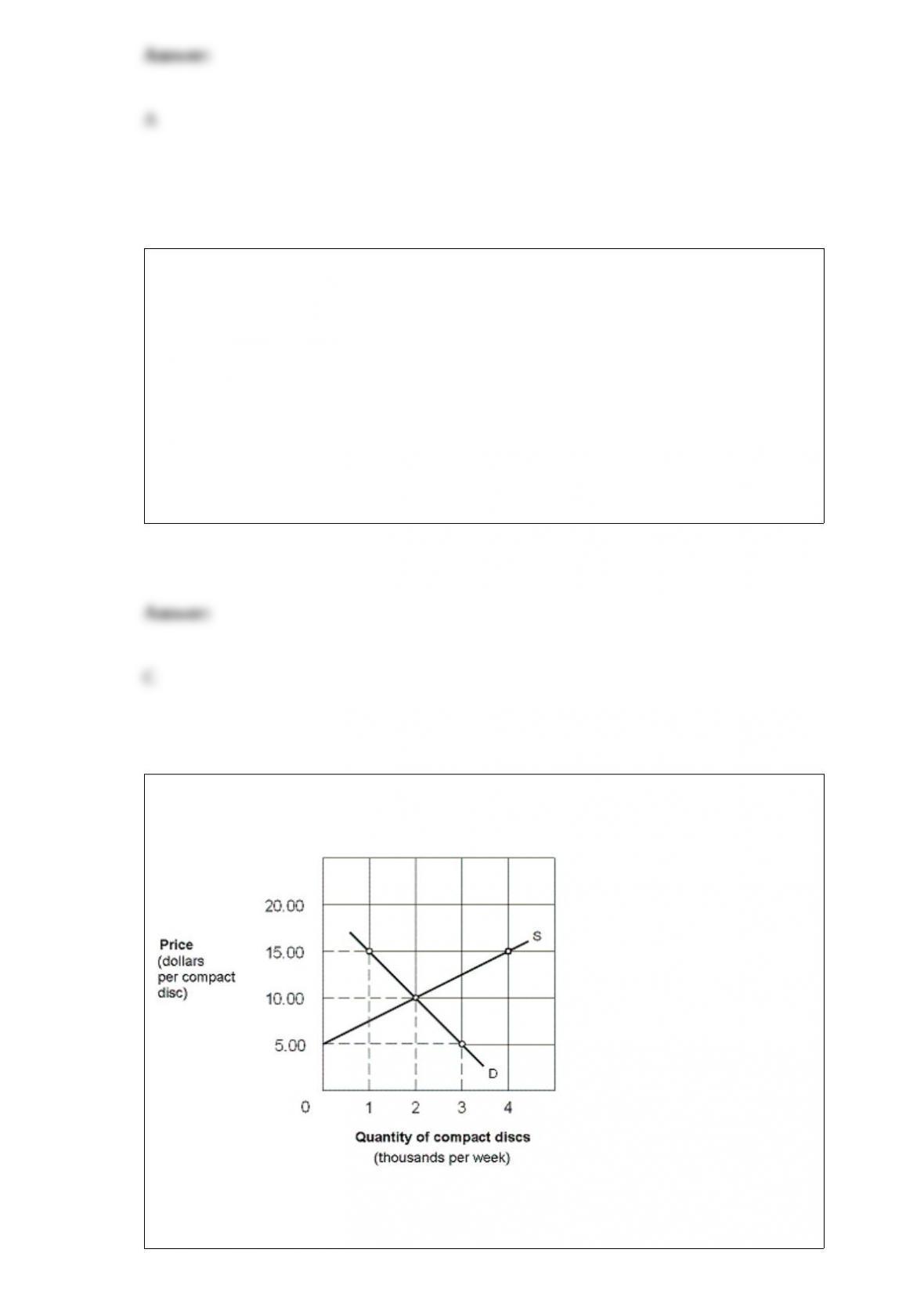
Exhibit 3-14 Supply and demand curves
In Exhibit 3-14, if the market price of compact discs is initially $15, a movement
toward equilibrium would require:

a. no change, because an equilibrium already exists.
b. the price to fall below $15 and both the quantity supplied and the quantity demanded
to fall.
c. the price to remain the same, but the supply curve to shift to the left.
d. the price to fall below $15, the quantity supplied to fall, and the quantity demanded
to rise.
If the income elasticity of demand for a good is negative, this means that:
a. only the poor will buy the good.
b. as incomes fall, less will be spent on the good.
c. as incomes rise, the demand for the good will fall.
d. the good does not obey the law of demand.
When marginal revenue is zero for a monopolist facing a downward-sloping
straight-line demand curve, the price elasticity of demand is:
a. greater than 1.
b. equal to 1.
c. less than 2.
d. equal to 0.
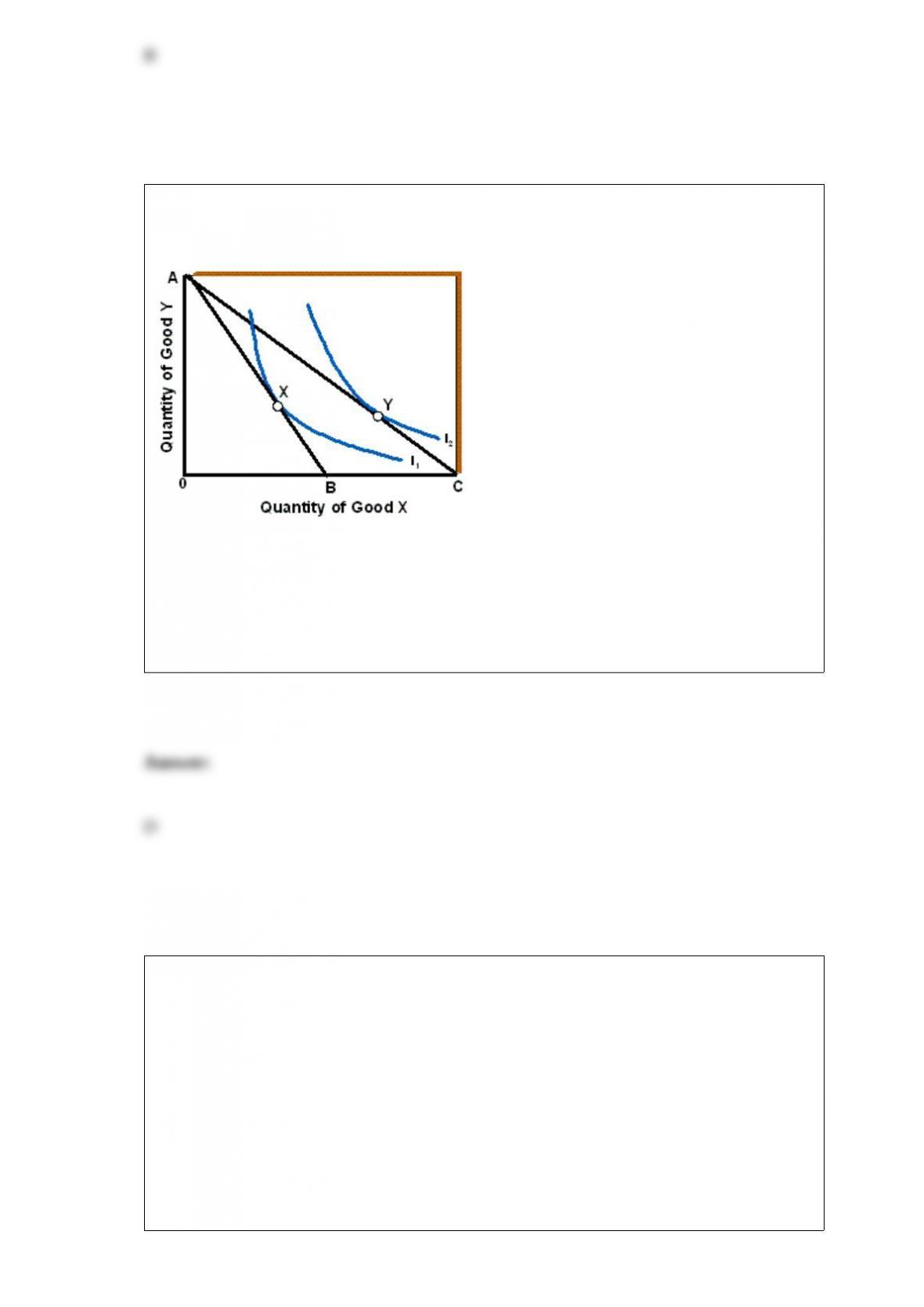
Exhibit 6A-4 Consumer Equilibrium
Given the budget lines and indifference curves shown in Exhibit 6A-4, if the budget
line shifts from AC to AB, then the consumer will purchase:
a. more of both goods Y and X.
b. a higher level of total utility.
c. less of both goods X and Y.
d. more of good Y and less of good X.
In the Utah Pie case, the economic effect of the Supreme Court decision was to:
a. prohibit the merger of two small pie companies.
b. encourage competition by ruling that the national competitors had engaged in illegal
price discrimination.
c. encourage competition by ruling that the national competitors had not engaged in
illegal price discrimination.
d. discourage competition by national competitors in the Salt Lake City market.

Which of the following sayings best reflects the concept of opportunity cost?
a. “You can’t teach an old dog new tricks.”
b. “There is no such thing as a free lunch.”
c. “I have a baker’s dozen.”
d. “There’s no business like show business.”
Which of the following is not a solution to the problem of negative externalities due to
pollution?
a. Create private property rights.
b. Levy pollution taxes.
c. Create obligatory controls.
d. Reward the production of these products through subsidies.
e. Establish strict limits on the amount of pollution allowed.

If goods X and Y are such that the cross price elasticity between them is negative, and if
the income elasticity of X is negative, then these goods are:
a. inferior complements.
b. luxury complements.
c. income elastic substitutes.
d. normal substitutes.
e. income elastic complements.
A merger between a leather supplier and a shoe manufacturer would be classified as a:
a. horizontal merger. c. conglomerate merger.
b. vertical merger. d. keiretsu.