
Using the midpoints formula, what would be price elasticity of demand for a
gallbladder operation if the number of operations fell from 6,000 to 4,000 per week
after its price increased from $6,000 to $10,000?
a. 0.25. c. 0.80.
b. 0.50. d. 1.25
A major characteristic of the theory of oligopoly is that:
a. there are no real-world examples.
b. the reactions of each firm depends on how the firm believes rivals will react.
c. in reality few oligopolies survive more than 10 years.
d. none of these.
You are part of a local community theater group. It is the goal of the group to increase
the amount of revenue earned through ticket sales. Mary says the obvious solution is to
increase ticket prices. Is Mary correct?
a. Mary is correct if the demand for tickets is price inelastic.
b. Mary is incorrect if the demand for tickets is price inelastic.
c. Mary is correct. The increase in ticket prices will always increase revenue.
d. Mary is incorrect. The increase in ticket prices will never increase revenue.
e. Mary is incorrect. The way to increase revenue is to decrease ticket prices.

Comparative advantage is the ability of a country to produce a good at a ________
opportunity cost relative to other countries.
a. higher
b. lower
c. equivalent
d. none of the above
If a nation follows a policy of being self-sufficient, its:
a. production possibilities equal its consumption possibilities.
b. consumption possibilities are greater than its production possibilities.
c. production possibilities curve shifts rightward.
d. consumption possibilities are less than its production possibilities.
An entrepreneur is:
a. an employee in a factory.
b. the manager of a factory.
c. the person who conceives and starts a business.
d. the person who contracts to work for a specific price.
e. the person who does not assume any risk in business.
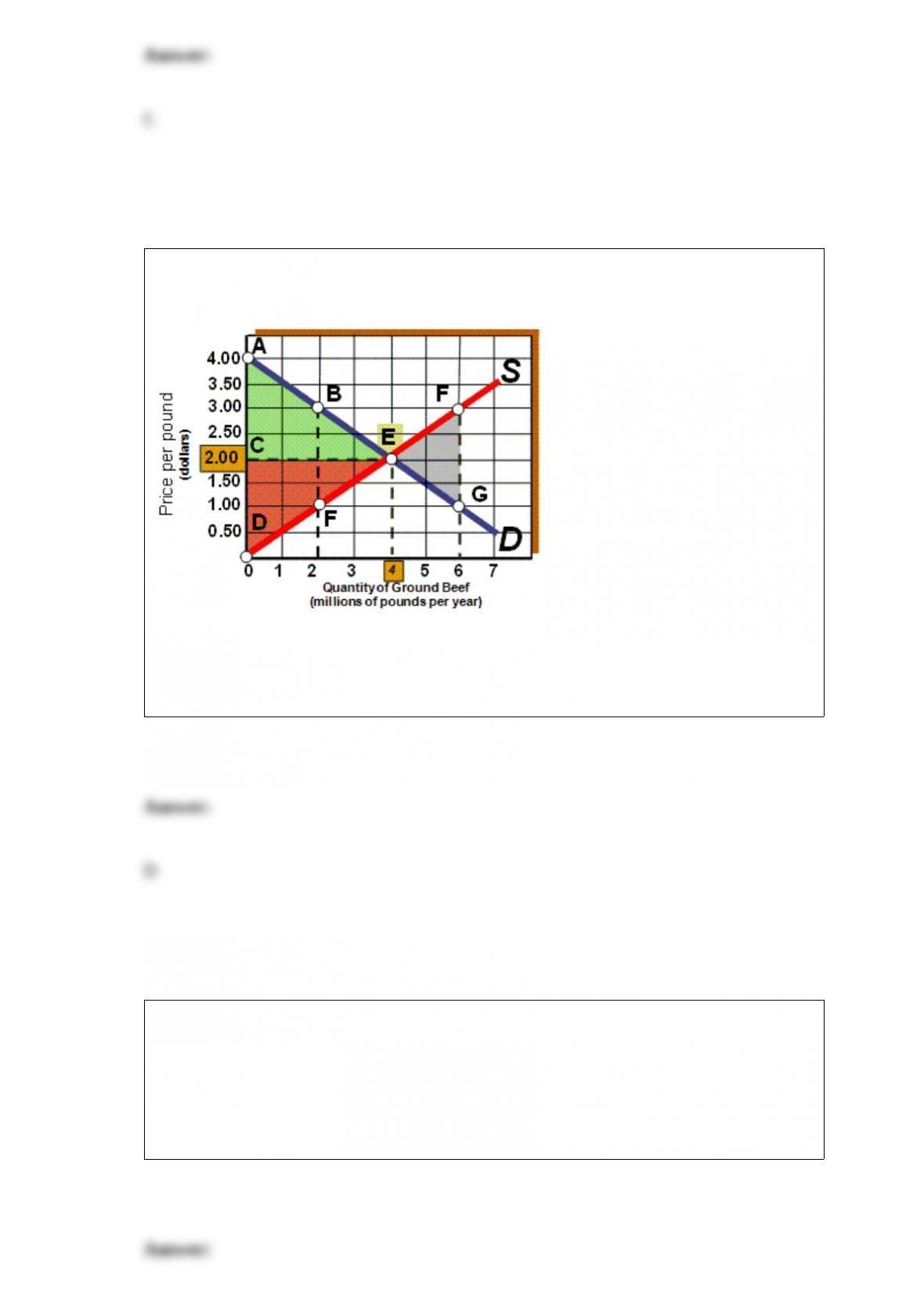
Exhibit 3A-1 Comparison of Market Efficiency and Deadweight Loss
As shown in Exhibit 3A-1, if the market price falls from $3.00 to $2.00, then area ____
disappears.
a. ABEFD c. CEFD
b. ABEC d. BEF
Assume that eggnog and cookies are complements. If the price of eggnog goes up, what
happens to the demand for cookies?
a. Demand for cookies increases.
b. Demand for cookies decreases.
c. Demand for cookies remains unchanged.
d. The shift in demand will depend on the original price of cookies.

Factors that prevent the Coase Theorem from working include all of the following,
except:
a. private property rights. c. income effects.
b. transaction costs. d. more than two individuals affected.
Which of the following is true about a monopoly?
a. A monopoly charges a higher price and produces a lower output level than if the
market were competitive.
b. A monopoly is guaranteed an economic profit.
c. A monopoly charges the highest possible price.
d. A monopoly will shut down whenever losses are incurred.
e. All of these.
Suppose a monopsonist hires its second worker and this hiring has a marginal factor
cost of $75 per day. If the market wage is now $62.50 per day, what was the first
employee earning when she worked alone?
a. $40.
b. $45.
c. $50.
d. $55.
e. $60.
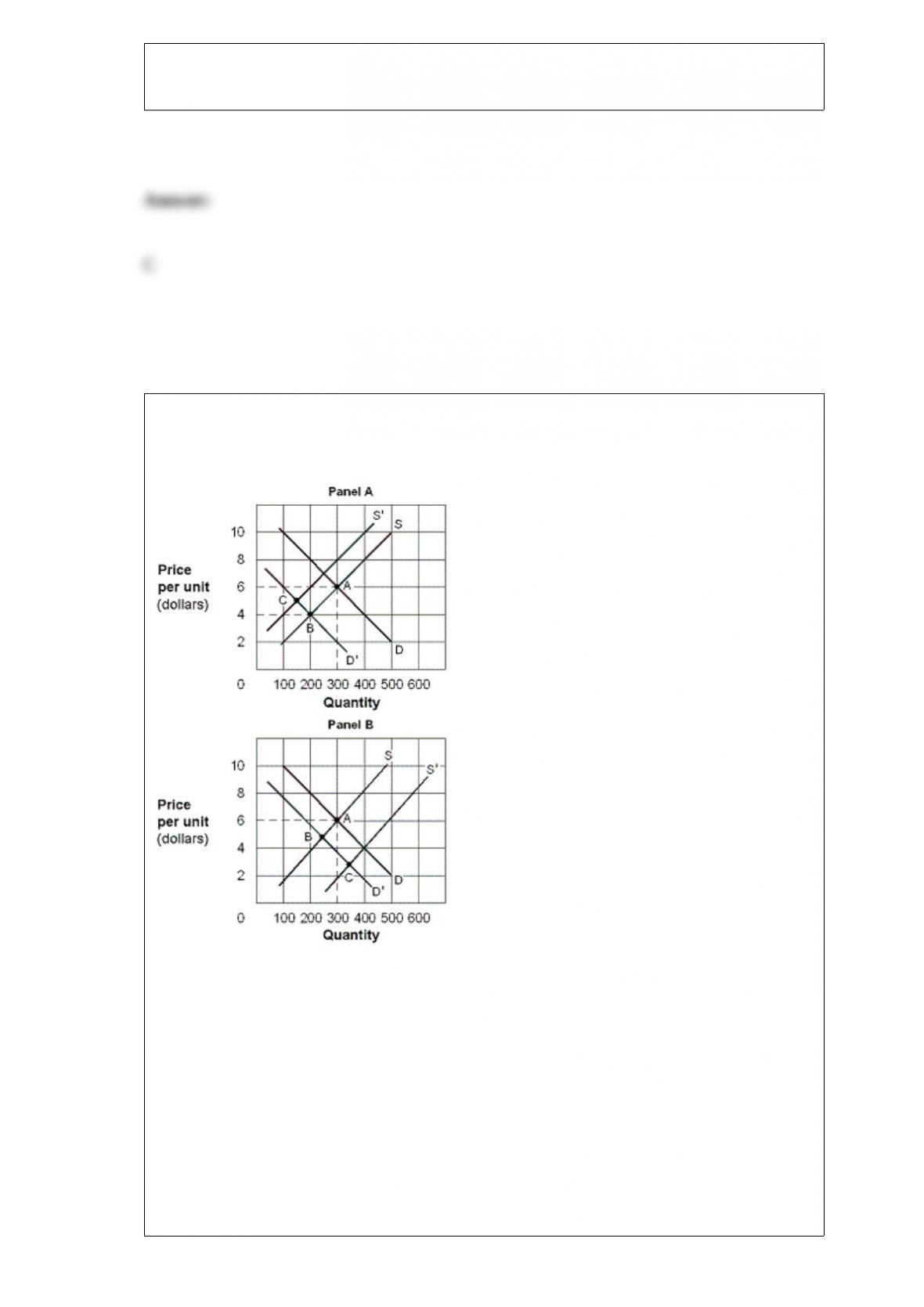
Exhibit 3-11 Demand and supply curves
In Exhibit 3-11, in Panel A the movement from A to C describes a(n):
a. ambiguous change in price and a decrease in quantity.
b. increase in price and an ambiguous change in quantity.
c. increase in both price and quantity.
d. decrease in both price and quantity.
e. change in supply that dominates a change in demand.
The law of demand states that:
a. as the price of a good increases, more units are demanded.
b. there is a direct relationship between the price of a good and the quantity of the good
produced.
c. there is a negative relationship between the price of a good and the quantity of the
good demanded.
d. there is an increase in the need for a good as the price of the good increases.
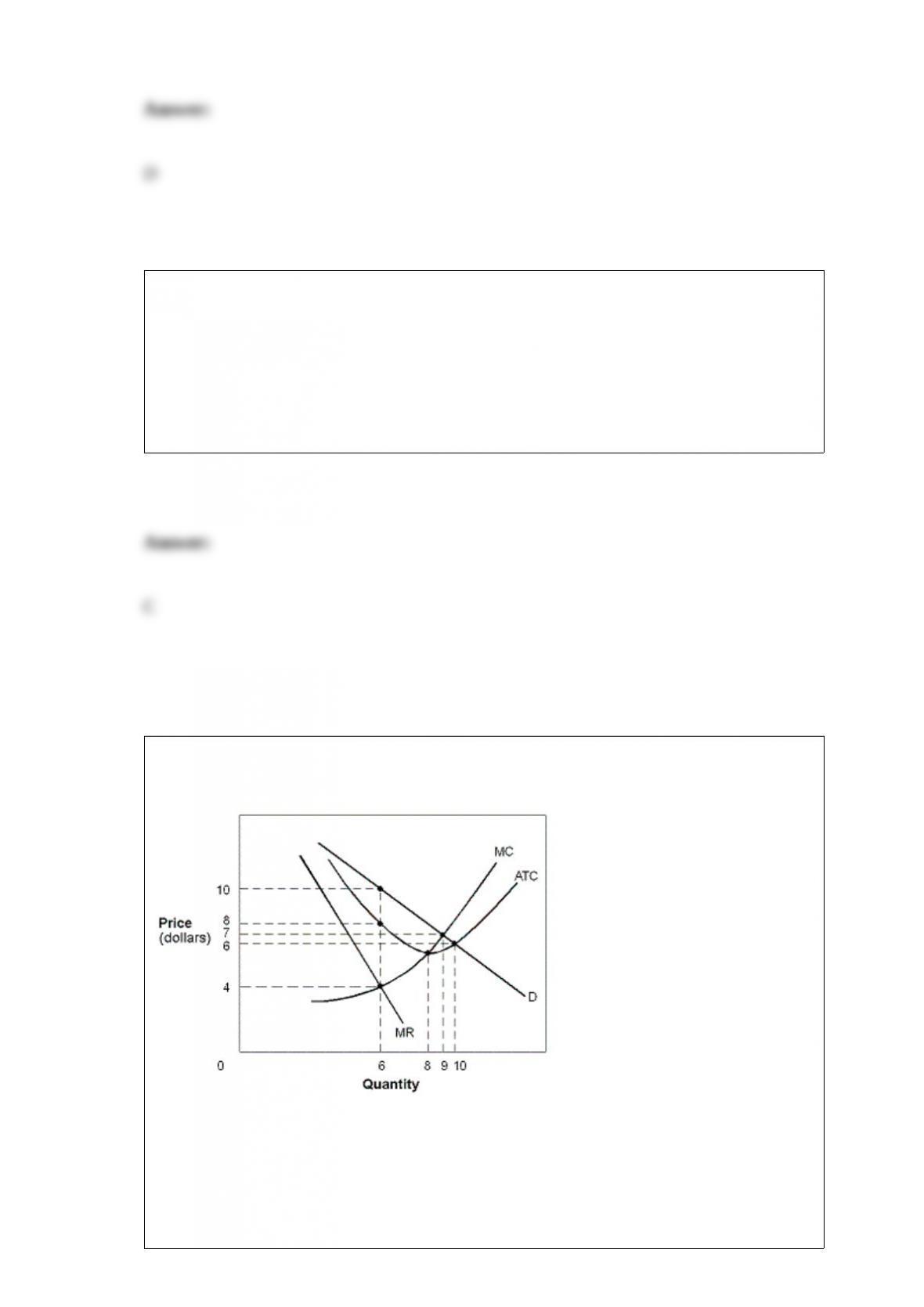
Exhibit 9-6 Monopoly
The maximum possible total monopoly profit in Exhibit 9-6 is:
a. $60.
b. $36.
c. $24.
d. $18.
e. $12.
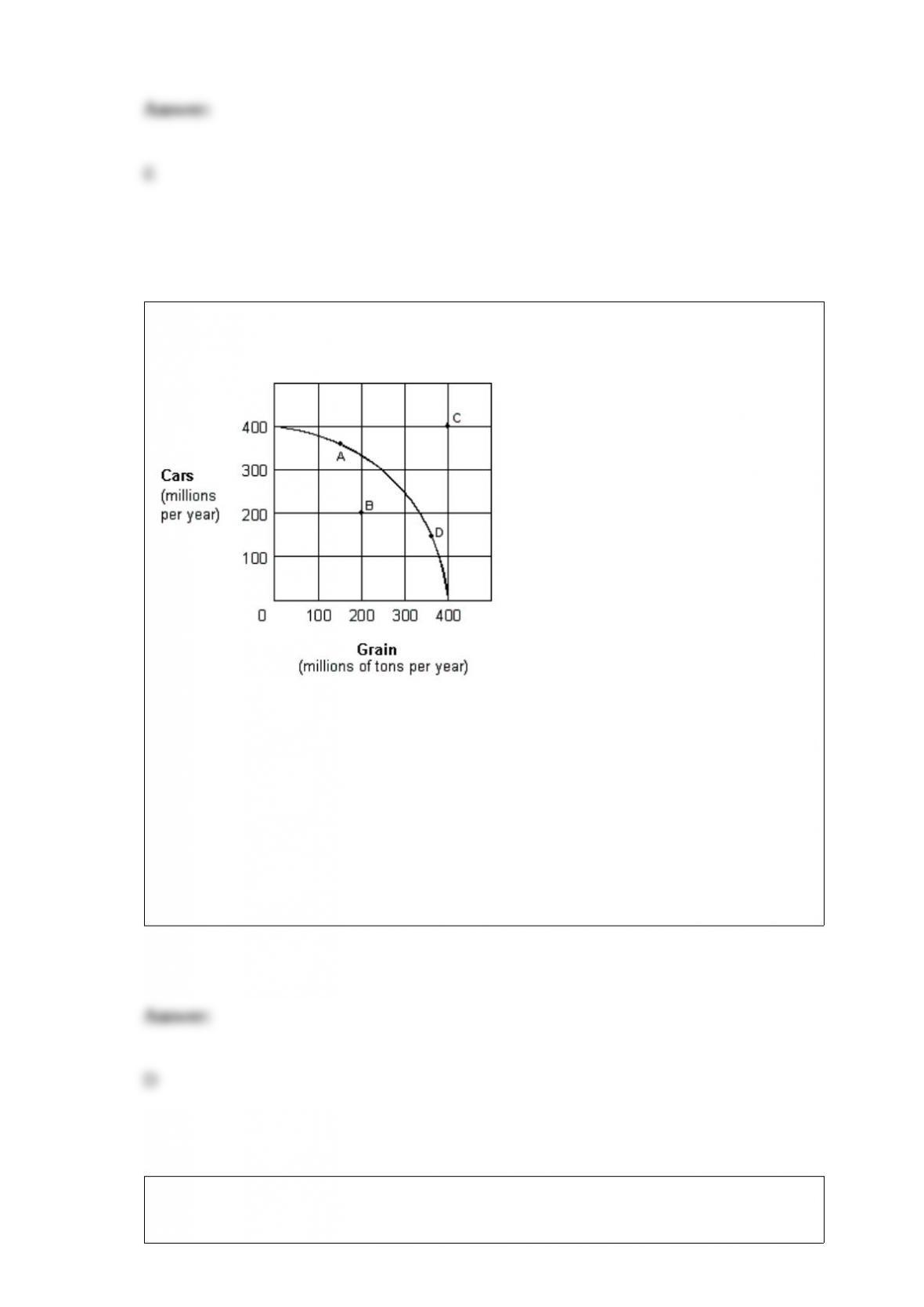
Exhibit 2-7 Production possibilities curve
For the economy shown in Exhibit 2-7 to operate at point C, it must:
a. be willing to lower the price of grain.
b. use its given resources more efficiently than it would at point A.
c. experience resource unemployment.
d. experience an increase in its resources and/or an improvement in its technology.
In the long run, a monopolistic competitive firm will operate at a price which:

a. is higher than minimum long-run average cost.
b. equals minimum long-run average cost.
c. equals marginal cost.
d. none of these.
For a monopolist, marginal revenue is always:
a. below market price.
b. equal to market price.
c. greater than market price.
d. equal to total revenue.
e. equal to total cost.
If a 10 percent price increase causes the quantity demanded for a good to decrease by 5
percent, demand is elastic.

If more of one good can be produced without producing less of another output, the
economy must have been operating efficiently.
In Marx’s ideal state of communism there would be no haves and have-nots.
The social marginal cost curve is higher than the private marginal cost curve.
In the short run, a firm should shut down if its economic loss from operating exceeds its
total fixed cost.

What does the “price elasticity of demand” measure? What does a price elasticity of
demand coefficient of 2 mean? Does the product have an elastic, unitary elastic or
inelastic demand?
The geographic region in the United States with the highest poverty rate is the South.