
Some people believe that employees should be paid the same wages when their jobs,
although different, require similar levels of education, training, experience, and
responsibility. This principle is known as:
a. the equal-pay-for-equal work doctrine.
b. Lorenz equivalence.
c. marginal productivity theory.
d. comparable worth.
The Sherman Antitrust Act was passed in:
a. 1890. c. 1929.
b. 1914. d. 1933.
Which of the following is an infant-industry argument in favor of restrictions on foreign
trade?
a. Foreign producers must be stopped from selling their products in this country below
cost of production.
b. Domestic workers must be protected from the lower wages paid in foreign countries.
c. The nation’s security demands we ensure an adequate domestic supply capacity of
certain products.
d. Do unto others as they do unto you.
e. Industries in the early stages of development must be protected from more mature
producers.

If the demand for cigarettes is highly inelastic, this indicates that:
a. higher cigarette prices will increase the demand for cigarettes.
b. the price elasticity coefficient of cigarettes exceeds 1.
c. the price elasticity coefficient of cigarettes equals 1.
d. the quantity of cigarettes purchased by consumers is not very responsive to a change
in the price of cigarettes.
Which of the following pairs is the best example of complements?
a. Coffee and tea. c. Hiking boots and athletic shoes.
b. DVDs and tapes. d. Tortillas and salsa.
If income increases, then with regard to expensive cuts of steak, it is likely that the
demand curve:
a. shifts to the right.
b. shifts to the left.
c. becomes steeper.
d. does not change.
e. becomes flatter.
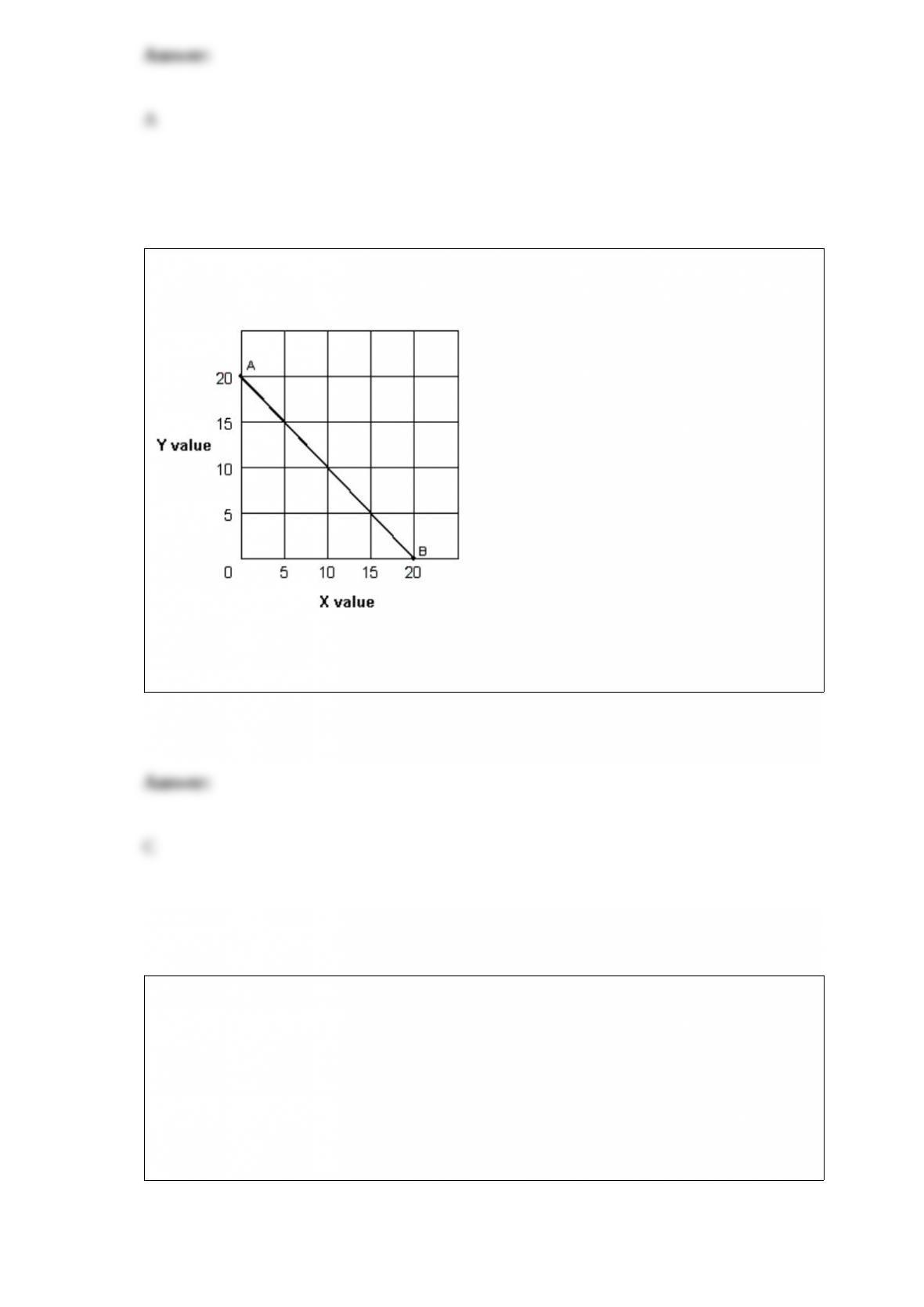
Exhibit 1A-3 Straight line
In Exhibit 1A-3, the slope of straight line AB is:
a. positive. c. negative.
b. zero. d. variable.
A local restaurant offers an “all you can eat” ribs special. You pay $11.95, and then you
can eat as many servings as you desire at no additional cost. It would follow that you
will stop eating when:
a. your marginal utility (or value) derived from eating another serving is zero.
b. your total utility (or value) derived from all of the servings consumed just equals
$11.95.
c. your marginal utility (or value) derived from another serving equals $11.95.
d. it is physically impossible for you to eat any more.

Which of the following is a positive statement?
a. I think we should pass a constitutional amendment to reduce the deficit.
b. President Clinton’s way of dealing with the economy is better than President Bush’s.
c. I hope interest rates come down soon.
d. If taxes are raised, unemployment will drop.
With time, which one of the following strategies would most likely result in an outward
shift in the production possibilities curve of an economy?
a. passage of legislation reducing the workweek to 30 hours.
b. instituting a tax policy encouraging consumption at the expense of investment.
c. instituting a tax policy encouraging investment at the expense of consumption.
d. an increase in the marginal income tax rate, which would reduce the work effort of
individuals.
If a good is inferior in an economic sense:
a. it is demand price elastic.

b. it is demand price inelastic.
c. the income elasticity of demand is negative.
d. it is a low-quality good.
e. it is not the highest quality good in its class.
Which of the following is true about average fixed cost?
a. Average fixed cost has a U-shape, and marginal cost crosses average fixed cost at its
minimum point.
b. Average fixed cost does not vary as output increases.
c. Average fixed cost is the difference between marginal cost and average total cost.
d. Average fixed cost is total fixed cost divided by the quantity of output produced, and
it declines steadily as output increases.
A union may attempt to obtain stricter certification requirements or longer
apprenticeships. These changes would raise workers’ wages because they:
a. create unnecessary unemployment.
b. shift in labor supply curve leftward.
c. decrease the marginal product of labor.
d. reduce management’s use of featherbedding.

If firms pollute when they produce:
a. marginal social cost equals marginal private cost.
b. marginal private cost exceeds marginal social cost.
c. marginal social cost exceeds marginal private cost.
d. marginal social cost equals marginal external cost.
The opportunity cost of your college education is:
a. c and d.
b. d and e.
c. the actual dollar cost of your college education.
d. your best alternative use of the money you spend for a college education.
e. money you could have earned working instead of going to college.
In Exhibit 11-6, at what wage rate will the firms hire these workers?
a. $25.00.
b. $20.00.
c. $15.00.
d. $10.00.

e. 0.
Human wants:
a. are unfilled only in the poorer countries of the world.
b. can be completely satisfied by advancing technology.
c. can never be fully satisfied.
d. only apply to necessities.
e. exist only if we are selfish.
Which of the following is true?
a. Nations achieve high rates of economic growth primarily because of their natural
resource endowments.
b. Human and physical capital investments are largely irrelevant to economic growth.
c. Poor nations grow slowly because they do not have access to modern technology.
d. A favorable political environment attracts more investment in human and physical
capital.

If a consumer allocates income between goods A and B, total utility is maximized
when:
a. the marginal utility of A = the marginal utility of B.
b. the marginal utility of A = the marginal utility of B = 0.
c. the price of A = price of B.
d. marginal utility of A / price of A = marginal utility of B / price of B = 0.
e. marginal utility of A / price of A = marginal utility of B / price of B.
If the equilibrium price of natural gas is $4 per thousand cubic feet and a price ceiling is
imposed at $3 per thousand cubic feet, the result will be:
a. a surplus of natural gas.
b. a shortage of natural gas.
c. an accumulation of inventories of unsold gas.
d. None of these.
The neighborhood ice cream shop finds that when it charges $3 per ice cream cone, its
total revenues are $90,000. It has total variable costs of $30,000 and total fixed costs of
$40,000. From this we can infer the:
a. shop should be moved because the rent is too high.
b. price is less than average total cost.
c. economic profits are $20,000.
d. shop will be closed in the long run.
e. shop sells 10,000 ice cream cones.
If marginal costs increase, a monopolist will:
a. decrease price and increase output.
b. decrease both price and output.
c. increase price and decrease output.
d. increase both price and output.
e. keep both price and output at the same level.
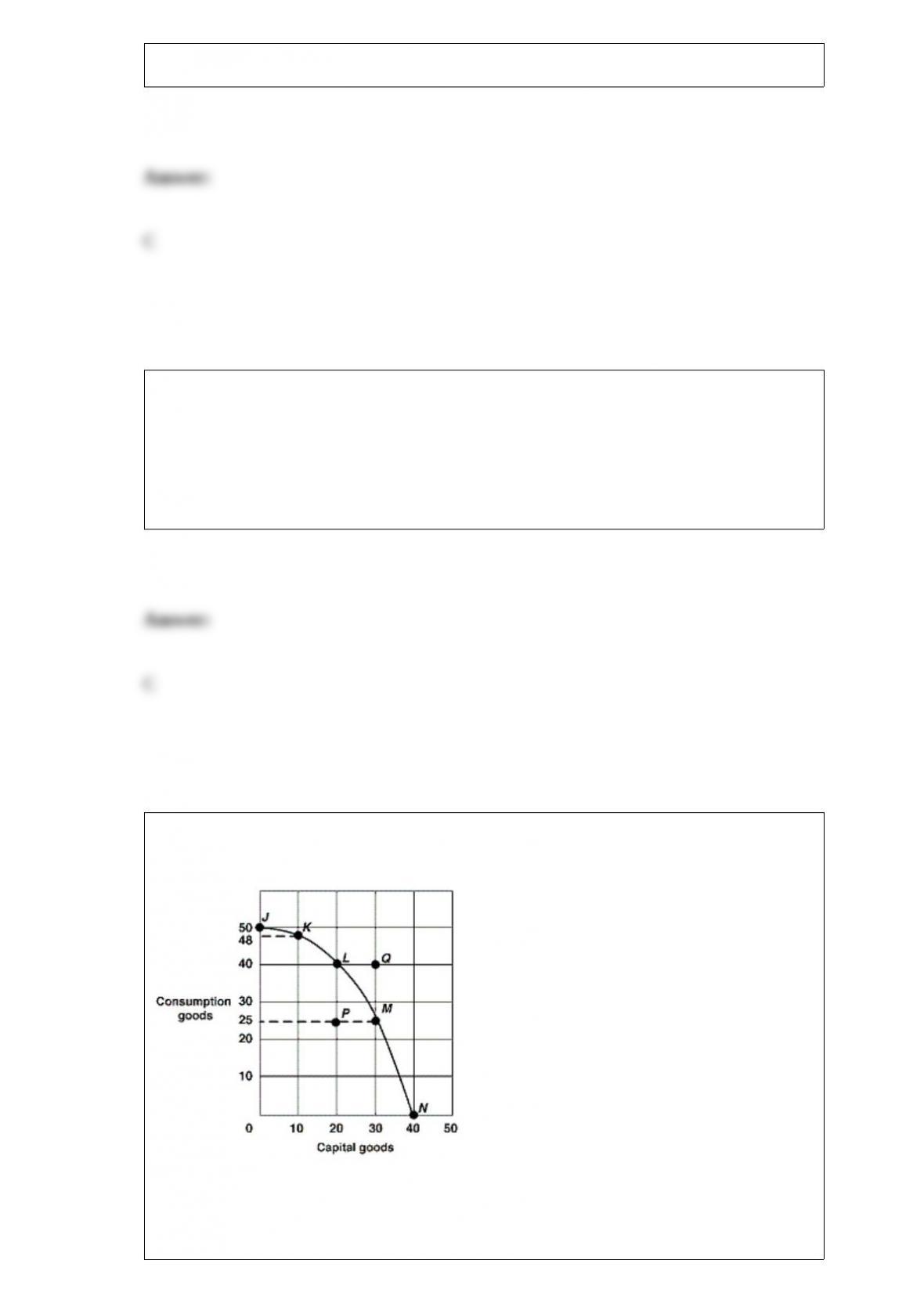
Exhibit 2-15 Production possibilities curve
In Exhibit 2-15, inefficient resource use is shown by which of the following points?
a. N.

b. J.
c. Q.
d. L.
e. P.
A tariff has the effect of:
a. raising the price of the exported product.
b. increasing the demand for the exported product.
c. increasing the demand for the imported product.
d. increasing the supply of the imported product.
e. raising the price of the imported product.