
When a perfectly competitive firm or a monopolistically competitive firm is making
zero economic profit,
a. no firms will want to enter or exit.
b. some firms will want to leave.
c. some firms will want to enter.
d. market demand shifts to the left.
e. the price of the output will rise in the long run.
A price ceiling:
a. is the lowest price that the law will allow to be charged in the market.
b. is the highest price that the law will allow to be charged in the market.
c. is the price that must be charged in the market.
d. would be imposed if the government believes the market equilibrium price is too low.
e. would only be applicable in the case of non-essential goods.
Food stamps and Medicaid are examples of:
a. money transfers
b. resource earnings
c. in-kind transfers
d. tax expenditures

If a firm has no ability to select the price of its product, it:
a. will go out of business due to losses.
b. is a price-maker.
c. cannot maximize profit.
d. has a horizontal individual demand curve.
The sub-discipline of economics that focuses especially on individual markets is:
a. normative economics.
b. positive economics.
c. microeconomics.
d. macroeconomics.
e. econometrics.
Exhibit 2-15 Production possibilities curve
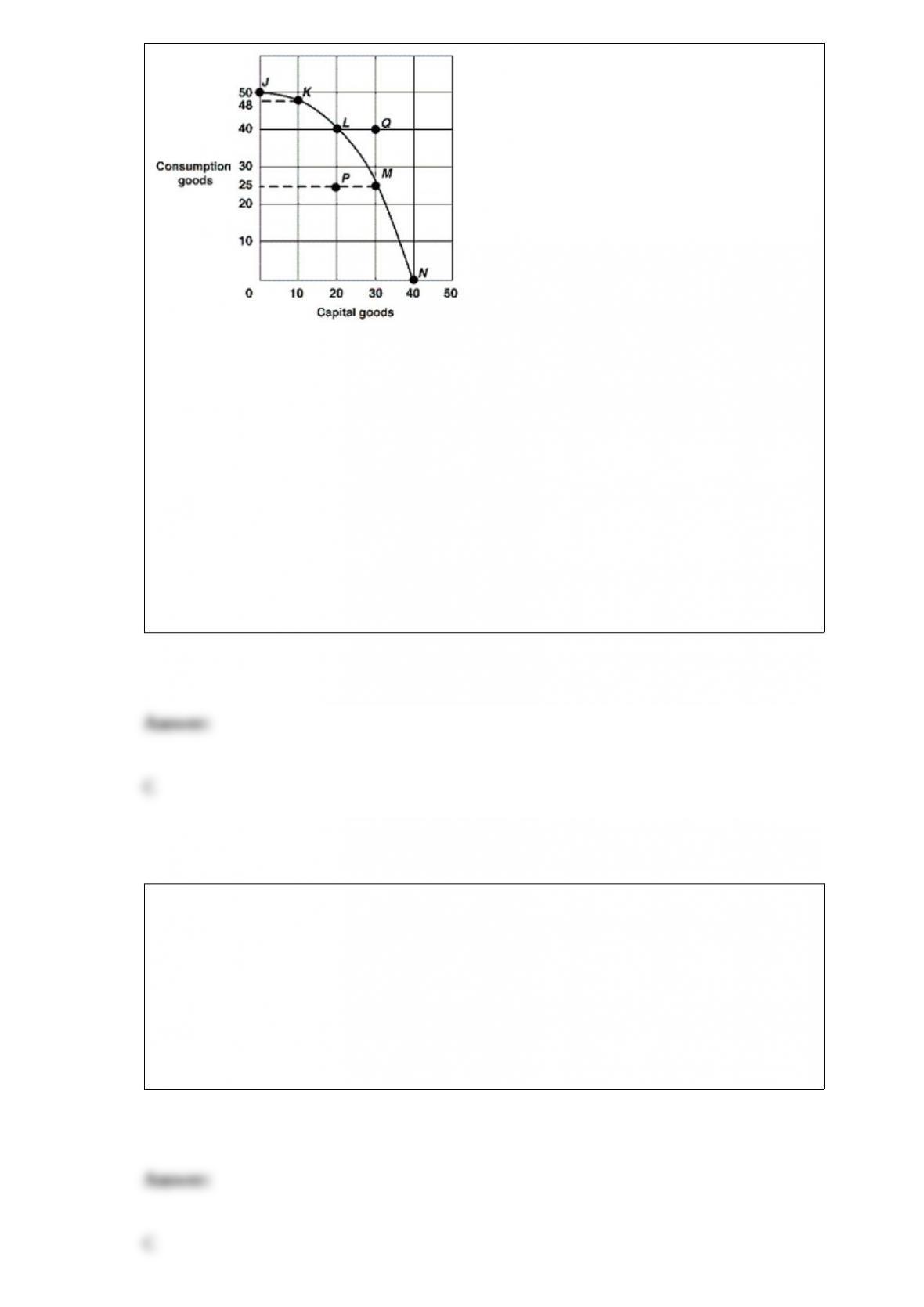
In Exhibit 2-15, if the economy moves from point L to point M, the opportunity cost of
producing 10 more capital goods is:
a. 40 less consumer goods.
b. 25 less consumer goods.
c. 15 less consumer goods.
d. 15 more consumer goods.
e. 25 more consumer goods.
The long-run price elasticity of demand is usually larger than the short-run price
elasticity of demand because:
a. demand curves tend to become steeper over time.
b. economists take the absolute value of long-run price elasticities but not of short-run
elasticities.
c. people have more time to find substitute goods.
d. incomes tend to rise over time.
e. supply curves change over time.
Which of the following practices is prohibited by the Clayton Act?
a. Price discrimination that substantially lessens competition.
b. Tying contracts that substantially lessen competition.
c. Exclusive dealing that substantially lessens competition.
d. All of these.
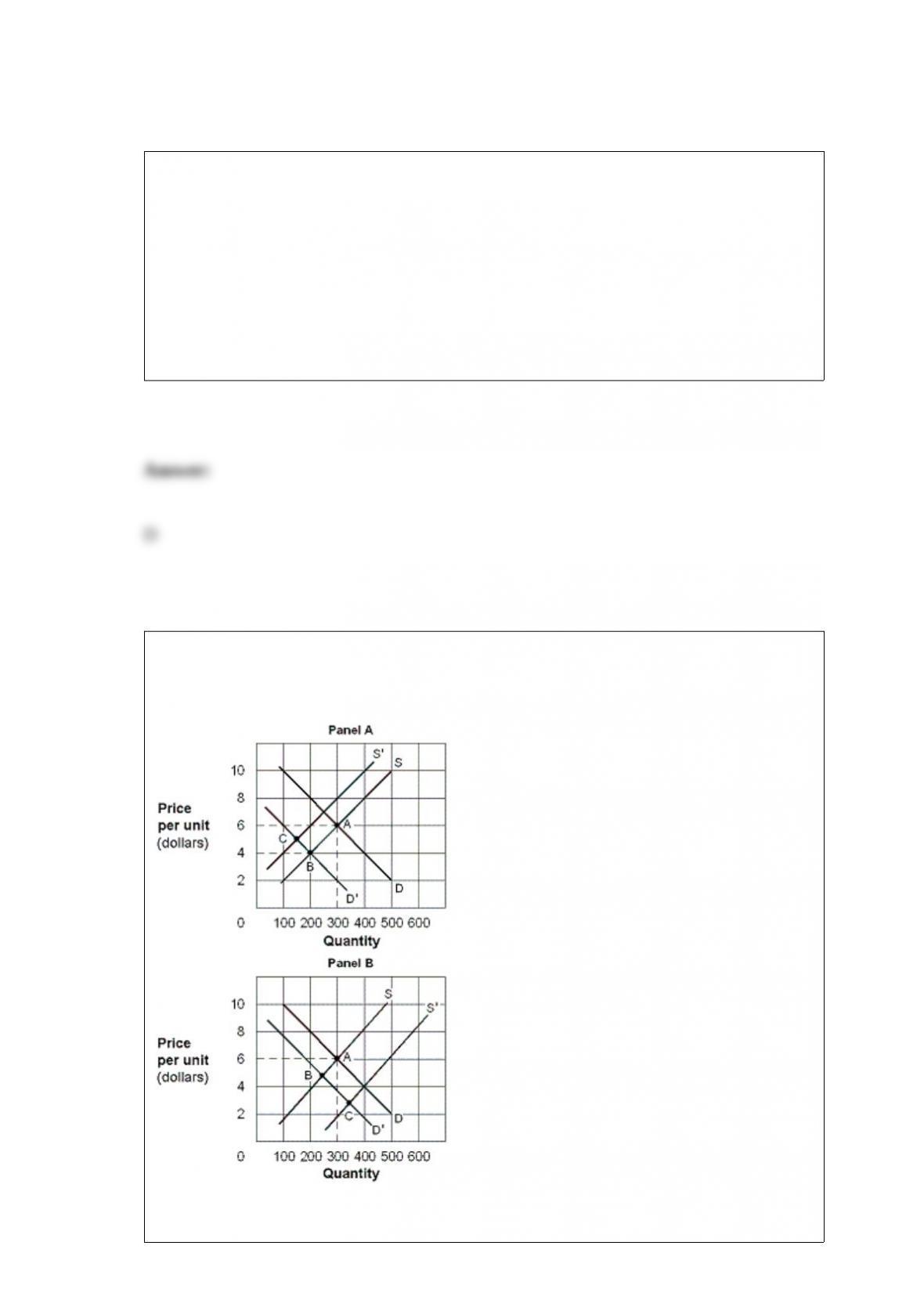
Exhibit 3-11 Demand and supply curves
In Exhibit 3-11, in Panel B the movement from A to C describes a(n):

a. increase in demand and a decrease in supply, where the increase in demand is
relatively bigger.
b. decrease in both demand and supply, where the decrease in supply is relatively
bigger.
c. increase in demand and a decrease in supply, where the decrease in supply is
relatively bigger.
d. decrease in demand and increase in supply, where the increase in supply is relatively
bigger.
e. increase in both demand and supply, where the increase in supply is relatively bigger.
If each of us relied exclusively on the market to determine what to buy, we would
probably end up with few, if any:
a. streetlights.
b. strawberries.
c. CDs.
d. raincoats.
e. televisions.
All of the following are examples of capital except:
a. the robot used to help produce your car.

b. a computer used by your professor to write this exam.
c. the factory that produces the costume jewelry you buy.
d. the inventory of unsold goods at your local hardware store.
e. an uncut diamond that you discover in your backyard.
If a firm is currently equating MR and MC and product price = $24, AVC = $22, and
ATC = $26, then in the long run this firm:
a. will continue to operate at a loss.
b. will earn a positive profit.
c. will go out of business.
d. should increase output.
e. should decrease price.
A direct relationship is expressed graphically as a:
a. positively sloped line or curve. c. horizontal line.
b. negatively sloped line or curve. d. vertical line.

A monopolist will earn economic profits as long as his price exceeds:
a. marginal revenue.
b. average fixed cost.
c. average variable cost.
d. average total cost.
An increased equilibrium price and a decreased equilibrium quantity results from a(an):
a. decrease in demand.
b. increase in supply.
c. decrease in supply.
d. increase in demand.
A kinked demand curve is based on the actions of an oligopolist to follow a price
increase but not a price reduction.

Adam Smith believed that the pursuit of the public interest is also the best way to
promote the private self interest.
In the short run, the profit maximizing (or minimizing) quantity of output for any firm
to produce exists at that output level at which marginal revenue equals marginal cost.
Most real world economies are mixed economies.
Assuming supply is held constant, an increase in demand for a product will cause an
increase in the equilibrium price and the amount bought and sold.

As a percentage of nonfarm workers, union membership in the United States grew most
rapidly since 1945.
A totally pollution free environment should be a primary social goal.
If X and Y are substitutes, the demand curve for X will shift to the right when the price
of Y decreases.