
A monopolist will operate in the short run if which of the following is above average
variable cost?
a. Marginal cost.
b. Marginal revenue.
c. Price.
d. All of these.
There are apartments in Chicago whose rooftops overlook Wrigley Field. On game day
you can find free riders on the roof enjoying ____.
a. free property rights c. a public good
b. an externality d. excess utility
“I’m tired of eating muffins for breakfast. Today, I’m trying a bagel.” These statements
most clearly reflect the:
a. law of increasing returns to scale.
b. second law of demand.
c. law of diminishing marginal utility.
d. law of comparative advantage.

Georgia has a MU/P of 10 for tennis lessons, a MU/P of 6 for sewing lessons, and a U/P
of 2 for cooking lessons. In order to maximize utility, she should:
a. take more cooking lessons.
b. take more sewing lessons.
c. take more tennis lessons.
d. stay with her current choices.
e. take fewer lessons of each choice.
Which act of Congress declared tying contracts, exclusive dealing, and price
discrimination illegal?
a. Celler-Kefauver Act. c. Clayton Act.
b. Sherman Antitrust Act. d. Robinson-Patman Act.
Exhibit 15-3 Potatoes and wheat output (tons per day)
In Exhibit 15-3, Ireland’s opportunity cost of producing one unit of wheat is:
a. 1/3 ton of potatoes. c. either a or b.
b. 3 tons of potatoes. d. neither a nor b.
If New York City expects that an increase in bus fares will raise mass transit revenues,
it must think that the demand for bus travel is:
a. elastic.
b. unit elastic.
c. inelastic.
d. perfectly inelastic.
e. 10.
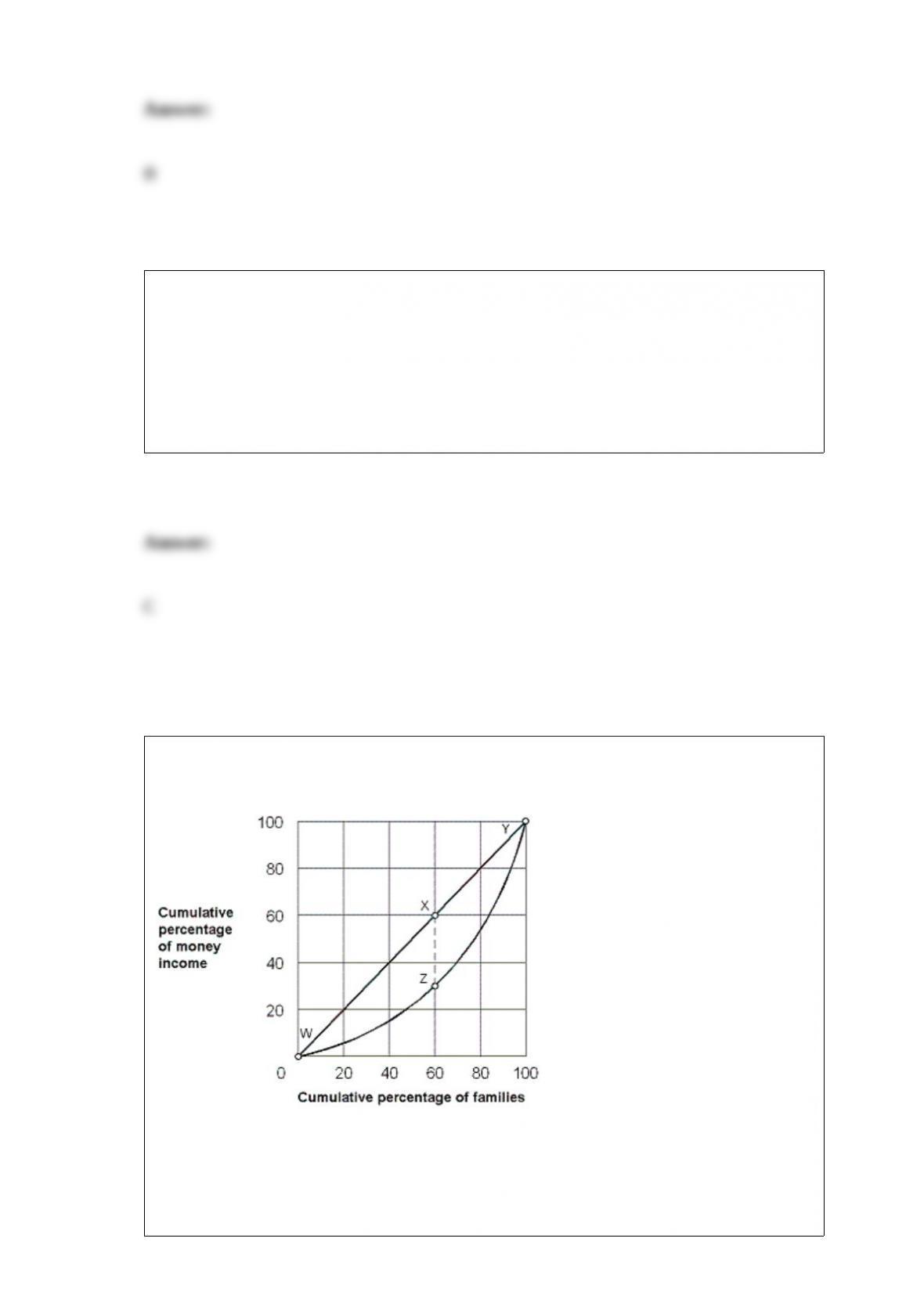
Exhibit 12-4 Lorenz curve
As shown in Exhibit 12-4, the perfect equality line is drawn between points:
a. W and Y along the curve.
b. X and Z.
c. W and Y along the straight line.
d. W and X.

Which of the following mergers would result from the purchase of a paper mill by a
textbook publishing company?
a. An interlocking merger. c. A conglomerate merger.
b. A vertical merger. d. A horizontal merger.
The production possibilities curve demonstrates the basic economic principle that:
a. market-based economies are more efficient.
b. supply will determine demand in the economy.
c. the production of more capital goods this year will cause the economy to produce less
consumption goods next year.
d. to produce more of any one thing, assuming full employment, the economy must
produce less of something else.
e. to produce more consumption goods this year requires the production of more capital
goods this year.
What act of Congress declared restraint of trade illegal and declared any attempt at
monopolizing unlawful?
a. Celler-Kefauver Act. c. Clayton Act.
b. Sherman Antitrust Act. d. Robinson-Patman Act.
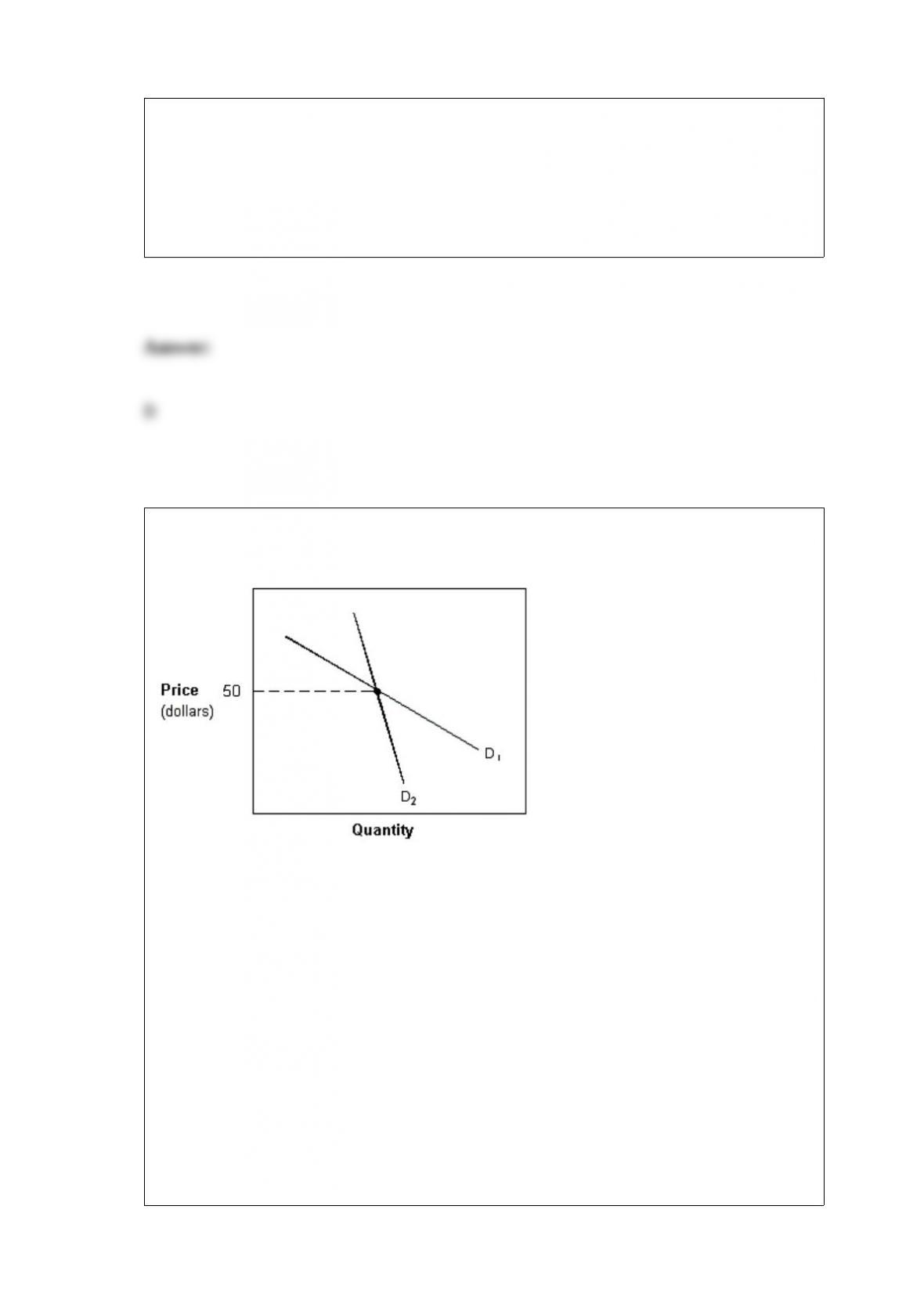
Exhibit 10-4 Kinked demand curves
In Exhibit 10-4, the exhibit represents a kinked-demand oligopoly model. Suppose the
current price is $50. If one firm in the oligopoly now attempts to lower price, all firms
will:
a. follow along demand curve D1.
b. follow along demand curve D2.
c. ignore this price decrease and cause the price-raising firm to move along D1.
d. ignore this price decrease and cause the price-raising firm to move along D2.
e. raise their prices.

Suppose that the price of telephones decreases. If more are purchased then:
a. the total utility of telephones will decrease.
b. the total utility of telephones will be unchanged.
c. the marginal utility of telephones will likely increase.
d. the marginal utility of telephones will likely decrease.
e. both a and d.
Imposing a restrictive quota on imported plasma TVs will:
a. increase the price of the plasma TVs and decrease the quantity consumed.
b. increase both the price of the plasma TVs and the quantity consumed.
c. leave the price of the plasma TVs unchanged but decrease the quantity consumed.
d. leave the price and the quantity consumed of plasma TVs unchanged, because
domestic producers will expand production to make up for the reduction in imports
Which of the following is illegal under Clayton Act of 1914?
a. Charging different prices for the same product.
b. Exclusive dealer agreements.
c. Tying contracts.

d. The purchase of the assets of a rival firm that lessens competition.
Consumer surplus:
a. is minimized in market equilibrium.
b. measures the value between the actual selling price of a product and the price at
which sellers are willing to sell the product.
c. measures the value between the price consumers are willing to pay for a product and
the price they actually pay.
d. measures the price at which sellers extract excess profits from consumers.
We can represent the entry of new firms into a monopolistically competitive market by
shifting the existing firms’:
a. demand curves downward.
b. demand curves upward.
c. demand curves more inelastic.
d. cost curves upward.
e. cost curves downward.

Which antitrust act prohibits price fixing and other conspiracies and combinations that
restrain trade and attempts to monopolize?
a. Sherman Antitrust Act of 1890.
b. Clayton Act of 1914.
c. Federal Trade Commission Act of 1914.
d. Robinson-Patman Act of 1936.
e. Cell-Kefauver Act of 1950.