
“Countries are poor because they cannot afford to save and invest” is called the:
a. vicious circle of poverty. c. LDC trap.
b. savings-investment trap. d. cycle of insufficient credit.
\Suppose the quantity demanded of steak is 200 million pounds per year when the price
is $6 per pound and 400 million pounds per year when the price is $2 per pound. The
price elasticity of demand for steak over this range is:
a. elastic.
b. inelastic.
c. unitary elastic.
d. perfectly elastic.
e. perfectly inelastic.
Which of the following is the best example of a command-and-control regulation?
a. Effluent taxes on pollutants.
b. Emissions trading.
c. Requiring automobiles to have catalytic converters.
d. Offset programs.

Most economists believe that there are positive externalities in education. One can
conclude that a free market would fail to give the socially optimal outcome because the
equilibrium:
a. price and quantity would be too high.
b. price would be too low and quantity would be too high.
c. price and quantity would be too low.
d. price would be too high and quantity would be too low.
e. price and quantity would be just right.
“Because of unseasonable cold weather, much of the peach crop has been destroyed.”
This statement indicates that the:
a. price of peaches will fall.
b. quantity of peaches that will be available at any given price has decreased.
c. demand for peaches will shift to the left.
d. quantity of peaches that will be available at any given price have increased.
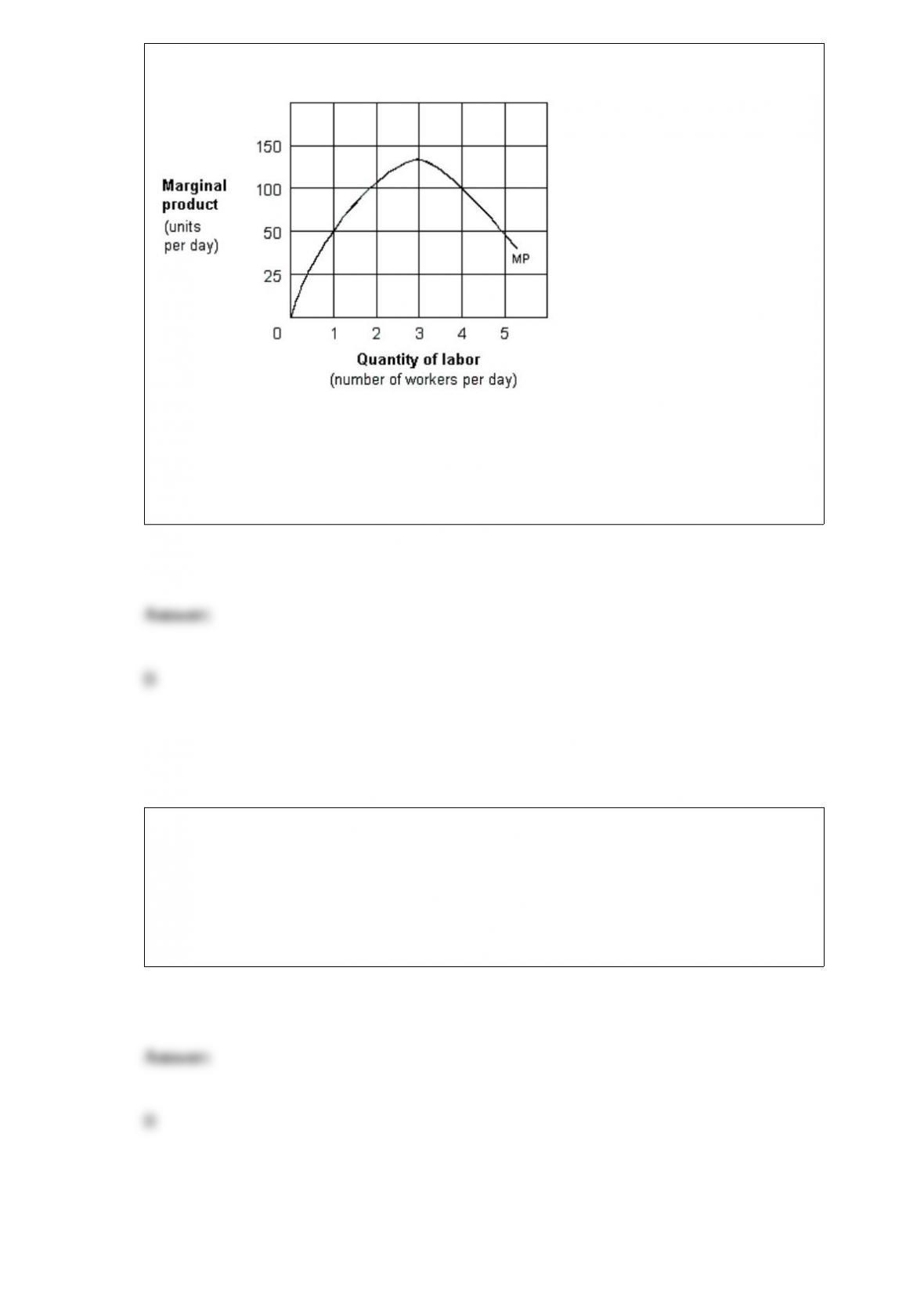
Exhibit 7-4 A marginal product curve
As shown in Exhibit 7-4, the law of diminishing returns applies in the range of:
a. over 10 workers per day.
b. over 5 workers per day.
c. over 2 workers per day.
d. between 0 and 5 workers per day.
The increase in total output that results from a unit increase in one unit of a variable
input is equal to the input’s:
a. total product.
b. marginal product.
c. average product.
d. marginal cost.

Diseconomies of scale exist for all of the following reasons except:
a. bureaucratic inefficiencies.
b. management problems.
c. failures in information flows.
d. firm size is too small.
e. organizational problems.
An inferior good is:
a. any good of low quality.
b. one that consumers buy less of at a higher price.
c. one that consumers buy less of as their income rises.
d. one that has few substitutes.
e. any good made with inexpensive labor.
Unlike implicit costs, explicit costs:
a. reflect opportunity costs.
b. include the value of the owner’s time.
c. are not included in the accounting statement of the firm.
d. are actual cash payments.
e. do not change with the output rate of the firm.

The Social Security Act was passed:
a. in 1955.
b. just after World War II.
c. in 1935.
d. in 1964.
The monopsonistic employer hires more workers until marginal:
a. physical product is zero.
b. revenue product equals marginal factor cost.
c. revenue product equals the wage.
d. physical product equals the wage.
e. physical product equals marginal factor cost
Exhibit 11-2 Labor and output data

In Exhibit 11-2, if product price is fixed at $8, the MRP of the 5th worker is equal to:
a. $50.
b. $80.
c. $10.
d. $100
e. $160.
The demand for a product is likely to be more elastic:
a. the smaller the share of the total budget spent on the product.
b. when more complementary products are available.
c. in the short run than in the long run.
d. when more good substitutes for the product are available.
The excess supply created when governments impose a price floor is:
a. shrinking as the floor rises.
b. the difference between the old quantity supplied and new quantity demanded.
c. the difference between the new quantity supplied and the old quantity demanded.

d. the difference between the new quantity supplied and the new quantity demanded.
e. actually efficient because prices are higher for suppliers.
A normal good is defined by economists to be a good:
a. with a negatively-sloped demand curve.
b. that is purchased by at least 75 percent of the population.
c. that is bought by consumers with normal tastes.
d. whose demand increases when incomes increase.
e. whose demand decreases when incomes increase.
Adam Smith’s book, The Wealth of Nations, was published at the time of the:
a. War of 1812. c. U.S. Civil War.
b. U.S. Declaration of Independence. d. Great Depression.
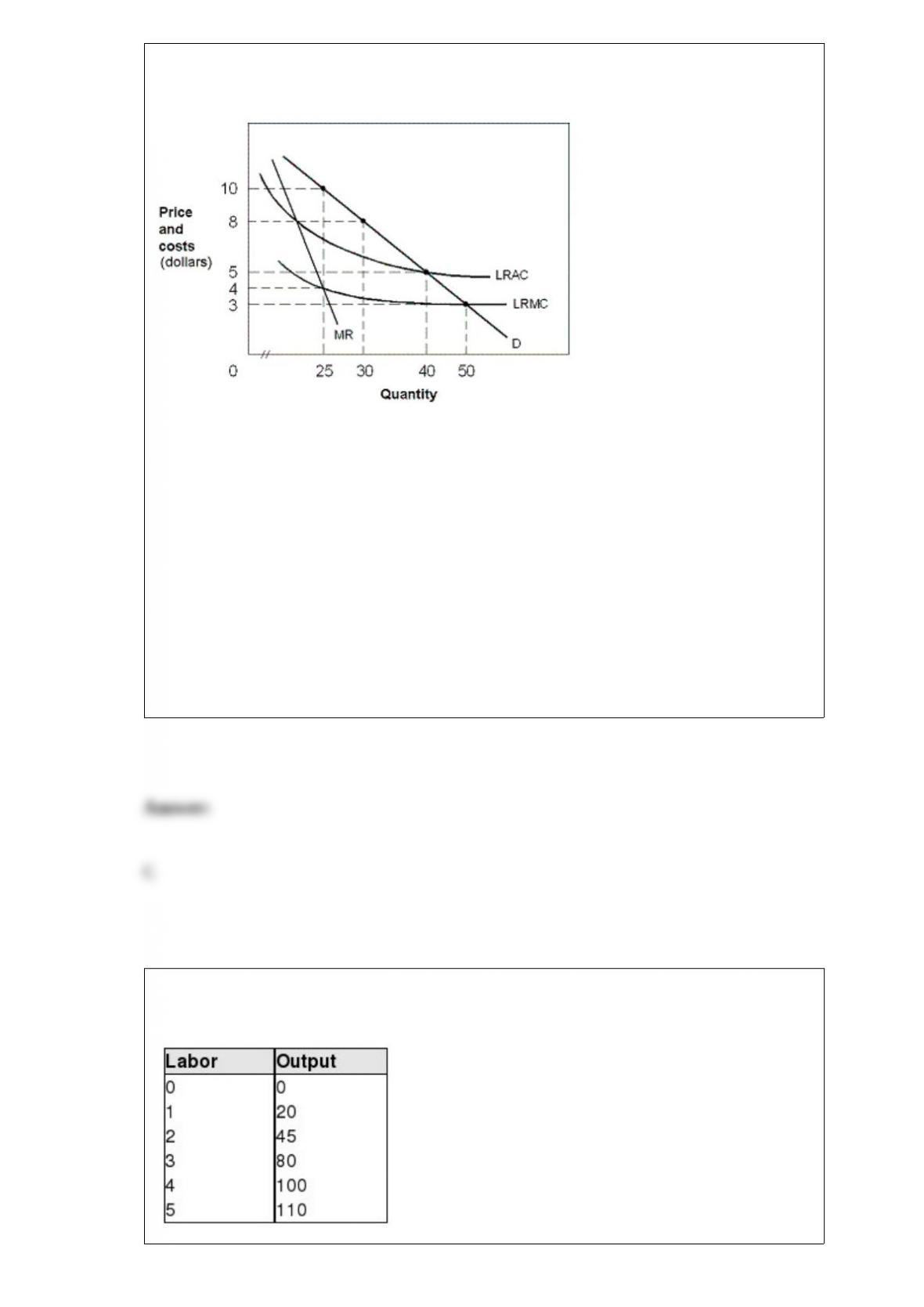
Exhibit 13-3 A monopolist
In Exhibit 13-3, if this industry is regulated and the regulatory commission sets price
equal to marginal cost, then:
a. this firm would earn excess profit.
b. price would equal ATC.
c. the firm would suffer losses.
d. revenue would just be sufficient to cover costs.
e. total revenue would just cover marginal cost.
Exhibit 11-2 Labor and output data

In Exhibit 11-2, the marginal product of the 3rd unit of labor is equal to:
a. 80.
b. 45.
c. 35.
d. 100.
e. 25.
Property rights allowing individuals to own goods, services, and factors of production
are most important in:
a. socialistic economies. c. capitalistic economies.
b. planned economies. d. command economies.
Supporters of advertising claim that it:
a. increases the variety of products. c. allows new firms to compete.
b. attacks established brand loyalties. d. all of these.

The demand schedule for a good shows:
a. the specific quantity of the good that people are willing and able to sell at different
prices.
b. the positive relationship between the price and the quantity of the good.
c. no relationship between the price and the quantity of the good.
d. the specific quantity of the good that people are willing and able to buy at different
prices.
e. the quantity of the good that is sold in the market.
Which of the following is a characteristic of a competitive price-taker market?
a. Profit maximizing firms in the market will expand output until price equals average
variable cost.
b. The market demand curve for the product is a horizontal line.
c. There are many firms in the market, each producing a small share of total market
output.
d. The product produced by each of the firms is differentiated.