
An example of a price ceiling would be:
a. a ration coupon.
b. a guarantee of a target price for farm products.
c. parity pricing.
d. rent control.
e. the soil bank program.
Externalities are unintended costs or benefits that are imposed on unsuspecting people
and that result from:
a. poor planning.
b. intentional damages.
c. excessive costs.
d. excessive losses.
e. the economic activity of others.
A textbook is an example of:
a. capital. c. labor.
b. a natural resource. d. all of these.
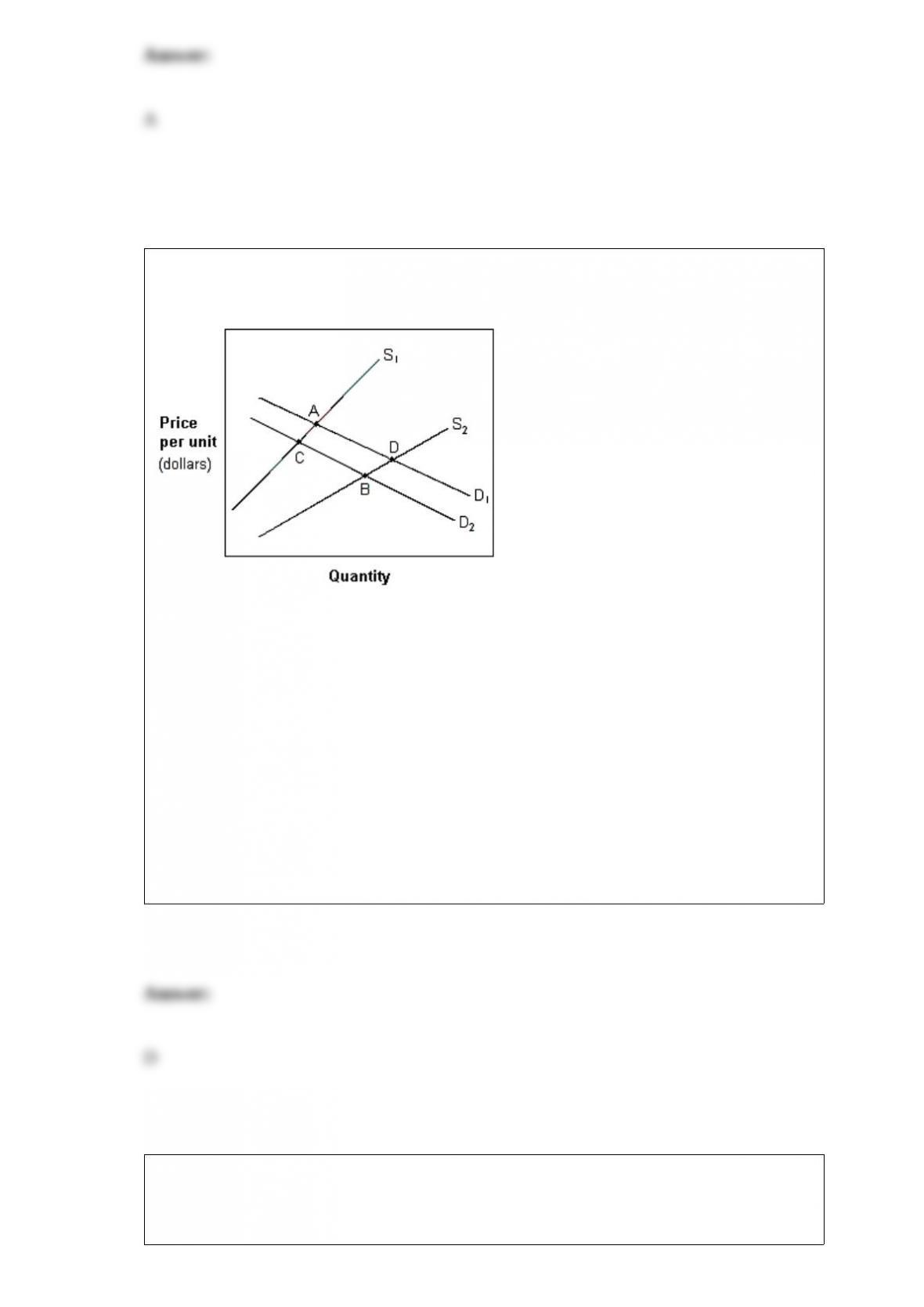
Exhibit 4-8 Demand and supply curves
In Exhibit 4-8, a movement from A to B is best explained by:
a. an increase in income and in the number of suppliers.
b. an increase in the price of other goods.
c. an increase in the population.
d. a decrease in income and an improvement in the technology used to produce the
good.
e. equilibrium quantity increases and the equilibrium price change is indeterminate.
Which of the following is a characteristic of socialism?
a. Rejection of central planning.
b. Government ownership of all factors of production.
c. Government ownership of most of the factors of production.
d. Private ownership of all factors of production.
Seller A, has an upward-sloping supply curve, and is willing to supply 400 units of a
commodity at a price of $5 per unit. Seller A is now willing to supply 500 units at a
price of $5 per unit. Evidently, seller A has experienced a(n):
a. increase in supply.
b. decrease in supply.
c. increase in quantity supplied.
d. decrease in the quantity supplied.
e. decrease in demand.
Exhibit 2-8 Production possibilities curve data
As shown in Exhibit 2-8, a total output of 0 units of capital goods and 10 units of
consumer goods is:
a. the maximum rate of output for this economy.
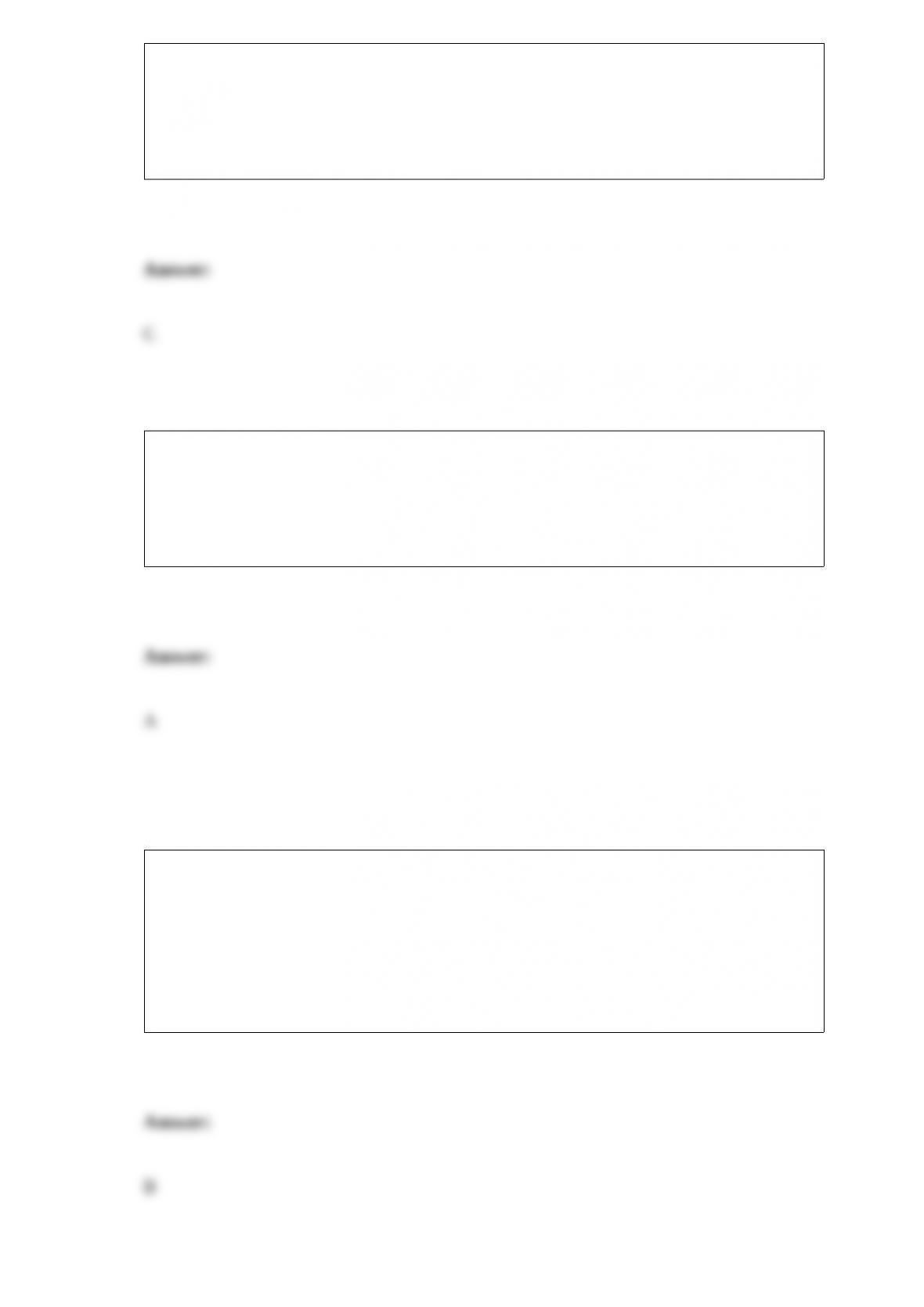
b. an inefficient way of using the economy’s scarce resources.
c. the result of maximum use of the economy’s labor force.
d. unobtainable in this economy.
Fixed costs are best defined as:
a. costs that do not vary with output.
b. costs that are at a minimum when output approaches the firm’s capacity.
c. the amount that one more unit of output adds to total costs.
d. costs that decline as output increases.
Assume that crackers and soup are complementary goods. The effect on the soup
market of an increase in the price of crackers (other things being equal) would best be
described as a(n):
a. decrease in the quantity of soup demanded.
b. decrease in the demand for soup.
c. increase in the quantity of soup demanded.
d. increase in the demand for soup.

A perfectly competitive firm in the short-run can earn:
a. positive economic profits. c. zero economic profits.
b. negative economic profits. d. all of these are possible
The production possibility curve is bowed outward from the origin because of:
a. the law of increasing opportunity costs.
b. the finite nature of the resource base.
c. inefficiency.
d. improper output mix.
e. unemployment.
The vicious circle of poverty makes it difficult for an LDC to:
a. establish political institutions. c. save and invest.
b. control inflation. d. fix its exchange rate.

Which of the following is an example of a pure public good?
a. A bus.
b. A mall.
c. A teddy bear.
d. An army.
e. An automobile.
The demand curve in monopolistic competition slopes downward because of:
a. strong barriers to entry.
b. product differentiation.
c. the small number of firms.
d. government regulation.
e. the similarities of the businesses.

If individuals who sit in the back of the classroom receive lower grades on average than
the rest of the class, does that mean that sitting in the back of a classroom causes one to
perform poorly on exams?
a. Not necessarily. The reoccurrence of a certain relationship between two variables
does not necessarily imply causation.
b. It is not possible for an economist to determine causation between variables.
c. The reoccurrence of such a relationship is sufficient evidence that sitting in the back
of a classroom will lead to lower grades.
d. The reoccurrence of such a relationship is sufficient evidence that students who
receive low grades prefer to keep a low profile and always sit in the back of the
classroom.
If the wage rate is fixed at a certain level, the:
a. total wage cost curve is horizontal.
b. total wage cost curve is a straight upward sloping line.
c. MP must be constant.
d. total wage cost curve will increase at an increasing rate.
e. total wage cost curve will increase at a decreasing rate.