Archives
978-0078024108 Chapter 1
Chapter 01 – Introduction to Operations Management CHAPTER 01 INTRODUCTION TO OPERATIONS MANAGEMENT Teaching Notes Many students come to this course with negative feelings, perhaps because they have heard that the course includes a certain amount of quantitative material (which […]
978-0078024108 Chapter 10 Part 1
Chapter 10 – Quality Control 10-1 Education. CHAPTER 10 QUALITY CONTROL Teaching Notes As a result of increased global competition, a rapidly growing number of companies of all sizes are paying much more attention to issues involving quality and productivity. […]
978-0078024108 Chapter 10 Part 2
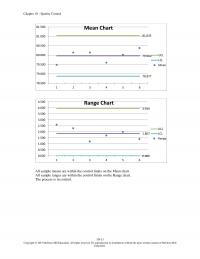
Chapter 10 – Quality Control 10–11 Education. All sample means are within the control limits on the Mean chart. All sample ranges are within the control limits on the Range chart. The process is in control. 81.043 79.960 78.877 78.500 […]
978-0078024108 Chapter 10 Part 3
Chapter 10 – Quality Control 10–21 Education. Median Test: Sample 39 was tied with the median. As shown below, the expected number of runs = 20.5. The expected number of runs will be greater than the observed number or runs […]
978-0078024108 Chapter 10 Part 4
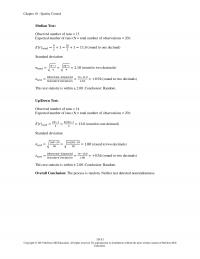
Chapter 10 – Quality Control Education. Median Test: Observed number of runs = 13 Expected number of runs (N = total number of observations = 20): (round to one decimal) Standard deviation: […]
978-0078024108 Chapter 10 Part 5
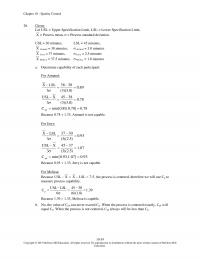
Chapter 10 – Quality Control 26. Given: Let USL = Upper Specification Limit, LSL = Lower Specification Limit, X = Process mean, = Process standard deviation. USL = 30 minutes, LSL = 45 minutes, X Armand = 38 minutes, […]
978-0078024108 Chapter 11 Part 1
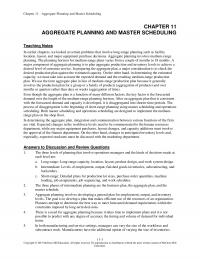
Chapter 11 – Aggregate Planning and Master Scheduling CHAPTER 11 AGGREGATE PLANNING AND MASTER SCHEDULING Teaching Notes In earlier chapters, we looked at certain problems that involve long-range planning such as facility location, layout, and major equipment purchase decisions. Aggregate […]
978-0078024108 Chapter 11 Part 2
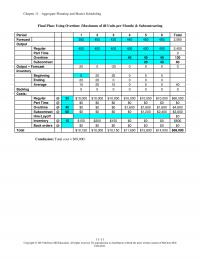
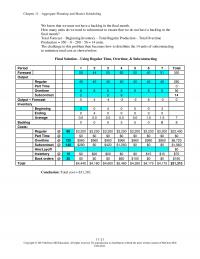
Chapter 11 – Aggregate Planning and Master Scheduling 11–11 Final Plan: Using Overtime (Maximum of 40 Units per Month) & Subcontracting Period 1 2 3 4 5 6 Total Forecast 380 400 420 440 460 480 2,580 Output Regular 400 […]
978-0078024108 Chapter 11 Part 3
Chapter 11 – Aggregate Planning and Master Scheduling We know that we must not have a backlog in the final month. How many units do we need to subcontract to ensure that we do not have a backlog in the […]
978-0078024108 Chapter 11 Part 4
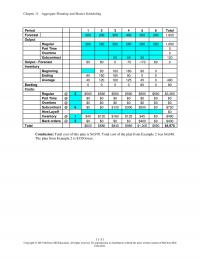
Chapter 11 – Aggregate Planning and Master Scheduling 11–31 Education. Period 1 2 3 4 5 6 Total Forecast 200 200 300 400 500 200 1,800 Output Regular 280 280 280 280 280 280 1,680 Part Time 0 Overtime 0 […]
978-0078024108 Chapter 11 Part 5
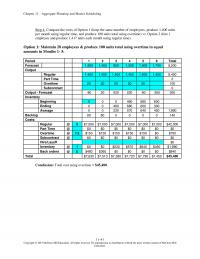
Chapter 11 – Aggregate Planning and Master Scheduling 11–41 Education. Step 4: Compare the costs of Option 1 (keep the same number of employees, produce 1,400 units per month using regular time, and produce 100 units total using overtime) vs. […]
978-0078024108 Chapter 11 Part 6
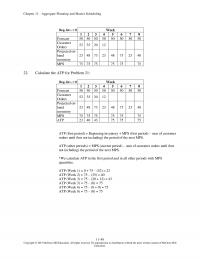
Chapter 11 – Aggregate Planning and Master Scheduling Beg. Inv. = 0 Week 1 2 3 4 5 6 7 8 Forecast 50 50 50 50 50 50 50 50 Customer Orders 52 35 20 12 Projected on- hand inventory […]
978-0078024108 Chapter 12 Part 1
Chapter 12 – MRP and ERP 12-1 Education. CHAPTER 12 MRP AND ERP Teaching Notes When covering the material in this chapter, the following points should be emphasized: Dependent demand item needs are generated from higher level item needs […]
978-0078024108 Chapter 12 Part 2
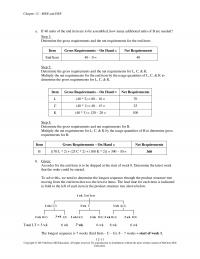
Chapter 12 – MRP and ERP 12–11 a. If 40 units of the end item are to be assembled, how many additional units of B are needed? Step 1: Determine the gross requirements and the net requirements for the end […]
978-0078024108 Chapter 12 Part 3
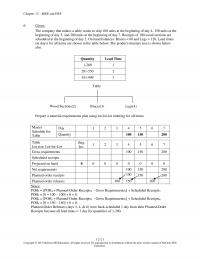
Chapter 12 – MRP and ERP Copyright © 2015 McGraw-Hill Education. All rights reserved. No reproduction or distribution without the prior written consent of McGraw-Hill 6. Given: The company that makes a table wants to ship 100 units at the […]
978-0078024108 Chapter 12 Part 4
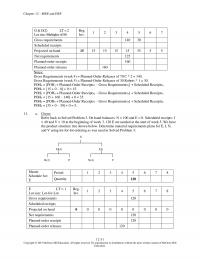
Chapter 12 – MRP and ERP Copyright © 2015 McGraw-Hill Education. All rights reserved. No reproduction or distribution without the prior written consent of McGraw-Hill G & G(2) LT = 2 Lot size: Multiples of 80 Beg. Inv. 1 2 […]
978-0078024108 Chapter 12 Part 5
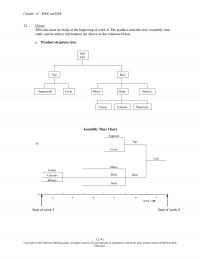
Chapter 12 – MRP and ERP 12–41 12. Given: 200 carts must be ready at the beginning of week 8. The product structure tree, assembly time chart, and inventory information are shown in the solutions below: a. Product structure tree: […]
978-0078024108 Chapter 12 Part 6
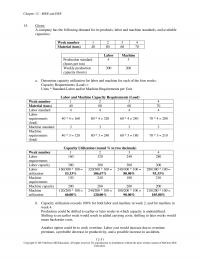
Chapter 12 – MRP and ERP 15. Given: A company has the following demand for its products, labor and machine standards, and available capacities: Week number 1 2 3 4 Material (tons) 40 80 60 70 Labor Machine Production standard […]
978-0078024108 Chapter 12 Part 7
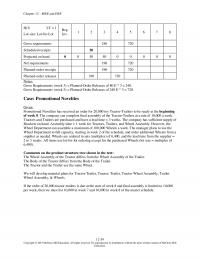
Chapter 12 – MRP and ERP 12–59 H(3) LT = 1 Lot size: Lot-for-Lot Beg. Inv. 1 2 3 4 5 6 7 8 Gross requirements 240 720 Scheduled receipts 50 Projected on hand 0 0 50 50 0 0 […]
978-0078024108 Chapter 13 Part 1
Chapter 13 – Inventory Management CHAPTER 13 INVENTORY MANAGEMENT Teaching Notes This is a fairly long and important chapter. Important points are: 1. Good inventory management is important for successful organizations. 2. The key inventory management issues are when to […]
978-0078024108 Chapter 13 Part 2
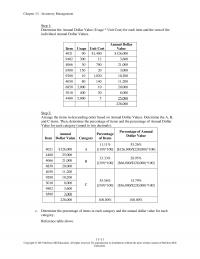
Chapter 13 – Inventory Management 13–11 Education. Step 1: Determine the Annual Dollar Value (Usage * Unit Cost) for each item and the sum of the individual Annual Dollar Values. Item Usage Unit Cost Annual Dollar Value 4021 90 $1,400 […]
978-0078024108 Chapter 13 Part 3
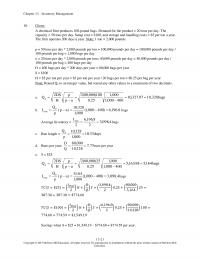
Chapter 13 – Inventory Management 13–21 Education. 10. Given: A chemical firm produces 100-pound bags. Demand for the product = 20 tons per day. The capacity = 50 tons per day. Setup cost = $100, and storage and handling costs […]
978-0078024108 Chapter 13 Part 4
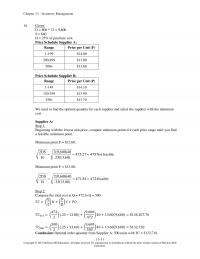
Chapter 13 – Inventory Management 16. Given: D = 800 * 12 = 9,600 S = $40 H = 25% of purchase cost Price Schedule Supplier A: Range Price per Unit (P) 1-199 $14.00 200-499 $13.80 500+ $13.60 Price Schedule […]
978-0078024108 Chapter 13 Part 5
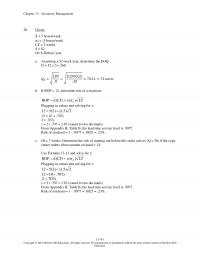
Chapter 13 – Inventory Management 13–41 Education. 26. Given: d = 5 boxes/week d = .5 boxes/week LT = 2 weeks S = $2 H= $.20/box/ year a. Assuming a 52-week year, determine the EOQ: D = 52 x […]
978-0078024108 Chapter 13 Part 6
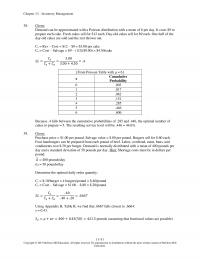
Chapter 13 – Inventory Management 38. Given: Demand can be approximated with a Poisson distribution with a mean of 6 per day. It costs $9 to prepare each cake. Fresh cakes sell for $12 each. Day-old cakes sell for $9 […]
978-0078024108 Chapter 13 Part 7
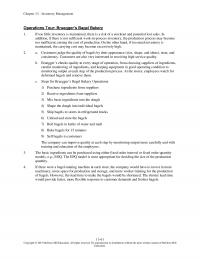
Chapter 13 – Inventory Management 13–61 Education. Operations Tour: Bruegger’s Bagel Bakery 1. If too little inventory is maintained, there is a risk of a stockout and potential lost sales. In addition, if there is not sufficient work-in–process inventory, the […]
978-0078024108 Chapter 14 Part 1
Chapter 14 – JIT and Lean Operations CHAPTER 14 JIT AND LEAN OPERATIONS Teaching Notes JIT and Lean operations seem to be two of the most popular subjects for students. Some are a bit skeptical at first, but most are […]
978-0078024108 Chapter 14 Part 2
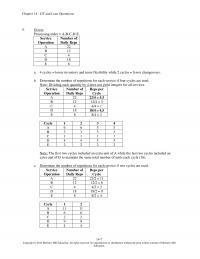
Chapter 14 – JIT and Lean Operations Copyright © 2015 McGraw-Hill Education. All rights reserved. No reproduction or distribution without the prior written consent of McGraw-Hill 5. Given: Processing order = A-B-C-D-E. Service Operation Number of Daily Reps A 22 […]
978-0078024108 Chapter 15 Part 1
Chapter 15 – Supply Chain Management 15-1 Education. CHAPTER 15 SUPPLY CHAIN MANAGEMENT Teaching Notes It is important to emphasize that supply chain management involves the entire range of production and distribution processes. Students need to understand the tradeoffs involved […]
978-0078024108 Chapter 15 Part 2
Chapter 15 – Supply Chain Management 15-9 Education. f. Procurement: Purchasing is responsible for obtaining materials, parts, supplies, and services needed to produce a product or provide a service. Purchasing is very important to a firm because for a manufacturing […]
978-0078024108 Chapter 16 Part 1
Chapter 16 – Scheduling 16-1 CHAPTER 16 SCHEDULING Teaching Notes Scheduling techniques are designed to disaggregate the master production schedule into time-phased daily or hourly activities. A detailed production schedule must include when and where each activity must take place […]
978-0078024108 Chapter 16 Part 2
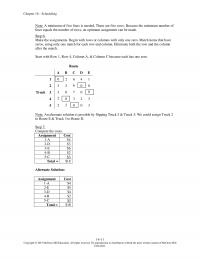
Chapter 16 – Scheduling 16–11 Note: A minimum of five lines is needed. There are five rows. Because the minimum number of lines equals the number of rows, an optimum assignment can be made. Step 6: Make the assignments. Begin […]
978-0078024108 Chapter 16 Part 3
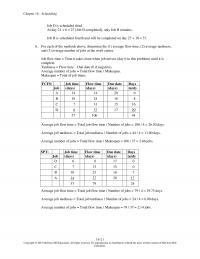
Chapter 16 – Scheduling 16–21 Education. Job D is scheduled third. At day 21 + 6 = 27 [Job D completed], only Job B remains. Job B is scheduled fourth and will be completed on day 27 + 10 = […]
978-0078024108 Chapter 16 Part 4
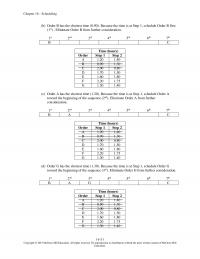
Chapter 16 – Scheduling 16–31 Education. (b) Order B has the shortest time (0.90). Because the time is at Step 1, schedule Order B first (1st) . Eliminate Order B from further consideration. 1st 2nd 3rd 4th 5th 6th 7th […]
978-0078024108 Chapter 16 Part 5
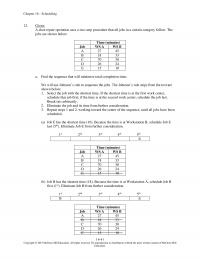
Chapter 16 – Scheduling 16–41 12. Given: A shoe repair operation uses a two-step procedure that all jobs in a certain category follow. The jobs are shown below: Time (minutes) Job WS A WS B A 27 45 B 18 […]
978-0078024108 Chapter 16 Part 6
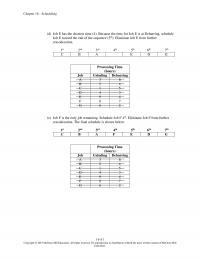
Chapter 16 – Scheduling 16–51 Education. (d) Job E has the shortest time (4). Because the time for Job E is at Deburring, schedule Job E toward the end of the sequence (5th). Eliminate Job E from further consideration. 1st […]
978-0078024108 Chapter 16 Part 7
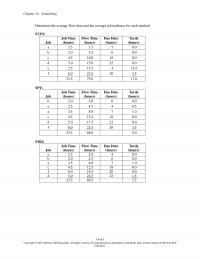
Chapter 16 – Scheduling 16–61 Education. Determine the average flow time and the average job tardiness for each method: FCFS: Job Job Time (hours) Flow Time (hours) Due Date (hours) Tardy (hours) a 3.5 3.5 7 0.0 b 2.0 5.5 […]
978-0078024108 Chapter 16 Part 8
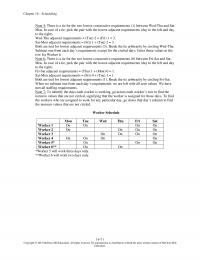
Chapter 16 – Scheduling 16–71 Note 5: There is a tie for the two lowest consecutive requirements (1) between Wed-Thu and Sat- Mon. In case of a tie, pick the pair with the lowest adjacent requirements (day to the left […]
978-0078024108 Chapter 16 Part 9
Chapter 16 – Scheduling Enrichment Module: Runout Time Method Make-to-stock companies produce different products on a common machine or work center. For example, a paint manufacturing company may decide to mix different colors of paint using the same “mixer.” In […]
978-0078024108 Chapter 17 Part 1
Chapter 17 – Project Management CHAPTER 17 PROJECT MANAGEMENT Teaching Notes In managing operations, we are often faced with activities that do not fit into the usual day-to–day operations of the firm. These non-typical, unusual activities of the firm are […]
978-0078024108 Chapter 17 Part 2
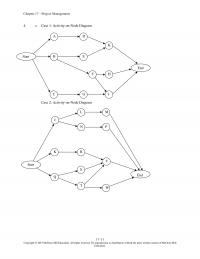
Chapter 17 – Project Management 4. c. Case 1: Activity-on-Node Diagram Case 2: Activity-on-Node Diagram A D K B E F H I G C M L J P N K R V Q S T W End End Start […]
978-0078024108 Chapter 17 Part 3
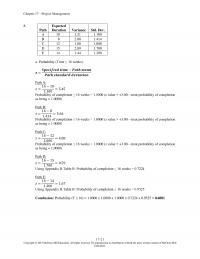
Chapter 17 – Project Management 8. Path Expected Duration Variance Std. Dev. A 10 1.21 1.100 B 8 2.00 1.414 C 12 1.00 1.000 D 15 2.89 1.700 E 14 1.44 1.200 a. Probability (Time ≤ 16 weeks): […]
978-0078024108 Chapter 17 Part 4
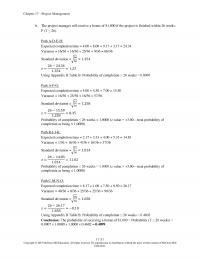
Chapter 17 – Project Management 17–31 Education. b. The project manager will receive a bonus of $1,000 if the project is finished within 26 weeks. P (T ≤ 26): Path A-D-E-H: Expected completion time = 4.00 + 8.00 + 9.17 […]
978-0078024108 Chapter 17 Part 5
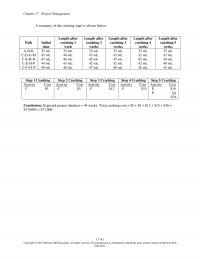
Chapter 17 – Project Management 17–41 Education. A summary of the crashing steps is shown below: Path Initial time Length after crashing 1 week Length after crashing 2 weeks Length after crashing 3 weeks Length after crashing 4 weeks Length […]
978-0078024108 Chapter 17 Part 6
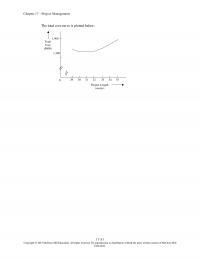
Chapter 17 – Project Management 29 1,300 ($000) 0 30 31 32 33 34 35 Project Length (weeks) The total cost-curve is plotted below: Total Cost 1,400 17–51 Copyright © 2015 McGraw-Hill Education. All rights reserved. No reproduction or distribution […]
978-0078024108 Chapter 17 Part 7
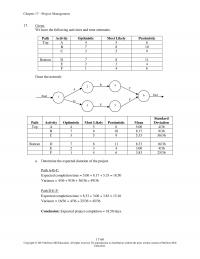
Chapter 17 – Project Management 17–60 Education. Start End 1 6 A D B C E F 17. Given: We have the following activities and time estimates: Path Activity Optimistic Most Likely Pessimistic Top A 4 5 6 B 7 […]
978-0078024108 Chapter 18 Part 1
Chapter 18 – Management of Waiting Lines 18-1 Education. CHAPTER 18 MANAGEMENT OF WAITING LINES Teaching Notes Some of the math and calculations can be left out to focus more clearly on the concepts of waiting lines. For example, all […]
978-0078024108 Chapter 18 Part 2
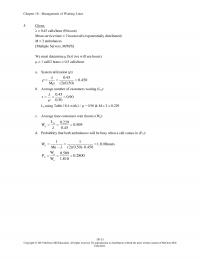
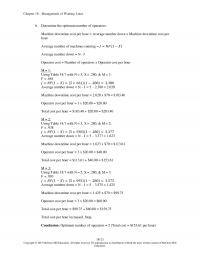
Chapter 18 – Management of Waiting Lines 18–11 5. Given: = 0.45 calls/hour (Poisson) Mean service time = 2 hours/call (exponentially distributed) M = 2 ambulances [Multiple Servers, M/M/S] We must determine first (we will use hours)μ […]
978-0078024108 Chapter 18 Part 3
Chapter 18 – Management of Waiting Lines 18–21 b. Determine the optimum number of operators: Machine downtime cost per hour = Average number down x Machine downtime cost per hour Average number of machines running = Average […]
978-0078024108 Chapter 18 Part 4
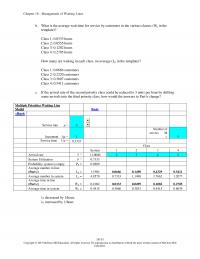
Chapter 18 – Management of Waiting Lines 18–31 Education. b. What is the average wait time for service by customers in the various classes (Wq in the template)? Class 1: 0.0333 hours Class 2: 0.0555 hours Class 3: 0.1202 hours […]
978-0078024108 Chapter 19 Part 1
Chapter 19 – Linear Programming 19-1 CHAPTER 19 LINEAR PROGRAMMING Teaching Notes The main goal of this supplement is to provide students with an overview of the types of problems that have been solved using linear programming (LP). In the […]
978-0078024108 Chapter 19 Part 10
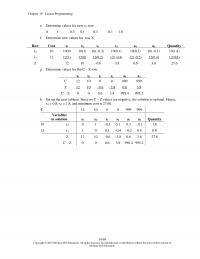
Chapter 19 – Linear Programming 19–89 e. Determine values for new x2 row: 0 1 –0.3 0.1 0.3 –0.1 1.8 f. Determine new values for row Z: Row Cost x1 x2 s1 s2 a1 a2 Quantity x2 10 10(0) 10(1) […]
978-0078024108 Chapter 19 Part 2
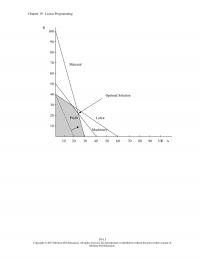
Chapter 19 – Linear Programming Copyright © 2015 McGraw-Hill Education. All rights reserved. No reproduction or distribution without the prior written consent of McGraw-Hill Education. Material 100 90 80 70 60 50 B 19–11 Optimal Solution Labor Machinery Profit 10 […]
978-0078024108 Chapter 19 Part 3
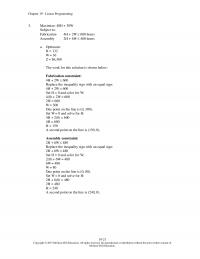
Chapter 19 – Linear Programming 3. Maximize: 40H + 30W Subject to: Fabrication 4H + 2W 600 hours Assembly 2H + 6W 480 hours a. Optimum: H = 132 W = 36 Z = $6,360 The work for […]
978-0078024108 Chapter 19 Part 4
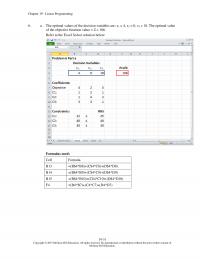
Chapter 19 – Linear Programming 6. a. The optimal values of the decision variables are: x1 = 4, x2 = 0, x3 = 18. The optimal value of the objective function value = Z = 106. Refer to the Excel […]
978-0078024108 Chapter 19 Part 5
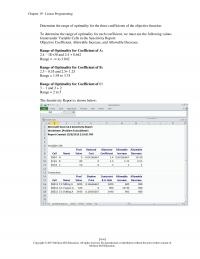
Chapter 19 – Linear Programming 19–41 Determine the range of optimality for the three coefficients of the objective function. To determine the range of optimality for each coefficient, we must use the following values found under Variable Cells in the […]
978-0078024108 Chapter 19 Part 6
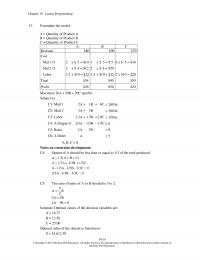
Chapter 19 – Linear Programming 13. Formulate the model: A = Quantity of Product A B = Quantity of Product B C = Quantity of Product C A B C Revenue $80 $90 $70 Cost Mat’l #1 2 x $ […]
978-0078024108 Chapter 19 Part 7
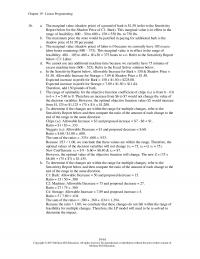
Chapter 19 – Linear Programming 19–61 16. a. The marginal value (shadow price) of a pound of bark is $1.50 (refer to the Sensitivity Report below for the Shadow Price of C1: Bark). This marginal value is in effect in […]
978-0078024108 Chapter 19 Part 8
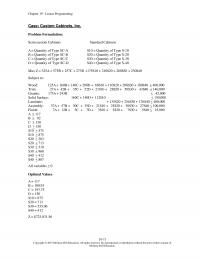
Chapter 19 – Linear Programming 19–71 Case: Custom Cabinets, Inc. Problem Formulation: Semi-custom Cabinets Standard Cabinets A = Quantity of Type SC-A S10 = Quantity of Type S-10 B = Quantity of Type SC-B S20 = Quantity of Type S-20 […]
978-0078024108 Chapter 19 Part 9
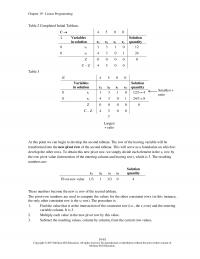
Chapter 19 – Linear Programming 19–81 Table 2 Completed Initial Tableau. C 4 5 0 0 Variables in solution x1 x2 s1 s2 Solution quantity 0 s1 1 3 1 0 12 0 s2 4 3 0 1 […]
978-0078024108 Chapter 2 Part 1
Chapter 02 – Competitiveness, Strategy, and Productivity CHAPTER 02 COMPETITIVENESS, STRATEGY, AND PRODUCTIVITY Teaching Notes The topics covered in this chapter can be used to help get your course in OM off to an interesting start. Most of your students […]
978-0078024108 Chapter 2 Part 2
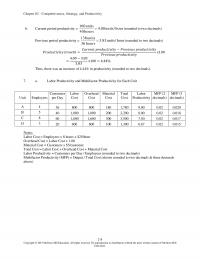
Chapter 02 – Competitiveness, Strategy, and Productivity 2-8 Education. 6. Current period productivity = hourunits hours units / 00.4 40 160 (rounded to two decimals) Previous period productivity = hourunits hours units / 83.3 63 381 (rounded to two […]
978-0078024108 Chapter 3 Part 1
Chapter 03 – Forecasting 3-1 CHAPTER 03 FORECASTING Forecasting is placed early in the text mainly because it is a point of departure. Some instructors like to emphasize the operations part of operations management and de-emphasize the design part. Other […]
978-0078024108 Chapter 3 Part 2
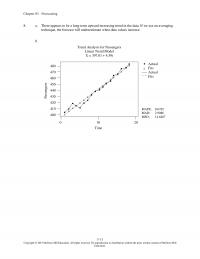
Chapter 03 – Forecasting Copyright © 2015 McGraw-Hill Education. All rights reserved. No reproduction or distribution without the prior written consent of McGraw-Hill 8. a. There appears to be a long-term upward increasing trend in the data. If we use […]
978-0078024108 Chapter 3 Part 3
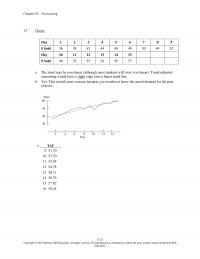
Chapter 03 – Forecasting Copyright © 2015 McGraw-Hill Education. All rights reserved. No reproduction or distribution without the prior written consent of McGraw-Hill 17. Given: Day 1 2 3 4 5 6 7 8 9 # Sold 36 38 42 […]
978-0078024108 Chapter 3 Part 4
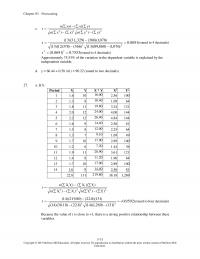
Chapter 03 – Forecasting 3–31 Education. c. 2222 )()()()( ))(()( yynxxn yxxyn r 8691.0 )076,1()860,89)(13()366()078,12)(13( 22 r (round to 4 decimals) 7553.0)8691.0( 22 r (round to 4 decimals) Approximately 75.53% of the variation in […]
978-0078024108 Chapter 3 Part 5
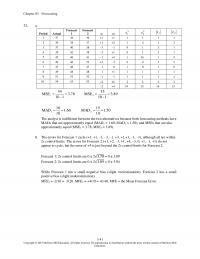
Chapter 03 – Forecasting 3–41 Education. 32. a. Period Actual Forecast 1 Forecast 2 e1 e2 2 1 e 2 2 e 1 e 2 e 1 37 36 36 +1 +1 1 1 1 1 2 39 38 37 […]
978-0078024108 Chapter 3 Part 6
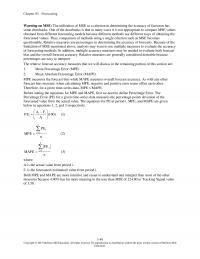
Chapter 03 – Forecasting 3–48 Education. Warning on MSE: The utilization of MSE as a criterion in determining the accuracy of forecasts has some drawbacks. One of the drawbacks is that in many cases it is not appropriate to compare […]
978-0078024108 Chapter 4 Part 1
Chapter 04 – Product and Service Design 4-1 CHAPTER 04 PRODUCT AND SERVICE DESIGN In planning the production system, major decisions are made concerning the design of the product or services as well as the design of the production processes. […]
978-0078024108 Chapter 4 Part 2
Chapter 04 – Product and Service Design 4-7 Education. Solutions 1. Student answers will vary. a. GPS versus maps: GPS offers voice commands—maps do not. GPS is more current than maps are and offers more detailed directions to many more […]
978-0078024108 Chapter 5 Part 1
Chapter 05 – Strategic Capacity Planning for Products and Services 5-1 Education. CHAPTER 05 STRATEGIC CAPACITY PLANNING FOR PRODUCTS AND SERVICES Teaching Notes Capacity is an upper bound on the load that a facility or a plant can serve or […]
978-0078024108 Chapter 5 Part 2
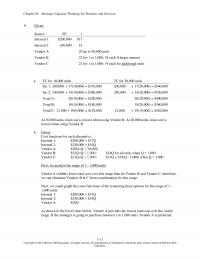
Chapter 05 – Strategic Capacity Planning for Products and Services 5–11 8. Given: Source FC v Internal 1 $200,000 $17 Internal 2 240,000 14 Vendor A 20 up to 30,000 units Vendor B 22 for 1 to 1,000; 18 each […]
978-0078024108 Chapter 5 Part 3
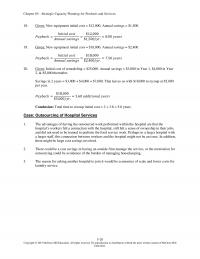
Chapter 05 – Strategic Capacity Planning for Products and Services 5–20 18. Given: New equipment initial cost = $12,000. Annual savings = $1,500. 19. Given: New equipment initial cost = $18,000. Annual savings […]
978-0078024108 Chapter 6 Part 1
Chapter 06 – Process Selection and Facility Layout 6-1 Education. CHAPTER 06 PROCESS SELECTION AND FACILITY LAYOUT Teaching Notes Facility layout involves physical placement of departments and/or arrangement of equipment within a plant or a service facility. A good layout […]
978-0078024108 Chapter 6 Part 2
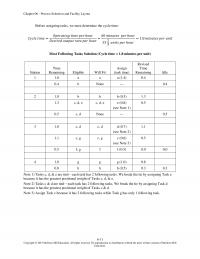
Chapter 06 – Process Selection and Facility Layout 6-11 Education. Before assigning tasks, we must determine the cycle time: Most Following Tasks Solution (Cycle time = 1.8 minutes per unit) […]
978-0078024108 Chapter 6 Part 3
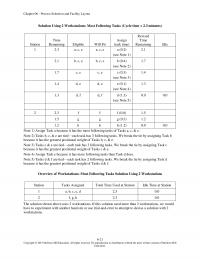
Chapter 06 – Process Selection and Facility Layout 6-21 Education. Solution Using 2 Workstations: Most Following Tasks (Cycle time = 2.3 minutes) Station Time Remaining Eligible Will Fit Assign (task time) Revised Time Remaining Idle 1 2.3 a, c, e […]
978-0078024108 Chapter 6 Part 4
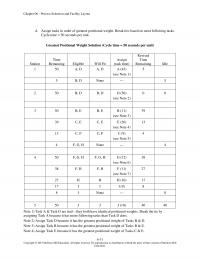
Chapter 06 – Process Selection and Facility Layout 6-31 Education. d. Assign tasks in order of greatest positional weight. Break ties based on most following tasks. Cycle time = 50 seconds per unit. Greatest Positional Weight Solution (Cycle time = […]
978-0078024108 Chapter 6 Part 5
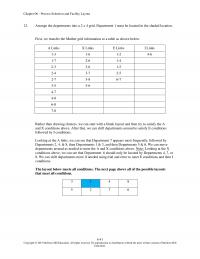
Chapter 06 – Process Selection and Facility Layout 6-41 Education. 12. Arrange the departments into a 2 x 4 grid. Department 1 must be located in the shaded location. First, we transfer the Muther grid information to a table as […]
978-0078024108 Chapter 6 Part 6
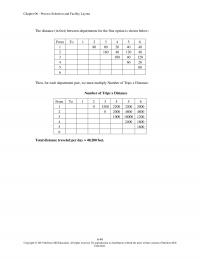
Chapter 06 – Process Selection and Facility Layout 6-49 Education. The distance (in feet) between departments for the first option is shown below: From To 1 2 3 4 5 6 1 80 80 20 40 40 2 160 40 […]
978-0078024108 Chapter 7 Part 1
Chapter 07 – Work Design and Measurement 7-1 Education. CHAPTER 07 WORK DESIGN AND MEASUREMENT Teaching Notes The main topics covered in this chapter are job design and work measurement. You may choose to focus on one and exclude or […]
978-0078024108 Chapter 7 Part 2
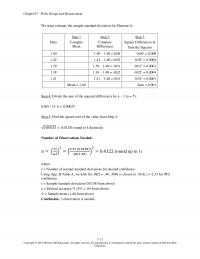
Chapter 07 – Work Design and Measurement We must estimate the sample standard deviation for Element A: Data Step 1 Compute Mean Step 2 Compute Differences Step 3 Square Differences & Sum the Squares 1.40 1.40 – 1.40 = 0.00 […]
978-0078024108 Chapter 7 Part 3
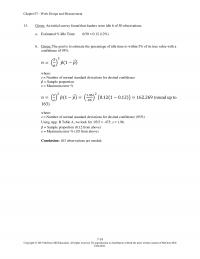
Chapter 07 – Work Design and Measurement 7-19 Education. 13. Given: An initial survey found that loaders were idle 6 of 50 observations. a. Estimated % Idle Time: 6/50 = 0.12 (12%) b. Given: The goal is to estimate the […]
978-0078024108 Chapter 8 Part 1
Chapter 08 – Location Planning and Analysis 8-1 Education. CHAPTER 08 LOCATION PLANNING AND ANALYSIS Teaching Notes Facility location refers to the location of a service or manufacturing facility with respect to customers, suppliers, and other existing facilities such that […]
978-0078024108 Chapter 8 Part 2
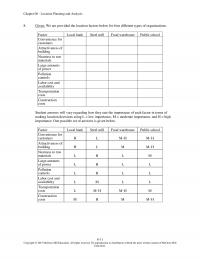
Chapter 08 – Location Planning and Analysis 8-11 Education. 8. Given: We are provided the location factors below for four different types of organizations. Factor Local bank Steel mill Food warehouse Public school Convenience for customers Attractiveness of building Nearness […]
978-0078024108 Chapter 8 Part 3
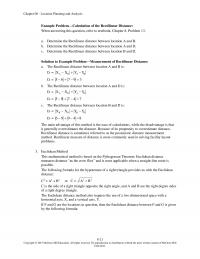
Chapter 08 – Location Planning and Analysis 8-21 Education. Example Problem—Calculation of the Rectilinear Distance: When answering this question, refer to textbook, Chapter 8, Problem 13. a. Determine the Rectilinear distance between location A and B. b. Determine the Rectilinear […]
978-0078024108 Chapter 8 Part 4
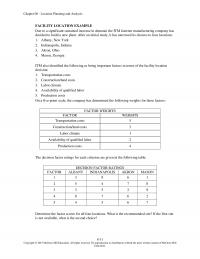
Chapter 08 – Location Planning and Analysis Copyright © 2015 McGraw-Hill Education. All rights reserved. No reproduction or distribution without the prior written consent of McGraw-Hill FACILITY LOCATION EXAMPLE Due to a significant sustained increase in demand, the ITM fastener […]
978-0078024108 Chapter 9 Part 1
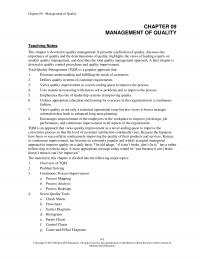
Chapter 09 – Management of Quality CHAPTER 09 MANAGEMENT OF QUALITY Teaching Notes This chapter is devoted to quality management. It presents a definition of quality, discusses the importance of quality and the determinations of quality, highlights the views of […]
978-0078024108 Chapter 9 Part 2
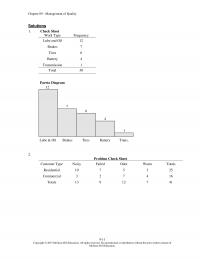
Chapter 09 – Management of Quality 9-11 Solutions 1. Check Sheet Work Type Frequency Lube and Oil 12 Brakes 7 Tires 6 Battery 4 Transmission 1 Total 30 Pareto Diagram 2. Check Sheet Problem Check Sheet Customer Type Noisy Failed […]
978-0078024108 Chapter 9 Part 3
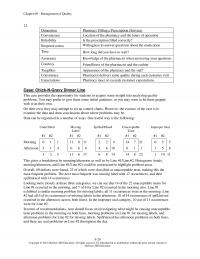
Chapter 09 – Management of Quality 9-20 12. Dimension Pharmacy Filling a Prescription (Service) Convenience Location of the pharmacy and the hours of operation Reliability Is the prescription filled correctly? Responsiveness Willingness to answer questions about the medication Time How […]
978-0078024108 IMChap04S Part 1
Chapter 04S – Reliability 4S-1 CHAPTER 04S RELIABILITY Teaching Notes The main topics of this chapter are: 1. Quantifying Reliability 2. Availability 3. Improving Reliability Reliability is a measure of the ability of a product, part, or system to perform […]
978-0078024108 IMChap04S Part 2
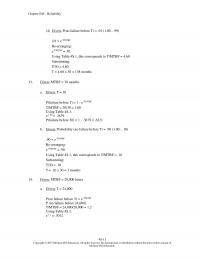
Chapter 04S – Reliability 4S–11 (4) Given: P(no failure before T) = .01 (1.00 – .99) .01 = e–T/MTBF Re-arranging: e–T/MTBF = .01 Using Table 4S.1, this corresponds to T/MTBF = 4.60 Substituting: T/30 = 4.60 T = 4.60 x […]
978-0078024108 IMChap04S Part 3
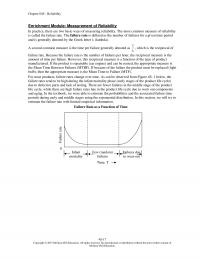
Chapter 04S – Reliability 4S–17 Enrichment Module: Measurement of Reliability In practice, there are two basic ways of measuring reliability. The most common measure of reliability is called the failure rate. The failure rate is defined as the number of […]
978-0078024108 IMChap05S Part 1
Chapter 05S – Decision Theory 5S-1 CHAPTER 05S DECISION THEORY Teaching Notes This chapter supplement lays the foundation for much of the remainder of the text, which is oriented towards problem solving and decision-making. This chapter supplement begins with a […]
978-0078024108 IMChap05S Part 2
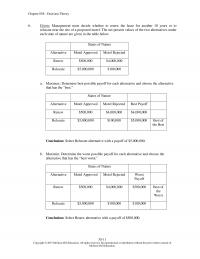
Chapter 05S – Decision Theory 5S–11 6. Given: Management must decide whether to renew the lease for another 10 years or to relocate near the site of a proposed motel. The net present values of the two alternatives under each […]
978-0078024108 IMChap05S Part 3
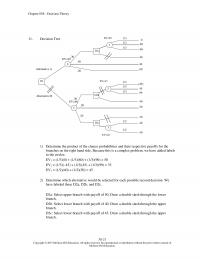
Chapter 05S – Decision Theory 5S–21 11. Decision Tree (45) 99 .30 Alternative A Alternative B D1 .20 60 D2b 2 1/3 1/3 .50 50 5 44 40 1/3 4 45 EV=46 EV=33 1) Determine the product of the chance […]
978-0078024108 IMChap05S Part 4
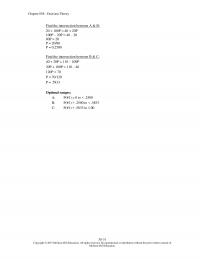
Chapter 05S – Decision Theory 5S–31 Find the intersection between A & B: 20 + 100P = 40 + 20P 100P – 20P = 40 – 20 80P = 20 P = 20/80 P = 0.2500 Find the intersection between […]
978-0078024108 IMChap07S Part 1
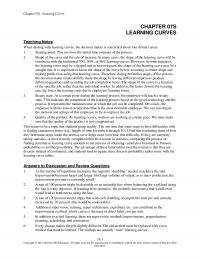
Chapter 07S – Learning Curves CHAPTER 07S LEARNING CURVES Teaching Notes When dealing with learning curves, the decision maker is concerned about four distinct areas: 1. Starting point: This involves the initial time estimate of the process. 2. Shape of […]
978-0078024108 IMChap07S Part 2
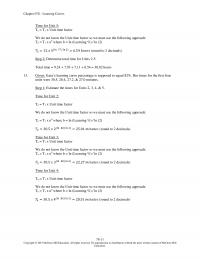
Chapter 07S – Learning Curves 7S–11 Education. Time for Unit 5: Tn = T1 x Unit time factor We do not know the Unit time factor so we must use the following approach: Tn = T1 x nb where b […]
978-0078024108 IMChap08S Part 1
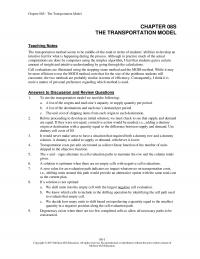
Chapter 08S – The Transportation Model CHAPTER 08S THE TRANSPORTATION MODEL Teaching Notes The transportation method seems to be middle-of-the-road in terms of students’ abilities to develop an intuitive feel for what is happening during the process. Although in practice […]
978-0078024108 IMChap08S Part 10
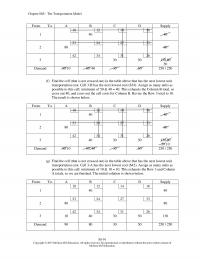
Chapter 08S – The Transportation Model From: To: A B C D Supply 18 12 14 16 1 40 40 23 24 27 33 2 80 80 42 34 31 26 3 30 50 130 80 50 Demand 90 10 […]
978-0078024108 IMChap08S Part 11
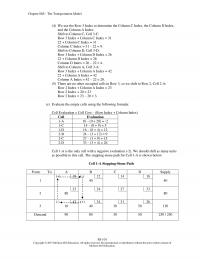
Chapter 08S – The Transportation Model 8S–101 (4) We use the Row 3 Index to determine the Column C Index, the Column D Index, and the Column A Index: Shift to Column C, Cell 3-C: Row 3 Index + Column […]
978-0078024108 IMChap08S Part 12
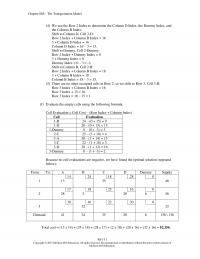
Chapter 08S – The Transportation Model 8S–111 (4) We use the Row 2 Index to determine the Column D Index, the Dummy Index, and the Column B Index: Shift to Column D, Cell 2-D: Row 2 Index + Column D […]
978-0078024108 IMChap08S Part 13
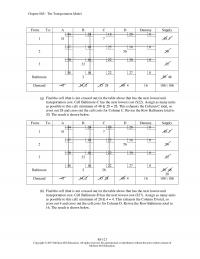
Chapter 08S – The Transportation Model 8S–121 From: To: A B C D Dummy Supply 14 24 18 28 0 1 41 7 48 7 17 18 25 16 0 2 56 56 30 16 22 30 0 3 32 […]
978-0078024108 IMChap08S Part 14
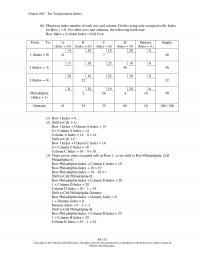
Chapter 08S – The Transportation Model 8S–131 (b) Obtain an index number of each row and column. Do this using only occupied cells. Index for Row 1 = 0. For other rows and columns, the following holds true: Row Index […]
978-0078024108 IMChap08S Part 15
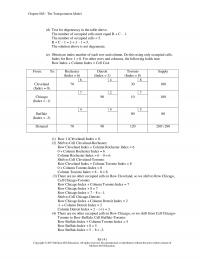
Chapter 08S – The Transportation Model (d) Test for degeneracy in the table above. The number of occupied cells must equal R + C – 1. The number of occupied cells = 5. R + C – 1 = 3 […]
978-0078024108 IMChap08S Part 16
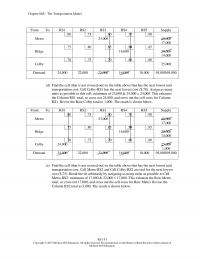
Chapter 08S – The Transportation Model From: To: RS1 RS2 RS3 RS4 RS5 Supply .80 .75 .60 .70 .90 Metro 23,000 40,000 17,000 .75 .80 .85 .70 .85 Ridge 16,000 30,000 14,000 .70 .75 .70 .80 .80 Colby 25,000 Demand […]
978-0078024108 IMChap08S Part 17
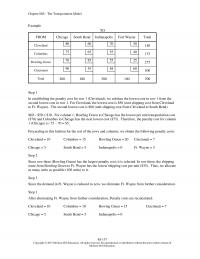
Chapter 08S – The Transportation Model 8S–157 Example TO FROM Chicago South Bend Indianapolis Fort Wayne Total Cleveland 80 60 70 50 150 Columbus 75 65 55 40 175 Bowling Green 70 85 55 35 275 Cincinnati 90 55 48 […]
978-0078024108 IMChap08S Part 2
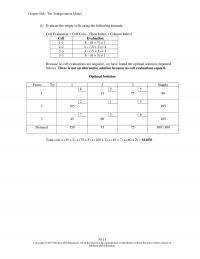
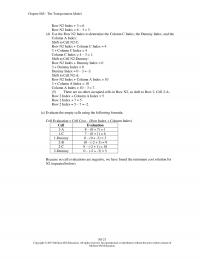
Chapter 08S – The Transportation Model 8S–11 (i) Evaluate the empty cells using the following formula: Cell Evaluation = Cell Cost – (Row Index + Column Index) Cell Evaluation 1-1 8 – (0 + 7) = 1 2-2 1 – […]
978-0078024108 IMChap08S Part 3
Chapter 08S – The Transportation Model 8S–21 Row N2 Index + 3 = 6 Row N2 Index = 6 – 3 = 3. (4) Use the Row N2 Index to determine the Column C Index, the Dummy Index, and the […]
978-0078024108 IMChap08S Part 4
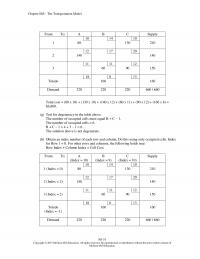
Chapter 08S – The Transportation Model From: To: A B C Supply 10 14 10 1 80 130 210 12 17 20 2 140 140 11 11 12 3 60 90 150 18 8 13 Toledo 160 160 Demand 220 […]
978-0078024108 IMChap08S Part 5
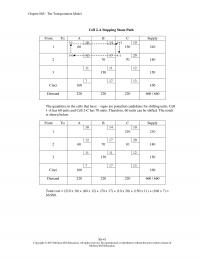
Chapter 08S – The Transportation Model 8S–41 Cell 2-A Stepping Stone Path From: To: A B C Supply (-) 10 14 (+) 10 1 60 150 210 (+) 12 17 (-) 20 2 70 70 140 11 11 12 3 […]
978-0078024108 IMChap08S Part 6
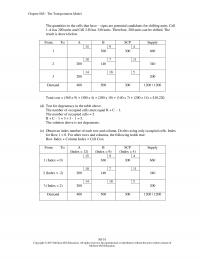
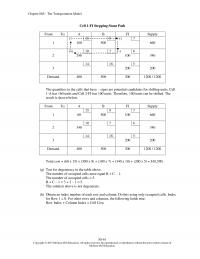
Chapter 08S – The Transportation Model 8S–51 The quantities in the cells that have – signs are potential candidates for shifting units. Cell 1-A has 200 units and Cell 2-B has 340 units. Therefore, 200 units can be shifted. The […]
978-0078024108 IMChap08S Part 7
Chapter 08S – The Transportation Model 8S–61 Cell 1-FI Stepping Stone Path From: To: A B FI Supply (-) 15 9 (+) 7 1 160 500 660 (+) 10 7 (-) 6 2 240 100 340 14 18 5 3 […]
978-0078024108 IMChap08S Part 8
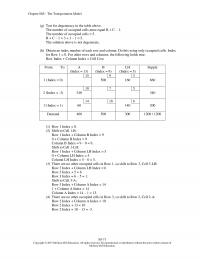
Chapter 08S – The Transportation Model Copyright © 2015 McGraw-Hill Education. All rights reserved. No reproduction or distribution without the prior written consent of McGraw-Hill Education. (g) Test for degeneracy in the table above. The number of occupied cells must […]
978-0078024108 IMChap08S Part 9
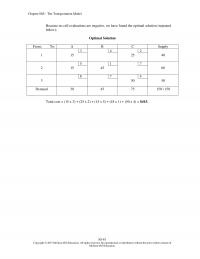
Chapter 08S – The Transportation Model 8S–81 Because no cell evaluations are negative, we have found the optimal solution (repeated below): Optimal Solution From: To: A B C Supply 3 4 2 1 15 25 40 5 1 7 2 […]
978-0078024108 IMChap10S Part 1
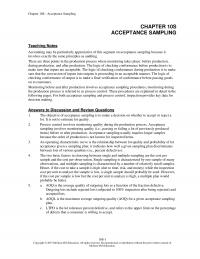
Chapter 10S – Acceptance Sampling 10S-1 CHAPTER 10S ACCEPTANCE SAMPLING Teaching Notes Accounting may be particularly appreciative of this segment on acceptance sampling because it involves exactly the same principles as auditing. There are three points in the production process […]
978-0078024108 IMChap10S Part 2
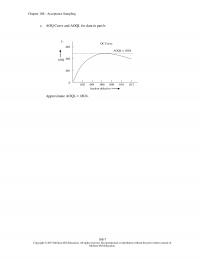
Chapter 10S – Acceptance Sampling Copyright © 2015 McGraw-Hill Education. All rights reserved. No reproduction or distribution without the prior written consent of McGraw-Hill Education. c. AOQ Curve and AOQL for data in part b: Approximate AOQL = .0024. .001 […]
978-0078024108 IMChap14S
Chapter 14S – Maintenance CHAPTER 14S MAINTENANCE Teaching Notes: Maintenance is critical to Lean and TQM implementation. Poor maintenance leads to direct repair expenses and other expenses resulting from lost production. The production line disruptions are particularly important in lean […]
BUS 135 Quiz
1) Seasonal relatives can be used to deseasonalize data or incorporate seasonality in a forecast. 2) Ergonomics is important for preventing common workplace injuries such as back injuries and repetitive-motion injuries. Answer: TRUE Ergonomics is a discipline that focuses on […]
BUS 225 Midterm
1) The normal time in time study is obtained by multiplying the observed time by the performance rating. 2) Government statistics are a good source of data about productivity trends in the service sector. Answer: FALSE The service sector is […]
BUS 284 Quiz 1
1) Global supply chains make purchasing easier because there are more options. 2) Global competition really only applies to multinational organizations. Answer: FALSE Domestic-only organizations experience competition from organizations in other countries. 3) A schedule chart depicts the loading and […]
BUS 287 1 Productivity is defined
1) Productivity is defined as the ratio of input to output. 2) People who work in the field of operations should have skills that include both knowledge and people skills. Answer: TRUE Operations management requires a blend of knowledge and […]
BUS 456 Quiz 2
1) A learning curve for an overqualified worker is higher than that for an average worker. 2) The optimal solutions produced by quantitative techniques should always be evaluated in terms of the larger framework. Answer: TRUE Quantitative techniques have limitations […]
BUS 490 Quiz 3
1) Product liability means that a manufacturer is liable for any injuries or damages caused by a faulty product because of poor workmanship or design. 2) Convenience, reliability, and assurance are dimensions of service quality. Answer: TRUE These are dimensions […]
BUS 530
1) Availability cannot be increased without improving the time between breakdowns. 2) The design of the supply chain and establishing partnerships with vendors and distributors are examples of operational issues in a supply chain. Answer: FALSE These are tactical responsibilities. […]
BUS 531 Midterm
1) Which of the following is not an application of E-business? A.Internet buying and selling B.e-mail C.order and shipment tracking D.electronic data interchange (EDI) E.universal product codes 2) Process design that supports lean does not include: A.production flexibility. B.duplicate facilities. […]
BUS 581 Homework
1) One of the primary output reports of MRP concerns changes to planned orders. 2) If a firm’s product mix is 60 percent of product A and 20 percent each of products B and C, an optimal mix-model production schedule […]
BUS 637 Homework
1) The standard time for a job can be obtained by multiplying the normal time by an appropriate allowance factor. 2) Process layouts feature departments or other functional groupings of personnel or equipment. Answer: TRUE Departmental or functional grouping is […]
BUS 674
1) A c-chart is used to monitor the number of defects per unit for process output. 2) No stopwatch is required in a work sampling study. Answer: TRUE In a work sampling study, observations are made at random points in […]
BUS 679
1) The optimum level of inspection occurs when we catch at least 98.6 percent of the defects. 2) The term failure as applied to reliability means that a part or item does not function at all. Answer: FALSE Failure means […]
BUS 741 Test
1) Technology choices seldom affect: A.costs. B.productivity. C.union activity. D.quality. E.flexibility. 2) Competitiveness doesn’t include: A.productivity. B.effectiveness. C.profitability. D.operations strategy. E.operations management. Answer: C A company can be competitive relative to similar companies and still be unprofitable if the competitive […]
BUS 830 Test
1) In order to determine the probability of timely project completion, it is sometimes necessary to take into account paths other than the critical path. 2) Deterministic networks use three time estimatesshortest, most likely, and longestfor each activity in order […]
BUSOP 132 Midterm 1
1) When operations are often bottlenecked, additional planned idle time will improve the throughput in those areas. 2) Avoiding bottlenecks is the primary goal of product design. Answer: FALSE Avoiding bottlenecks is a primary consideration in facilities layout. 3) Approximately […]
BUSOP 225 Test
1) Constraints limit the alternatives available to a decision maker; removing constraints adds viable alternative solutions. 2) The rate of demand is an important factor in determining the ROP. Answer: TRUE The demand rate multiplied by the lead time is […]
BUSOP 242 Midterm
1) The transportation model assumes shipping cost per unit is the same regardless of the number of units shipped (there are no quantity discounts). 2) In order to update a moving average forecast, the values of each data point in […]
BUSOP 256 Quiz 1
1) Applied research is the major R&D effort of business organizations because of their desire for commercial applications. 2) Environmental scanning is a search for events or trends that present either threats or opportunities to the organization. Answer: TRUE These […]
BUSOP 272 Quiz 3
1) As a general rule, continuous processing systems produce products for inventory rather than for customer order. 2) A benefit of the lean philosophy is the flexibility to respond quickly to changing customer requirements. Answer: TRUE Lean systems can be […]
BUSOP 597 Test
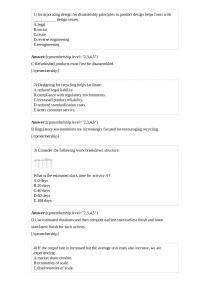
1) Incorporating design for disassembly principles in product design helps firms with ___________ design issues. A.legal B.social C.reuse D.reverse engineering E.reengineering 2) Designing for recycling helps facilitate: A.reduced legal liability. B.compliance with regulatory environments. C.increased product reliability. D.reduced standardization costs. […]
BUSOP 653 Midterm 2
1) Information technology is the key to success of global supply chains. 2) One potential disadvantage of self-directed teams is higher training costs. Answer: FALSE Training costs might be in different areas, but they won’t necessarily be higher. 3) Acceptance […]
BUSOP 716 Test 2
1) A maximization problem may be characterized by all greater than or equal to constraints. 2) The main issue in the design of process layouts concerns the relative positioning of the departments involved. Answer: TRUE Designing process layouts involves the […]
BUSOP 755 Quiz 2
1) Departmental budgeting is an example of aggregate planning. 2) Removing the seasonal component from a data series (deseasonalizing) can be accomplished by dividing each data point by its appropriate seasonal relative. Answer: TRUE Deseasonalized data points have been adjusted […]
BUSOP 774 Midterm 1
1) Creating an effective supply chain requires linking the marketing, distribution, and supplier channels. 2) A run test checks a sequence of observations for randomness. Answer: TRUE Run tests can be used to detect nonrandomness in sequences of observations. 3) […]
BUSOP 805
1) Heuristic rules are used primarily in which of these types of layouts? (I) Product (II) Process (III) Fixed-position A.I B.II C.I and III D.I and II E.II and III 2) Which of the following is a potential shortcoming of […]
BUSOP 821
1) Organizations that are capable of responding quickly to changing requirements can use a shorter forecast horizon and therefore benefit from more accurate forecasts. 2) According to learning curve theory, for certain kinds of tasks the cost per unit decreases […]
BUSOP 822 Quiz
1) Services often don’t fit simple yield measurements. 2) The Baldrige award can only be won by manufacturing organizations. Answer: FALSE It can and has been won by service organizations. 3) The purpose of benchmarking is to establish a standard […]
BUSOPMT 230 Final
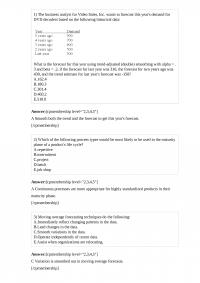
1) The business analyst for Video Sales, Inc. wants to forecast this year’s demand for DVD decoders based on the following historical data: What is the forecast for this year using trend-adjusted (double) smoothing with alpha = . 3 and […]
BUSOPMT 263
1) MRP II did not replace or improve the basic MRP. 2) If a system depends on two subsystems functioning when activated, the reliability of that system is equal to that of the less reliable subsystem. Answer: FALSE The reliability […]
BUSOPMT 406 Quiz 3
1) In a lean environment, anything not essential to the product or process is viewed as waste. 2) The assignment of work to specific machines and people are examples of aggregate planning. Answer: FALSE Assigning work to specific machines or […]
BUSOPMT 467 Test 2
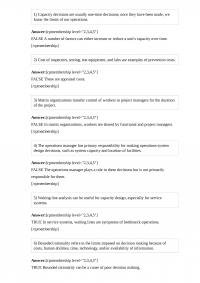
1) Capacity decisions are usually one-time decisions; once they have been made, we know the limits of our operations. 2) Cost of inspectors, testing, test equipment, and labs are examples of prevention costs. Answer: FALSE These are appraisal costs. 3) […]
BUSOPMT 684
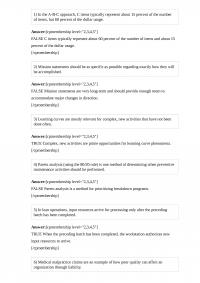
1) In the A-B-C approach, C items typically represent about 15 percent of the number of items, but 60 percent of the dollar usage. 2) Mission statements should be as specific as possible regarding exactly how they will be accomplished. […]
BUSOPMT 716 Quiz 2
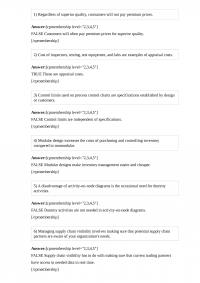
1) Regardless of superior quality, consumers will not pay premium prices. 2) Cost of inspectors, testing, test equipment, and labs are examples of appraisal costs. Answer: TRUE These are appraisal costs. 3) Control limits used on process control charts are […]
BUSOPMT 720 Quiz 3
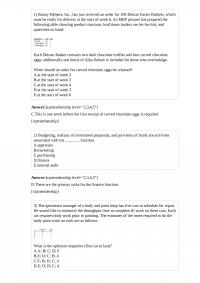
1) Bunny Helpers, Inc., has just received an order for 100 Deluxe Easter Baskets, which must be ready for delivery at the start of week 6. An MRP planner has prepared the following table showing product structure, lead times (orders […]
BUSOPMT 763 Quiz
1) The symbols for operation, storage, transportation, inspection, and delay would usually be found on which type of chart? A.flow process B.Gantt C.simultaneous motion D.worker-machine E.delay analysis 2) The project management strategy of injecting additional resources in order to reduce […]
BUSOPMT 851
1) Many lower-level jobs are monotonous and boring. 2) Utilization is defined as the ratio of effective capacity to design capacity. Answer: FALSE Utilization is the ratio of output to design capacity. 3) An objective function represents a family of […]
BUSOPMT 880
1) If an 80 percent curve is appropriate for a task and the first unit takes 10 hours, the average time for the first two units would be eight hours. 2) Limited WIP lowers inventory carrying costs but reduces flexibility. […]
MGMT 176
1) Service involves a much higher degree of customer contact than manufacturing. 2) The break-even quantity can be determined by dividing the fixed costs by the difference between the revenue per unit and the variable cost per unit. Answer: TRUE […]
MGMT 242 Test 1 1 Which statement
1) Which statement best characterizes a typical search for location alternatives? A.Identify the best location choice. B.Minimize cost consequences. C.Maximize associated profits. D.Locate near markets. E.Identify acceptable locations. 2) A single-channel queuing system has an average service time of 16 […]
MGMT 320 Midterm 2
1) The naive forecast can serve as a quick and easy standard of comparison against which to judge the cost and accuracy of other techniques. 2) The sampling distribution can be assumed to be approximately normal even when the underlying […]
MGMT 333 Final
1) The assignment method is limited to a maximum of two jobs per resource. 2) The single-period model can be very helpful in determining how much to order. Answer: TRUE The single-period model helps determine how many to order. 3) […]
MGMT 386 Midterm 2
1) According to Little’s law, the number of people in line depends on the time of day that they arrive. 2) Project management software eliminates conflicts when there are shared resources. Answer: FALSE Project management software simply points to conflicts, […]
MGMT 435 Midterm
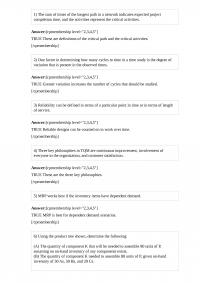
1) The sum of times of the longest path in a network indicates expected project completion time, and the activities represent the critical activities. 2) One factor in determining how many cycles to time in a time study is the […]
MGMT 559 1 Scheduling personnel is
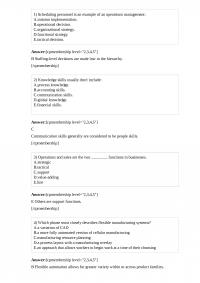
1) Scheduling personnel is an example of an operations management: A.mission implementation. B.operational decision. C.organizational strategy. D.functional strategy. E.tactical decision. 2) Knowledge skills usually don’t include: A.process knowledge. B.accounting skills. C.communication skills. D.global knowledge. E.financial skills. Answer: C Communication skills […]
MGMT 573
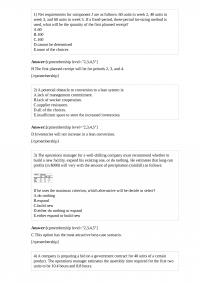
1) Net requirements for component J are as follows: 60 units in week 2, 40 units in week 3, and 60 units in week 5. If a fixed-period, three-period lot-sizing method is used, what will be the quantity of the […]
MGMT 605 1 Kanban is the Japanese
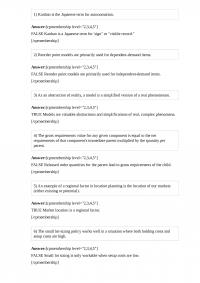
1) Kanban is the Japanese term for autonomation. 2) Reorder point models are primarily used for dependent-demand items. Answer: FALSE Reorder point models are primarily used for independent-demand items. 3) As an abstraction of reality, a model is a simplified […]
MGMT 847 Midterm 1
1) A 30 percent reduction in product and service variety will not affect the efficiency of a supply chain. 2) Ideally, preventive maintenance will be performed before a breakdown or failure. Answer: TRUE This will result in the longest possible […]
MSE 303 Final
1) The single-period model can be very helpful in determining when to order. 2) A single-period model would be used mainly by organizations going out of business. Answer: FALSE The single-period model applies to many regularly occurring circumstances. 3) The […]
MSE 462 Final
1) The goal of queuing analysis is to balance the cost of providing a level of service capacity with the possible loss of business due to customers leaving the line or refusing to wait. 2) Productivity is directly related to […]
MSE 719
1) Which of the following mechanisms for enhancing profitability is most likely to result from improving short-term forecast performance? A.increased inventory B.reduced flexibility C.higher-quality products D.greater customer satisfaction E.greater seasonality 2) Which item would be least likely to be ordered […]
OIM 106 Test 1
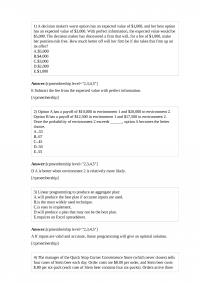
1) A decision maker’s worst option has an expected value of $1,000, and her best option has an expected value of $3,000. With perfect information, the expected value would be $5,000. The decision maker has discovered a firm that will, […]
OIM 129 Final
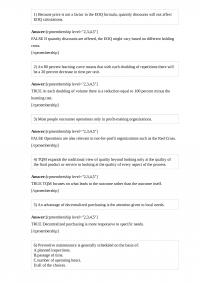
1) Because price is not a factor in the EOQ formula, quantity discounts will not affect EOQ calculations. 2) An 80 percent learning curve means that with each doubling of repetitions there will be a 20 percent decrease in time […]
OIM 178
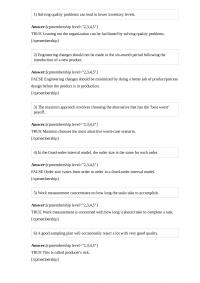
1) Solving quality problems can lead to lower inventory levels. 2) Engineering changes should not be made in the six-month period following the introduction of a new product. Answer: FALSE Engineering changes should be minimized by doing a better job […]
OIM 371 Midterm 2
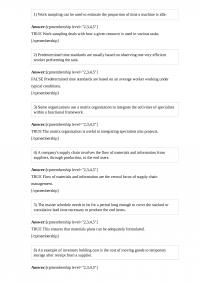
1) Work sampling can be used to estimate the proportion of time a machine is idle. 2) Predetermined time standards are usually based on observing one very efficient worker performing the task. Answer: FALSE Predetermined time standards are based on […]
OIM 486
1) The PDSA cycle forms the conceptual basis for continuous improvement. 2) To save money, it is essential that designers revise the production capabilities to meet the requirements of the new products. Answer: FALSE Saving money requires designers to ensure […]
OIM 536 Quiz 1
1) The primary purpose of statistical process control is to detect a defective product before it is shipped to a customer. 2) Repetitive processing systems usually produce goods specifically for customer orders rather than for inventory. Answer: FALSE Repetitive processing […]
OIM 599 Quiz 3
1) Modern quality management emphasizes finding and correcting mistakes before they reach the customercatching the errors before they are shipped. 2) Quality of conformance refers to the degree to which goods and services conform to the intent of the designers […]
OIM 633
1) Organizational strategy should be determined without considering the realities of functional area strengths and weaknesses since they can be changed to meet our strategy. 2) Line balancing is a major factor in the design and scheduling of low-volume systems […]
OIM 649 Midterm 2
1) The lean philosophy recognizes that some work-in-process inventories are a necessary investment to allow for smooth work flow. 2) The maximax approach is a pessimistic strategy. Answer: FALSE Maximax is optimistic. 3) The probability that the project will go […]
OIM 660 Homework 1 In linear
1) In linear programming, sensitivity analysis is associated with: (I) the objective function coefficient. (II) right-hand-side values of constraints. (III) the constraint coefficient. A.I and II only B.II and III only C.I, II, and III D.I and III only E.I […]
OIM 688 Quiz 2
1) Lot-for-lot ordering in MRP provides coverage for some predetermined number of periods (such as two or three) that extend beyond the orders already received for those periods. 2) The service function of purchasing interfaces with many areas, including legal, […]
OIM 722 Midterm 2
1) Traffic management refers to truck movement within our parking areas. 2) Kanban focuses on specific part numbers; CONWIP does not. Answer: TRUE This makes CONWIP more suitable for a mixed-product environment. 3) Strategic partnering is encouraged when two or […]
Operation Management 165 Quiz 2
1) Statistical process control is the measurement of rejects in the final product. 2) Forecasts based on time-series (historical) data are referred to as associative forecasts. Answer: FALSE Forecasts based on time-series data are referred to as time-series forecasts. 3) […]
Operation Management 483
1) The first step in developing location alternatives is identifying important factors. 2) Predetermined time standards use historical data from a company’s own files. Answer: FALSE Predetermined time standards involve the use of published data on standard elemental times. 3) […]
Operation Management 566
1) When the task is fairly complex and has a longer duration, it will take a larger number of repetitions before improvement is observed. 2) When orders exceed our capacity, priority rules are used to select which orders will be […]
Operation Management 569 Midterm 1
1) A shadow price indicates how much a one-unit decrease/increase in the right-hand-side value of a constraint will decrease/increase the optimal value of the objective function. 2) Flow-shop scheduling is used in high-volume systems. Answer: TRUE Flows shops are high-volume […]
Operation Management 600 Test 1
1) Methods analysis cannot be done for new jobs (ones that do not yet exist) since it requires observation of the process. 2) The overall objective of inventory management is to achieve satisfactory levels of customer service while keeping inventory […]
Operation Management 699
1) Ergonomics is the use of computers and robots in the workplace. 2) The learning curve is a basic tool for mass production-type activities because it can deal with large volumes of output. Answer: FALSE In mass production, learning curves […]
Operation Management 749 Quiz 1
1) Preventive maintenance is additional maintenance done immediately after a breakdown has occurred to help prevent any further breakdowns. 2) The elimination of idle time on both bottleneck and non-bottleneck operations must be accomplished to optimize output. Answer: FALSE Eliminating […]
Operation Management 878 Homework
1) One of the main advantages of standardization is that it increases the potential variety of products. 2) Scheduling and maintaining equipment are operational decisions. Answer: TRUE Maintenance would be a form of corrective or preventive action to ensure the […]
OPMGT 296 Quiz 2
1) If a pattern appears when a dependent variable is plotted against time, one should use time series analysis instead of regression analysis. 2) Organizations facing seasonal changes in demand are prevented from using aggregate planning techniques. Answer: FALSE Aggregate […]
OPMGT 344
1) The goal of waiting-line management is to eliminate customer waiting lines. 2) The term “computer-aided manufacturing” refers primarily to the use of robotics in process control. Answer: FALSE CAM involves using computer technology to control various facets of the […]
OPMGT 373
1) A consumer survey is an easy and sure way to obtain accurate input from future customers since most people enjoy participating in surveys. 2) One concern in the design of production systems is the degree of standardization. Answer: TRUE […]
OPMGT 630 Quiz 3
1) Scheduled due dates are the result of: A.promises to customers. B.MRP processing. C.managerial decisions. D.all of the choices. E.our competitor’s promises. 2) The owner of Tastee Cookies needs to decide whether to lease a small, medium, or large new […]
OPMGT 635 Quiz 2
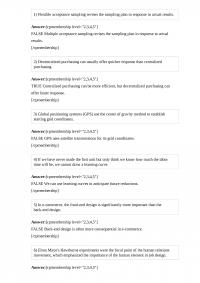
1) Flexible acceptance sampling revises the sampling plan in response to actual results. 2) Decentralized purchasing can usually offer quicker response than centralized purchasing. Answer: TRUE Centralized purchasing can be more efficient, but decentralized purchasing can offer faster response. 3) […]
OPMGT 722 Quiz 2
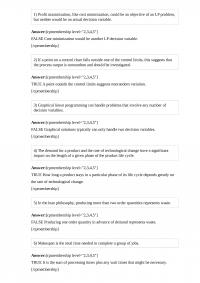
1) Profit maximization, like cost minimization, could be an objective of an LP problem, but neither would be an actual decision variable. 2) If a point on a control chart falls outside one of the control limits, this suggests that […]
OPMGT 859 Quiz
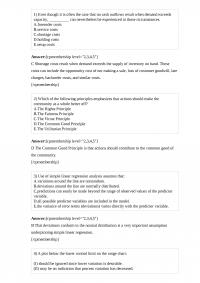
1) Even though it is often the case that no cash outflows result when demand exceeds capacity, __________ can nevertheless be experienced in those circumstances. A.foreorder costs B.service costs C.shortage costs D.holding costs E.setup costs 2) Which of the following […]
OPMT 214 Test 2
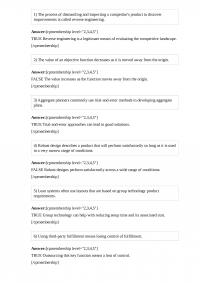
1) The process of dismantling and inspecting a competitor’s product to discover improvements is called reverse engineering. 2) The value of an objective function decreases as it is moved away from the origin. Answer: FALSE The value increases as the […]
OPMT 230
1) A c-chart is used to monitor the total number of defectives in the output of a process. 2) A worker-machine chart can be used to determine how many machines an operator can manage. Answer: TRUE Worker-machine charts highlight when […]
OPMT 360
1) In the area of product and service design, the acronym CAD refers to: A.conceptually appropriate design. B.computer-aided design. C.commercial applications design. D.competitive advantage design. E.completely automated design. 2) A manager is quite concerned about the recent deterioration of a […]
OPMT 361 Midterm 1
1) ISO 9000 currently requires _____ of a certified organization. A.quarterly reporting B.product diversity C.annual audits D.a minimum of four supervisory levels E.continuous improvement 2) It took exactly 10 hours to perform the first kidney transplant on a 100 percent […]
OPMT 578
1) The maximin approach involves choosing the alternative with the highest payoff. 2) Net requirements equal gross requirements minus safety stock. Answer: FALSE If safety stock is required, net requirements will be higher. 3) A dental office with two professionals […]
OPMT 598 Test
1) Trend-adjusted exponential smoothing requires selection of two smoothing constants. 2) Flexible manufacturing systems bring the benefits of automation to continuous processes. Answer: FALSE FMS can bring the benefits of flexibility to continuous processes. 3) An advantage of a “chase” […]
OPMT 631
1) Most likely time generally is more than optimistic time. 2) Sampling plans are designed considering both the cost and time required for the inspection. Answer: TRUE These factors must be weighed in formulating the sampling plan. 3) When considering […]
OPMT 820 Final
1) Activities not on the critical path have a slack time equal to zero. 2) An inventory buffer adds value and lowers cost in all supply chains. Answer: FALSE Many buffers increase costs across supply chains. 3) The fixed-order-interval model […]
QSO 143
1) The theory of constraints has a goal of maximizing flow through the entire system. 2) A regenerative MRP system is one that is updated continuously, every time there is a schedule change. Answer: FALSE Regenerative systems are updated periodically. […]
QSO 216 Quiz 3
1) Forecasts of future demand are used by operations people to plan capacity. 2) A control chart is a visual representation of the various states in a process. Answer: FALSE A control chart is a visual representation of the output […]
QSO 265 Homework
1) A job with a 70 percent learning curve required 20 hours for the initial unit. The fourth unit should require approximately how many hours? A.6 B.9.8 C.14 D.20 E.34 2) Which of the following is not true of vendor […]
QSO 303 Midterm
1) Using third-party logistics involves using your organization’s logistics function to ship to customers that are not officially part of the supply chain. 2) Standardization refers to the extent to which there is absence of variety in a product, service, […]
QSO 374
1) When the item is offered for resale, shortage costs in the single-period model can include a charge for loss of customer goodwill. 2) “Balance delay” is another name for the percentage of idle time in a process layout. Answer: […]
QSO 381 Quiz 1
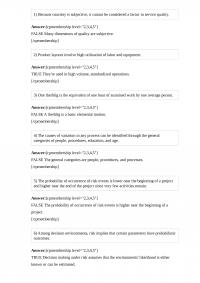
1) Because courtesy is subjective, it cannot be considered a factor in service quality. 2) Product layouts involve high utilization of labor and equipment. Answer: TRUE They’re used in high volume, standardized operations. 3) One therblig is the equivalent of […]
QSO 474 Midterm
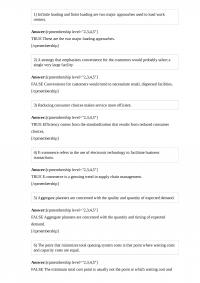
1) Infinite loading and finite loading are two major approaches used to load work centers. 2) A strategy that emphasizes convenience for the customers would probably select a single very large facility. Answer: FALSE Convenience for customers would tend to […]
QSO 649 Midterm
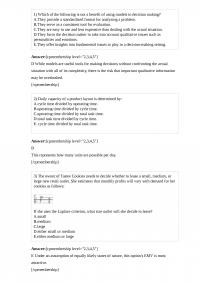
1) Which of the following is not a benefit of using models in decision making? A.They provide a standardized format for analyzing a problem. B.They serve as a consistent tool for evaluation. C.They are easy to use and less expensive […]
QSO 672 Quiz 1
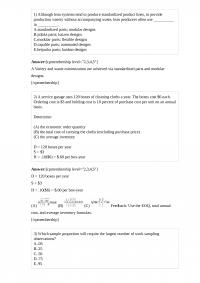
1) Although lean systems tend to produce standardized product lines, to provide production variety without accompanying waste, lean producers often use __________ in __________. A.standardized parts; modular designs B.jidoka parts; kaizen designs C.modular parts; flexible designs D.capable parts; automated designs […]
QSO 740 Homework
1) For service and retail stores, a prime factor in location analysis is customer access. 2) Studies on worker efficiency and time of day suggest that the greatest efficiency is at the end of the day when workers are “warmed […]
QSO 861 Quiz 1
1) In the single-period model, the service level is the probability that demand will not exceed the stocking level in any period. 2) Applied research has the objective of achieving commercial applications for new ideas. Answer: TRUE Applied research is […]