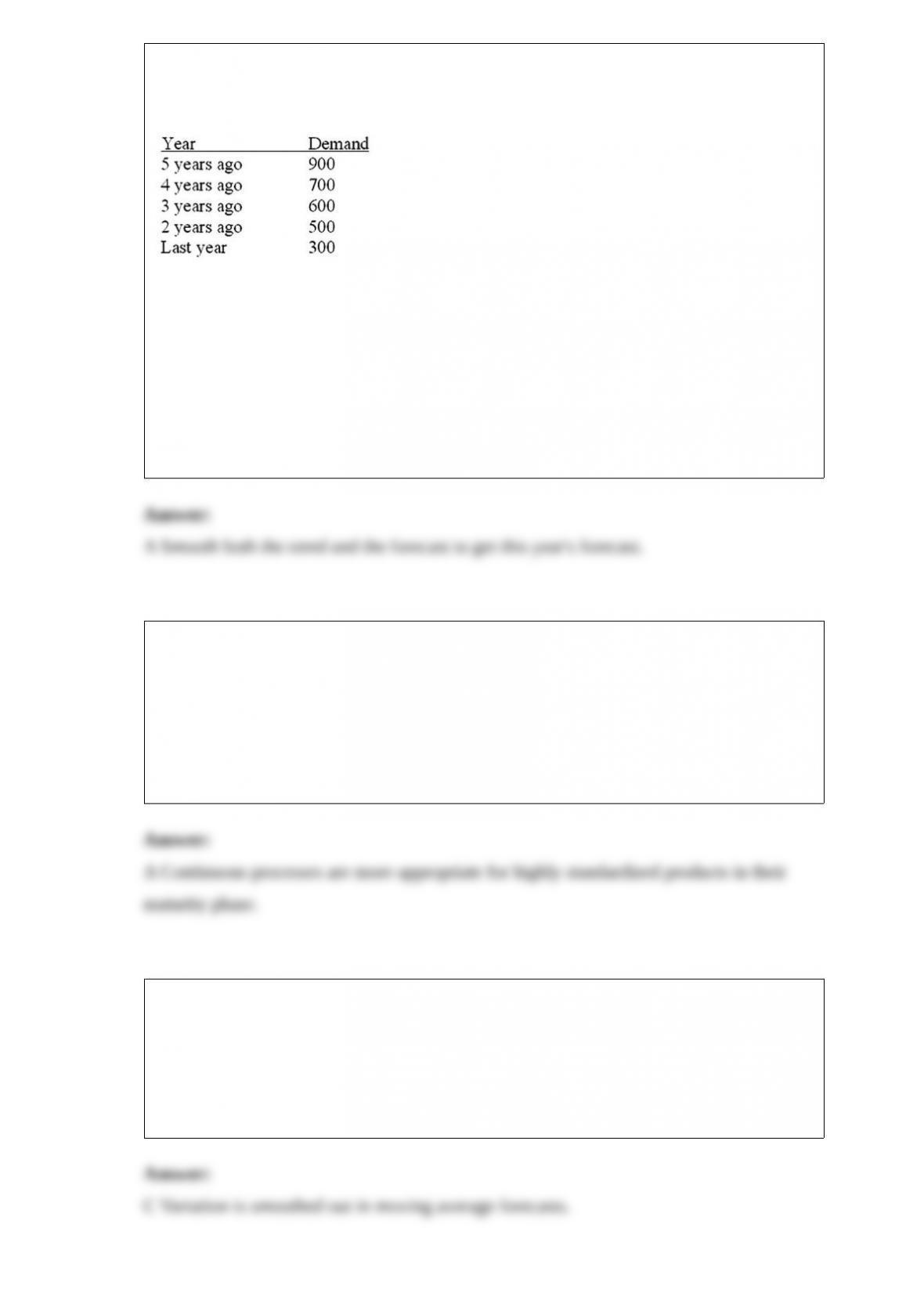
1) The business analyst for Video Sales, Inc. wants to forecast this year’s demand for
DVD decoders based on the following historical data:
What is the forecast for this year using trend-adjusted (double) smoothing with alpha = .
3 and beta = .2, if the forecast for last year was 310, the forecast for two years ago was
430, and the trend estimate for last year’s forecast was -150?
A.162.4
B.180.3
C.301.4
D.403.2
E.510.0
2) Which of the following process types would be most likely to be used in the maturity
phase of a product’s life cycle?
A.repetitive
B.intermittent
C.project
D.batch
E.job shop
3) Moving average forecasting techniques do the following:
A.Immediately reflect changing patterns in the data.
B.Lead changes in the data.
C.Smooth variations in the data.
D.Operate independently of recent data.
E.Assist when organizations are relocating.
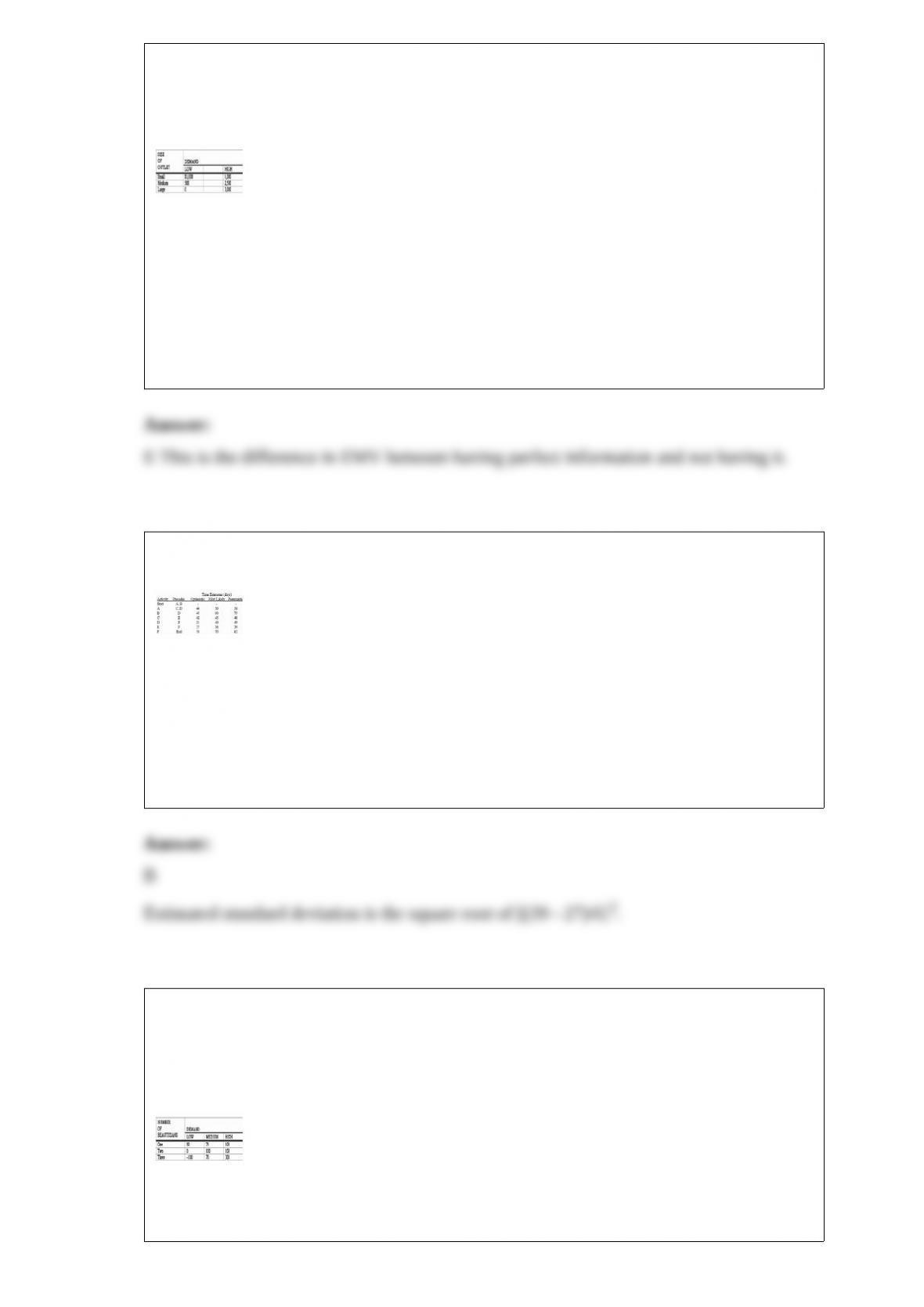
4) The owner of Tastee Cookies needs to decide whether to lease a small, medium, or
large new retail outlet. She estimates that monthly profits will vary with demand for her
cookies as follows:
If she feels there is a 30 percent chance that demand will be high, what is her expected
value of perfect information?
A.$1,600
B.$1,100
C.$1,000
D.$900
E.$500
5) Consider the following work breakdown structure:
What is the estimated standard deviation in the time for activity E?
A.1 days
B.2 days
C.3 days
D.4 days
E.5 days
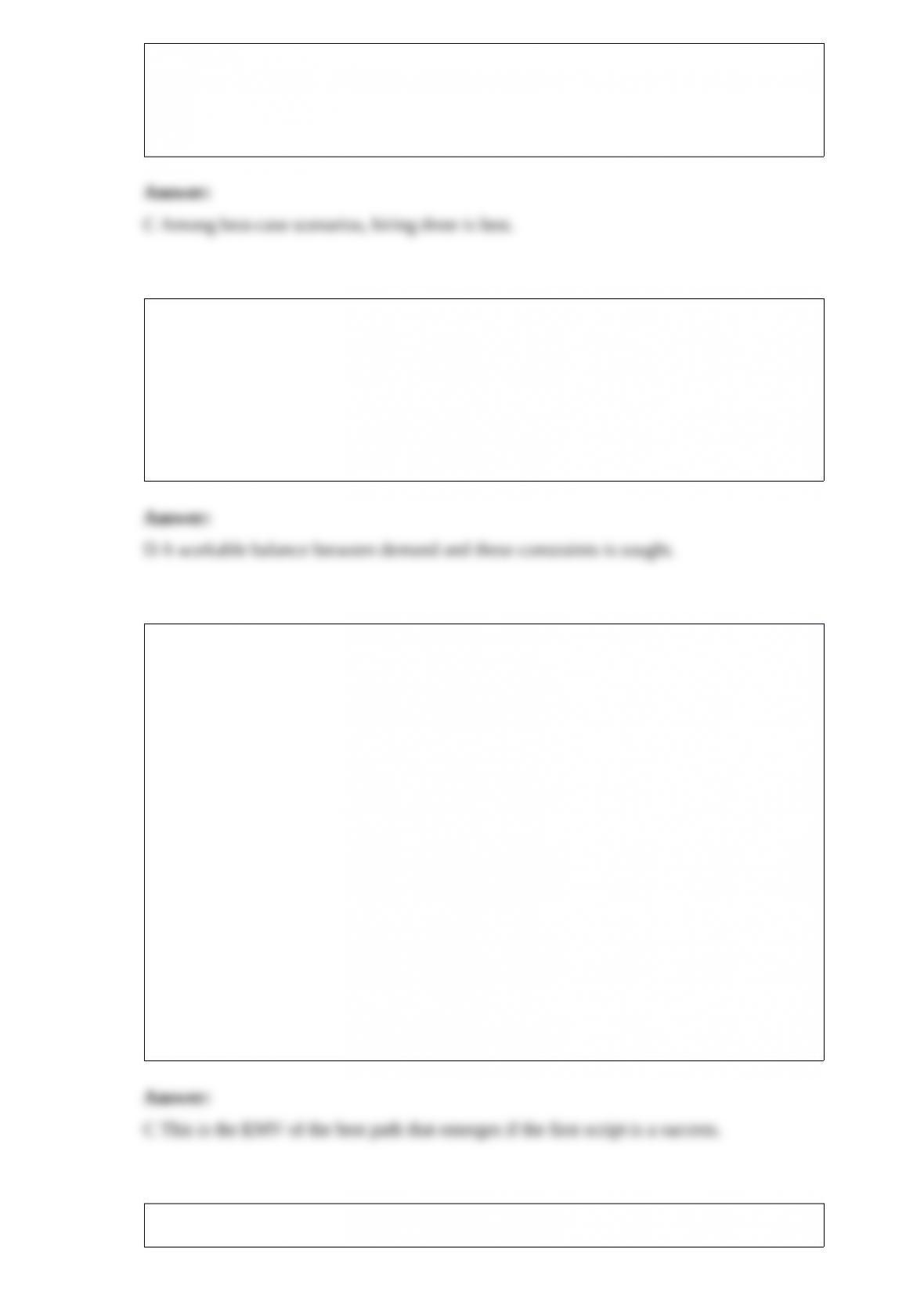
6) The new owner of a beauty shop is trying to decide whether to hire one, two, or three
beauticians. She estimates that profits next year (in thousands of dollars) will vary with
demand for her services, and she has estimated demand in three categories, low,
medium, and high.
If she uses the maximax criterion, how many beauticians will she decide to hire?
A.one
B.two
C.three
D.either one or two
E.either two or three
7) Which of the following best describes aggregate planning?
A.the link between intermediate-term planning and short-term operating decisions
B.a collection of objective planning tools
C.make-or-buy decisions
D.an attempt to respond to predicted demand within the constraints set by product,
process, and location decisions
E.manpower planning
8) The head of operations for a movie studio wants to determine which of two new
scripts they should select for their next major production. (Due to budgeting constraints,
only one new picture can be undertaken at this time.) She feels that script 1 has a 70
percent chance of earning about $10,000,000 over the long run, but a 30 percent chance
of losing $2,000,000. If this movie is successful, then a sequel could also be produced,
with an 80 percent chance of earning $5,000,000, but a 20 percent chance of losing
$1,000,000. On the other hand, she feels that script 2 has a 60 percent chance of earning
$12,000,000, but a 40 percent chance of losing $3,000,000. If successful, its sequel
would have a 50 percent chance of earning $8,000,000, but a 50 percent chance of
losing $4,000,000. Of course, in either case, if the original movie were a flop, then no
sequel would be produced.
What would be the total payoff if script 1 were a success, but its sequel were not?
A.$15,000,000
B.$10,000,000
C.$9,000,000
D.$5,000,000
E.$-1,000,000
9) Which of the following most closely describes dependent demand?
A.demand generated by suppliers
B.estimates of demand using regression analysis of independent variables
C.derived demand
D.demands placed on suppliers by their customers
E.net material requirements
10) The two types of decisions that are relevant to supply chain management are:
A.short- and long-term.
B.domestic and international.
C.location and layout.
D.in-sourcing and outsourcing.
E.tactical and operational.
11) An operations strategy for inventory management should work toward:
A.increasing lot sizes.
B.decreasing lot sizes.
C.increasing safety stocks.
D.decreasing service levels.
E.increasing order quantities.
12) Determining the average payoff for each alternative and choosing the alternative
with the highest average is the approach called:
A.minimin.
B.maximin.
C.maximax.
D.minimax regret.
E.Laplace.
13) Which of the following is not true about the systems approach?
A.A systems viewpoint is almost always beneficial in decision making.
B.A systems approach emphasizes interrelationships among subsystems.
C.A systems approach concentrates on efficiency within subsystems.
D.A systems approach is essential whenever something is being redesigned or
improved.
E.All of the choices are true.
14) A hierarchical listing of what must be done in a project is called a:
A.work breakdown structure (WBS).
B.PERT.
C.planning matrix.
D.crashing plan.
E.critical path.
15) Deciding how much to invest in the prevention of defects can be analyzed using:
A.EVPI.
B.net present value.
C.weighted factor analysis.
D.return on quality.
E.break-even analysis.
16) Quality planning and administration, quality training, and quality control
procedures are examples of:
A.internal failure costs.
B.external failure costs.
C.appraisal costs.
D.prevention costs.
E.replacement costs.