1) In the area of product and service design, the acronym CAD refers to:
A.conceptually appropriate design.
B.computer-aided design.
C.commercial applications design.
D.competitive advantage design.
E.completely automated design.
2) A manager is quite concerned about the recent deterioration of a section of the roof
on a building that houses her firm’s computer operations. According to her assistant
there are three options which merit consideration: A, B, and C. Moreover, there are
three possible future conditions that must be included in the analysis: I, which has a
probability of occurrence of .5; II, which has a probability of .3; and III, which has a
probability of .2.
If condition I materializes, A will cost $12,000, B will cost $20,000, and C will cost
$16,000. If condition II materializes, the costs will be $15,000 for A, $18,000 for B, and
$14,000 for C. If condition III materializes, the costs will be $10,000 for A, $15,000 for
B, and $19,000 for C.
(A) Draw a decision tree for this problem.
(B) Using expected monetary value, which alternative should be chosen?
3) A disadvantage of teams is:
A.higher quality.
B.higher productivity.
C.greater worker satisfaction.
D.team member conflict.
E.lower turnover.
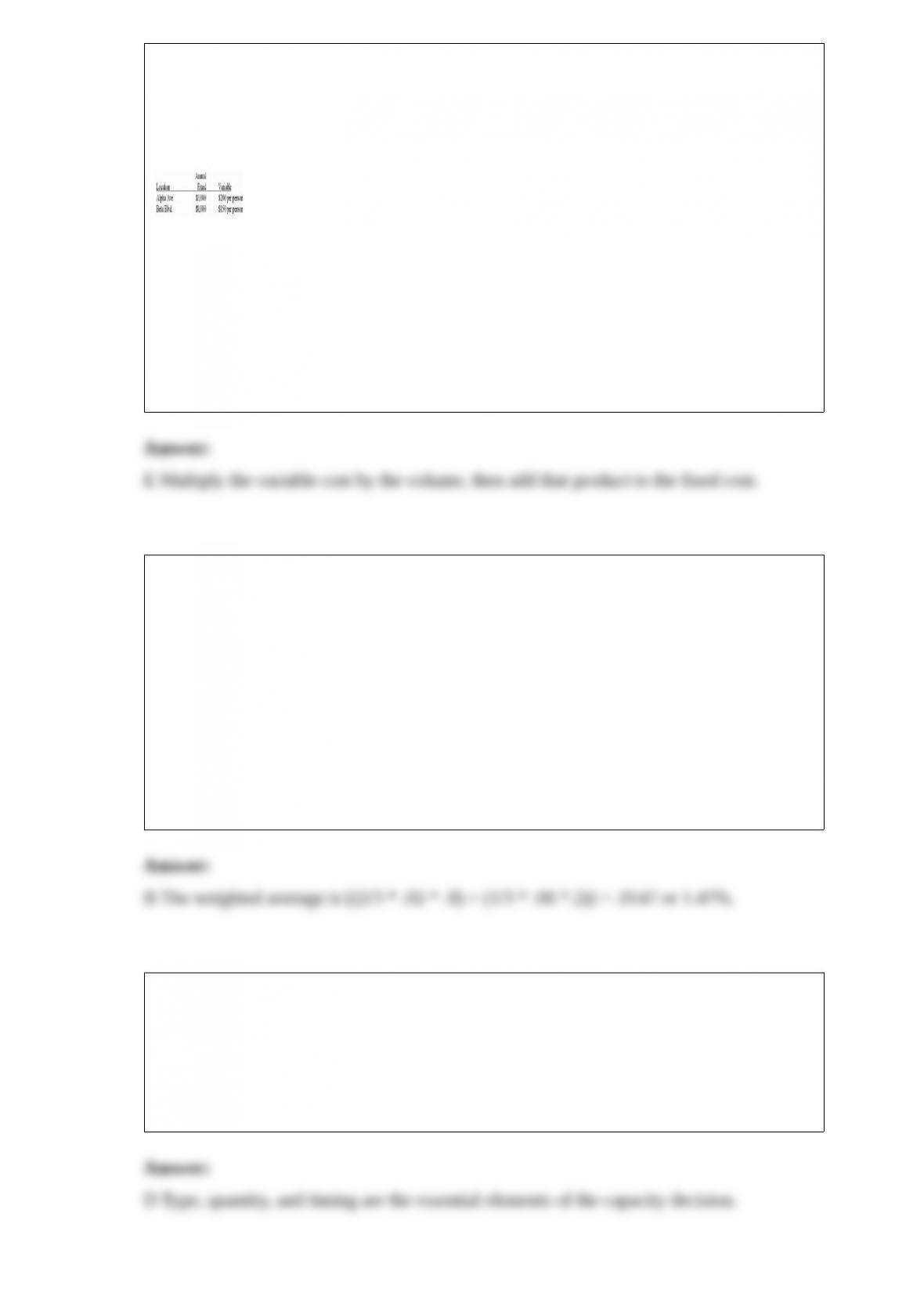
4) The Skulls, a student social organization, has two different locations under
consideration for constructing a new chapter house. The Skulls’ president, a POM
student, estimates that due to differing land costs, utility rates, etc., both fixed and
variable costs would be different for each of the proposed sites, as follows:
What would be the total annual costs for the Alpha Ave. location with 20 persons living
there?
A.$5,400
B.$4,000
C.$5,000
D.$7,000
E.$9,000
5) Suppose that only two incoming fraction defective levels, 2 percent and 6 percent,
are possible. The 2 percent incoming fraction defective level is twice as likely as the 6
percent. At a 2 percent incoming fraction defective, there’s an 80 percent chance that a
lot will be accepted. At 6 percent incoming fraction defective, there’s a 20 percent
chance that a lot will be accepted. Lots that are not accepted are subject to 100 percent
sorting. What is average outgoing quality (approximately)?
A.1.60 percent
B.1.47 percent
C.1.20 percent
D..73 percent
E..80 percent
6) Which of the following is not a basic question in capacity planning?
A.what kind is needed
B.how much is needed
C.when is it needed
D.who will pay for it
E.what it will be used for
7) As the ratio of arrival rate to service rate is increased, which of the following is
likely?
A.Customers move through the system in less time because utilization is increased.
B.Customers move through the system more slowly because utilization is increased.
C.Utilization is decreased because of the added strain on the system.
D.The average number in the system decreases.
E.There really is no change since arrival rates are offset by service rates.
8) In an assignment model where there are fewer jobs than resources:
A.dummy jobs are needed to solve the problem.
B.dummy resources are needed to solve the problem.
C.the problem cannot be solved using an assignment model.
D.the problem will have multiple optimum solutions.
E.the simplex method must be used to solve the problem.
9) A company needs to locate three departments (X, Y, and Z) in the three areas (I, II,
and III) of a new facility. They want to minimize interdepartmental transportation costs,
which are expected to be $.50 per load meter moved. An analyst has prepared the
following flow and distance matrices:
What are total weekly costs for an optimum layout?
A.$2,600
B.$3,600
C.$6,200
D.$7,200
E.$8,200
10) ISO certification differs substantially from the Baldrige Award in that it:
A.focuses primarily on quality teams.
B.emphasizes self-appraisal.
C.is an ongoing process.
D.is customer-driven.
E.is national rather than international.
11) Which of the following is not a potential benefit of the use of self-directed teams?
A.higher quality
B.higher productivity
C.greater worker satisfaction
D.greater satisfaction for middle managers
E.lower turnover
12) A manager must decide on the mix of products to produce for the coming week.
Product A requires three minutes per unit for molding, two minutes per unit for
painting, and one minute per unit for packing. Product B requires two minutes per unit
for molding, four minutes per unit for painting, and three minutes per unit for packing.
There will be 600 minutes available for molding, 600 minutes for painting, and 420
minutes for packing. Both products have profits of $1.50 per unit.
(A) What combination of A and B will maximize profit?
(B) What is the maximum possible profit?
(C) How much of each resource will be unused for your solution?
13) Scheduled receipts differ from planned receipts in that scheduled receipts:
A.have longer lead times.
B.involve orders that have not yet been placed.
C.have not been pegged with actual customer orders.
D.involve orders that have already been placed.
E.involve exceptions to order quantity policies.