Chapter 04S – Reliability
4S–11
(4) Given: P(no failure before T) = .01 (1.00 – .99)
.01 = e–T/MTBF
13. Given: MTBF = 30 months
a. Given: T = 30
P(failure before T) = 1 – e–T/MTBF
b. Given: Probability (no failure before T) = .90 (1.00 – .10)
.90 = e–T/MTBF
Re-arranging:
e–T/MTBF = .90
14. Given: MTBF = 20,000 hours
a. Given: T = 24,000
P(no failure before T) = e–T/MTBF
P (no failure before 24,000):
Chapter 04S – Reliability
4S–12
b. Given: T = 4,000
P(failure before 4,000):
c. P(4,000 < failure < 24,000)
P(failure before 24,000) = 1 – .3012 = .6988
15. a. Given: T = 9
P(no failure before T) = e–T/MTBF
P (no failure before 9):
T/MTBF = 9/6 = 1.5
Using Table 4S.1:
e-1.5 = .2231
b. Given: T = 12
P(failure before T) = 1 – e–T/MTBF
c. Given: P(9 < failure < 12)
P(failure before 12) = .8647 (from above)
4S–13
d. Given: T = 21
P(no failure before T) = e–T/MTBF
P (no failure before 21:
16. Given: = 41 mo. & = 4 mo.
a. P(T
.75.
4
4138
z:)38
Probability = .2266 (From App. B Table B)
b. P(40 < T < 45):
P(40 < T < 41) = .0987 (From App. B Table A)
41

Chapter 04S – Reliability
4S–14
c. Given:
P(39 < T < 43):
P (39 < T < 41) = .1915 (From App. B Table A)
a.
17. Given: = 6 years & = .5 years
a. (1) P(T > 5) = 1 – P(T < 5)
65
38
41
.2266
41
.3413
40
45
.0987
b.
41
39
43
.1915
c.
.1915
0
.5000
Chapter 04S – Reliability
(3) >
00.3
5.
65.7
z:yr .57
18. a. 2%: Find 2% (.02) in App. B Table B:
z = –2.05 (probability closest to .02 is .0202)
+ z = 6 – 2.05(.5) = 4.98 yr.
b. 5%: Find 5% (.05) in App. B Table B:
Note: .05 falls exactly midway between .0495 (z = 1.64) and .0505 (z = 1.65)
19.
a.
02
20.
21.
–4
6
4.98
yr–scale
6
5.18
yr–scale
0
Chapter 04S – Reliability
4S–16
22.
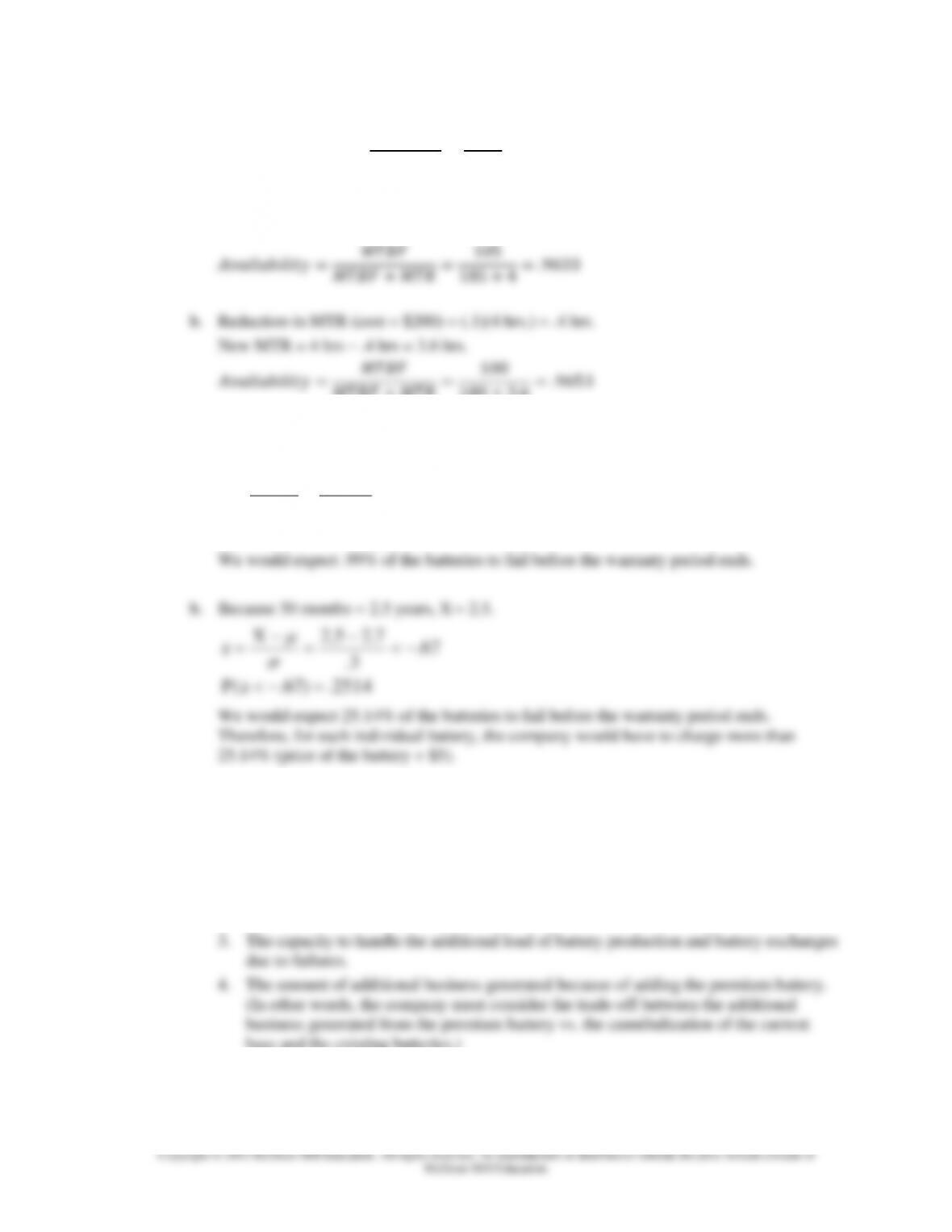
a. Increase in MTBF (cost = $450) = (.05)(100) = 5 hrs.
New MTBF = 100 + 5 = 105 hrs.
Option b (reduce average repair time by 10% at a cost of $200) is most cost-effective. It costs
$250 less than Option a, and it provides higher availability.
23. a.
33.2
3.
7.22
X
z
P(z < -2.33) = .0099 (App. B. Table B)
c. In addition to price of the battery, the company should consider:
1. Possible lost future sales of this type of battery as well as lost sales of other products
manufactured and sold by the company due to a high volume of replaced batteries.
2. Possible loss of good will, reputation, and poor image in the market due to higher
failure rate.
base and the existing batteries.)