Archives
978-0077660772 Chapter 1 Appendix Part 1
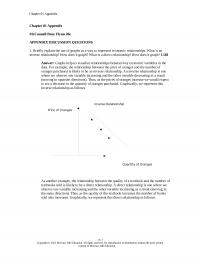
Price of Oranges Quantity of Oranges Inverse Relationship Chapter 01 Appendix Chapter 01 Appendix McConnell Brue Flynn 20e APPENDIX DISCUSSION QUESTIONS 1. Briefly explain the use of graphs as a way to represent economic relationships. What is an inverse relationship? […]
978-0077660772 Chapter 1 Appendix Part 2
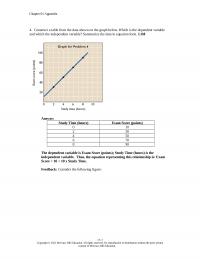
Chapter 01 Appendix 4. Construct a table from the data shown on the graph below. Which is the dependent variable and which the independent variable? Summarize the data in equation form. LO8 Answer: Study Time (hours) Exam Score (points) 0 […]
978-0077660772 Chapter 1 Lecture Note Part 1
Chapter 01 – Limits, Alternatives, and Choices CHAPTER ONE LIMITS, ALTERNATIVES, AND CHOICES CHAPTER OVERVIEW This chapter begins with a discussion of the meaning and importance of economics. In this first chapter, however, we will not plunge into problems and […]
978-0077660772 Chapter 1 Lecture Note Part 2
Chapter 01 – Limits, Alternatives, and Choices I. Individual’s Economizing Problem A. Individuals are confronted with the need to make choices because their wants exceed their means to satisfy them. B. Limited income – everyone, even the most wealthy, has […]
978-0077660772 Chapter 1 McConnell Brue Flynn 20e
Content Option for Instructors #1 The United States and the Global Economy Content Option for Instructors #1 The United States and the Global Economy McConnell Brue Flynn 20e DISCUSSION QUESTIONS 1. Describe the four major economic flows that link the […]
978-0077660772 Chapter 1 Solution Manual Part 1
Chapter 01 – Limits, Alternatives, and Choices Chapter 01 – Limits, Alternatives, and Choices McConnell Brue Flynn 20e DISCUSSION QUESTIONS 1. What is an opportunity cost? How does the idea relate to the definition of economics? Which of the following […]
978-0077660772 Chapter 1 Solution Manual Part 2
Chapter 01 – Limits, Alternatives, and Choices PROBLEMS 1. Potatoes cost Janice $1 per pound, and she has $5.00 that she could possibly spend on potatoes or other items. If she feels that the first pound of potatoes is worth […]
978-0077660772 Chapter 10 Lecture Note
Chapter 10 – Basic Macroeconomic Relationships CHAPTER TEN BASIC MACROECONOMIC RELATIONSHIPS CHAPTER OVERVIEW The central purpose of this chapter is to introduce three basic macroeconomic relationships that will help us organize our thinking about macroeconomic theories and controversies: First, the […]
978-0077660772 Chapter 10 Solution Manual Part 1
Chapter 10 – Basic Macroeconomic Relationships Chapter 10 – Basic Macroeconomic Relationships McConnell Brue Flynn 20e DISCUSSION QUESTIONS 1. Precisely how do the MPC and the APC differ? How does the MPC differ from the MPS? Why must the sum […]
978-0077660772 Chapter 10 Solution Manual Part 2
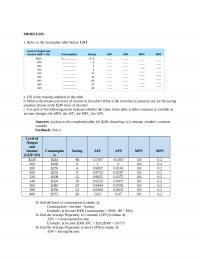
PROBLEMS 1. Refer to the incomplete table below. LO1 a. Fill in the missing numbers in the table. b. What is the break-even level of income in the table? What is the term that economists use for the saving situation […]
978-0077660772 Chapter 11 Lecture Note
Chapter 11 – The Aggregate Expenditures Model CHAPTER ELEVEN THE AGGREGATE EXPENDITURES MODEL CHAPTER OVERVIEW We have seen in Chapter 10 three basic relationships: how income relates to consumption and saving, how the interest rate affects investment spending, and how […]
978-0077660772 Chapter 11 Solution Manual Part 1
Chapter 11 – The Aggregate Expenditures Model Chapter 11 – The Aggregate Expenditures Model McConnell Brue Flynn 20e DISCUSSION QUESTIONS 1. What is an investment schedule and how does it differ from an investment demand curve? LO2 Answer: An investment […]
978-0077660772 Chapter 11 Solution Manual Part 2
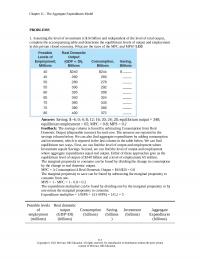
Chapter 11 – The Aggregate Expenditures Model PROBLEMS 1. Assuming the level of investment is $16 billion and independent of the level of total output, complete the accompanying table and determine the equilibrium levels of output and employment in this […]
978-0077660772 Chapter 12 Appendix
Chapter 12 Appendix Chapter 12 Appendix McConnell Brue and Flynn 20e DISCUSSION QUESTIONS 1. Explain carefully: “A change in the price level shifts the aggregate expenditures curve but not the aggregate demand curve.” LO7 Answer: A change in the price […]
978-0077660772 Chapter 12 Lecture Note
Chapter 12 – Aggregate Demand and Aggregate Supply CHAPTER TWELVE AGGREGATE DEMAND AND AGGREGATE SUPPLY CHAPTER OVERVIEW The aggregate expenditures model developed in Chapter 12 is a fixed-price-level model. Its focus is on changes in real GDP, not on changes […]
978-0077660772 Chapter 12 Solution Manual Part 1
Chapter 12 – Aggregate Demand and Aggregate Supply Chapter 12 – Aggregate Demand and Aggregate Supply McConnell, Brue, and Flynn 20e DISCUSSION QUESTIONS 1. Why is the aggregate demand curve downsloping? Specify how your explanation differs from the explanation for […]
978-0077660772 Chapter 12 Solution Manual Part 2
Chapter 12 – Aggregate Demand and Aggregate Supply REVIEW QUESTIONS 1. Which of the following help to explain why the aggregate demand curve slopes downward? LO1 a. When the domestic price level rises, our goods and services become more expensive […]
978-0077660772 Chapter 13 Lecture Note
Chapter 13 – Fiscal Policy, Deficits, and Debt CHAPTER THIRTEEN FISCAL POLICY, DEFICITS, AND DEBT CHAPTER OVERVIEW This chapter explores the tools of government stabilization policy in terms of the aggregate demand- aggregate (AD-AS) model. Next, the chapter examines fiscal […]
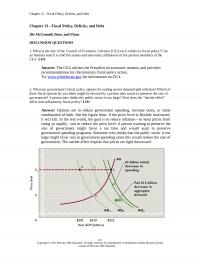
978-0077660772 Chapter 13 Solution Manual Part 1
Chapter 13 – Fiscal Policy, Deficits, and Debt Chapter 13 – Fiscal Policy, Deficits, and Debt 20e McConnell, Brue, and Flynn DISCUSSION QUESTIONS 1. What is the role of the Council of Economic Advisers (CEA) as it relates to fiscal […]
978-0077660772 Chapter 13 Solution Manual Part 2
Chapter 13 – Fiscal Policy, Deficits, and Debt REVIEW QUESTIONS 1. Which of the following would help a government reduce an inflationary output gap? LO1 a. Raising taxes. b. Lowering taxes. c. Increasing government spending. d. Decreasing government spending. Feedback: […]
978-0077660772 Chapter 14 Lecture Note
Chapter 14 – Money, Banking, and Financial Institutions CHAPTER FOURTEEN MONEY, BANKING, AND FINANCIAL INSTITUTIONS CHAPTER OVERVIEW Chapters 14, 15, 16, and 17 form part four of the text, a conventional unit on money and banking. These chapters provide the […]
978-0077660772 Chapter 14 Solution Manual
Chapter 14 – Money, Banking, and Financial Institutions Chapter 14 – Money, Banking, and Financial Institutions 20e McConnell Brue Flynn DISCUSSION QUESTIONS 1. What are the three basic functions of money? Describe how rapid inflation can undermine money’s ability to […]
978-0077660772 Chapter 15 Lecture Note
Chapter 15 – Money Creation CHAPTER FIFTEEN MONEY CREATION CHAPTER OVERVIEW The central topic of this chapter is the creation of checkable (demand) deposit money by commercial banks. First, a number of routine but significant introductory transactions are covered, followed […]
978-0077660772 Chapter 15 Solution Manual Part 1
Chapter 15 – Money Creation Chapter 15 – Money Creation McConnell Brue Flynn 20e DISCUSSION QUESTIONS 1. Explain why merchants accepted gold receipts as a means of payment even though the receipts were issued by goldsmiths, not the government. What […]
978-0077660772 Chapter 15 Solution Manual Part 2
Chapter 15 – Money Creation REVIEW QUESTIONS 1. A goldsmith has $2 million of gold in his vaults. He issues $5 million in gold receipts. His gold holdings are what fraction of the paper money (gold receipts) he has issued? […]
978-0077660772 Chapter 16 Lecture Note
Chapter 16 – Interest Rates and Monetary Policy CHAPTER SIXTEEN INTEREST RATES AND MONETARY POLICY CHAPTER OVERVIEW The objectives and the mechanics of monetary policy are covered in this chapter. It is organized around seven major topics: (1) interest rate […]
978-0077660772 Chapter 16 Solution Manual Part 1
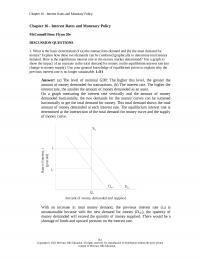
Chapter 16 – Interest Rates and Monetary Policy Chapter 16 – Interest Rates and Monetary Policy McConnell Brue Flynn 20e DISCUSSION QUESTIONS 1. What is the basic determinant of (a) the transactions demand and (b) the asset demand for money? […]
978-0077660772 Chapter 16 Solution Manual Part 2
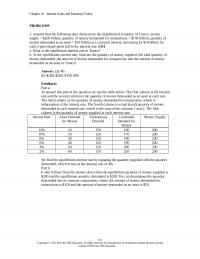
Chapter 16 – Interest Rates and Monetary Policy PROBLEMS 1. Assume that the following data characterize the hypothetical economy of Trance: money supply = $200 billion; quantity of money demanded for transactions = $150 billion; quantity of money demanded as […]
978-0077660772 Chapter 17 Lecture Note
Chapter 17 – Financial Economics CHAPTER SEVENTEEN FINANCIAL ECONOMICS CHAPTER OVERVIEW This chapter provides an introduction to financial economics. It begins by distinguishing between economic investment and financial investment. Next the calculation and use of present value in decision- making […]
978-0077660772 Chapter 17 Solution Manual
Chapter 17 – Financial Economics Chapter 17 – Financial Economics McConnell Brue Flynn 20e DISCUSSION QUESTIONS 1. Suppose that the city of New York issues bonds to raise money to pay for a new tunnel linking New Jersey and Manhattan. […]
978-0077660772 Chapter 18 Lecture Note
Chapter 18 – Extending the Analysis of Aggregate Supply CHAPTER EIGHTEEN EXTENDING THE ANALYSIS OF AGGREGATE SUPPLY CHAPTER OVERVIEW This is the first chapter of Part nine, “Extensions and Issues.” This chapter explains the difference between long-run and short-run aggregate […]
978-0077660772 Chapter 18 Solution Manual
Chapter 18 – Extending the Analysis of Aggregate Supply Chapter 18 – Extending the Analysis of Aggregate Supply McConnell Brue Flynn 20e DISCUSSION QUESTIONS 1. Distinguish between the short run and the long run as they relate to macroeconomics. Why […]
978-0077660772 Chapter 19 Lecture Note
Chapter 19 – Current Issues in Macro Theory and Policy CHAPTER NINETEEN CURRENT ISSUES IN MACRO THEORY AND POLICY CHAPTER OVERVIEW One of the great traditions in scholarship is the challenge to mainstream thinking. Many such challenges to the “conventional […]
978-0077660772 Chapter 19 Solution Manual
Chapter 19 – Current Issues in Macro Theory and Policy Chapter 19 – Current Issues in Macro Theory and Policy McConnell Brue Flynn 20e DISCUSSION QUESTIONS 1. According to mainstream economists, what is the usual cause of macroeconomic instability? What […]
978-0077660772 Chapter 2 Lecture Note
Chapter 02 – The Market System and the Circular Flow CHAPTER TWO THE MARKET SYSTEM AND THE CIRCULAR FLOW CHAPTER OVERVIEW This chapter begins with a brief comparison of the command and market systems, transitioning quickly to a discussion of […]
978-0077660772 Chapter 2 Solution Manual
Chapter 02 – The Market System and the Circular Flow Chapter 02 – The Market System and the Circular Flow McConnell Brue Flynn 20e DISCUSSION QUESTIONS 1. Contrast how a market system and a command economy try to cope with […]
978-0077660772 Chapter 20 Lecture Note
Chapter 20 – International Trade CHAPTER TWENTY INTERNATIONAL TRADE CHAPTER OVERVIEW This chapter builds provides analysis of international trade and protectionism. First, it reviews important facts about world trade. Second, it examines how international specialization based on comparative advantage can […]
978-0077660772 Chapter 20 Solution Manual Part 1
Chapter 20 – International Trade Chapter 20 – International Trade McConnell Brue Flynn 20e DISCUSSION QUESTIONS 1. Quantitatively, how important is international trade to the United States relative to the importance of trade to other nations? What country is the […]
978-0077660772 Chapter 20 Solution Manual Part 2
Chapter 20 – International Trade 10. Suppose that the current international price of wheat is $6 per bushel and that the United States is currently exporting 30 million bushels per year. If the United States suddenly became a closed economy […]
978-0077660772 Chapter 21 Lecture Note Part 1
Chapter 21 – The Balance of Payments, Exchange Rates, and Trade Deficits CHAPTER TWENTY-ONE THE BALANCE OF PAYMENTS, EXCHANGE RATES, AND TRADE DEFICITS CHAPTER OVERVIEW This chapter addresses several important aspects of international trade. The chapter begins with a brief […]
978-0077660772 Chapter 21 Lecture Note Part 2
Chapter 21 – The Balance of Payments, Exchange Rates, and Trade Deficits CHAPTER TWENTY-ONE THE BALANCE OF PAYMENTS, EXCHANGE RATES, AND TRADE DEFICITS CHAPTER OVERVIEW This chapter addresses several important aspects of international trade. The chapter begins with a brief […]
978-0077660772 Chapter 21 Solution Manual Part 1
Chapter 21 – The Balance of Payments, Exchange Rates, and Trade Deficits Chapter 21 – The Balance of Payments, Exchange Rates, and Trade Deficits McConnell Brue Flynn 20e DISCUSSION QUESTIONS 1. Do all international financial transactions necessarily involve exchanging one […]
978-0077660772 Chapter 21 Solution Manual Part 2
Chapter 21 – The Balance of Payments, Exchange Rates, and Trade Deficits 4. A meal at a McDonald’s restaurant in New York costs $8. The identical meal at a McDonald’s restaurant in London costs £4. According to the purchasing-power-parity theory […]
978-0077660772 Chapter 21 Solution Manual Part 3
4. A meal at a McDonald’s restaurant in New York costs $8. The identical meal at a McDonald’s restaurant in London costs £4. According to the purchasing-power-parity theory of exchange rates, the exchange rate between U.S. dollars and British pounds […]
978-0077660772 Chapter 3 Appendix
Chapter 03 Appendix Chapter 03 Appendix McConnell Brue Flynn 20e APPENDIX DISCUSSION QUESTIONS 1. Why are shortages or surpluses more likely with preset prices, such as those on tickets, than flexible prices, such as those on gasoline? LO7 Answer: Preset […]
978-0077660772 Chapter 3 Lecture Note Part 1
Chapter 03 – Demand, Supply, and Market Equilibrium CHAPTER THREE DEMAND, SUPPLY, AND MARKET EQUILIBRIUM CHAPTER OVERVIEW This chapter provides an introduction to demand and supply concepts. Both demand and supply are defined and illustrated; determinants of demand and supply […]
978-0077660772 Chapter 3 Lecture Note Part 2
Chapter 03 – Demand, Supply, and Market Equilibrium I. Changes in Supply and Demand, and Equilibrium A. Changing demand with supply held constant: 1. Increase in demand will have effect of increasing equilibrium price and quantity (Figure 3.7a). 2. Decrease […]
978-0077660772 Chapter 3 Solution Manual Part 1
Chapter 03 – Demand, Supply, and Market Equilibrium Chapter 03 – Demand, Supply, and Market Equilibrium McConnell Brue Flynn 20e DISCUSSION QUESTIONS 1. Explain the law of demand. Why does a demand curve slope downward? How is a market demand […]
978-0077660772 Chapter 3 Solution Manual Part 2
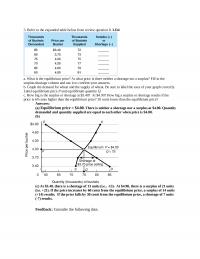
3. Refer to the expanded table below from review question 8. LO4 a. What is the equilibrium price? At what price is there neither a shortage nor a surplus? Fill in the surplus-shortage column and use it to confirm your […]
978-0077660772 Chapter 4 Appendix
Chapter 04 Appendix Chapter 04 Appendix McConnell Brue Flynn 20e APPENDIX DISCUSSION QUESTIONS 1. Because medical records are private, an individual applying for health insurance will know more about his own health conditions than will the insurance companies to which […]
978-0077660772 Chapter 4 Lecture Note
Chapter 04 – Market Failures: Public Goods and Externalities CHAPTER FOUR MARKET FAILURES: PUBLIC GOODS AND EXTERNALITIES CHAPTER OVERVIEW Chapter 3 touched on how properly functioning, competitive markets achieve economic efficiency, but this chapter extends and deepens the analysis by […]
978-0077660772 Chapter 4 Solution Manual Part 1
Chapter 04 – Market Failures: Public Goods and Externalities Chapter 04 – Market Failures: Public Goods and Externalities McConnell Brue Flynn 19e DISCUSSION QUESTIONS 1. Explain the two causes of market failures. Given their definitions, could a market be affected […]
978-0077660772 Chapter 4 Solution Manual Part 2
2. Refer to Table 4.2. If the six people listed in the table are the only producers in the market and the equilibrium price is $6 (not the $8 shown), how much producer surplus will the market generate? LO2 Feedback: […]
978-0077660772 Chapter 5 Appendix
Chapter 05 Appendix Chapter 05 Appendix McConnell Brue Flynn 20e APPENDIX DISCUSSION QUESTIONS 1. Explain how affirmative and negative majority votes can sometimes lead to inefficient allocations of resources to public goods. Is this problem likely to be greater under […]
978-0077660772 Chapter 5 Lecture Note
Chapter 05 – Government’s Role and Government Failure CHAPTER FIVE GOVERNMENT’S ROLE AND GOVERNMENT FAILURE CHAPTER OVERVIEW The chapter begins by reviewing the topic of market failure and the important role that the government can play in (potentially) improving economic […]
978-0077660772 Chapter 5 Solution Manual
Chapter 05 – Government’s Role and Government Failure Chapter 05 – Government’s Role and Government Failure McConnell Brue Flynn 20e DISCUSSION QUESTIONS 1. Why might citizens interested in maximizing economic efficiency be happy to invest their government with the right […]
978-0077660772 Chapter 6 Lecture Note
Chapter 06 – An Introduction to Macroeconomics CHAPTER SIX AN INTRODUCTION TO MACROECONOMICS CHAPTER OVERVIEW As you know from Chapter 1, macroeconomics studies the behavior of the economy as a whole. It is primarily concerned with two topics: long-run economic […]
978-0077660772 Chapter 6 Solution Manual
Chapter 06 – An Introduction to Macroeconomics Chapter 06 – An Introduction to Macroeconomics McConnell, Brue, and Flynn 20e DISCUSSION QUESTIONS 1. Why do you think macroeconomists focus on just a few key statistics when trying to understand the health […]
978-0077660772 Chapter 7 Lecture Note
Chapter 07 – Measuring Domestic Output and National Income CHAPTER SEVEN MEASURING DOMESTIC OUTPUT AND NATIONAL INCOME CHAPTER OVERVIEW News headlines frequently report the status of the nation’s economic conditions, but to many citizens the information is confusing or incomprehensible. […]
978-0077660772 Chapter 7 Solution Manual Part 1
Chapter 07 – Measuring Domestic Output and National Income Chapter 07 – Measuring Domestic Output and National Income McConnell, Brue, and Flynn 20e DISCUSSION QUESTIONS 1. In what ways are national income statistics useful? LO1 Answer: National income accounting does […]
978-0077660772 Chapter 7 Solution Manual Part 2
Chapter 07 – Measuring Domestic Output and National Income REVIEW QUESTIONS 1. Tina walks into Ted’s sporting goods store and buys a punching bag for $100 dollars. That $100 payment counts as ________________ for Tina and _______________ for Ted. LO1 […]
978-0077660772 Chapter 8 Lecture Note
Chapter 08 – Economic Growth CHAPTER EIGHT ECONOMIC GROWTH CHAPTER OVERVIEW This chapter looks at the impact of economic growth in general. Although punctuated by periods of cyclical instability, economic growth in the United States has been impressive. For example, […]
978-0077660772 Chapter 8 Solution Manual
Chapter 08 – Economic Growth Chapter 08 – Economic Growth McConnell, Brue, and Flynn 20e DISCUSSION QUESTIONS 1. How is economic growth measured? Why is economic growth important? Why could the difference between a 2.5 percent and a 3 percent […]
978-0077660772 Chapter 9 Lecture Note
Chapter 09 – Business Cycles, Unemployment, and Inflation CHAPTER NINE BUSINESS CYCLES, UNEMPLOYMENT, AND INFLATION CHAPTER OVERVIEW This chapter discusses the business cycle, unemployment, and inflation. It sets the stage for the analytical presentation in later chapters. The business cycle […]
978-0077660772 Chapter 9 Solution Manual
Chapter 09 – Business Cycles, Unemployment, and Inflation Chapter 09 – Business Cycles, Unemployment, and Inflation McConnell, Brue, and Flynn 20e DISCUSSION QUESTIONS 1. What are the four phases of the business cycle? How long do business cycles last? Why […]
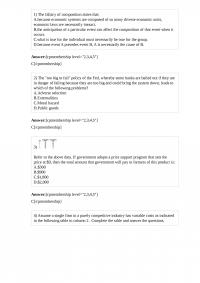
BUS 102 Midterm 1 1 The fallacy of
1) The fallacy of composition states that: A.because economic systems are composed of so many diverse economic units, economic laws are necessarily inexact. B.the anticipation of a particular event can affect the composition of that event when it occurs. C.what […]
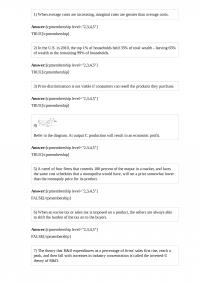
BUS 104 Test 2
1) When average costs are increasing, marginal costs are greater than average costs. 2) In the U.S. in 2010, the top 1% of households held 35% of total wealth – leaving 65% of wealth to the remaining 99% of households. […]
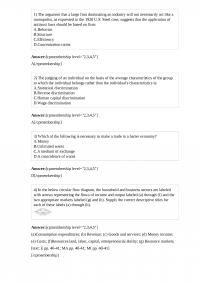
BUS 108 Midterm 2
1) The argument that a large firm dominating an industry will not necessarily act like a monopolist, as expressed in the 1920 U.S. Steel case, suggests that the application of antitrust laws should be based on firm: A.Behavior B.Structure C.Efficiency […]
BUS 115 Quiz 1
1) Suppose a firm anticipates that an R&D expenditure of $100 million will result in a new production process that will reduce costs and thus create a one-time added profit of $112 million a year later. The firm’s expected rate […]
BUS 131 Quiz 3
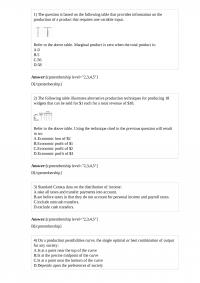
1) The question is based on the following table that provides information on the production of a product that requires one variable input. Refer to the above table. Marginal product is zero when the total product is: A.0 B.5 C.56 […]
BUS 135 Midterm 2
1) In pure competition, price is determined where the industry: A.Demand and supply curves intersect B.Total cost is greater than total revenue C.Demand intersects the individual firm’s marginal cost curve D.Average total cost equals total variable cost 2) If country […]
BUS 141 Midterm
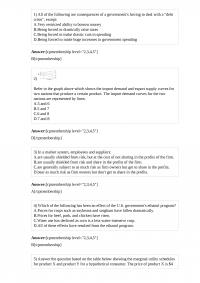
1) All of the following are consequences of a government’s having to deal with a “debt crisis”, except: A.Very restricted ability to borrow money B.Being forced to drastically raise taxes C.Being forced to make drastic cuts in spending D.Being forced […]
BUS 153 Midterm 1
1) Creative destruction is most often associated with: A.International trade B.Technological advance C.Government spending D.Private consumption 2) Which of the following best explains why the net flow of illegal immigrants to the United States has been close to zero (particularly […]
BUS 160 Quiz 2
1) Which of the following countries received the largest amount of emigrant remittances in 2011? A.India B.Mexico C.Philippines D.China 2) Why do cereals marketers most prefer to have their brand occupy the shelf-space a foot or two below a typical […]
BUS 180
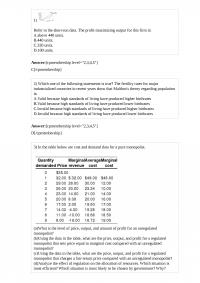
1) Refer to the short-run data. The profit-maximizing output for this firm is: A.above 440 units. B.440 units. C.320 units. D.100 units. 2) Which one of the following statements is true? The fertility rates for major industrialized countries in recent […]
BUS 224 Midterm 1
1) The optimal level of immigration occurs where marginal benefit is at its greatest. 2) The substitution effect of a price-decrease for a good causes an increase in the consumption of the good, regardless of whether the good is normal […]
BUS 238 Quiz 1
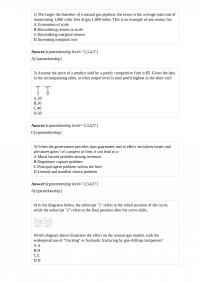
1) The larger the diameter of a natural gas pipeline, the lower is the average total cost of transmitting 1,000 cubic feet of gas 1,000 miles. This is an example of one reason for: A.Economies of scale B.Diminishing returns to […]
BUS 240 Quiz 3
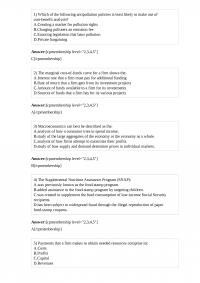
1) Which of the following antipollution policies is least likely to make use of cost-benefit analysis? A.Creating a market for pollution rights B.Charging polluters an emission fee C.Enacting legislation that bans pollution D.Private bargaining 2) The marginal cost-of-funds curve for […]
BUS 242 Midterm 2
1) Marginal resource cost is: A.The increase in a firm’s total cost caused by hiring one additional unit of an input B.A firm’s cost of hiring one group of inputs, such as capital or labor C.The firm’s demand curve for […]
BUS 257 Quiz
1) The following factors have boosted farm income per farm household in the U.S., except: A.Consolidation of farms B.Outmigration from farming C.Stronger or appreciating dollar D.Significant government subsidies 2) Which would be an avenue for resolving the inefficiencies associated with […]
BUS 264 Quiz
1) Illegal immigrants make up about what percent of all agricultural workers in the U.S.? A.10% B.5% C.40% D.25% 2) Refer to the above table. The average variable cost of producing 35 units of output is: A.$6.00 B.$7.43 C.$4.57 D.$1.43 […]
BUS 280 Midterm 1
1) Some economists claim that unions reduce economic efficiency by: A.providing a voice mechanism for workers. B.insisting that promotions be based on ability rather than seniority. C.imposing restrictions on the kinds of jobs workers may perform. D.increasing worker turnover. 2) […]
BUS 296 1 The best example of an
1) The best example of an industrial union is the: A.United Association of Plumbers and Pipefitters B.International Brotherhood of Electrical Workers C.American Medical Association D.United Auto Workers 2) Which of the following groups does not belong with the others? A.Permanent […]
BUS 298 1Refer to the diagram For
1) Refer to the diagram. For output level Q, per unit costs of C are: A.unattainable and imply the inefficient use of resources. B.unattainable, given resource prices and the current state of technology. C.attainable, but imply the inefficient use of […]
BUS 327 Test 1
1) Environmentalists generally support price supports because these subsidies motivate additional farm production. 2) It is impossible for a nation to have a comparative advantage in producing everything. Answer: TRUE 3) A government tax per unit of output reduces supply. […]
BUS 330 Test 1
1) In terms of the circular flow diagram, households make expenditures in the _____ market and receive income through the _____ market. A.product; financial B.resource; product C.product; resource D.capital; product 2) Since 1980 the difference between the earnings of college […]
BUS 336 Midterm 2
1) Unlike most demand curves, the demand curve for loanable funds is upsloping. 2) Patents and copyrights were established by the government to reduce oligopoly and monopoly power. Answer: FALSE 3) The Social Security program is financed with funds from […]
BUS 344
1) Chronic budget deficits can be attributed to: A.unfunded liabilities. B.voters wanting government programs but not wanting to pay taxes. C.inappropriate monetary policy. D.state budget laws. 2) In a typical graph for a purely competitive firm, at the point where […]
BUS 351 Quiz 1
1) Edith is buying products X and Y with her money income. Suppose her budget line shifts rightward (outward). This might be the result of: A.the prices of X and Y increasing while her money income remains constant. B.her money […]
BUS 354 Test
1) If you know that when a firm produces 10 units of output, total costs are $1,030 and average fixed costs are $10, then total variable costs are: A.$104 B.$930 C.$1,040 D.$1,130 2) A fundamental difference between the command system […]
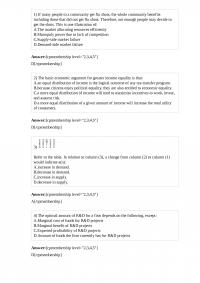
BUS 360
1) If many people in a community get flu shots, the whole community benefits including those that did not get flu shots. Therefore, not enough people may decide to get the shots. This is one illustration of: A.The market allocating […]
BUS 363 Quiz 1
1) Which of the following would not be considered a capital resource by economists? A.A van used by a mother to transport the family around B.An office computer used by an accountant C.A crane used by a building contractor D.A […]
BUS 373
1) Some low-income workers are not covered by Medicaid because of the income that they are earning from their jobs. 2) In 2011, China overtook Mexico to become the number one country of origin of U.S. legal immigrants. Answer: FALSE […]
BUS 379 Test 2
1) A game in which one firm’s gain must equal the other firm’s loss is called a: A.Positive-sum game B.Zero-sum game C.Negative-sum game D.One-time game 2) A firm decides to make a $10 million expenditure on research and development that […]
BUS 390 Midterm
1) If the total costs of producing 1,500 units of output is $15,000 and this output sold to consumers for a total of $16,500, then the firm would earn profits of: A.$1,000 B.$16,500 C.$1,500 D.$15,000 2) In which market model […]
BUS 403
1) If producers must obtain higher prices than before to produce a given level of output, then the following has occurred: A.A decrease in demand. B.An increase in demand. C.A decrease in supply. D.An increase in supply. 2) Based on […]
BUS 408
1) Overall, economists believe that deregulation of industries formerly subjected to industrial regulation: A.has been a clear failure. B.is neutral in its impact to society’s well-being, creating minimal net benefits at best. C.has produced large net benefits for consumers and […]
BUS 414 Test 1
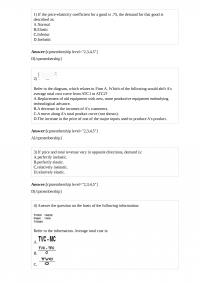
1) If the price-elasticity coefficient for a good is .75, the demand for that good is described as: A.Normal B.Elastic C.Inferior D.Inelastic 2) Refer to the diagram, which relates to Firm A. Which of the following would shift A’s average […]
BUS 420 Quiz
1) If the wage rate in a purely competitive labor market increases, it will cause the: A.Marginal resource cost curve for a single competitive firm in the industry to shift down B.Marginal resource cost curve for a single competitive firm […]
BUS 426 Midterm
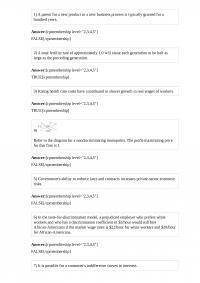
1) A patent for a new product or a new business process is typically granted for a hundred years. 2) A total fertility rate of approximately 1.0 will cause each generation to be half as large as the preceding generation. […]
BUS 430 Quiz
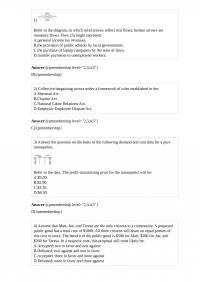
1) Refer to the diagram, in which solid arrows reflect real flows; broken arrows are monetary flows. Flow (5) might represent: A.personal income tax revenues. B.the provision of public schools by local governments. C.the purchase of laptop computers by the […]
BUS 434 Midterm 2
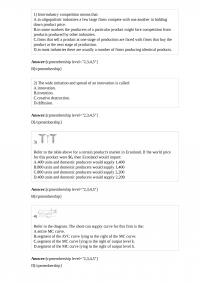
1) Interindustry competition means that: A.in oligopolistic industries a few large firms compete with one another in bidding down product price. B.in some markets the producers of a particular product might face competition from products produced by other industries. C.firms […]
BUS 436 Test 1
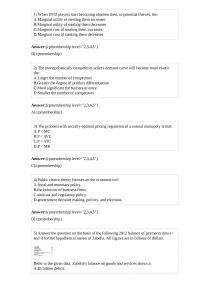
1) When DVD players start becoming obsolete then, to potential thieves, the: A.Marginal utility of stealing them increases B.Marginal utility of stealing them decreases C.Marginal cost of stealing them increases D.Marginal cost of stealing them decreases 2) The monopolistically competitive […]
BUS 442 Test 1 1 In interpreting
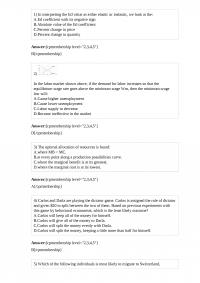
1) In interpreting the Ed value as either elastic or inelastic, we look at the: A.Ed coefficient with its negative sign B.Absolute value of the Ed coefficient C.Percent change in price D.Percent change in quantity 2) In the labor market […]
BUS 453 Test 1
1) Available research suggests that the union wage advantage diminishes the national output by: A.15 percent. B.8 percent. C.3 percent. D.less than 1 percent. 2) Microfinance can help directly support: A.Labor or workers B.Local governments C.Entrepreneurs D.Consumers Answer: C 3) […]
BUS 474 Quiz 3
1) The Sherman Act was designed to: A.exempt commercial banks from the antitrust laws. B.make interlocking directorates legal. C.prohibit misleading and antisocial advertising. D.make monopoly and acts that restrain trade illegal. 2) Reasons for the rapid rise in demand for […]
BUS 492 Quiz 3
1) Which of the following statements pertains to macroeconomics? A.Because the minimum wage was raised, Mrs. Olsen decided to enter the labor force. B.A decline in the price of soybeans caused farmer Wanek to plant more land in wheat. C.National […]
BUS 501 Homework
1) The three most important sources of federal tax revenue in order of descending importance are: A.sales, payroll, and personal income taxes. B.personal income, corporate income, and sales taxes. C.personal income, corporate income, and payroll taxes. D.personal income, payroll, and […]
BUS 521 Final
1) When people look at consumption options in isolation, such as when considering to buy an over-priced warranty to go with the purchase of a new high-end refrigerator, and focusing on the value of the refrigerator in isolation (not relative […]
BUS 524 Midterm 2
1) Opportunity costs exist because: A.the decision to engage in one activity means forgoing some other activity. B.wants are scarce relative to resources. C.households and businesses make rational decisions. D.most decisions do not involve sacrifices or trade-offs. 2) A nation’s […]
BUS 525 Homework
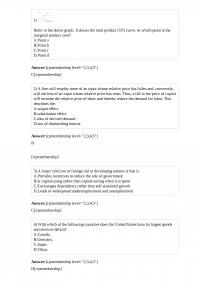
1) Refer to the above graph. It shows the total product (TP) curve. At which point is the marginal product zero? A.Point a B.Point b C.Point c D.Point d 2) A firm will employ more of an input whose relative […]
BUS 543 Quiz 3
1) Which of the following is not a reason why government may play a key role in the early stage of economic development in developing nations? A.The infrastructure provided by government B.The abundance of entrepreneurs who need to be regulated […]
BUS 562 Homework
1) In a nation’s balance of payments, which one of the following items is always recorded as a positive entry? A.Goods imports. B.Changes in foreign currency reserves. C.U.S. purchases of assets abroad. D.Exports of services. 2) DASH Airlines is considering […]
BUS 568 Test
1) Which of the following is not an example of a socio-cultural impediment to economic growth? A.Tribal allegiances that take precedence over national unity B.Religious beliefs and practices that severely limit economic activity C.Migration of labor resources from agricultural to […]
BUS 570 Quiz 2
1) Regulatory capture in government often happens because the people who are most qualified to supervise and regulate an industry oftentimes are or have been the leaders of the industry. 2) The demand curve for loanable funds illustrates the behavior […]
BUS 578 Homework
1) Many governments end up with chronic budget deficits because: A.Many government programs are popular with voters, but hardly any voter likes paying taxes B.The nation simply cannot produce everything that it consumes, so it has to rely on others […]
BUS 587 Midterm
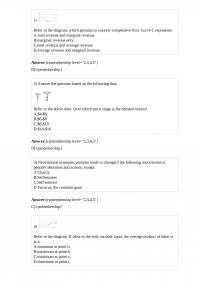
1) Refer to the diagram, which pertains to a purely competitive firm. Curve C represents: A.total revenue and marginal revenue. B.marginal revenue only. C.total revenue and average revenue. D.average revenue and marginal revenue. 2) Answer the question based on the […]
BUS 589 Quiz 1
1) “Impulse buying” is often the result of a: A.Rational optimizing decision in response to incentives and prices B.Precise estimation of one’s marginal utilities and price comparisons C.Systematic non-rational behavior that marketers can take advantage of D.Random error in a […]
BUS 610 Test 1
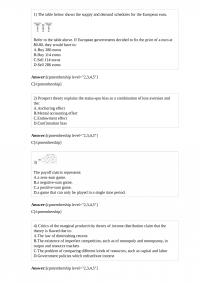
1) The table below shows the supply and demand schedules for the European euro. Refer to the table above. If European governments decided to fix the price of a euro at $0.80, they would have to: A.Buy 286 euros B.Buy […]
BUS 613 Quiz 3
1) What is one of the major shortcomings of using tariffs or quotas to ‘save American jobs”? A.Trade barriers protect the development of new technology, but the new technology eliminates jobs B.Import restrictions alter the composition of domestic employment, but […]
BUS 619 Quiz 2
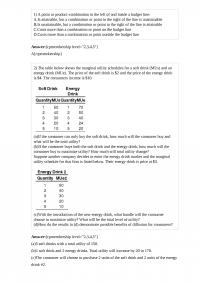
1) A point or product-combination to the left of and inside a budget line: A.Is attainable, but a combination or point to the right of the line is unattainable B.Is unattainable, but a combination or point to the right of […]
BUS 639 Test
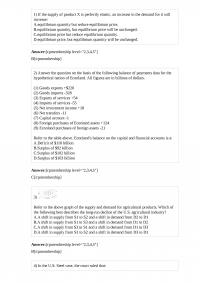
1) If the supply of product X is perfectly elastic, an increase in the demand for it will increase: A.equilibrium quantity but reduce equilibrium price. B.equilibrium quantity, but equilibrium price will be unchanged. C.equilibrium price but reduce equilibrium quantity. D.equilibrium […]
BUS 654 Test
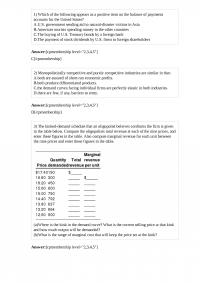
1) Which of the following appears as a positive item on the balance of payments accounts for the United States? A.U.S. government sending aid to natural-disaster victims in Asia B.American tourists spending money in the other countries C.The buying of […]
BUS 655 Midterm 2
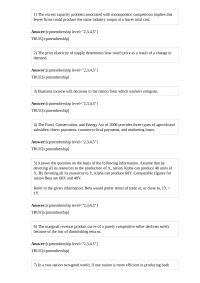
1) The excess capacity problem associated with monopolistic competition implies that fewer firms could produce the same industry output at a lower total cost. 2) The price elasticity of supply determines how much price as a result of a change […]
BUS 659 Homework
1) China is very close to catching up with the United States in its standard of living as measured by per capita income. 2) If all nations prohibited the international migration of labor, we would expect world output to decline. […]
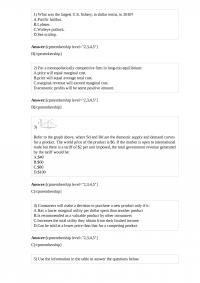
BUS 666
1) What was the largest U.S. fishery, in dollar terms, in 2010? A.Pacific halibut. B.Lobster. C.Walleye pollock. D.Sea scallop. 2) For a monopolistically competitive firm in long-run equilibrium: A.price will equal marginal cost. B.price will equal average total cost. C.marginal […]
BUS 678 Quiz 2
1) “Price maker” means that a monopoly can decide whatever price it wants to, in order to sell a specific given quantity of its product. 2) In general for an excise tax on a product, given supply, the more elastic […]
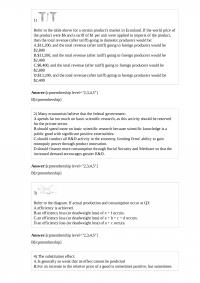
BUS 691 Midterm
1) Refer to the table above for a certain product’s market in Econland. If the world price of the product were $6 and a tariff of $1 per unit were applied to imports of the product, then the total revenue […]
BUS 694 Quiz 3
1) Generally speaking, the smaller the percentage of one’s total budget devoted to a particular product, the more price elastic will be the demand for that product. 2) The presence of an agency shop requires all workers to join the […]
BUS 702 Test 1
1) The legal cartel theory of regulation argues that: A.regulation encourages firms to inflate their production costs. B.firms in certain industries want to be regulated rather than face the rigors of competition. C.social regulation has been carried beyond the point […]
BUS 712 Test
1) The pizza analogy of income distribution would be most closely associated with which one of the following questions? A.If resources are used to make pizza, what other goods and services must be given up to do this? B.If cutting […]
BUS 717
1) In pure competition, the industry demand curve is infinitely price elastic. 2) A good with a price-elasticity coefficient of 0.75 has a demand that is price-inelastic. Answer: TRUE 3) The basic difference between pure competition and monopolistic competition is […]
BUS 727 Quiz
1) Which of the following is least likely to violate the Sherman Act or the Clayton Act? A.Competitive firms A, B, and C meet and agree to charge a common price. B.Competitive firms D and E, each with 35 percent […]
BUS 743
1) For all practical purposes, the supply of land is: A.almost perfectly inelastic. B.negatively sloped. C.relatively elastic. D.perfectly elastic. 2) Suppose that under its collective bargaining agreement the ABC Corporation can hire nonunion workers, but such workers must join the […]
BUS 759 Quiz 2
1) Why, according to behavioral economics, would supermarkets place gum, candy, and other small convenience items near the cash registers? A.Those are the shelving locations that minimize costs. B.Stores try to make frequently purchased items quicker and easier for consumers […]
BUS 773 Final
1) There is a surplus of tomatoes in the market. This implies that: A.The current price is set above the equilibrium level B.The price will be rising, as a result C.Supply of tomatoes is more than the demand D.Quantity demanded […]
BUS 781 Test
1) Which of the following is a public assistance or welfare program as opposed to a social insurance program? A.Supplemental Security Income (SSI). B.Unemployment compensation. C.Medicare. D.Social Security. 2) Assume the Environmental Protection Agency imposes an excise tax on polluting […]
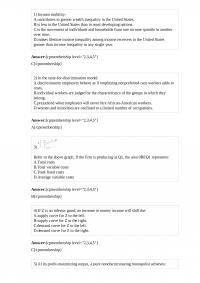
BUS 784
1) Income mobility: A.contributes to greater wealth inequality in the United States. B.is less in the United States than in most developing nations. C.is the movement of individuals and households from one income quintile to another over time. D.makes lifetime […]
BUS 787
1) Insurance co-pays and deductibles are methods used by insurance companies to reduce moral hazard. 2) Reducing the payment of rent to land-owners will decrease the quantity of land supplied. Answer: FALSE 3) If MRP of labor < wage rate, […]
BUS 820 Quiz
1) Total allowable catch policies promote economic efficiency better than individual transferable quotas. 2) Self-control problems, say among people on a diet, is caused by the cognitive bias known as time inconsistency. Answer: TRUE 3) Government guarantees that socialize losses […]
BUS 828 Quiz 2
1) In a world with two products, wheat (W) and coffee (C), nation Alpha produces wheat and nation Beta produces coffee. Nation Alpha prefers an exchange rate of 1W = 2C and nation Beta prefers an exchange rate of 1W […]
BUS 840 Midterm 2
1) An industry has five firms, each with a market share of 20 percent. There is no foreign competition, entry into the industry is difficult, and no firm is on the verge of bankruptcy. If two of the firms in […]
BUS 841 Quiz
1) A normative statement is one that: A.is based on the law of averages. B.applies only to microeconomics. C.applies only to macroeconomics. D.is based on value judgments. 2) In a graph showing the market supply and demand for British pounds […]
BUS 869 Test
1) The short-run supply curve for a competitive firm is the: A.Entire MC curve B.Segment of the MC curve lying below the AVC curve C.Segment of the MC curve lying above the AVC curve D.Segment of the AVC curve lying […]
BUS 888 – Profits are the primary success indicator for firms in a centrally planned economy
1) Profits are the primary ‘success indicator” for firms in a centrally planned economy. 2) In the U.S., the progressive income-tax system substantial redistributes income. Answer: FALSE 3) Even if a majority of the population wants a law and the […]
BUS 890 Quiz 1
1) Government transfer programs result in a U.S. Lorenz curve that is closer to the diagonal line than would be the case without the programs. 2) When total utility is at a maximum, marginal utility is zero. Answer: TRUE 3) […]
ECB 130 Homework
1) A state government wants to increase the taxes on cigarettes to increase tax revenue. Because cigarettes are addictive, we would expect its demand to be: A.Elastic, thus the government’s cigarette-tax revenues would rise with a tax increase B.Elastic, thus […]
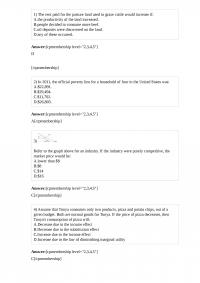
ECB 135
1) The rent paid for the pasture land used to graze cattle would increase if: A.the productivity of the land increased. B.people decided to consume more beef. C.oil deposits were discovered on the land. D.any of these occurred. 2) In […]
ECB 141
1) An oil company is considering drilling in the Gulf at a current cost of $300,000 with an expected profit of $500,000 in three years. The current market rate is 10 percent. Should the company make the investment? A.Yes, the […]
ECB 163
1) Which country has the largest share of total world exports? A.Japan. B.Germany. C.United States. D.China. 2) In considering euros and dollars, the rates of exchange for the euro and the dollar: A.are directly related. B.are inversely related. C.are unrelated. […]
ECB 170 Test
1) Between 1995 and 2007 in the United States: A.average U.S. household wealth increased and median household wealth declined. B.average U.S. household wealth declined and median household wealth increased. C.both average and median U.S. household wealth declined. D.both average and […]
ECB 174
1) Which of the following is mainly involved in social regulation? A.The Social Security Administration B.The Federal Communications Commission C.The Food and Drug Administration D.The Interstate Commerce Commission 2) Which of the following DVC policies is not likely to increase […]
ECB 179 Test
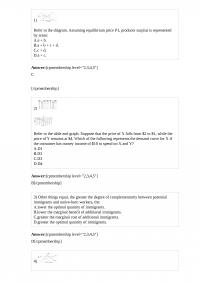
1) Refer to the diagram. Assuming equilibrium price P1, producer surplus is represented by areas: A.a + b. B.a + b + c + d. C.c + d. D.a + c. 2) Refer to the table and graph. Suppose that […]
ECB 196 Midterm 1
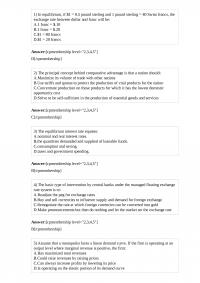
1) In equilibrium, if $1 = 0.5 pound sterling and 1 pound sterling = 40 Swiss francs, the exchange rate between dollar and franc will be: A.1 franc = $.10 B.1 franc = $.20 C.$1 = 80 francs D.$1 = […]
ECB 198
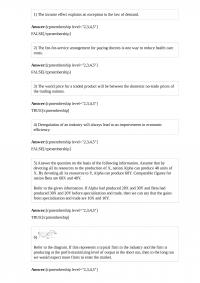
1) The income effect explains an exception to the law of demand. 2) The fee-for-service arrangement for paying doctors is one way to reduce health care costs. Answer: FALSE 3) The world price for a traded product will be between […]
ECB 222 1Refer to the above graph of
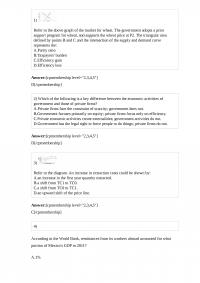
1) Refer to the above graph of the market for wheat. The government adopts a price support program for wheat, and supports the wheat price at P2. The triangular area defined by points B and C and the intersection of […]
ECB 256 Midterm
1) A balance-of-payments deficit occurs: A.when a nation must make an inpayment of official reserves to its capital and financial account. B.whenever a nation has a goods and services deficit. C.whenever a nation has a goods and services surplus. D.when […]
ECB 266 Quiz 1
1) OPEC functions as a classic example of a kinked demand curve oligopoly. 2) Rivalry means that when one person buys and consumes a product, it is not available for purchase and consumption by another person. Answer: TRUE 3) The […]
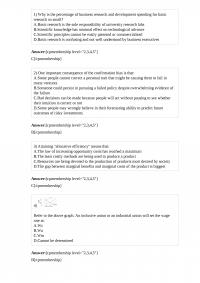
ECB 290 Test
1) Why is the percentage of business research and development spending for basic research so small? A.Basic research is the sole responsibility of university research labs B.Scientific knowledge has minimal effect on technological advance C.Scientific principles cannot be easily patented […]
ECB 306
1) Which is the best example of price discrimination? A.An airline company charging lower fares per pound for air freight than for passengers B.A telephone company charging lower rates to weekend users than weekday users C.A supermarket charging lower prices […]
ECB 327 Midterm 2
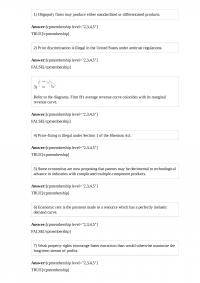
1) Oligopoly firms may produce either standardized or differentiated products. 2) Price discrimination is illegal in the United States under antitrust regulations. Answer: FALSE 3) Refer to the diagrams. Firm B’s average revenue curve coincides with its marginal revenue curve. […]
ECB 336 Quiz 2
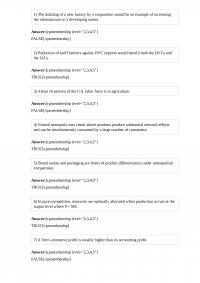
1) The building of a new factory by a corporation would be an example of increasing the infrastructure in a developing nation. 2) Reduction of tariff barriers against DVC imports would benefit both the DVCs and the IACs. Answer: TRUE […]
ECB 344 Quiz 2
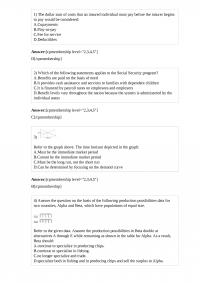
1) The dollar sum of costs that an insured individual must pay before the insurer begins to pay would be considered: A.Copayments B.Play-or-pay C.Fee for service D.Deductibles 2) Which of the following statements applies to the Social Security program? A.Benefits […]
ECB 370 Quiz 3
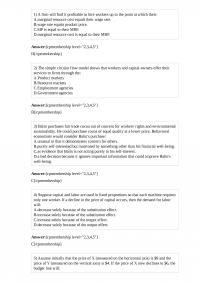
1) A firm will find it profitable to hire workers up to the point at which their: A.marginal resource cost equals their wage rate. B.wage rate equals product price. C.MP is equal to their MRP. D.marginal resource cost is equal […]
ECB 393 Test 2
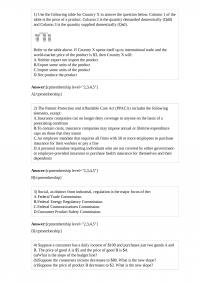
1) Use the following table for Country X to answer the question below. Column 1 of the table is the price of a product. Column 2 is the quantity demanded domestically (Qdd) and Column 3 is the quantity supplied domestically […]
ECB 399 Test
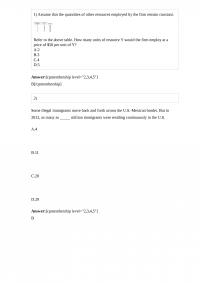
1) Assume that the quantities of other resources employed by the firm remain constant. Refer to the above table. How many units of resource Y would the firm employ at a price of $50 per unit of Y? A.2 B.3 […]
ECB 401 Quiz 3
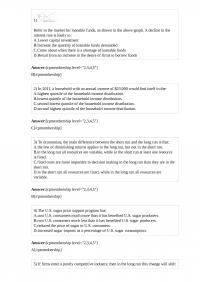
1) Refer to the market for loanable funds, as shown in the above graph. A decline in the interest rate is likely to: A.Lower capital investment B.Increase the quantity of loanable funds demanded C.Come about when there is a shortage […]
ECB 418 Midterm
1) The so-called pork-barrel politics refers to congressional members: A.Trading votes with one another B.Receiving perks and freebies from businesses trying to sway their votes C.Paying close attention to the vocal special interest groups D.Inserting provisions for local narrow projects […]
ECB 420 Test
1) A voluntary export restraint (VER) is similar to an import quota; except that the former benefits the foreign producers while the latter benefits the domestic producers. 2) Monopolistically competitive firms have some control over the price of their products. […]
ECB 448
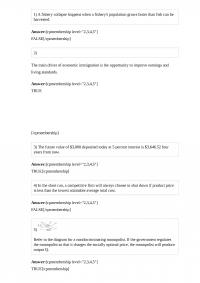
1) A fishery collapse happens when a fishery’s population grows faster than fish can be harvested. 2) The main driver of economic immigration is the opportunity to improve earnings and living standards. Answer: TRUE 3) The future value of $3,000 […]
ECB 451
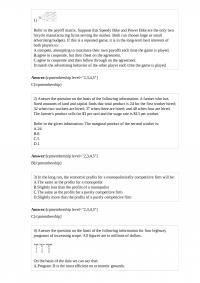
1) Refer to the payoff matrix. Suppose that Speedy Bike and Power Bike are the only two bicycle manufacturing firms serving the market. Both can choose large or small advertising budgets. If this is a repeated game, it is in […]
ECB 483 Midterm
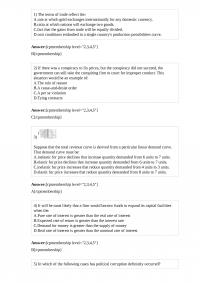
1) The terms of trade reflect the: A.rate at which gold exchanges internationally for any domestic currency. B.ratio at which nations will exchange two goods. C.fact that the gains from trade will be equally divided. D.cost conditions embodied in a […]
ECB 491 Midterm
1) What is the reason why large, short-run declines in farm prices do not significantly reduce farm production in the short run? A.Farmers’ variable costs are high compared with their fixed costs B.Farmers’ fixed costs are high compared with their […]
ECB 491 Quiz 1
1) U.S. businesses are demanders of foreign currencies because they need them to: A.Sell goods and services exported to foreign countries B.Pay for goods and services imported from foreign countries C.Receive interest payments from foreign governments D.Receive interest payments from […]
ECB 498 Quiz 3
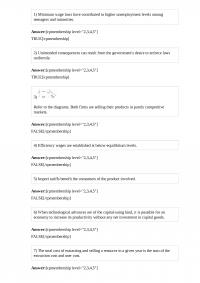
1) Minimum wage laws have contributed to higher unemployment levels among teenagers and minorities. 2) Unintended consequences can result from the government’s desire to enforce laws uniformly. Answer: TRUE 3) Refer to the diagrams. Both firms are selling their products […]
ECB 521 Quiz 3
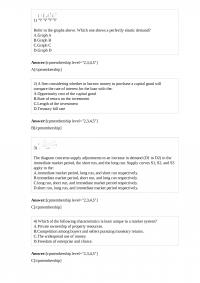
1) Refer to the graphs above. Which one shows a perfectly elastic demand? A.Graph A B.Graph B C.Graph C D.Graph D 2) A firm considering whether to borrow money to purchase a capital good will compare the rate of interest […]
ECB 538 Midterm 2
1) The demand curve for loanable funds represents the behavior of: A.Lenders B.Savers C.Borrowers D.Bankers 2) Which of the following policies has succeeded in reducing fishery catch sizes without creating an “arms race” among fishers? A.Limiting the length of the […]
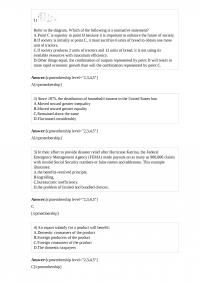
ECB 554 Quiz 3
1) Refer to the diagram. Which of the following is a normative statement? A.Point C is superior to point B because it is important to enhance the future of society. B.If society is initially at point C, it must sacrifice […]
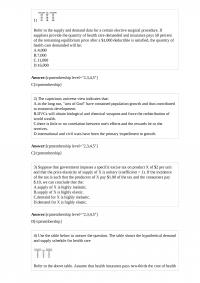
ECB 573
1) Refer to the supply and demand data for a certain elective surgical procedure. If suppliers provide the quantity of health care demanded and insurance pays 50 percent of the remaining equilibrium price after a $1,000 deductible is satisfied, the […]
ECB 577 Quiz 2
1) In the short run, a purely competitive firm will always make an economic profit if: A.P = ATC. B.P > AVC. C.P = MC. D.P > ATC. 2) Scholarly estimates of the impact of immigration on the average American […]
ECB 579 Quiz 3
1) The following are commonly-used arguments for protection against imports, except: A.Self-sufficiency and diversification-for-stability B.Protection against dumping C.Infant industry protection D.Price- and profit-maintenance 2) The marginal revenue product schedule is: A.the same whether the firm is selling in a purely […]
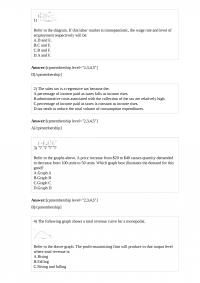
ECB 583 Quiz 3
1) Refer to the diagram. If this labor market is monopsonistic, the wage rate and level of employment respectively will be: A.D and E. B.C and F. C.B and F. D.A and F. 2) The sales tax is a regressive […]
ECB 588 Quiz
1) In the extraction of a nonrenewable resource, increased current extraction will reduce the extraction firm’s user costs. 2) The price elasticity of demand for most agricultural products is relatively low. Answer: TRUE 3) In the demand-enhancing union model, a […]
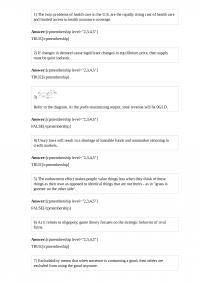
ECB 598 Quiz 1
1) The twin problems of health care in the U.S. are the rapidly rising cost of health care and limited access to health insurance coverage. 2) If changes in demand cause significant changes in equilibrium price, then supply must be […]
ECB 602 1 An amount of RampD
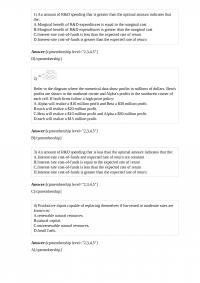
1) An amount of R&D spending that is greater than the optimal amount indicates that the: A.Marginal benefit of R&D expenditures is equal to the marginal cost B.Marginal benefit of R&D expenditures is greater than the marginal cost C.Interest-rate cost-of-funds […]
ECB 612 Midterm 2
1) Firms that pay efficiency wages tend to have higher worker turnover. 2) The principal-agent problem in labor markets arises because of the possibility of shirking by workers. Answer: TRUE 3) Usury laws are a special case of “price floors” […]
ECB 614 Midterm
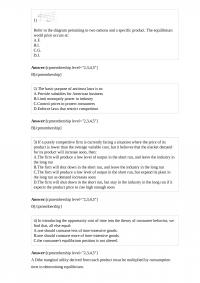
1) Refer to the diagram pertaining to two nations and a specific product. The equilibrium world price occurs at: A.F. B.I. C.G. D.J. 2) The basic purpose of antitrust laws is to: A.Provide subsidies for American business B.Limit monopoly power […]
ECB 622 Quiz 2
1) The U.S. government has been increasing the portion of its budget and its spending on R&D activities, for the nation’s long-term growth. 2) The economy of the United States can best be described as laissez-faire capitalism. Answer: FALSE 3) […]
ECB 660
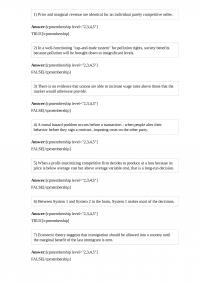
1) Price and marginal revenue are identical for an individual purely competitive seller. 2) In a well-functioning “cap-and-trade system” for pollution rights, society benefits because pollution will be brought down to insignificant levels. Answer: FALSE 3) There is no evidence […]
ECB 664 Midterm 2
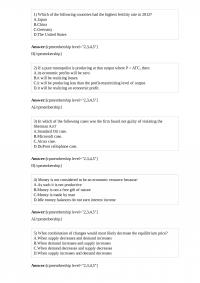
1) Which of the following countries had the highest fertility rate in 2012? A.Japan B.China C.Germany D.The United States 2) If a pure monopolist is producing at that output where P = ATC, then: A.its economic profits will be zero. […]
ECB 669
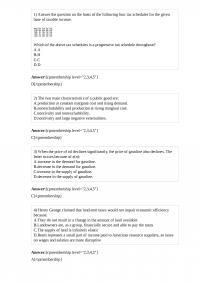
1) Answer the question on the basis of the following four tax schedules for the given base of taxable income. Which of the above tax schedules is a progressive tax schedule throughout? A.A B.B C.C D.D 2) The two main […]
ECB 681
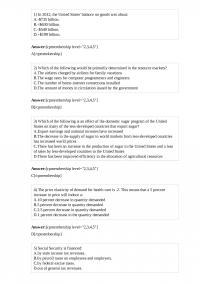
1) In 2012, the United States’ balance on goods was about: A.-$735 billion. B.+$630 billion. C.-$540 billion. D.+$199 billion. 2) Which of the following would be primarily determined in the resource markets? A.The airfares charged by airlines for family vacations […]
ECB 703 Midterm 2
1) In a monopoly at equilibrium, price is greater than marginal cost. 2) Monetary policy attempts to change the level of spending by altering interest rates. Answer: TRUE 3) One consequence of the confirmation bias is that many people believe […]
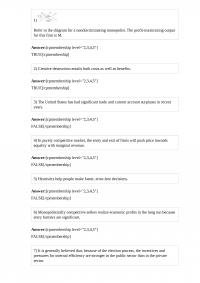
ECB 713 Quiz
1) Refer to the diagram for a nondiscriminating monopolist. The profit-maximizing output for this firm is M. 2) Creative destruction entails both costs as well as benefits. Answer: TRUE 3) The United States has had significant trade and current account […]
ECB 731 Quiz
1) Which of the following statements about a competitive firm is correct? A.To maximize profits a competitive firm should produce at that output at which total revenue is greatest B.In long-run equilibrium a competitive firm will produce at the point […]
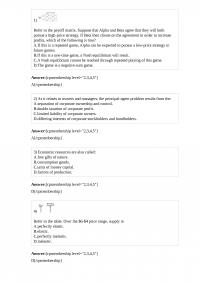
ECB 748 Quiz 3
1) Refer to the payoff matrix. Suppose that Alpha and Beta agree that they will both pursue a high-price strategy. If Beta then cheats on the agreement in order to increase profits, which of the following is true? A.If this […]
ECB 786 Quiz 2
1) Precommitments must impose costs on people to be effective. 2) The World Trade Organization (WTO) is an international organization designed to provide short-term advances of foreign monies to those nations faced with trade deficits. Answer: FALSE 3) The Food, […]
ECB 797 Test 2
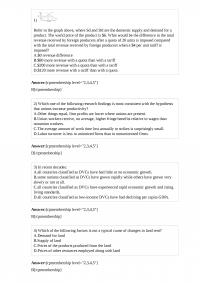
1) Refer to the graph above, where Sd and Dd are the domestic supply and demand for a product. The world price of the product is $6. What would be the difference in the total revenue received by foreign producers […]
ECB 809
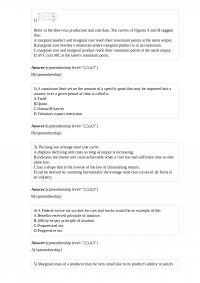
1) Refer to the short-run production and cost data. The curves of Figures A and B suggest that: A.marginal product and marginal cost reach their maximum points at the same output. B.marginal cost reaches a minimum where marginal product is […]
ECB 814 Test 1
1) Why do credit card companies typically require small minimum payment amounts on their customers’ monthly credit card statements? A.Credit card companies are concerned that their customers will be put in financial distress if required to make higher payments. B.Credit […]
ECB 817 Homework
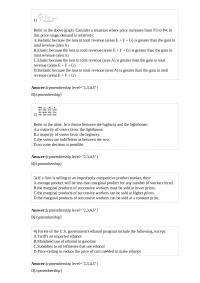
1) Refer to the above graph. Consider a situation where price increases from P3 to P4. In this price range, demand is relatively: A.Inelastic because the loss in total revenue (areas E + F + G) is greater than the […]
ECB 822 1 What do wages paid to
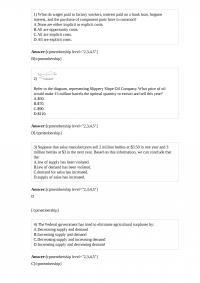
1) What do wages paid to factory workers, interest paid on a bank loan, forgone interest, and the purchase of component parts have in common? A.None are either implicit or explicit costs. B.All are opportunity costs. C.All are implicit costs. […]
ECB 828 Homework
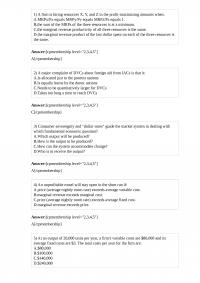
1) A firm is hiring resources X, Y, and Z in the profit-maximizing amounts when: A.MRPx/Px equals MRPy/Py equals MRPz/Pz equals 1. B.the sum of the MRPs of the three resources is at a minimum. C.the marginal revenue productivity of […]
ECB 849
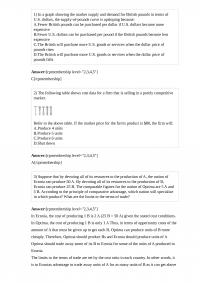
1) In a graph showing the market supply and demand for British pounds in terms of U.S. dollars, the supply-of-pounds curve is upsloping because: A.Fewer British pounds can be purchased per dollar if U.S. dollars become more expensive B.Fewer U.S. […]
ECB 850 Quiz 3
1) Refer to the above graph. It shows the cost curves for a competitive firm. If the market price of the product is $1.05 per unit, then the firm will produce how many units in the short run? A.Between 0 […]
ECB 850 Test 2
1) A monopolistically competitive industry combines elements of both competition and monopoly. It is correct to say that the competitive element results from: A.a relatively large number of firms and the monopolistic element from product differentiation. B.product differentiation and the […]
ECB 855 Midterm 2
1) All of the following statements about economic profits are correct, except that they: A.Act as a signal to producers who make decisions about how to allocate scarce resources B.Are influenced by the degree of monopoly power C.Represent a reward […]
ECB 875 1 A farmer discovers a
1) A farmer discovers a natural gas reserve on his property. He can extract the natural gas for a profit of $40 per unit now, $55 per unit in one year, $57 per unit in two years, and $60 in […]
ECB 877 Test 2
1) Alex and Ben are both loggers wanting to harvest timber from the same forest. Alex prefers to harvest and replant at a sustainable rate; Ben wants to harvest as many trees as possible to maximize short-run profit, and then […]
ECB 880 Test
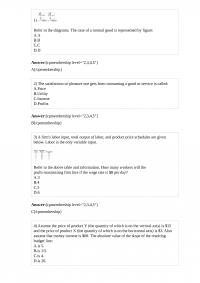
1) Refer to the diagrams. The case of a normal good is represented by figure: A.A B.B C.C D.D 2) The satisfaction or pleasure one gets from consuming a good or service is called: A.Price B.Utility C.Income D.Profits Answer: B […]
ECON 102 Test
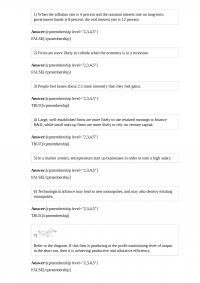
1) When the inflation rate is 4 percent and the nominal interest rate on long-term government bonds is 8 percent, the real interest rate is 12 percent. 2) Firms are more likely to collude when the economy is in a […]
ECON 112 Midterm 1
1) In the last six decades (1950-2009) farm employment in the U.S. has been: A.Increasing both in absolute numbers and as a proportion of the total employment B.Increasing in absolute numbers, but declining as a proportion of the total employment […]
ECON 117 Homework
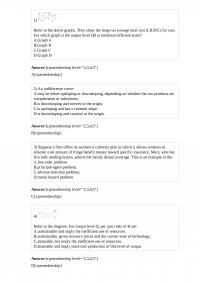
1) Refer to the above graphs. They show the long-run average total cost (LRATC) for cars. For which graph is the output level Q0 at minimum efficient scale? A.Graph A B.Graph B C.Graph C D.Graph D 2) An indifference curve: […]
ECON 117 Test 1
1) The entrance of large numbers of “baby boomers” into the labor force in the 1970s and 1980s: A.caused substantial reductions in permanent unemployment. B.lessened income inequality. C.increased income inequality. D.had no impact on income inequality. 2) Which of the […]
ECON 136
1) In the taste-for-discrimination model: A.a decline in discrimination will reduce the actual African-American-white wage ratio. B.an increase in collective discrimination coefficients of employers will reduce the demand for African-American workers, decrease the African-American wage, and increase African-American employment. C.firms […]
ECON 169 Midterm 1 1 Kelly works
1) Kelly works at an ice cream shop and observes that the number of people buying ice cream varies greatly from day to day. For a couple of weeks she has recorded the number of people at the shop each […]
ECON 173 Midterm
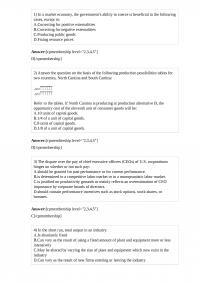
1) In a market economy, the government’s ability to coerce is beneficial in the following cases, except in: A.Correcting for positive externalities B.Correcting for negative externalities C.Producing public goods D.Fixing resource prices 2) Answer the question on the basis of […]
ECON 189 Final
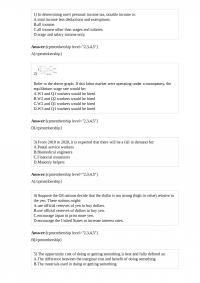
1) In determining one’s personal income tax, taxable income is: A.total income less deductions and exemptions. B.all income. C.all income other than wages and salaries. D.wage and salary income only. 2) Refer to the above graph. If this labor market […]
ECON 195 Midterm
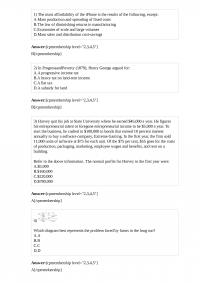
1) The mass affordability of the iPhone is the results of the following, except: A.Mass production and spreading of fixed costs B.The law of diminishing returns in manufacturing C.Economies of scale and large volumes D.Mass sales and distribution cost-savings 2) […]
ECON 219 Quiz 1
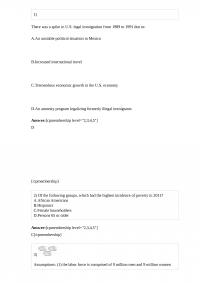
1) There was a spike in U.S. legal immigration from 1989 to 1991 due to: A.An unstable political situation in Mexico B.Increased international travel C.Tremendous economic growth in the U.S. economy D.An amnesty program legalizing formerly illegal immigrants 2) Of […]
ECON 235 Midterm 2
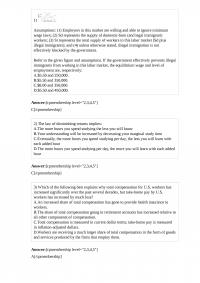
1) Assumptions: (1) Employers in this market are willing and able to ignore minimum wage laws; (2) Sd represents the supply of domestic-born (and legal immigrant) workers; (3) St represents the total supply of workers in this labor market (Sd […]
ECON 252
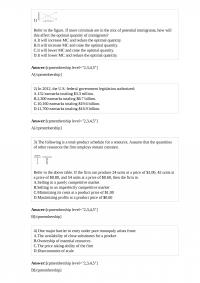
1) Refer to the figure. If more criminals are in the mix of potential immigrants, how will this affect the optimal quantity of immigrants? A.It will increase MC and reduce the optimal quantity. B.It will increase MC and raise the […]
ECON 270 Homework
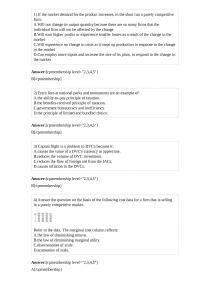
1) If the market demand for the product increases, in the short run a purely competitive firm: A.Will not change its output quantity because there are so many firms that the individual firm will not be affected by the change […]
ECON 284
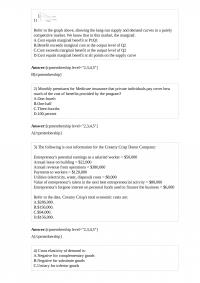
1) Refer to the graph above, showing the long-run supply and demand curves in a purely competitive market. We know that in this market, the marginal: A.Cost equals marginal benefit at P1Q1 B.Benefit exceeds marginal cost at the output level […]
ECON 285 1 An increase in the dollar
1) An increase in the dollar price of the British pounds will: A.Increase the pound price of dollars B.Decrease the pound price of dollars C.Leave the pound price of dollars unchanged D.Cause Britain’s terms of trade with the United States […]
ECON 294 Quiz 2
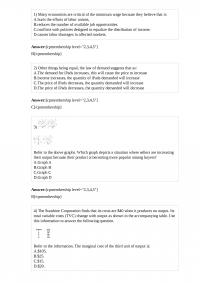
1) Many economists are critical of the minimum wage because they believe that it: A.hurts the efforts of labor unions. B.reduces the number of available job opportunities. C.conflicts with policies designed to equalize the distribution of income. D.causes labor shortages […]
ECON 300
1) The process by which new firms and new products replace existing dominant firms and products is called: A.monopolistic competition. B.mergers and acquisitions. C.process innovation. D.creative destruction. 2) Some economists have criticized standard government figures on income inequality, arguing that […]
ECON 341 Homework
1) Which of the following cases established that the mere possession of monopoly power violated antitrust laws? A.IBM case of 1982 B.Microsoft case of 1998 C.Alcoa case of 1945 D.AT&T case of 1982 2) According to behavioral economics: A.gains are […]
ECON 368 Midterm 1
1) After the implementation of TANF, the U.S. welfare rolls fell by more than one-half between 1996 and 2007. 2) If neither player has an incentive to deviate from the outcome of a game, the outcome is a Nash equilibrium. […]
ECON 380 Homework
1) About two-thirds of U.S. electricity is generated at coal and gas plants. 2) A purely competitive firm that is earning positive profits in its short-run equilibrium situation will continue to earn positive profits at the long-run equilibrium. Answer: FALSE […]
ECON 401 Test
1) To maximize profits, a competitive firm will maximize the difference between MRP and the wage rate for the laborers it hires. 2) In the U.S., the taxes mostly come from the rich and government spending mostly goes to programs […]
ECON 417 Quiz 2
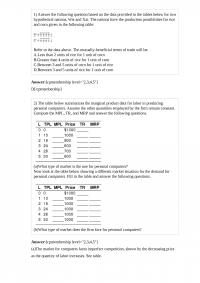
1) Answer the following question based on the data provided in the tables below for two hypothetical nations, Wat and Xat. The nations have the production possibilities for rice and corn given in the following table: Refer to the data […]
ECON 422
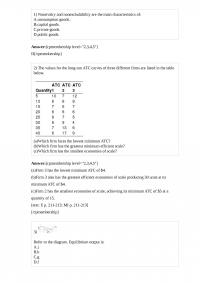
1) Nonrivalry and nonexcludability are the main characteristics of: A.consumption goods. B.capital goods. C.private goods. D.public goods. 2) The values for the long-run ATC curves of three different firms are listed in the table below. (a)Which firm faces the lowest […]
ECON 445 Midterm
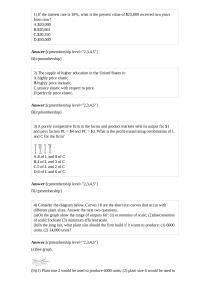
1) If the interest rate is 10%, what is the present value of $25,000 received two years from now? A.$20,000 B.$20,661 C.$30,250 D.$30,000 2) The supply of higher education in the United States is: A.highly price elastic. B.highly price inelastic. […]
ECON 447 Quiz
1) The fundamental economic question regarding the distribution of output in the economy is equivalent to the question of who will produce the output. 2) The dictator and ultimatum games reveal that fairness and concern for others motivate people’s behavior. […]
ECON 451 1 A fishery collapse
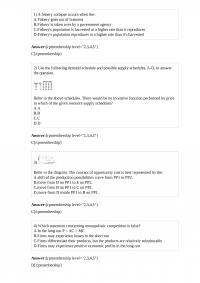
1) A fishery collapse occurs when the: A.Fishery goes out of business B.Fishery is taken over by a government agency C.Fishery’s population is harvested at a higher rate than it reproduces D.Fishery’s population reproduces at a higher rate than it’s […]
ECON 471 1Refer to the given data
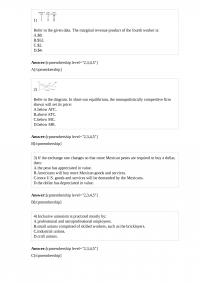
1) Refer to the given data. The marginal revenue product of the fourth worker is: A.$8. B.$52. C.$2. D.$4. 2) Refer to the diagram. In short-run equilibrium, the monopolistically competitive firm shown will set its price: A.below ATC. B.above ATC. […]
ECON 476
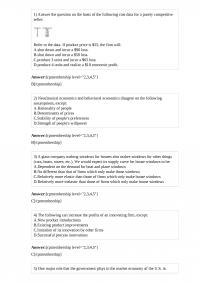
1) Answer the question on the basis of the following cost data for a purely competitive seller: Refer to the data. If product price is $25, the firm will: A.shut down and incur a $90 loss. B.shut down and incur […]
ECON 494 Quiz
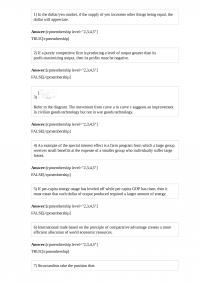
1) In the dollar/yen market, if the supply of yen increases other things being equal, the dollar will appreciate. 2) If a purely competitive firm is producing a level of output greater than its profit-maximizing output, then its profits must […]
ECON 505 Homework
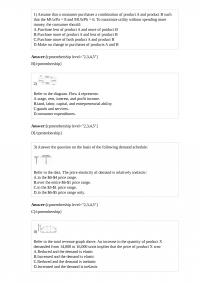
1) Assume that a consumer purchases a combination of product A and product B such that the MUa/Pa = 8 and MUb/Pb = 6. To maximize utility without spending more money, the consumer should: A.Purchase less of product A and […]
ECON 506 Test 2
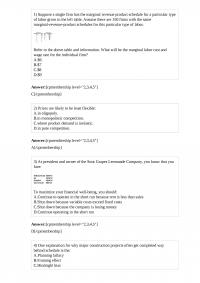
1) Suppose a single firm has the marginal revenue product schedule for a particular type of labor given in the left table. Assume there are 150 firms with the same marginal-revenue-product schedules for this particular type of labor. Refer to […]
ECON 521 Quiz 1
1) The Patient Protection and Affordable Care Act (PPACA) of 2010 is more commonly known as: A.Dodd Frank B.Obamacare C.Stimulus spending D.Quantitative easing (QE) 2) Suppose that Rosa is considering migration to another country. To move, she will have to […]
ECON 525 Midterm
1) If price changes and total revenue changes in the opposite direction, demand is relatively elastic. 2) An increase in the expected rates of return on investments would most likely increase the supply of loanable funds. Answer: FALSE 3) The […]
ECON 537 Midterm 2
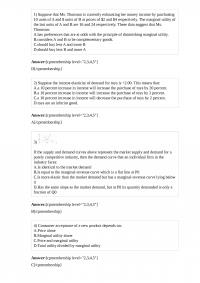
1) Suppose that Ms. Thomson is currently exhausting her money income by purchasing 10 units of A and 8 units of B at prices of $2 and $4 respectively. The marginal utility of the last units of A and B […]
ECON 545 Test 2
1) Assume that an industry is significantly affected by import competition from foreign suppliers. Taking this factor into account, it would mean that: A.The Herfindahl index would be significantly higher in that industry because there are more firms in the […]
ECON 563 Quiz 2 1 The real
1) The real interest rate can be estimated by: A.subtracting the pure interest rate from the nominal interest rate. B.dividing the nominal interest rate by the consumer price index. C.subtracting the nominal interest rate from the rate of inflation. D.subtracting […]
ECON 565 Homework
1) Indifference curve analysis: A.presumes, as does utility analysis, that satisfaction is numerically measurable. B.presumes, unlike utility analysis, that satisfaction is numerically measurable. C.presumes only that the consumer can say one combination of two goods yields more or less utility […]
ECON 582 Test 2
1) What does “there is no such thing as a free lunch” mean in economics? A.That scarce resources are used up to provide “freebies” and giveaways B.That sometimes people may take friends out to lunch and pay for them C.That […]
ECON 626 Quiz 1
1) If income inequality is increasing, it means that the income levels of the poor are falling while the income levels of the rich are rising. 2) The risk that the firm’s employees might get hurt while working is an […]
ECON 629 Test 1 Which of the
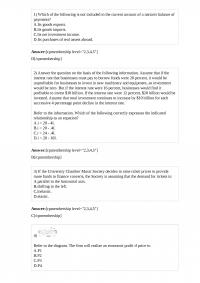
1) Which of the following is not included in the current account of a nation’s balance of payments? A.Its goods exports. B.Its goods imports. C.Its net investment income. D.Its purchases of real assets abroad. 2) Answer the question on the […]
ECON 646
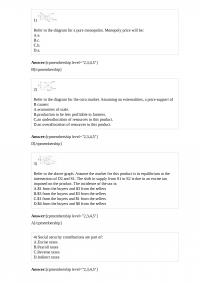
1) Refer to the diagram for a pure monopolist. Monopoly price will be: A.e. B.c. C.b. D.a. 2) Refer to the diagram for the corn market. Assuming no externalities, a price support of B causes: A.economies of scale. B.production to […]
ECON 652 Test
1) Maximum profits are what motivate consumers to decide who will get the goods and services in a market system. 2) The era after the Industrial Revolution proved that it was impossible to have improved standards of living with large […]
ECON 655
1) Economists widely support deregulation of industries that tend toward monopoly or generate substantial negative externalities. 2) The simple immigration model suggests that labor migration raises the wage rate in the country of origin while reducing the wage rate in […]
ECON 694
1) Normal profit is considered an economic cost. 2) The fundamental reason that newspapers have such high prices is the high production costs from diseconomies of scale. Answer: FALSE 3) One implication of the median-voter model as applied to a […]
ECON 726 Quiz 2
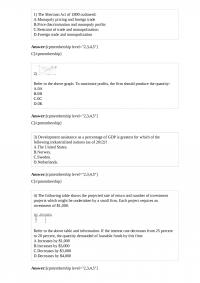
1) The Sherman Act of 1890 outlawed: A.Monopoly pricing and foreign trade B.Price discrimination and monopoly profits C.Restraint of trade and monopolization D.Foreign trade and monopolization 2) Refer to the above graph. To maximize profits, the firm should produce the […]
ECON 743 Midterm 1
1) When a bakery manager reports that at her bakery, productivity of her 15 workers last month was 1,800 loaves per worker, she is referring to the: A.Total product of labor B.Average product of labor C.Marginal product of labor D.Total […]
ECON 757
1) Factors that have hampered the increase in the supply of physicians in the U.S. include the following, except: A.Actions by doctors’ unions, like the AMA B.Rising direct expenses for a medical degree C.Higher opportunity cost of medical education and […]
ECON 799
1) The introduction of automatic elevator equipment allowed firms to handle the movement of people in a multi-story building at less cost, thus decreasing the demand for elevator operators. The best explanation for this change is that the: A.Marginal product […]
ECON 814 Test 1 Informal
1) Informal collusion to restrict output and increase prices is sometimes referred to as a: A.Merger B.Cartel C.Tacit understanding D.Kinked-demand oligopoly 2) An implication of the taste-for-discrimination model is that: A.discrimination can lower a firm’s production costs. B.discrimination will move […]
ECON 819 Midterm 1
1) U.S. exports represent two flows: A.An outflow of goods or services, and an outflow of payments B.An inflow of goods or services, and an outflow of payments C.An outflow of goods or services, and an inflow of payments D.An […]
ECON 830
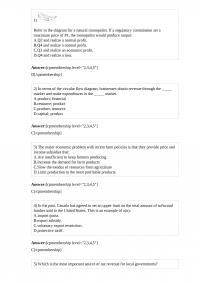
1) Refer to the diagram for a natural monopolist. If a regulatory commission set a maximum price of P1, the monopolist would produce output: A.Q2 and realize a normal profit. B.Q4 and realize a normal profit. C.Q3 and realize an […]
ECON 839 Final
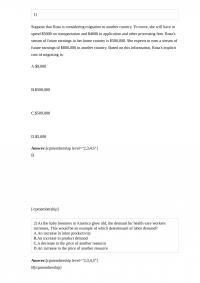
1) Suppose that Rosa is considering migration to another country. To move, she will have to spend $5000 on transportation and $4000 in application and other processing fees. Rosa’s stream of future earnings in her home country is $500,000. She […]
ECON 845 Midterm 2
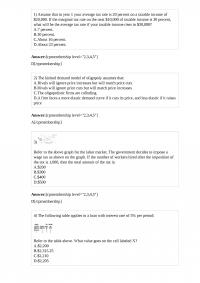
1) Assume that in year 1 your average tax rate is 20 percent on a taxable income of $20,000. If the marginal tax rate on the next $10,000 of taxable income is 30 percent, what will be the average tax […]
ECON 846 Homework
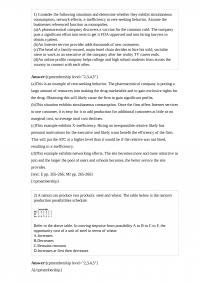
1) Consider the following situations and determine whether they exhibit simultaneous consumption, network effects, x-inefficiency or rent-seeking behavior. Assume the businesses referenced function as monopolies. (a)A pharmaceutical company discovers a vaccine for the common cold. The company puts a significant […]
ECON 863 Quiz 3
1) The domestic opportunity cost of producing 100 barrels of chemicals in Germany is one ton of steel. In France, the domestic opportunity cost of producing 100 barrels of chemicals is two tons of steel. In this case: A.France has […]
ECON 880 Final
1) Assume the total real output of a developing country increases from $8 billion to $8.2 billion while its population expands from 14 to 15 million people from one year to the next. Over the year, per capita income has: […]
ECON 891 Final
1) When gasoline at $3.60/gallon looks relatively cheap after a period of $5-a-gallon gas, that’s an illustration of the: A.Planning fallacy B.Confirmation bias C.Framing effect D.Availability heuristic 2) Entrepreneurs are those people who are: A.Their own bosses B.Executive officers of […]
ECON 892
1) An increase in the mobility of labor across nations tends to decrease the world’s output of goods and services. 2) If the real outputs per capita of a rich nation and a poor nation grow at the same percentage […]
ECON 895
1) In recent years, the industrially advanced nations as a group have provided foreign aid amounting to about what percentage of their aggregate outputs? A.0.25 percent. B.0.7 percent. C.1 percent. D.2 percent. 2) In a sequential game, the first mover […]
ECON A 125
1) The downward-sloping demand curve of a monopolistic competitor: A.Reflects some level of control over its own price B.Becomes eventually horizontal in the long run C.Indicates collusion among the members of the product group D.Ensures that the firm will produce […]
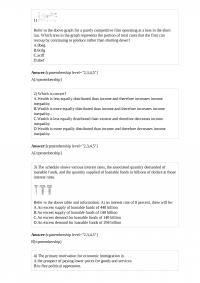
ECON A 138 Midterm 1
1) Refer to the above graph for a purely competitive firm operating at a loss in the short run. Which area in the graph represents the portion of total costs that the firm can recoup by continuing to produce rather […]
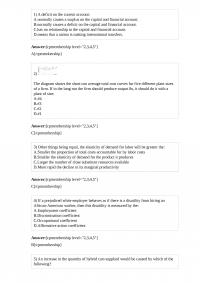
ECON A 154 Quiz 1
1) A deficit on the current account: A.normally causes a surplus on the capital and financial account. B.normally causes a deficit on the capital and financial account. C.has no relationship to the capital and financial account. D.means that a nation […]
ECON A 172
1) If taxes are $2,000 when income is $15,000 and they are $3,000 when income is $19,000, then the marginal tax rate is: A.20 percent B.25 percent C.30 percent D.40 percent 2) Which statement is correct? A.The percentage change in […]
ECON A 175
1) Some employers have reacted to rising health care costs by hiring more part-time and temporary workers. 2) Income elasticity measures the effect of a change in income on the purchases of some good or service. Answer: TRUE 3) If […]
ECON A 183 Quiz 2
1) Which of the following countries has the highest Gini ratio, as of 2011? A.Italy. B.United States. C.South Africa. D.Mexico. 2) When the elasticity coefficient for resource demand is less than one, resource demand is: A.inelastic. B.elastic. C.unit-elastic. D.infinitely elastic. […]
ECON A 187 Quiz 1
1) Refer to the diagram. Arrows (1) and (3) are associated with: A.the money market. B.the resource market. C.the product market. D.international trade. 2) Kara and Kyle are competing sockeye salmon fishers. Both have been allocated ITQs that limit their […]
ECON A 204 Homework
1) In the inverted-U theory of R&D: A.process innovation and product innovation are inversely related. B.technological change is inversely related to scientific discovery. C.R&D expenditures rise continuously as a percentage of firms’ sales as industry concentration rises. D.R&D expenditures first […]
ECON A 213 Quiz 1
1) In which of the following industry structures is the entry of new firms the most difficult? A.Pure monopoly. B.Oligopoly. C.Monopolistic competition. D.Pure competition. 2) The individual firm in a purely competitive labor market faces: A.a perfectly elastic labor supply […]
ECON A 215 Test 2
1) Answer the question on the basis of the following production possibilities tables for two countries, North Cantina and South Cantina: Refer to the tables. The opportunity cost of the fifth unit of capital goods: A.is higher in North Cantina […]
ECON A 225 Quiz 1
1) In pure competition, if the market price of the product is initially higher than the minimum average cost of the firms, then: A.Some firms will exit the industry and the industry supply will decrease B.Other firms will enter the […]
ECON A 230 Quiz 3
1) Which of the following would be a significant cause of income inequality in the United States? A.Housing B.Discrimination C.In-kind transfers D.Social Security 2) The U.S. Department of Agriculture’s productivity index in terms of farm output per unit of farm […]
ECON A 242 Test
1) Refer to the above graph for a purely competitive firm. When the firm is in equilibrium in the short run, its average fixed cost is: A.EH B.DE C.DH D.DB 2) If you sum the squares of the market shares […]
ECON A 246 Homework
1) Refer to the above graph. A 3-percent general sales tax would have a structure that is illustrated by: A.Curve A B.Curve B C.Curve C D.None of the graphs 2) If the price of A is $12 and the price […]
ECON A 250 Homework
1) U.S. workers will be attracted to otherwise undesirable work as long as: A.The compensating wage differential is high enough B.The compensating wage differential is low enough C.There are not enough illegal immigrants to fill all of the available jobs […]
ECON A 261 Midterm 2
1) When critics of unemployment insurance claim that some of the unemployed are not exerting much effort to find jobs because of the unemployment benefits, they are referring to the moral hazard problem. 2) If the nominal rate of interest […]
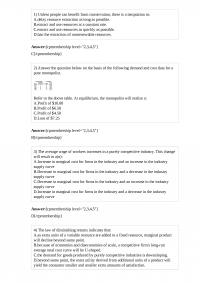
ECON A 261 Quiz
1) Unless people can benefit from conservation, there is a temptation to: A.delay resource extraction as long as possible. B.extract and use resources at a constant rate. C.extract and use resources as quickly as possible. D.ban the extraction of nonrenewable […]
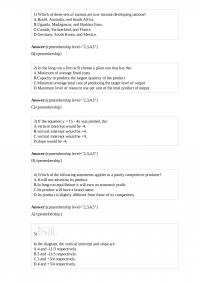
ECON A 267 Midterm
1) Which of these sets of nations are low-income developing nations? A.Brazil, Australia, and South Africa. B.Uganda, Madagascar, and Burkina Faso. C.Canada, Switzerland, and France. D.Germany, South Korea, and Mexico. 2) In the long run a firm will choose a […]
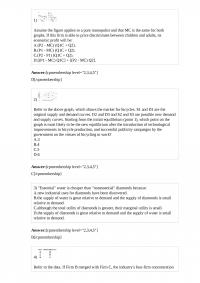
ECON A 270 Quiz
1) Assume the figure applies to a pure monopolist and that MC is the same for both graphs. If this firm is able to price discriminate between children and adults, its economic profit will be: A.(P2 – MC) (Q1C + […]
ECON A 281
1) The interest rate is the price paid for the use of money. 2) ITQs both limit catches and encourage fishing in the least costly way. Answer: TRUE 3) In analyzing a market system, economists often assume that firms will […]
ECON A 285 Homework
1) Refer to the data. At $20 million of R&D expenditures, the: A.marginal cost of R&D exceeds the marginal benefit. B.expected total return from R&D is at a maximum. C.interest-rate cost of funds is negative. D.marginal benefit of R&D exceeds […]
ECON A 288 Test 2
1) Saving is a larger percentage of domestic output in DVCs than in IACs, but the saving is put to poor use. 2) The vast majority of the labor forces of the low-income DVCs are engaged in agriculture. Answer: TRUE […]
ECON A 289
1) Suppose that the Anytown city government asks private citizens to donate money to support the town’s annual holiday lighting display. Assuming that the citizens of Anytown enjoy the lighting display, the request for donations suggests that: A.the display creates […]
ECON A 296 Midterm 2
1) The low-energy mental shortcuts or heuristics that the human brain commonly employs is one major reason for the systematic errors in decision-making that people make which is the focus of behavioral economics. 2) Noncash gift-giving involves value loss when […]
ECON A 308 Midterm 2
1) The principal beneficiaries of government agricultural aid have been the very low-income farmers. 2) If a firm doubles its resource inputs and as a result output triples, then the long-run average cost curve must be upward-sloping. Answer: FALSE 3) […]
ECON A 314 1 When a competitive
1) When a competitive firm is in long-run equilibrium, its accounting profits are greater than zero. 2) Answer the question on the basis of the following information. Assume that by devoting all its resources to the production of X, nation […]
ECON A 314 Quiz 3
1) If the price of hand calculators falls from $10 to $9 and, as a result, the quantity demanded increases from 100 to 125, then: A.demand is elastic. B.demand is inelastic. C.demand is of unit elasticity. D.not enough information is […]
ECON A 319 Quiz
1) One reason for the year-to-year instability of agricultural product demand is the: A.High price-elasticity for agricultural products B.Fluctuations in weather patterns C.Declining role of technological progress in agriculture D.Greater dependence on exports to foreign markets 2) Which of the […]
ECON A 323 Quiz
1) If a technological advance increases a firm’s labor productivity, we would expect its: A.average total cost curve to rise. B.average total cost curve to fall. C.total cost curve to rise. D.average total cost curve to be unaffected. 2) Suppose […]
ECON A 324
1) Refer to the diagrams for two separate product markets. Assume that society’s optimal level of output in each market is Q0 and that government purposely shifts the market supply curve from S to S1 in diagram (a) on the […]
ECON A 335 Test 2
1) If technology dictates that labor and capital must be used in fixed proportions, an increase in the price of capital will cause a firm to use: A.more labor as a consequence of the substitution effect. B.more labor as a […]
ECON A 345 Quiz 2
1) A firm pays the market equilibrium wage of $15.00 an hour, and the workers produce 25 units of output an hour. If the firm adopts an efficiency-wage policy, then the wage rate for these workers would be expected to: […]
ECON A 362 Midterm 2
1) The table below shows the rate of return and R&D spending for a hypothetical firm. Refer to the above table. Assume the interest-rate cost of funds falls from 10 percent to 6 percent. What will happen to the optimal […]
ECON A 367 Test
1) The parity concept of agricultural policy suggests that farmers should obtain a constant ratio of the prices they receive for their farm products and the prices they pay for goods and services in general. 2) Industrial unions are more […]
ECON A 395 Midterm
1) Assume that in year 1 you pay an average tax rate of 20 percent on a taxable income of $20,000. In year 2, you pay an average tax rate of 25 percent on a taxable income of $30,000. Assuming […]
ECON A 422 Midterm 2
1) From the viewpoint of a firm, competition can come even from other firms that are not in the same industry. 2) Because of their large-scale level of production, pure monopolists overallocate resources to their industry by producing beyond the […]
ECON A 448 Final
1) In 2001, a U.S. court of appeals tossed out an earlier U.S. district court order that Microsoft: A.license Windows for sale by competitors. B.be split into two competing firms. C.divest itself of its Word and PowerPoint software programs. D.end […]
ECON A 460 Midterm 1
1) Normative statements are expressions of facts. 2) An increase in the supply of farm products relative to the demand for them tends to cause farm incomes to decline. Answer: TRUE 3) The Temporary Assistance for Needy Families (TANF) that […]
ECON A 471 Test 1
1) What activity traditionally receives the largest share of total business spending on R&D (research and development) in the U.S.? A.Invention B.Development C.Basic research D.Applied research 2) Between 2002 and 2011, legal immigration into the U.S. averaged about: A.500,000 per […]
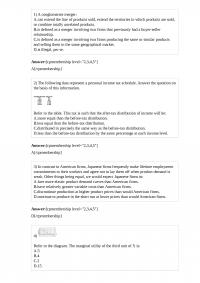
ECON A 478 Final
1) A conglomerate merger: A.can extend the line of products sold, extend the territories in which products are sold, or combine totally unrelated products. B.is defined as a merger involving two firms that previously had a buyer-seller relationship. C.is defined […]
ECON A 478 Homework
1) The largest source of tax revenue for state governments is the property tax. 2) A decrease in supply of X increases the equilibrium price of X, which reduces the demand for X and automatically returns the price of X […]
ECON A 499 1 Junior collects
1) Junior collects baseball cards. He owns one Felix Hernandez card that sells in most shops for $15. He is interested in buying a different Felix card that also sells for $15. According to behavioral economics: A.Junior should value the […]
ECON A 502 Midterm 2
1) The marginal cost to a firm of R&D expenditures is the market interest rate the firm must pay to obtain the needed financing. 2) Present value allows us to weigh the benefits and costs of using resources today or […]
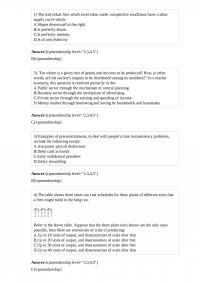
ECON A 505 Midterm 1
1) The individual firm which hires labor under competitive conditions faces a labor supply curve which: A.Slopes downward to the right B.Is perfectly elastic C.Is perfectly inelastic D.Is of unit elasticity 2) “For whom is a given mix of goods […]
ECON A 513
1) The United States produces more than twice as much output per million BTUs of energy consumed than it did in 1950. 2) Only politicians, not the voters, are to blame for the problem of chronic budget deficits that many […]
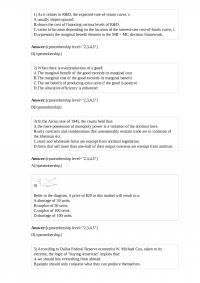
ECON A 573 Quiz 3
1) As it relates to R&D, the expected-rate-of-return curve, r: A.usually slopes upward. B.shows the cost of financing various levels of R&D. C.varies in location depending on the location of the interest-rate cost-of-funds curve, i. D.represents the marginal benefit element […]
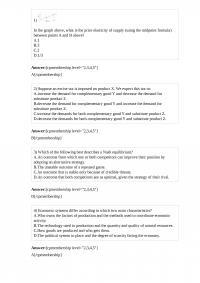
ECON A 586 Test 2
1) In the graph above, what is the price elasticity of supply (using the midpoint formula) between points A and B above? A.1 B.3 C.2 D.1/3 2) Suppose an excise tax is imposed on product X. We expect this tax […]
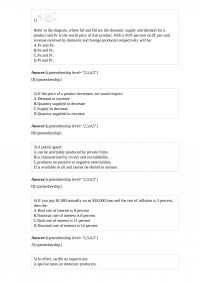
ECON A 589
1) Refer to the diagram, where Sd and Dd are the domestic supply and demand for a product and Pc is the world price of that product. With a PcPt per-unit tariff, per-unit revenue received by domestic and foreign producers […]
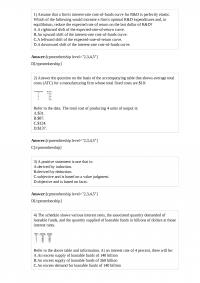
ECON A 591 Quiz 2
1) Assume that a firm’s interest-rate cost-of-funds curve for R&D is perfectly elastic. Which of the following would increase a firm’s optimal R&D expenditures and, in equilibrium, reduce the expected rate of return on the last dollar of R&D? A.A […]
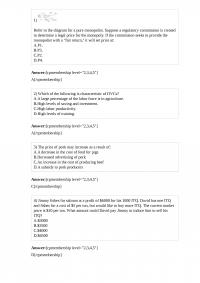
ECON A 607 Test 1
1) Refer to the diagram for a pure monopolist. Suppose a regulatory commission is created to determine a legal price for the monopoly. If the commission seeks to provide the monopolist with a “fair return,” it will set price at: […]
ECON A 612 1 If the demand for wheat
1) If the demand for wheat is highly price inelastic, an extraordinarily large crop may reduce farm incomes. 2) The problems of central planning become less complex as an economy grows in size over time. Answer: FALSE 3) Hiring the […]
ECON A 625
1) There is an adverse selection problem in the market for used cars because: A.Owners of poor-quality cars have a strong incentive to sell their cars, while owners of high-quality used cars have more incentive to keep their cars B.Owners […]
ECON A 629
1) Assuming competitive markets with typical supply and demand curves, which of the following statements is correct? A.An increase in supply with a decrease in demand will result in an increase in price. B.An increase in supply with no change […]
ECON A 634 Quiz 1
1) “Remittances” occur when: A.two countries send immigrants to each other in approximately equal numbers. B.physical capital flows into a country that has lost labor due to migration. C.immigrants send financial payments back to family in their country of origin. […]
ECON A 638 Midterm
1) Price support programs for agricultural products tend to cause shortages of these products. 2) Restricting the supply of labor is a means of increasing wage rates more commonly used by industrial unions than craft unions. Answer: FALSE 3) The […]
ECON A 647 Quiz 1
1) The concept of price elasticity of demand measures: A.the slope of the demand curve. B.the number of buyers in a market. C.the extent to which the demand curve shifts as the result of a price decline. D.the sensitivity of […]
ECON A 650
1) The demand curve for a purely competitive industry is perfectly elastic, but the demand curves faced by individual firms in such an industry are downsloping. 2) The arguments that illegal immigrants do not take away jobs from legal residents, […]
ECON A 655 Quiz 2
1) Refer to the diagrams. The demand for Firm B’s product is elastic at all prices in excess of $4. 2) Marginal analysis means that decision makers compare the extra benefits with the extra costs of a specific choice. Answer: […]
ECON A 670 Test 2
1) Which of the following claims is not made by opponents of a value-added tax (VAT)? A.Savings and investment is discouraged because future consumption is penalized. B.The VAT is regressive, potentially leading to additional progressive taxes to offset the regressive […]
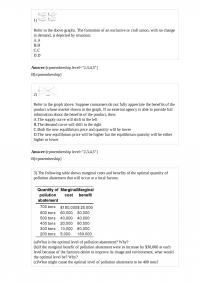
ECON A 680 Quiz
1) Refer to the above graphs. The formation of an exclusive or craft union, with no change in demand, is depicted by situation: A.A B.B C.C D.D 2) Refer to the graph above. Suppose consumers do not fully appreciate the […]
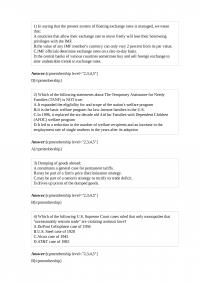
ECON A 683
1) In saying that the present system of floating exchange rates is managed, we mean that: A.countries that allow their exchange rate to move freely will lose their borrowing privileges with the IMF. B.the value of any IMF member’s currency […]
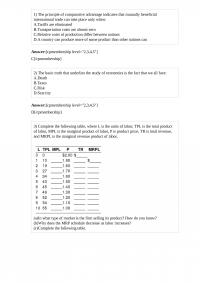
ECON A 741 Quiz
1) The principle of comparative advantage indicates that mutually beneficial international trade can take place only when: A.Tariffs are eliminated B.Transportation costs are almost zero C.Relative costs of production differ between nations D.A country can produce more of some product […]
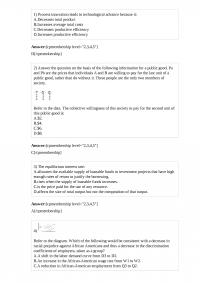
ECON A 742 Test 2
1) Process innovation leads to technological advance because it: A.Decreases total product B.Increases average total costs C.Decreases productive efficiency D.Increases productive efficiency 2) Answer the question on the basis of the following information for a public good. Pa and Pb […]
ECON A 749 Quiz 1
1) The ability of the DVCs to use the technologies of the IACs is somewhat limited because: A.the IACs have patents on most of their technologies. B.the IACs and the DVCs have much different resource endowments. C.the technologies of the […]
ECON A 749 Quiz 3
1) In the short run, the individual competitive firm’s supply curve is that segment of the: A.average variable cost curve lying below the marginal cost curve. B.marginal cost curve lying above the average variable cost curve. C.marginal revenue curve lying […]
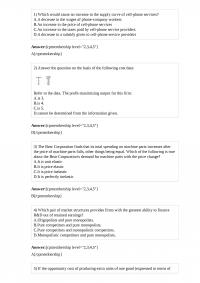
ECON A 751 Quiz 3
1) Which would cause an increase in the supply curve of cell-phone services? A.A decrease in the wages of phone-company workers B.An increase in the price of cell-phone services C.An increase in the taxes paid by cell-phone service providers D.A […]
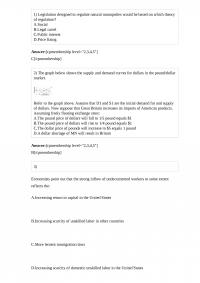
ECON A 773 Midterm 2
1) Legislation designed to regulate natural monopolies would be based on which theory of regulation? A.Social B.Legal cartel C.Public interest D.Price fixing 2) The graph below shows the supply and demand curves for dollars in the pound/dollar market. Refer to […]
ECON A 774 Quiz
1) Taxes on commodities or on purchases are known as: A.corporate income taxes. B.sales and excise taxes. C.personal income taxes. D.payroll taxes. 2) The fundamental cause of agricultural price and income instability in the United States has been a(n): A.Lack […]
ECON A 783 1 The purely
1) The purely competitive employer of resource A will maximize the profits from A by equating the: A.price of A with the MRP of A. B.marginal productivity of A with the MRC of A. C.marginal productivity of A with the […]
ECON A 792
1) According to behavioral economists, people tend to put too much weight on the future when they make decisions. 2) The present choice of position on the production possibilities curve will not influence the future location of the curve. Answer: […]
ECON A 799 Quiz 3
1) Voters’ preference for having government programs serve them is inherently in conflict with their preference to pay no taxes. 2) Allocative efficiency occurs where (for the last unit) maximum willingness to pay exceeds minimum acceptable price by the greatest […]
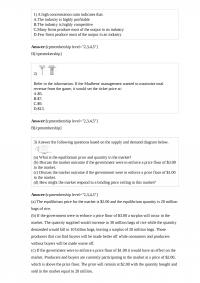
ECON A 806 Homework
1) A high concentration ratio indicates that: A.The industry is highly profitable B.The industry is highly competitive C.Many firms produce most of the output in an industry D.Few firms produce most of the output in an industry 2) Refer to […]
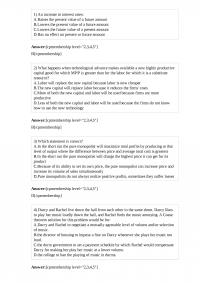
ECON A 809 1 An increase in
1) An increase in interest rates: A.Raises the present value of a future amount B.Lowers the present value of a future amount C.Lowers the future value of a present amount D.Has no effect on present or future amount 2) What […]
ECON A 819 Midterm 1
1) The marginal utility of leisure time appears to: A.Be the same even for people with widely different incomes B.Be exempt from the law of diminishing marginal utility C.Increase as the quantity of available leisure time decreases D.Equal zero for […]
ECON A 826
1) Which set of characteristics below best describes the basic features of monopolistic competition? A.Easy entry, many firms, and standardized products B.Barriers to entry, few firms, and differentiated products C.Easy entry, many firms, and differentiated products D.Easy entry, few firms, […]
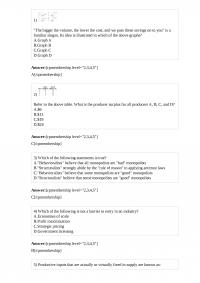
ECON A 829 Quiz 2
1) “The bigger the volume, the lower the cost, and we pass these savings on to you” is a familiar slogan. Its idea is illustrated in which of the above graphs? A.Graph A B.Graph B C.Graph C D.Graph D 2) […]
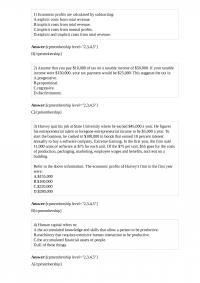
ECON A 840 Midterm 2
1) Economic profits are calculated by subtracting: A.explicit costs from total revenue. B.implicit costs from total revenue. C.implicit costs from normal profits. D.explicit and implicit costs from total revenue. 2) Assume that you pay $10,000 of tax on a taxable […]
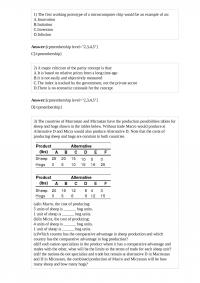
ECON A 854 Test 1
1) The first working prototype of a microcomputer chip would be an example of an: A.Innovation B.Imitation C.Invention D.Infusion 2) A major criticism of the parity concept is that: A.It is based on relative prices from a long time ago […]
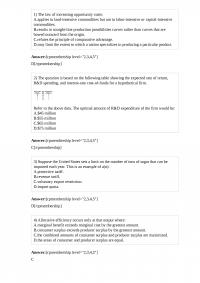
ECON A 859 Midterm
1) The law of increasing opportunity costs: A.applies to land-intensive commodities but not to labor-intensive or capital-intensive commodities. B.results in straight-line production possibilities curves rather than curves that are bowed outward from the origin. C.refutes the principle of comparative advantage. […]
ECON A 863
1) Farm policy in the United States over the past eight decades has been designed primarily to: A.Shift resources from the farm sector to the nonfarm sector B.Reduce monopoly in the farm sector C.Enhance and stabilize farm prices and income […]
ECON A 889 Quiz 1
1) The fast-food restaurant industry would be an example of which market model? A.Monopolistic competition B.Pure competition C.Pure monopoly D.Oligopoly 2) An electricity company has the opportunity to use natural gas to generate electricity at a cost of $30 per […]
ECON E 101 Midterm 2
1) According to prospect theory, firms are more likely to shrink packages than raise prices because: A.consumers feel the loss of a price increase more than they feel the loss of buying a smaller package for their money. B.they don’t […]
ECON E 135 Midterm
1) Majority voting may produce economically inefficient outcomes because it: A.Does not always lead to fair results B.Requires everyone to vote and bear the costs C.Does not consider the strength of individual voters’ preferences D.Does not provide benefits to everyone […]
ECON E 150
1) The persistence of some “urban legends” and some myths is a reflection of the: A.Framing effect B.Confirmation bias C.Hindsight bias D.Availability heuristic 2) Most economists agree that deregulation in the 1970s and 1980s greatly benefited consumers in the following […]
ECON E 163 Homework
1) Which of the following would, other things equal, reduce the demand for U.S. farm products? A.Poorer crops abroad. B.Strong economic growth abroad. C.Improved trade relations with China and Russia. D.Appreciation of the U.S. dollar. 2) New scientific knowledge mainly […]
ECON E 171 Quiz
1) Assume a DVC has a real per capita output of $1,000 as compared to $20,000 for an IAC. If both nations realize a 4 percent growth of their real per capita outputs, after one year the absolute real per […]
ECON E 181 Test 2
1) Refer to the diagram pertaining to two nations and a specific product. Point G is the: A.domestic price for the nation represented by lines FA and FC. B.world equilibrium price. C.domestic price for the nation represented by lines GB […]
ECON E 204 Final
1) Earnings received from wealth: A.Contribute to income inequality B.Are the major source of income for families C.Are becoming more equal in the society D.Are primarily the result of advanced education 2) Monopolistic competition means: A.a market situation where competition […]
ECON E 207
1) Refer to the graph above. If the industry were purely competitive, then the market price would be: A.$25, which is higher than what the price would have been if the industry were a monopoly B.$25, which is lower than […]
ECON E 242 Homework
1) Refer to the above graph with three demand curves. An “increase in quantity demanded” would be illustrated by a change from: A.Point 4 to point 6 B.Point 5 to point 1 C.Point 4 to point 1 D.Point 2 to […]
ECON E 270 Midterm 1
1) Assume that if the interest rate that businesses must pay to borrow funds were 20 percent, it would be unprofitable for businesses to invest in new machinery and equipment, so investment would be zero. But if the interest rate […]
ECON E 287
1) Answer the question based on the table below showing the marginal utility schedules for product X and product Y for a hypothetical consumer. The price of product X is $4 and the price of product Y is $2. The […]
ECON E 291
1) Assume that the graphs show a competitive market for the product stated in the question. Select the graph above that best shows the change in the market specified in the following situation: In the market for leather coats, when […]
ECON E 308 Test
1) If you pay a $2,000 tax on $10,000 of taxable income and a $4,000 tax on a taxable income of $16,000, the tax is progressive. 2) The supply curve for a monopolist is the upward-sloping portion of the marginal […]
ECON E 326
1) Refer to the diagram. Marginal utility: A.increases at an increasing rate. B.becomes negative after consuming 4 units of output. C.is found by dividing total utility by the number of units purchased. D.cannot be calculated from the total utility information. […]
ECON E 342 Homework
1) During the past thirty-five years or so, the degree of income inequality in the United States has decreased considerably. 2) The entrepreneur’s sole function is to combine other resources (land, labor, and capital) in the production of some good […]
ECON E 358
1) The concept of limited and bundled choice, as used in public choice theory, refers to the fact that: A.Politicians may not be objective in evaluating economic policy programs B.Because of the importance of television and other modern communication techniques, […]
ECON E 358 1 The exchange rate
1) The exchange rate system that we now have for major currencies like the U.S. dollar, yen, and euro is a “managed-floating” system. 2) The short-run supply curve of a purely competitive industry tends to be steeper than the long-run […]
ECON E 415 Final
1) Since 1990, U.S. immigrants have founded ____ of every _____ public companies financed by venture capital. A.1; 4 B.1; 3 C.1; 2 D.2; 5 2) Entrepreneurs: A.work exclusively in government and university R&D laboratories. B.often form small companies called […]
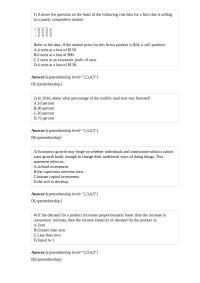
ECON E 419 Homework
1) Answer the question on the basis of the following cost data for a firm that is selling in a purely competitive market. Refer to the data. If the market price for this firm’s product is $24, it will produce: […]
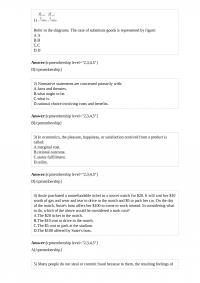
ECON E 419 Test 1
1) Refer to the diagrams. The case of substitute goods is represented by figure: A.A B.B C.C D.D 2) Normative statements are concerned primarily with: A.facts and theories. B.what ought to be. C.what is. D.rational choice involving costs and benefits. […]
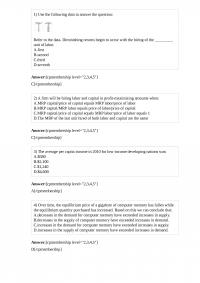
ECON E 428
1) Use the following data to answer the question: Refer to the data. Diminishing returns begin to occur with the hiring of the _________ unit of labor. A.first B.second C.third D.seventh 2) A firm will be hiring labor and capital […]
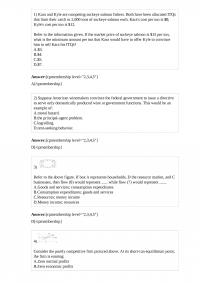
ECON E 432 Midterm 1 Kara and Kyle
1) Kara and Kyle are competing sockeye salmon fishers. Both have been allocated ITQs that limit their catch to 2,000 tons of sockeye salmon each. Kara’s cost per ton is $8; Kyle’s cost per ton is $12. Refer to the […]
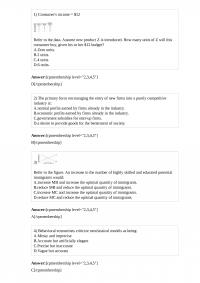
ECON E 438
1) Consumer’s income = $12 Refer to the data. Assume new product Z is introduced. How many units of Z will this consumer buy, given his or her $12 budget? A.Zero units. B.2 units. C.4 units. D.6 units. 2) The […]
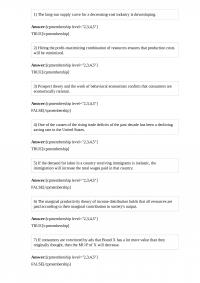
ECON E 473 Quiz
1) The long-run supply curve for a decreasing-cost industry is downsloping. 2) Hiring the profit-maximizing combination of resources ensures that production costs will be minimized. Answer: TRUE 3) Prospect theory and the work of behavioral economists confirm that consumers are […]
ECON E 489 Test 2
1) According to Paul Ehrlich’s 1968 prediction in The Population Bomb, population growth would result in: A.Overuse of natural resources leading to famines B.Stable uses of natural resources creating long-term stability C.Efficient use of natural resources fostering prosperity D.Reduced dependence […]
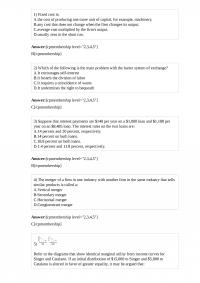
ECON E 499 Quiz
1) Fixed cost is: A.the cost of producing one more unit of capital, for example, machinery. B.any cost that does not change when the firm changes its output. C.average cost multiplied by the firm’s output. D.usually zero in the short […]
ECON E 501 Homework
1) Elephants are moving closer to extinction in places where they are treated as private property. 2) An economy cannot produce at a point outside of its production possibilities curve because human economic wants are insatiable. Answer: FALSE 3) Normal […]
ECON E 505 Quiz 2
1) The demand curve in a purely competitive industry is ______, while the demand curve to a single firm in that industry is ______. A.perfectly inelastic; perfectly elastic B.downsloping; perfectly elastic C.downsloping; perfectly inelastic D.perfectly elastic; downsloping 2) The view […]
ECON E 534 Test 1
1) An economy will always operate at some point on its production possibilities curve. 2) The probable incidence of the tax on business property is on consumers. Answer: TRUE 3) A major factor explaining economies of scale is increased specialization […]
ECON E 540 Final
1) If a more efficient technology was discovered by a firm, there would be: A.An upward shift in the AVC curve B.An upward shift in the AFC curve C.A downward shift in the AFC curve D.A downward shift in the […]
ECON E 540 Test 2
1) The following data show the supply and demand schedules for a product. Refer to the above data. The government now introduces a subsidy payment to producers of $30 per unit. Assuming a purely competitive market for the product, the […]
ECON E 550 1 A decrease in the
1) A decrease in the prices of two products that a consumer buys out of a constant budget would cause the consumer’s: A.Indifference curves to shift outward from the origin B.Indifference curves to shift inward to the origin C.Budget line […]
ECON E 553 Quiz
1) Refer to the diagram, where Sd and Dd are the domestic supply and demand for a product and Pc is the world price of that product. With a per-unit tariff of PcPt, the total amount of tariff revenue collected […]
ECON E 559 Quiz 3
1) Answer the question on the basis of the following information: Harry owns a barber shop and charges $6 per haircut. By hiring one barber at $10 per hour, the shop can provide 24 haircuts per eight-hour day. By hiring […]
ECON E 578 Quiz 2
1) Which of the following would not shift the demand curve for beef? A.A widely publicized study that indicates beef consumption increases one’s cholesterol. B.A reduction in the price of cattle feed. C.An effective advertising campaign by pork producers. D.A […]
ECON E 634 Test 2
1) In a zero-sum game, the gains by one player will be exactly offset by the losses of the other. 2) The demand for cocaine among addicts is relatively elastic. Answer: FALSE 3) As a monopolist lowers the price of […]
ECON E 660 Midterm 2
1) The safest way for an individual to leave a burning theater is to run for the nearest exit; it is therefore also the best means of escape for a large audience. This assertion illustrates the: A.”after this, therefore because […]
ECON E 662
1) If the demand for a product produced by an input decreases, the demand for the input will also decrease. 2) The basic function of profits and losses is to allocate society’s scarce resources to their highest valued uses. Answer: […]
ECON E 670
1) Refer to the long-run cost diagram for a firm. If the firm produces output Q2 at an average cost of ATC3, then the firm is: A.producing the profit-maximizing output but is failing to minimize production costs. B.incurring X-inefficiency but […]
ECON E 698 Midterm 1
1) Which of the following claims is not made by defenders of lotteries? A.Lotteries are a relatively painless way to fund important government services. B.Lotteries help reduce organized crime by providing an alternative to illegal gambling. C.Lotteries are preferable to […]
ECON E 710 Quiz 3
1) To keep the exchange rate constant, an increase in the demand for a country’s currency should be matched by a corresponding increase in supply to be administered by the government. 2) Both neoclassical and behavioral economics believe that people […]
ECON E 721 Quiz 3
1) Refer to the above graph. Which of the following movements would indicate a reduction in unemployment? A.From point C to point D B.From point F to point H C.From point E to point D D.From point D to point […]
ECON E 730 Midterm 1
1) In constructing models, economists: A.make simplifying assumptions. B.include all available information. C.must use mathematical equations. D.attempt to duplicate the real world. 2) Suppose there are only two planets in the universe, Zenope and Zuranda. On each planet, its inhabitants […]
ECON E 730 Quiz 3
1) Suppose some firms exit an industry characterized by monopolistic competition. We would expect the demand curve of a firm already in the industry to: A.Shift to the left B.Shift to the right C.Become less elastic D.Remain the same since […]
ECON E 730 Test 1
1) Which of the following best describes the typical growth pattern of trees for logging? A.Trees grow slowly at first, then grow exponentially until cut down. B.Trees grow quickly at first, then continue to grow at a declining rate. C.Trees […]
ECON E 744 Quiz
1) In the long run, typical firms that are monopolistically competitive earn economic profits. 2) In recent years, immigration has contributed an insignificant amount to the U.S. population growth. Answer: FALSE 3) If a firm produces zero output in the […]
ECON E 753 Test
1) The user cost of nonrenewable resources is: A.The current cost of extracting and selling the resource B.The future cost of extracting and selling the resource C.The opportunity cost of extracting and selling the resource today instead of in the […]
ECON E 760
1) Which of the following statements regarding people’s wants is true? A.Over time, people’s wants tend to be stable and constant B.As people consume more products, their wants will be reduced C.Intangible serves, like tangible goods, may satisfy people’s wants […]
ECON E 765 Test 2
1) Export subsidies tend to hurt domestic consumers and benefit the foreign consumers. 2) Answer the question on the basis of the following information. Assume that by devoting all its resources to the production of X, nation Alpha can produce […]
ECON E 772
1) Other things equal, which of the following would shift an economy’s production possibilities curve to the left? A.The discovery of a low-cost means of generating and storing solar energy. B.The entrance of more women into the labor force. C.A […]
ECON E 780 Quiz 2
1) If the price in a competitive market falls and goes below the equilibrium price, then consumer surplus might increase, but producer surplus will definitely decrease. 2) Because of the ability to influence price, a pure monopolist can increase price […]
ECON E 811 Midterm 2
1) Farm outputs’ share of U.S. GDP from 1950 to the present: A.Has stayed roughly constant at about 10% B.Has dropped from about 30% to 10% C.Has stayed roughly constant at about 30% D.Has dropped from about 7% to 1% […]
ECON E 821 Test 1
1) Price discrimination for concessions at ball parks is not applied to adults and children because: A.Children’s demand for food is elastic and adults’ demand for food is inelastic B.Adults’ demand for food is elastic and children’s demand for food […]
ECON E 854
1) The ceteris paribus assumption is employed in economic analysis, in order to: A.State economic goals B.Simplify the complex world C.Evaluate an economic system D.Approximate real-world conditions 2) Which act specifically outlawed price discrimination when such discrimination is not justified […]
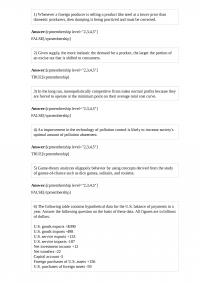
ECON E 866
1) Whenever a foreign producer is selling a product like steel at a lower price than domestic producers, then dumping is being practiced and must be corrected. 2) Given supply, the more inelastic the demand for a product, the larger […]
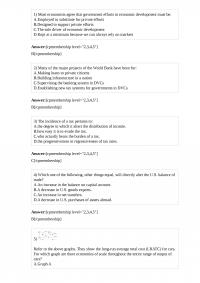
ECON E 899 Quiz 3
1) Most economists agree that government efforts in economic development must be: A.Employed to substitute for private efforts B.Designed to support private efforts C.The sole driver of economic development D.Kept at a minimum because we can always rely on markets […]
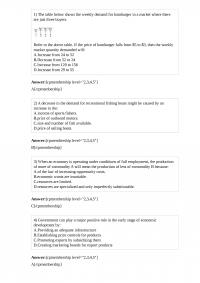
Economics 114
1) The table below shows the weekly demand for hamburger in a market where there are just three buyers. Refer to the above table. If the price of hamburger falls from $5 to $3, then the weekly market quantity demanded […]
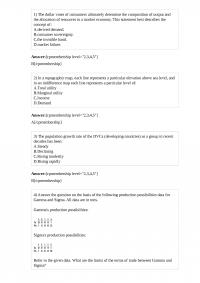
Economics 128
1) The dollar votes of consumers ultimately determine the composition of output and the allocation of resources in a market economy. This statement best describes the concept of: A.derived demand. B.consumer sovereignty. C.the invisible hand. D.market failure. 2) In a […]
Economics 131
1) Process innovation is represented as a downward shift in a firm’s total product curve and its average total cost curve. 2) A cross elasticity of demand coefficient of +2.5 indicates that the two products are substitutes. Answer: TRUE 3) […]
Economics 143 Quiz 3
1) Use the resource demand data shown on the left and the resource supply data on the right in answering the following question: Refer to the given data. How many workers will this profit-maximizing firm choose to employ? A.6 B.5 […]
Economics 149 Test 1
1) When the total product is at its maximum level, the marginal product is zero. 2) System 1 is the part of the brain that carefully weighs the benefits and costs when making decisions. Answer: FALSE 3) Although sleeping in […]
Economics 156 Quiz 1
1) Refer to the above graph. It shows a firm which buys its inputs and sells its output in competitive markets. If the firm develops a new technology that increases labor productivity, the equilibrium level of employment for this firm […]
Economics 158 Quiz 3
1) Under which of the following conditions would a profit-maximizing monopolist necessarily raise price? A.If product demand was price-elastic B.If marginal revenue is positive C.If marginal revenue was greater than marginal cost D.If marginal cost was greater than marginal revenue […]
Economics 170 Test 1
1) Public choice theorists contend that: A.government can efficiently correct instances of market system failure. B.the existence of cost-benefit analysis has brought about the efficient use of resources in the public sector. C.public bureaucracies are inherently more efficient than private […]
Economics 172 Midterm 2
1) Which of the following measurement issues makes interpretation of U.S. poverty rates difficult? A.Poverty statistics measure consumption rather than income, and some families may receive income that is above the official poverty line. B.The high cost of living in […]
Economics 182 Midterm 1
1) Suppose that Katie and Kelly each expects to receive $500 worth of marginal benefits from a proposed new recreation center, whereas Kerry expects to receive only $100 worth. If the proposed tax levied on each for the center would […]
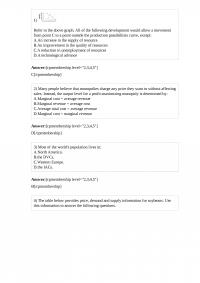
Economics 183
1) Refer to the above graph. All of the following development would allow a movement from point C to a point outside the production possibilities curve, except: A.An increase in the supply of resource B.An improvement in the quality of […]
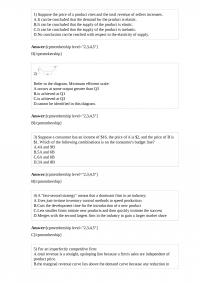
Economics 185
1) Suppose the price of a product rises and the total revenue of sellers increases. A.It can be concluded that the demand for the product is elastic. B.It can be concluded that the supply of the product is elastic. C.It […]
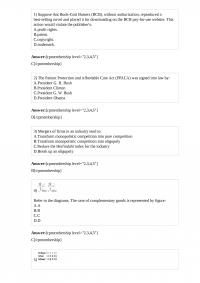
Economics 191 Homework
1) Suppose that Book-Cost Busters (BCB), without authorization, reproduced a best-selling novel and placed it for downloading on the BCB pay-for-use website. This action would violate the publisher’s: A.profit rights. B.patent. C.copyright. D.trademark. 2) The Patient Protection and Affordable Care […]
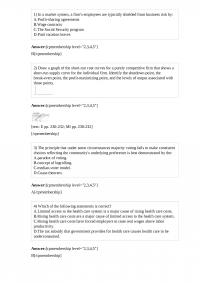
Economics 203 Midterm 2
1) In a market system, a firm’s employees are typically shielded from business risk by: A.Profit-sharing agreements B.Wage contracts C.The Social Security program D.Paid vacation leaves 2) Draw a graph of the short-run cost curves for a purely competitive firm […]
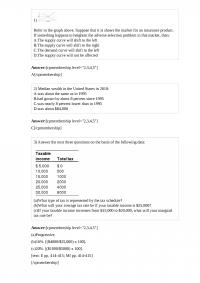
Economics 240 Test
1) Refer to the graph above. Suppose that it is shows the market for an insurance product. If something happens to heighten the adverse selection problem in this market, then: A.The supply curve will shift to the left B.The supply […]
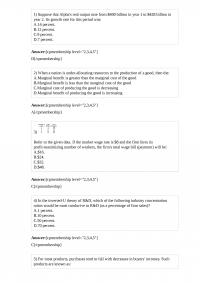
Economics 303 Quiz 2
1) Suppose that Alpha’s real output rose from $400 billion in year 1 to $428 billion in year 2. Its growth rate for this period was: A.14 percent. B.12 percent. C.9 percent. D.7 percent. 2) When a nation is under-allocating […]
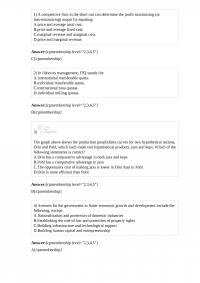
Economics 310
1) A competitive firm in the short run can determine the profit-maximizing (or loss-minimizing) output by equating: A.price and average total cost. B.price and average fixed cost. C.marginal revenue and marginal cost. D.price and marginal revenue. 2) In fisheries management, […]
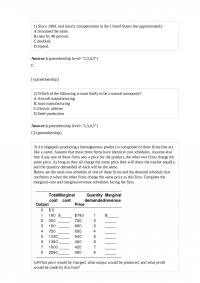
Economics 313 Quiz 1
1) Since 1960, real hourly compensation in the United States has approximately: A.remained the same. B.risen by 40 percent. C.doubled. D.tripled. 2) Which of the following is most likely to be a natural monopoly? A.Aircraft manufacturing B.Auto manufacturing C.Electric utilities […]
Economics 343 Midterm 2
1) “Time inconsistency” refers to the: A.tendency for policies with high short-run benefits to have high long-run costs. B.fallacy that what is true for the short run must be true for the long run. C.tendency to regularly misjudge in the […]
Economics 356 Quiz
1) The following is cost information for the Creamy Crisp Donut Company: Entrepreneur’s potential earnings as a salaried worker = $50,000 Annual lease on building = $22,000 Annual revenue from operations = $380,000 Payments to workers = $120,000 Utilities (electricity, […]
Economics 359 Quiz 3
1) An increase in demand accompanied by an increase in supply will increase the equilibrium quantity, but the effect on equilibrium price will be indeterminate. 2) Present value is the amount to which some current amount of money will grow […]
Economics 391 Midterm 2
1) Nonrenewable natural resources are fixed in supply (actually or virtually). 2) The reason why the long-run supply curve for a purely competitive industry may be upward-sloping is because of diminishing marginal returns. Answer: FALSE 3) The Coase Theorem suggests […]
Economics 405 Test 2
1) If unemployed workers leave a nation, the standard of living (national income per capita) will rise in that nation. 2) Which of the following groups has the highest proportion of unskilled illegal immigrants in the U.S.? A.Agricultural workers B.Construction […]
Economics 419 Test 1
1) The reason that the supply curve for labor in a purely competitive market slopes upward is because: A.The wage rate paid to workers falls as more are hired B.The marginal product of labor falls as output increases C.Marginal resource […]
Economics 438 Final
1) Fiscal policy is more susceptible to politicization than monetary policy. 2) If the minimum efficient scale in an industry is smaller than the size of the market of that industry, then we would have a natural-monopoly situation. Answer: FALSE[/cpmembership] […]
Economics 442 Midterm 1
1) Central planning often suffers from a coordination problem and an incentive problem. 2) Given demand, the more inelastic the supply of a product, the larger the portion of an excise tax that is borne by producers. Answer: TRUE 3) […]
Economics 446 Quiz 1
1) Shirking refers to the behavior of workers who provide less-than-expected effort on the job. 2) Economic models of illegal immigration suggest that domestic-born workers avoid certain types of work more because the inflow of immigrants has reduced wages, rather […]
Economics 449
1) Suppose that Julia receives a $20 gift card for the local coffee shop, where she only buys lattes and muffins. If the price of a latte is $4 and the price of a muffin is $2, then we can […]
Economics 463 Test 1
1) The Federal Trade Commission: A.is empowered to hold public hearings to investigate unfair practices. B.prohibits interlocking directorates in interstate industries. C.regulates airline fares. D.regulates such transportation industries as railroads and trucking. 2) A child is given $4 of pocket […]
Economics 472 Midterm
1) The minimum efficient scale of a firm: A.is realized somewhere in the range of diseconomies of scale. B.occurs where marginal product becomes zero. C.is in the middle of the range of constant returns to scale. D.is the smallest level […]
Economics 474
1) When new firms enter a purely competitive industry, the market supply curve will shift to the left. 2) Land reform (or the reform of land ownership) is a relatively minor institutional obstacle to economic growth in many developing countries. […]
Economics 478 Midterm
1) The demographic transition view of population growth argues that, on average (and as perceived by parents), the marginal: A.benefits of extra children are larger in IACs than in DVCs. B.costs of extra children are lower in IACs than in […]
Economics 501
1) The following table contains hypothetical data for the 2012 U.S. balance of payments. Answer the question on the basis of this information. All figures are in billions of dollars. Refer to the given data. Item (6) indicates that: A.the […]
Economics 506 Test 2
1) The endowment effect describes when people value a good more when they own it than when they don’t. 2) Neoclassical theory suggests that to the extent impulse buying occurs, it is infrequent and does not affect the ability of […]
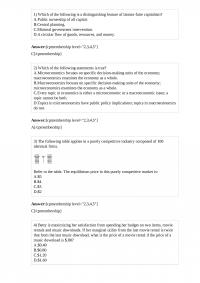
Economics 535 Quiz 1
1) Which of the following is a distinguishing feature of laissez-faire capitalism? A.Public ownership of all capital. B.Central planning. C.Minimal government intervention. D.A circular flow of goods, resources, and money. 2) Which of the following statements is true? A.Microeconomics focuses […]
Economics 542
1) Technological advances have occurred throughout the history of agriculture, resulting in higher productivity but lower incomes to farmers. 2) Among the principal exports of the United States are agricultural products. Answer: TRUE 3) Monopolistically competitive sellers produce efficiently because […]
Economics 542 1 If a public good
1) If a public good provides social benefits that are greater than its costs, then majority of voters would always vote in favor of producing the good. 2) The nation that has a comparative advantage in a particular product will […]
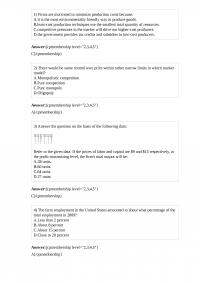
Economics 544 Test 1
1) Firms are motivated to minimize production costs because: A.it is the most environmentally friendly way to produce goods. B.least-cost production techniques use the smallest total quantity of resources. C.competitive pressures in the market will drive out higher-cost producers. D.the […]
Economics 549 Midterm
1) The basic explanation for high real wages in the United States and other industrially advanced economies is that the: A.Labor supply has increased more rapidly than labor demand in these nations B.Labor demand has increased more rapidly than labor […]
Economics 565 1 Conglomerate
1) Conglomerate mergers are combinations of: A.Many small firms B.Firms producing the same product C.Firms producing unrelated products D.Firms operating at different stages in a given production process 2) Tariffs and import quotas would benefit the following groups, except: A.Consumers […]
Economics 608 Quiz
1) The demographic transition view alleges that: A.the DVCs must first accept the use of birth control techniques to increase their standards of living. B.population growth will only decline if mortality rates exceed birth rates. C.if incomes first rise, population […]
Economics 610 Quiz 1
1) A firm charged with monopolizing a market is less likely to be convicted if: A.the court accepts a broad definition of the market. B.the court accepts a narrow definition of the market. C.it has gained its monopoly through abusive […]
Economics 615 Midterm 1
1) In 2005, chief executive officers’ (CEOs’) pay at U.S. firms with around $500 million in annual sales averaged: A.$600 thousand. B.$1.2 million. C.$2.2 million. D.$4.5 million. 2) If a regulatory commission wants to provide a natural monopoly with a […]
Economics 630 Midterm
1) If a nondiscriminating pure monopolist decides to sell one more unit of output, the marginal revenue associated with that unit will be: A.equal to its price. B.the price at which that unit is sold less the price reductions that […]
Economics 635
1) The moral hazard problem is the tendency of some parties to a contract to alter their behavior as a result of the contract in ways that are costly to the other party. 2) The “hedonic treadmill” of prospect theory […]
Economics 637 Test 1
1) That government that has the smallest budget is the most efficient in the economic sense. 2) U.S. immigrants (legal and illegal combined) have lower prison rates than the native-born population. Answer: TRUE 3) When the government is doing “deficit […]
Economics 641 Quiz 2
1) As a percentage of GDP, U.S. health care spending is higher than that of any other major industrial country. 2) The smaller the number of good substitutes for a product, the greater will be the price elasticity of demand […]
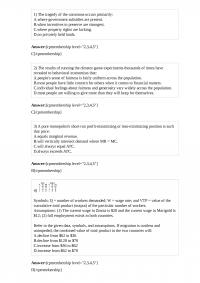
Economics 644 Midterm
1) The tragedy of the commons occurs primarily: A.where government subsidies are present. B.when incentives to preserve are strongest. C.where property rights are lacking. D.on privately held lands. 2) The results of running the dictator game experiments thousands of times […]
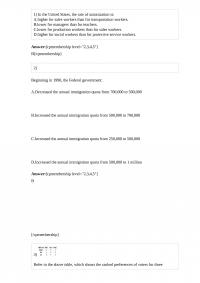
Economics 656 Quiz 3
1) In the United States, the rate of unionization is: A.higher for sales workers than for transportation workers. B.lower for managers than for teachers. C.lower for production workers than for sales workers. D.higher for social workers than for protective service […]
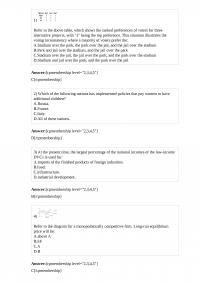
Economics 659 Homework
1) Refer to the above table, which shows the ranked preferences of voters for three alternative projects, with “1” being the top preference. This situation illustrates the voting inconsistency where a majority of voters prefer the: A.Stadium over the park, […]
Economics 670 Midterm 2
1) If the law of diminishing returns applies to study time: A.the tenth hour of study will likely be less productive than the third. B.this implies that longer lectures are less productive than shorter ones. C.there is no benefit to […]
Economics 693
1) Farmer Jones is producing wheat, and must accept the market price of $6.00 per bushel. At this time, her average total costs and her marginal costs both equal $8.00 per bushel. Her average variable costs are $5 per bushel. […]
Economics 705 Homework
1) In competitive markets, a surplus or shortage will: A.Never exist because the markets are always at equilibrium B.Cause changes in the quantities demanded and supplied that tend to eliminate the surplus or shortage C.Cause shifts in the demand and […]
Economics 754 Final
1) If a country has a total fertility rate of 1.8, then all else equal we would expect: A.population in that country to rise over time. B.population in that country to fall over time. C.the replacement rate to also equal […]
Economics 757 Midterm 2
1) Assume that Abby, Ben, Clara, Joe, and Matt are the only citizens in a community. A proposed public good has a total cost of $1000. All five citizens will share an equal portion of this cost in taxes. The […]
Economics 760 Test 2
1) Suppose a college economics department decides to use a single economics text for all sections of principles of economics. Also assume that the three individual members of the textbook selection committee have the following preferences. Assuming all other textbook […]
Economics 763 Quiz 3
1) A market: A.reflects upsloping demand and downsloping supply curves. B.entails the exchange of goods, but not services. C.is an institution that brings together buyers and sellers. D.always requires face-to-face contact between buyer and seller. 2) Anti-competitive price discrimination, interlocking […]
Economics 790 Test 2
1) Refer to the diagram for athletic shoes. The optimal output of shoes is: A.Q1. B.Q2. C.Q3. D.greater than Q3. 2) The traditional view regarding population and growth in DVCs is that: A.The most important factor affecting population growth in […]
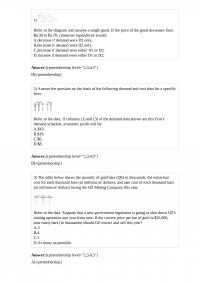
Economics 794
1) Refer to the diagram and assume a single good. If the price of the good decreases from $6.30 to $5.70, consumer expenditure would: A.decrease if demand were D1 only. B.decrease if demand were D2 only. C.decrease if demand were […]
Economics 800 Final
1) If price and total revenue are directly related, demand is inelastic. 2) The elasticity of demand for labor varies inversely with the elasticity of demand for the product it is used to produce. Answer: FALSE 3) A bilateral monopoly […]
Economics 816 Test
1) If a firm increases all of its inputs by 10 percent and its output increases by 15 percent, then: A.it is encountering diseconomies of scale. B.it is encountering economies of scale. C.the law of diminishing returns is taking hold. […]
Economics 848 Quiz 1
1) If a person drives with less care after purchasing auto insurance, this situation would be an example of a(n): A.Reverse wealth problem B.Negative externality problem C.Adverse selection problem D.Moral hazard problem 2) The debate over income distribution focuses on […]
Economics 865
1) Refer to the diagram for a nondiscriminating monopolist. If the government regulates the monopolist so that it charges the “fair return” price, the monopolist will produce output N. 2) In dealing with market failures, the government always bases its […]
Economics 886
1) Property rights give to some people the right to coerce others into giving up their property. 2) The Celler-Kefauver Act outlawed interlocking directorates. Answer: FALSE 3) One of the world’s greatest economic challenges over the coming decades will be […]
Economics 890
1) In drawing a particular budget line, money income and the prices of the two products are fixed. 2) The marginal productivity theory of resource demand suggests that those resources whose productivity levels are high will end up getting a […]
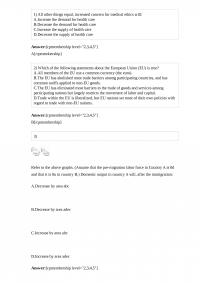
Economics 890 1 All other things
1) All other things equal, increased concern for medical ethics will: A.Increase the demand for health care B.Decrease the demand for health care C.Increase the supply of health care D.Decrease the supply of health care 2) Which of the following […]
Economics 890 Final
1) A increase in demand coupled with a simultaneous and bigger decrease in supply will cause equilibrium: A.Price to go up and quantity to go down B.Price to go up and quantity to go up C.Price to go down and […]
Economics 898 Midterm 2
1) Managed-care organizations attempt to control their enrolled members’ use of health care as a way of containing costs. 2) Granting property rights to forest land tends to increase the rate at which the land is deforested. Answer: FALSE 3) […]
MicroEconomic 104
1) Federal food distribution programs such as the food stamp program represent efforts to: A.Increase supplies of agricultural commodities B.Increase demand for agricultural commodities C.Decrease the value of farming to the nation D.Facilitate the movement of people from farms to […]
MicroEconomic 112
1) It is possible for a competitive firm that is maximizing profits in the short run to make its profits even bigger in the long run by expanding its plant. 2) Labor’s share of income earned by Americans is smaller […]
MicroEconomic 120
1) The “principal-agent problem” often arises in public choice when politicians pursue the best interests of their constituents. 2) Behavioral economists avoid dealing with fairness concerns because the concept is too subjective. Answer: FALSE 3) In 2011, approximately 5 percent […]
MicroEconomic 122 Quiz
1) If the consumer is willing to pay a price higher than the actual price of a product, then the consumer will not buy the product because the consumer surplus will be negative. 2) In the extraction of a nonrenewable […]
MicroEconomic 141 Final
1) If the demand for agricultural products is inelastic, a relatively small increase in supply will cause farm prices and incomes to decline. 2) Because economic generalizations are simplifications from reality, they are impractical and useless. Answer: FALSE 3) When […]
MicroEconomic 142
1) What is the best economic explanation for why a person would drop out of college to take a job or start a business? A.he has a good idea for starting a business B.he has to pay a higher tuition […]
MicroEconomic 197 Quiz 3
1) Which statement about oligopoly is false? A.Oligopolistic firms recognize their interdependence B.Prices in oligopoly are predicted to fluctuate widely and frequently C.A few firms play an important role in the sale of a product D.One firm’s behavior is a […]
MicroEconomic 201
1) ATMs and human bank tellers: A.are substitute resources. B.are capital goods. C.have both declined in number because of bank mergers. D.are complementary resources. 2) What health care program provides payment for medical benefits to certain low-income people, including the […]
MicroEconomic 218 Quiz 3
1) Answer the question on the basis of the following information. Suppose the members of population A, consisting of Al, Bob, Curt, Doris, and Ellie, receive annual incomes of $5,000, $2,500, $1,250, $750, and $500, respectively. Refer to the given […]
MicroEconomic 238 Test 2
1) Which of the following occupations is not among the ten projected fastest-growing U.S. occupations in terms of percentage increases? A.School teachers. B.Biomedical engineers. C.Physical therapist assistants. D.Personal care aides. 2) The market system’s answer to the fundamental question “What […]
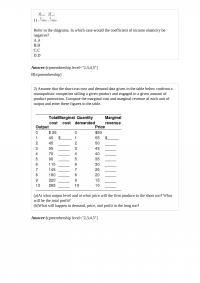
MicroEconomic 275 Quiz 3
1) Refer to the diagrams. In which case would the coefficient of income elasticity be negative? A.A B.B C.C D.D 2) Assume that the short-run cost and demand data given in the table below confront a monopolistic competitor selling a […]
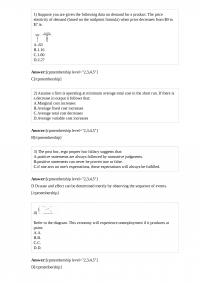
MicroEconomic 290 Homework
1) Suppose you are given the following data on demand for a product. The price elasticity of demand (based on the midpoint formula) when price decreases from $9 to $7 is: A..63 B.1.16 C.1.60 D.2.27 2) Assume a firm is […]
MicroEconomic 293
1) Consumers will buy a new product instead of an old one that they are used to buying, if the MU of the new product is larger than the MU of the old product. 2) A firm should reduce its […]
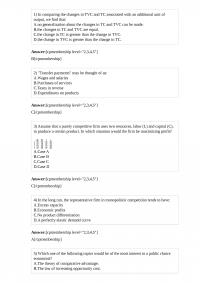
MicroEconomic 293 Quiz 1
1) In comparing the changes in TVC and TC associated with an additional unit of output, we find that: A.no generalization about the changes in TC and TVC can be made. B.the changes in TC and TVC are equal. C.the […]
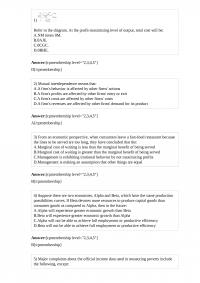
MicroEconomic 294
1) Refer to the diagram. At the profit-maximizing level of output, total cost will be: A.NM times 0M. B.0AJE. C.0CGC. D.0BHE. 2) Mutual interdependence means that: A.A firm’s behavior is affected by other firms’ actions B.A firm’s profits are affected […]
MicroEconomic 295
1) Indifference curves and budget lines can be used to derive an individual’s demand curve for a product. 2) The U.S. often has a significant surplus in services trade, even though it has a deficit in goods trade. Answer: TRUE […]
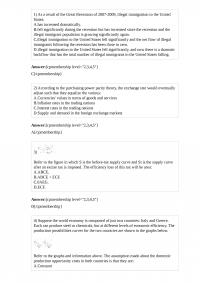
MicroEconomic 312
1) As a result of the Great Recession of 2007-2009, illegal immigration to the United States: A.has increased dramatically. B.fell significantly during the recession but has increased since the recession and the illegal immigrant population is growing significantly again. C.illegal […]
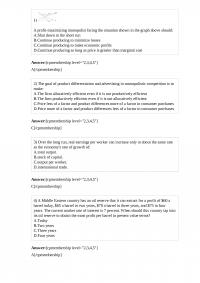
MicroEconomic 313 Homework
1) A profit-maximizing monopolist facing the situation shown in the graph above should: A.Shut down in the short run B.Continue producing to minimize losses C.Continue producing to make economic profits D.Continue producing as long as price is greater than marginal […]
MicroEconomic 333 Midterm 2
1) Answer the question on the basis of the following information about the cost ratios for two productsfish (F) and chicken (C)in countries Singsong and Harmony. Assume that production occurs under conditions of constant costs and these are the only […]
MicroEconomic 333 Test 2
1) Suppose that a union successfully negotiated a 10 percent wage increase and the quantity of labor demanded decreased by 10 percent. Given a fixed labor demand curve, we can conclude that: A.the labor demand curve is upsloping. B.labor demand […]
MicroEconomic 345 Quiz 1
1) The ability to impose fines, revoke licenses, and put people into jail allows the government to: A.Ensure positive profits for its agencies B.Maximize revenues from its operations C.Enforce involuntary transactions D.Set market prices for goods and services 2) Cash […]
MicroEconomic 349 Midterm 1
1) Demand-side market failures refer to those situations when there is a shortage in the market because buyers want to buy more than what is available in the market. 2) If two nations specialize in their respective comparative advantage and […]
MicroEconomic 359
1) Suppose that at prices of $1, $2, $3, $4, and $5 for product Z, the corresponding quantities supplied are 3, 4, 5, 6, and 7 units, respectively. Which of the following would increase the quantities supplied of Z to, […]
MicroEconomic 375 Quiz
1) The “dictator game” and “ultimatum game” are experiments that have provided field evidence for: A.The invisible hand B.Fairness C.Self-interest D.Cognitive biases 2) As the firm in the diagram expands from plant size #3 to plant size #5, it experiences: […]
MicroEconomic 381 1 The US Census
1) The U.S. Census Bureau estimates that more than one million illegal immigrants enter the United States each year. 2) In order to achieve economic efficiency in market economies like the U.S., the government must be stripped of its power […]
MicroEconomic 414 Midterm
1) If the quantity of X is measured on the horizontal axis and the quantity of Y on the vertical, then the slope of the budget line is equal to the price of X divided by the price of Y. […]
MicroEconomic 456
1) The interest-rate cost-of-funds curve is perfectly elastic because firms can borrow as much or as little as they want at market interest rates. 2) Mutually-cancelling advertising by oligopolistic firms tend to improve economic efficiency in the industry. Answer: FALSE […]
MicroEconomic 468 Test 2
1) Which of the following would be an example of a moral hazard problem? A.A person in poor health who purchases life insurance B.A person who is taxed on the purchase of a carton of cigarettes C.A person who purchases […]
MicroEconomic 471
1) Refer to the diagram. At P1, this firm will produce: A.47 units and break even. B.47 units and realize an economic profit. C.66 units and earn only a normal profit. D.24 units and earn only a normal profit. 2) […]
MicroEconomic 485
1) The concept of parity has provided a rationale for government price supports for farm products. 2) The U.S. breakfast cereal industry is an example of differentiated oligopoly. Answer: TRUE 3) When a consumer is maximizing total utility, he or […]
MicroEconomic 487 Quiz 1
1) Symbols: Q = number of workers demanded; W = wage rate; and VTP = value of the cumulative total product (output) of the particular number of workers. Assumptions: (1) The current wage in Zinnia is $20 and the current […]
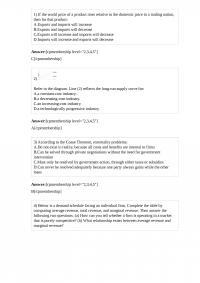
MicroEconomic 500
1) If the world price of a product rises relative to the domestic price in a trading nation, then for that product: A.Exports and imports will increase B.Exports and imports will decrease C.Exports will increase and imports will decrease D.Imports […]
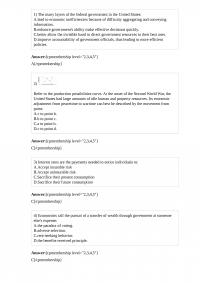
MicroEconomic 503 Quiz 1
1) The many layers of the federal government in the United States: A.lead to economic inefficiencies because of difficulty aggregating and conveying information. B.enhance government’s ability make effective decisions quickly. C.better allow the invisible hand to direct government resources to […]
MicroEconomic 504 Quiz 3
1) Which would be an example of public ownership as a response to natural monopolies? A.Federal Energy Regulatory Commission B.Federal Trade Commission C.U.S. Food and Drug Administration D.U.S. Postal Service 2) Which of the following goods would most probably be […]
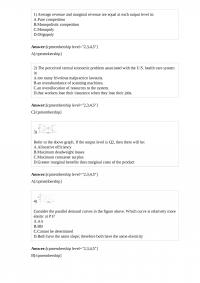
MicroEconomic 514 Test 1
1) Average revenue and marginal revenue are equal at each output level in: A.Pure competition B.Monopolistic competition C.Monopoly D.Oligopoly 2) The perceived central economic problem associated with the U.S. health care system is: A.too many frivolous malpractice lawsuits. B.an overabundance […]
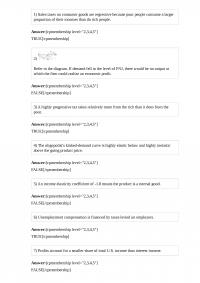
MicroEconomic 542 Final
1) Sales taxes on consumer goods are regressive because poor people consume a larger proportion of their incomes than do rich people. 2) Refer to the diagram. If demand fell to the level of FNJ, there would be no output […]
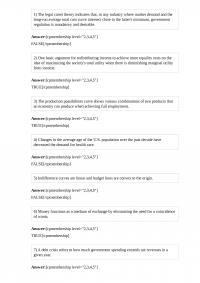
MicroEconomic 543 Midterm 1
1) The legal cartel theory indicates that, in any industry where market demand and the long-run average total cost curve intersect close to the latter’s minimum, government regulation is mandatory and desirable. 2) One basic argument for redistributing income to […]
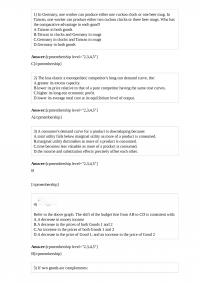
MicroEconomic 544 1 In Germany one
1) In Germany, one worker can produce either one cuckoo clock or one beer mug. In Taiwan, one worker can produce either two cuckoo clocks or three beer mugs. Who has the comparative advantage in each good? A.Taiwan in both […]
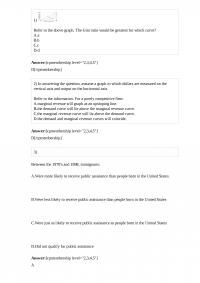
MicroEconomic 549 Quiz 2
1) Refer to the above graph. The Gini ratio would be greatest for which curve? A.a B.b C.c D.d 2) In answering the question, assume a graph in which dollars are measured on the vertical axis and output on the […]
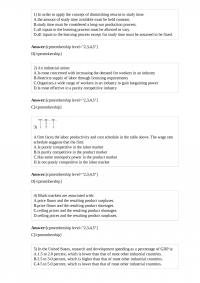
MicroEconomic 553 Midterm 1
1) In order to apply the concept of diminishing returns to study time: A.the amount of study time available must be held constant. B.study time must be considered a long-run production process. C.all inputs to the learning process must be […]
MicroEconomic 596
1) In a purely competitive labor market, a profit-maximizing firm will hire labor up to the point where the marginal resource cost equals the wage rate. 2) Tying agreements are contracts by which retailers agree to charge the prices that […]
MicroEconomic 599 Quiz 1
1) The presence of large and fast-growing populations in developing countries contributes to lower per capita incomes. 2) Economic analysis would focus on the size of the government, in order to assess whether or not it fosters economic efficiency. Answer: […]
MicroEconomic 634
1) Refer to the diagram. Rent controls are best illustrated by: A.price A B.quantity E C.price C D.price B 2) Which of the following would be the best example of regulatory capture? A.Starbucks buys up all the available supplies of […]
MicroEconomic 637 Midterm 1
1) Answer the following questions based on the payoff matrix for a single-period, two-firm game for firms, Capoc and Caroc. The numbers in the matrix indicate the profit in billions of dollars for a national of regional strategy. The profit […]
MicroEconomic 649 Midterm 1
1) Other things being the same, if the demand for labor is inelastic: A.Decreases in wage rates will result in greater payrolls B.Increases in wage rates will result in greater payrolls C.Increases in wage rates will result in smaller payrolls […]
MicroEconomic 655
1) If sellers could price-discriminate and charge two different prices to two different groups of buyers in order to increase revenues, then the sellers would charge: A.A higher price to the buyers whose demand is elastic B.A higher price to […]
MicroEconomic 656 Homework
1) Which of the following would not be covered by Medicare? Payments for: A.All reasonable costs for the first sixty days of inpatient care in a hospital per “benefit period” B.Post-hospital nursing services, home health care, and hospice care for […]
MicroEconomic 659 Test 1
1) Refer to the diagram for a nondiscriminating monopolist. At output R economic profits will be zero. 2) Studies by economists indicate that economic growth and rising living standards are good for the environment because as societies get richer, they […]
MicroEconomic 697 Quiz
1) Economic profits are usually larger than accounting profits. 2) The interest-rate cost-of-funds curve is perfectly elastic because expected rates of return on R&D are constant. Answer: FALSE 3) There is a consensus among economists that the amount of resources […]
MicroEconomic 720 Test
1) Which of the following best explains why most basic scientific research in the United States is financed by the government? A.Basic scientific research takes a long time to become commercially viable. B.Basic scientific research rarely results in commercially viable […]
MicroEconomic 724 Quiz 2
1) The principal objective of industrial regulation is to: A.Increase product safety B.Promote improvements in the quality of life C.Protect the consuming public from the market power of natural monopolies D.Solve problems associated with industry such as the problems of […]
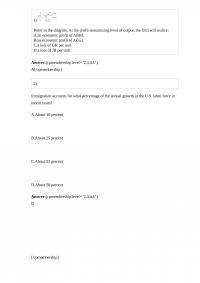
MicroEconomic 749 Midterm
1) Refer to the diagram. At the profit-maximizing level of output, the firm will realize: A.an economic profit of ABHJ. B.an economic profit of ACGJ. C.a loss of GH per unit. D.a loss of JH per unit. 2) Immigration accounts […]
MicroEconomic 757
1) The economic inefficiency in an oligopoly may be reduced by the following, except: A.Increased competition from foreign producers B.Limit pricing due to potential entrants C.Economic profits used to fund technological advance D.Aggressive advertising by rivals 2) Refer to the […]
MicroEconomic 780 1 quotInformal
1) “Informal payments” or “under-the table fees” are a common form of corruption. 2) Changes in tax rates are a form of monetary policy. Answer: FALSE 3) If the lumber companies are required to internalize the negative externalities of deforestation, […]
MicroEconomic 781
1) The marginal tax rate is: A.less than the average tax rate when a tax is progressive. B.calculated by dividing total taxes paid by one’s total taxable income. C.the percentage of one’s total income that is paid in taxes. D.the […]
MicroEconomic 786
1) Public policy has been ineffective in alleviating the resource misallocation problem in American agriculture. 2) Over a longer time period after a price-change, the price elasticity of supply tends to decrease. Answer: FALSE 3) The basic source of state […]
MicroEconomic 802 Test
1) A decrease in the supply of loanable funds would tend to lower the interest rate. 2) Trade adjustment assistance provides subsidies to companies that have lost business to foreign firms. Answer: FALSE 3) The government’s ability to coerce people […]
MicroEconomic 812 Test
1) A perfectly elastic demand curve implies that the firm: A.must lower price to sell more output. B.can sell as much output as it chooses at the existing price. C.realizes an increase in total revenue that is less than product […]
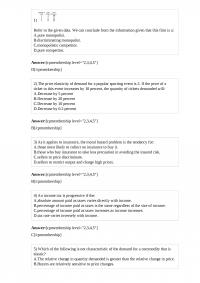
MicroEconomic 842 Quiz 1
1) Refer to the given data. We can conclude from the information given that this firm is a: A.pure monopolist. B.discriminating monopolist. C.monopolistic competitor. D.pure competitor. 2) The price elasticity of demand for a popular sporting event is 2. If […]
MicroEconomic 855
1) The demand for computers is derived from the demand for the capital resources that are used to produce computers. 2) Process innovation raises the firm’s total product curve and lowers its average total cost curve. Answer: TRUE 3) The […]
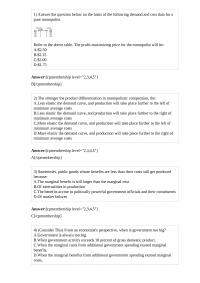
MicroEconomic 861 Quiz 1
1) Answer the question below on the basis of the following demand and cost data for a pure monopolist. Refer to the above table. The profit-maximizing price for the monopolist will be: A.$2.50 B.$2.25 C.$2.00 D.$1.75 2) The stronger the […]
MicroEconomic 891 Test 1
1) An industry with which of the following four-firm concentration ratios would tend to have the greatest amount of R&D expenditures as a percentage of sales? A.0 B.10 C.50 D.100 2) Which of the following is not characteristic of long-run […]
MicroEconomic 893 Midterm 1
1) Which of the following nations has the highest per capita spending on health care? A.Germany B.Canada C.France D.United States 2) Public finance is the sub-discipline of economics that studies the various ways in which: A.The general public acquire financing […]
MicroEconomic 898 Final
1) Refer to the diagram above, which shows three supply curves for corn. A movement from point a to point b is caused by a change in the: A.Price of resources used to produce corn B.Number of corn farmers C.Price […]
MicroEconomic 898 Homework
1) Answer the question based on the following information. Normal University has found it necessary to institute a crime-control program on its campus to deal with the high costs of theft and vandalism. The university is now considering several alternative […]