1) Economists widely support deregulation of industries that tend toward monopoly or
generate substantial negative externalities.
2)
The simple immigration model suggests that labor migration raises the wage rate in the
country of origin while reducing the wage rate in the host country.
3) A firm in a cartel typically cheats on its collusive agreement by raising its price and
restricting output more than it agreed to with other cartel members.
4) Electricity generating plants with low fixed costs tend to have high operating costs.
5) Central planning in the Soviet Union and pre-reform China emphasized the
expansion of the production of consumer goods to raise the domestic standard of living.
6) Increases in U.S. living standards have matched increases in per capita energy use.

7) Game-theory model analyzes the interdependence of oligopolists’ strategies.
8) In a purely competitive industry competition centers more on advertising and sales
promotion than on price.
9) Hardwired heuristics make it easy to change behavior by simply presenting people
with better information.
10) Behavioral economics recognizes that people frequently make errors, but these
errors generally cancel out in such a way that neoclassical models are sufficient for
predicting economic outcomes.
11) Unfunded liabilities occur when the government considers long-term benefits and
costs of projects, and approves only those with positive long-term net benefits.
12) Economic or pure rent is:
A.a payment made for the use of housing, factory buildings, or capital goods.
B.a payment for resources used in the production of “free goods.”
C.a payment for the use of those resources whose supply is perfectly elastic.
D.the price paid for the use of land and other nonreproducible resources.
13) Which of the following statements is correct?
A.An increase in the price of C will decrease the demand for complementary product D.
B.A decrease in income will decrease the demand for an inferior good.
C.An increase in income will reduce the demand for a normal good.
D.A decline in the price of X will increase the demand for substitute product Y.
14) Selfishness is:
A.exhibited more strongly in the ultimatum game than in the dictator game.
B.exhibited more strongly in the dictator game than in the ultimatum game.
C.exhibited equally strongly in both the ultimatum and dictator games.
D.rarely exhibited in either the ultimatum or dictator games.
15) A firm finds that it must increase wages to attract extra workers. The firm will hire
labor up to the point where the marginal:
A.Product of labor equals the wage rate
B.Revenue product of labor is greater than the wage rate
C.Revenue product of labor starts to decline
D.Revenue product equals the additional cost of hiring an extra worker
16)
Refer to the data for a nondiscriminating monopolist. This firm will maximize its profit
by producing:
A.3 units.
B.4 units.
C.5 units.
D.6 units.
17) The fact that most medical care purchases are financed through insurance:

A.has no effect on health care consumption because aggregate costs are the same
regardless of payment method.
B.reduces the amount of health care consumed by raising the price of additional units of
care.
C.has decreased health care costs and therefore reduced aggregate health care
expenditures.
D.increases the amount of health care consumed by reducing the price of additional
units of care.
18) Answer the question on the basis of the following information: The equations for
the demand and supply curves for a particular product are P = 10 – .4Q and P = 2 + .4Q,
where P is price and Q is quantity expressed in units of 100. After an excise tax is
imposed on the product, the supply equation is P = 3 + .4Q.
Refer to the given information. The efficiency loss of this tax is:
A.$125.00.
B.$62.50.
C.$87.50.
D.$1.00.
19) A technological improvement that causes an increase in the marginal product of a
resource will:
A.Decrease the demand for the resource
B.Increase the demand for the resource
C.Decrease the marginal revenue product
D.Increase the marginal resource cost
20)
Refer to the above table. A technological advance lowers production costs such that the
quantity supplied increases by 60 units of this product at each price. As a result of this
technological change, equilibrium output in this market:
A.Decreased by 60 units
B.Increased by 60 units
C.Increased by 30 units
D.Decreased by 30 units
21) Gigantic State University raises tuition for the purpose of increasing its revenue so
that more faculty can be hired. GSU is assuming that the demand for education at GSU
is:
A.decreasing.
B.relatively elastic.
C.perfectly elastic.
D.relatively inelastic.
22) If MPa/Pa = MPb/Pb and MRPa/Pa = MRPb/Pb > 1, this firm is:
A.producing its output with the least costly combination of resources but is not
producing the profit-maximizing output.
B.maximizing profits but failing to minimize costs.
C.neither maximizing profits nor minimizing costs.
D.combining resources a and b so as to minimize costs and maximize profits.
23) Suppose that government imposes a specific excise tax on product X of $2 per unit
and that the price elasticity of demand for X is unitary (coefficient = 1). If the incidence
of the tax is such that consumers pay $1.80 of the tax and the producers pay $.20, we
can conclude that the:
A.supply of X is highly inelastic.
B.supply of X is highly elastic.
C.demand for X is highly inelastic.
D.demand for X is highly elastic.
24) Some of the ways that industrially advanced countries (IACs) can help developing
countries (DVCs) in achieving faster economic growth include the following, except:
A.Expanding trade
B.Admitting in more temporary workers
C.Subsidizing their own agricultural sectors
D.Discouraging arms sales
25) The rationing function of prices refers to the:
A.tendency of supply and demand to shift in opposite directions.
B.fact that ration coupons are needed to alleviate wartime shortages of goods.
C.capacity of a competitive market to equalize quantity demanded and quantity
supplied.
D.ability of the market system to generate an equitable distribution of income.
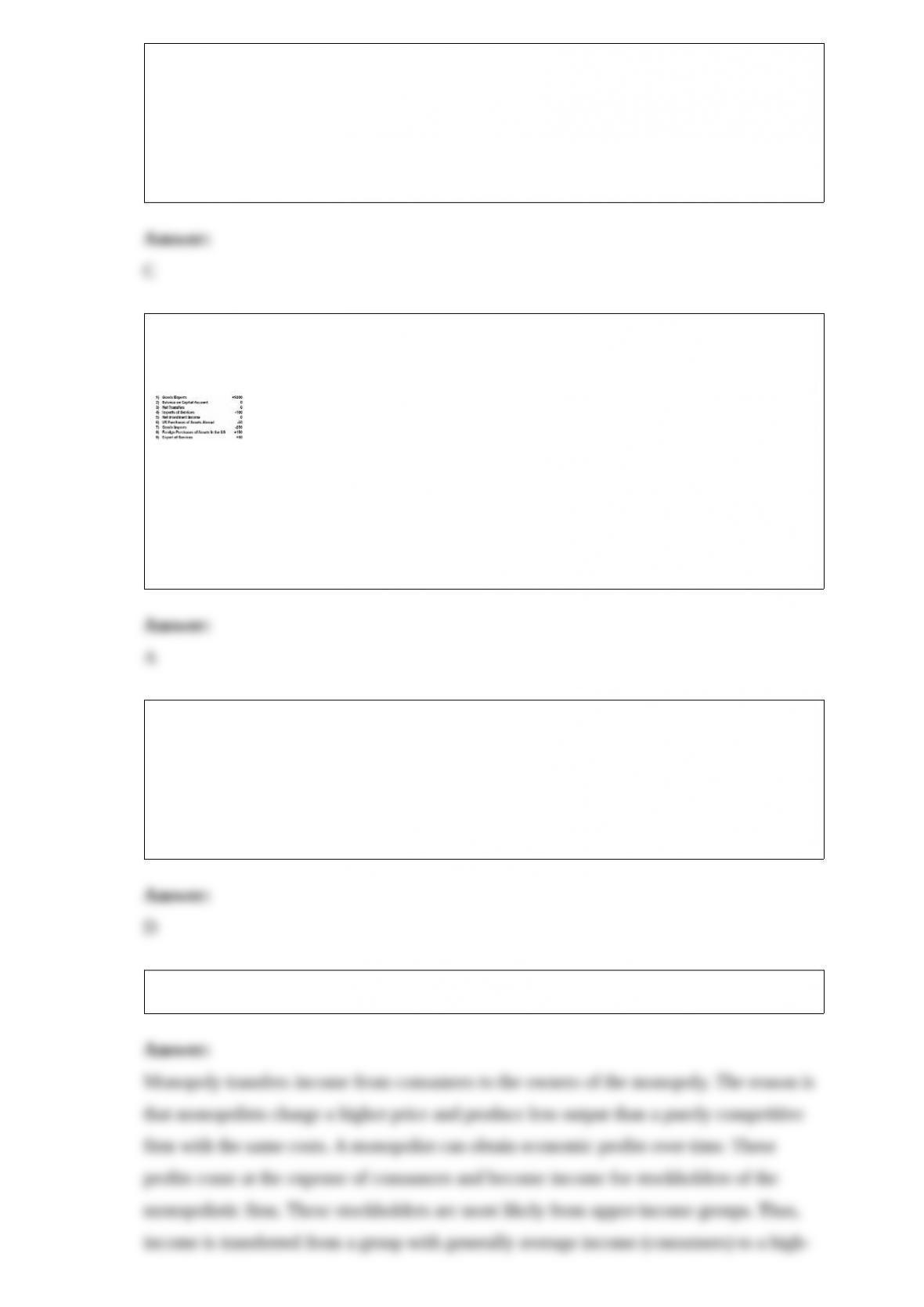
26) The plus items below are “export-type” entries and the minus items are
“import-type” entries in the balance of payments for the hypothetical country of Zippo.
Refer to the given information. Zippo has a:
A.current account deficit.
B.capital account deficit.
C.balance of payments deficit.
D.trade surplus on goods and services.
27) The demand for health care in industrially advanced economies is:
A.highly elastic with respect to both price and income.
B.highly inelastic with respect to both price and income.
C.highly elastic with respect to income but highly inelastic with respect to price.
D.about unit elasticity with respect to income and relatively inelastic with respect to
price.
28) How does monopoly result in income transfers?
29) Discuss the continuing problem with farm policy after the Food, Conservation and
Energy Act of 2008.
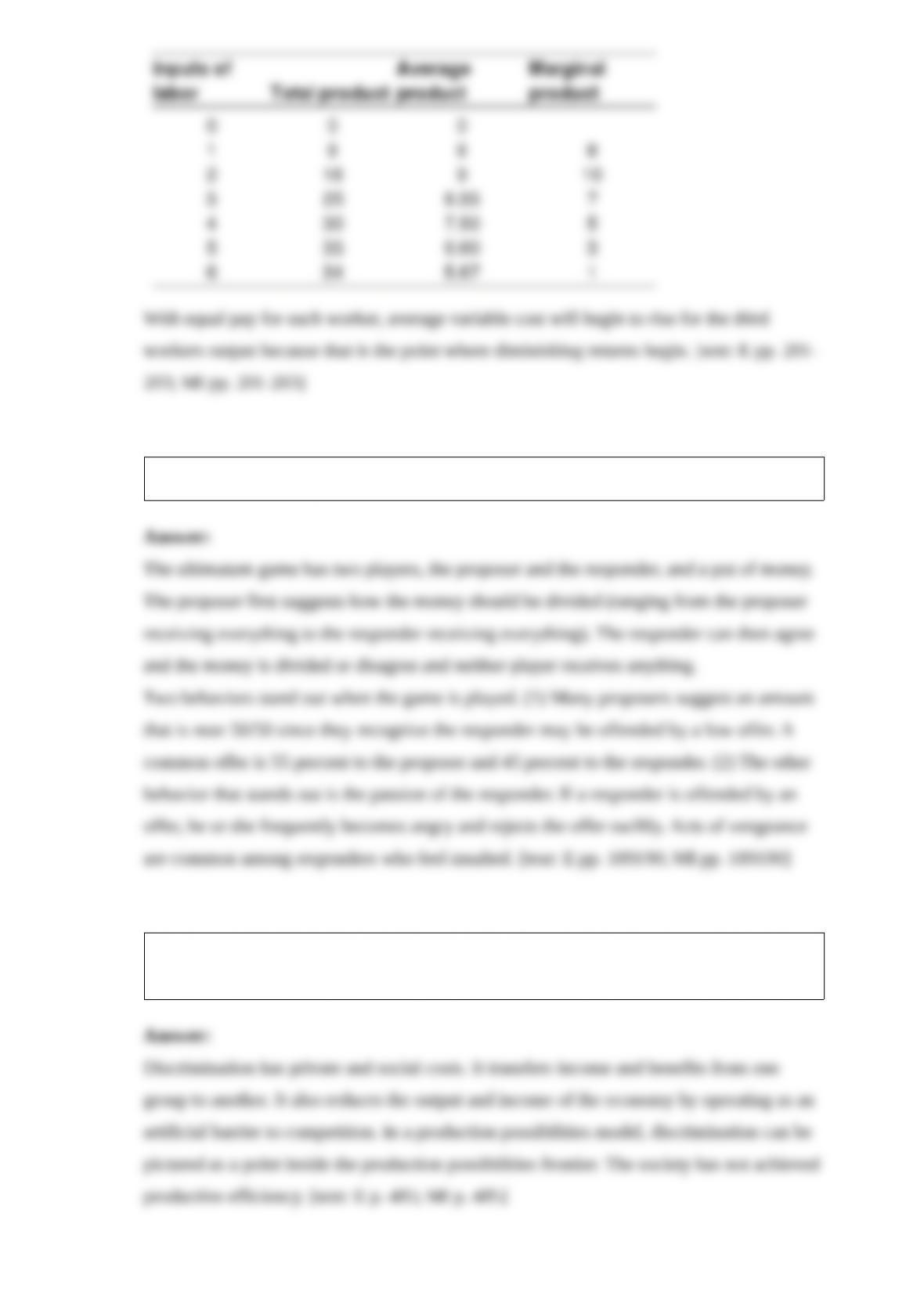
30) Complete the following table by finding the average and marginal product. At what
input-output level will average variable cost begin to rise? Explain.
31) What is the ultimatum game? What behaviors are common among the players?
32) Describe the cost of discrimination to society. How is the cost of discrimination
illustrated in a production possibilities curve?
33) The sizeable and continuous flow of immigrants into the United States seems to
indicate that there is a positive return to moving. Many economic immigrants, however,
never achieve pay-parity with similarly educated native-born workers while others
eventually outdo domestic-born workers in salary wage advancement. Explain.