Chapter 03 Appendix
Chapter 03 Appendix
McConnell Brue Flynn 20e
APPENDIX DISCUSSION QUESTIONS
1. Why are shortages or surpluses more likely with preset prices, such as those on tickets, than
flexible prices, such as those on gasoline? LO7
Answer: Preset prices, rather than responding to demand conditions, attempt to
Preset prices often apply to one-time-only events, versus something like gasoline
2. Most scalping laws make it illegal to sell—but not to buy—tickets at prices above those printed
on the tickets. Assuming that is the case, use supply and demand analysis to explain why the
equilibrium ticket price in an illegal secondary market tends to be higher than in a legal
secondary market. LO7
Answer: Ticket prices tend to be higher in illegal secondary markets because
sellers face higher costs (thus reducing supply relative to what it would be in a
3. Go to the Web site of the Energy Information Administration, www.eia.doe.gov, and follow the
links to find the current retail price of gasoline. How does the current price of regular gasoline
compare with the price a year ago? What must have happened to either supply, demand, or both to
explain the observed price change? LO7
4. Suppose the supply of apples sharply increases because of perfect weather conditions
throughout the growing season. Assuming no change in demand, explain the effect on the
equilibrium price and quantity of apples. Explain why quantity demanded increases even though
demand does not change. LO7
Answer: The increase in supply will lower the equilibrium price and increase the
3A-1
Copyright © 2015 McGraw-Hill Education. All rights reserved. No reproduction or distribution without the prior written
consent of McGraw-Hill Education.

Chapter 03 Appendix
demanded increases without a shift in the demand curve because the greater
3A-2
Copyright © 2015 McGraw-Hill Education. All rights reserved. No reproduction or distribution without the prior written
consent of McGraw-Hill Education.
Price of Bottled Water
Quantity of Bottled Water
S1
S2
D1
D2
Q1 Q2
P2
P1
Chapter 03 Appendix
5. Assume the demand for lumber suddenly rises because of a rapid growth of demand for new
housing. Assume no change in supply. Why does the equilibrium price of lumber rise? What
would happen if the price did not rise under the demand and supply circumstances described?
LO7
Answer: Buyers are willing to purchase more new housing, causing price and
quantity to increase in that market. In order to satisfy the increased demand for
If something prevented an increase in the price of lumber (e.g., a price control by
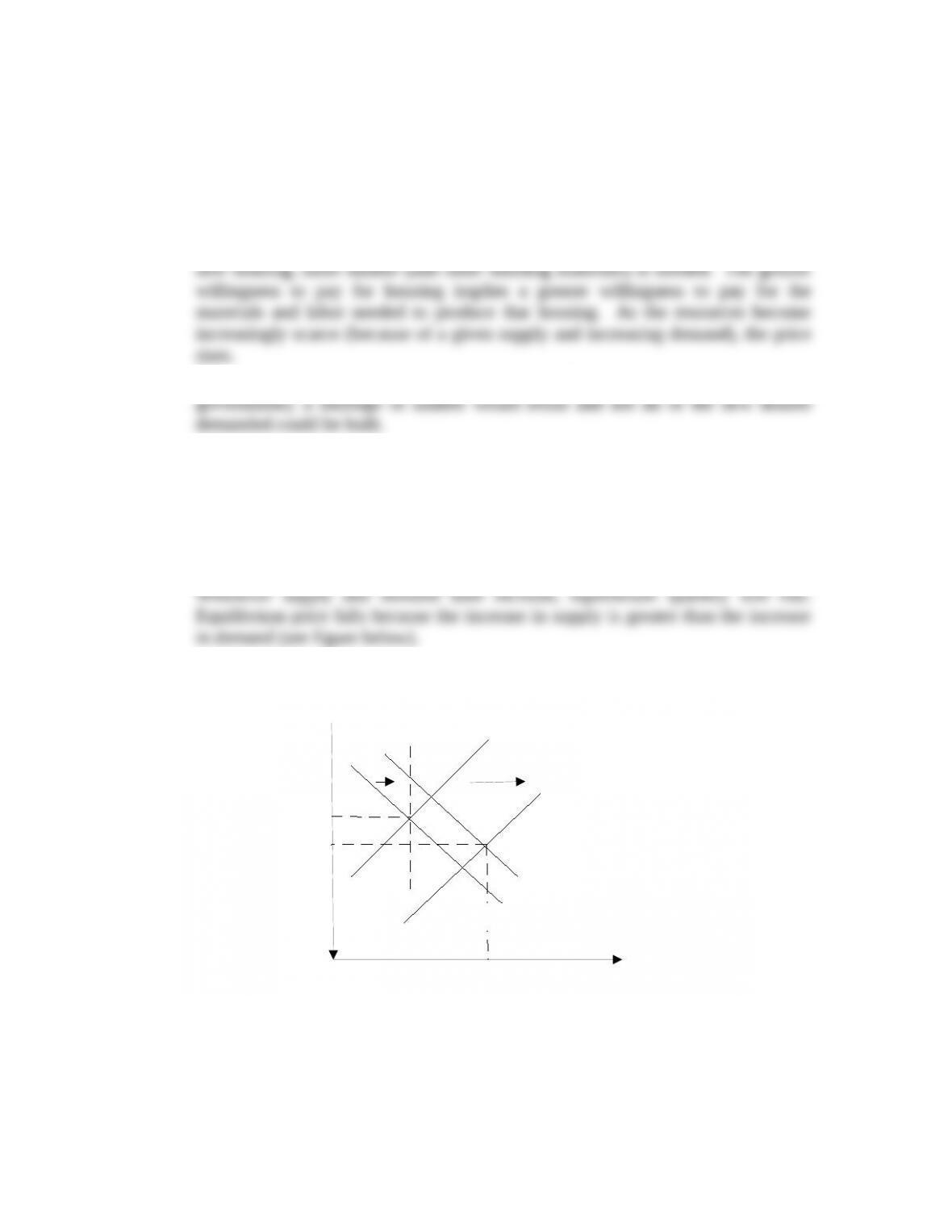
6. Assume that both the supply of bottled water and the demand for bottled water rise during the
summer but that supply increases more rapidly than demand. What can you conclude about the
directions of the impacts on equilibrium price and equilibrium quantity? LO7
Answer: The equilibrium price will fall and the equilibrium quantity will rise.
3A-3
Copyright © 2015 McGraw-Hill Education. All rights reserved. No reproduction or distribution without the prior written
consent of McGraw-Hill Education.
Chapter 03 Appendix
7. When asked for investment advice, humorist Will Rogers joked that people should “[b]uy land.
They ain’t making any more of the stuff.” Explain his advice in terms of the supply and demand
model. LO7
Answer: By saying they aren’t making any more land, he is signifying there will
eventually be a shortage of land. In the case of a shortage, quantity demanded
APPENDIX REVIEW QUESTIONS
1. Will the the equilibrium price of orange juice increase or decrease in each of the following
situations? LO7
a. A medical study reporting that orange juice reduces cancer is released at the same time that a
freak storm destroys half of the orange crop in Florida.
b. The prices of all beverages except orange juice fall in half while unexpectedly perfect weather
in Florida results in an orange crop that is 20 percent larger than normal.
Answer: a. Increase. The medical study reporting that orange juice reduces cancer will
cause the demand curve for orange juice to shift to the right. The storm that destroys half
b. Decrease. When the prices of other beverages fall in half, demand for orange juice
will fall as many people will drink less orange juice. Thus, the demand curve for orange
2. Consider the market for coffee beans. Suppose that the prices of all other caffeinated beverages
go up 30 percent while at the same time a new fertilizer boosts production at coffee plantations
dramatically. Can you tell what will happen to the equilibrium price? What about the equilibrium
quantity? LO7
a. Both the equilibrium price and the quantity will rise.
b. The equilibrium price will rise but the equilibrium quantity will fall.
c. The equilibrium price may rise or fall but the equilibrium quantity will rise for certain.
d. Neither the price change nor the quantity change can be determined for certain.
e. None of the above.
3A-4
Copyright © 2015 McGraw-Hill Education. All rights reserved. No reproduction or distribution without the prior written
consent of McGraw-Hill Education.
Chapter 03 Appendix
Answer: C; the equilibrium price may rise or fall but the equilibrium quantity will rise
Coffee and other caffeinated beverages are substitutes. Thus, when the prices of all other
caffeinated beverages rise, people will substitute away from them and consume more
3. A price ceiling will result in a shortage only if the ceiling price is ____________ the
equilibrium price. LO7
a. less than
b. equal to
c. greater than
d. louder than
Answer: Less than. If the ceiling price is set at a value below the equilibrium price, then
a shortage will result because quantity demanded will exceed quantity supplied. By
4. Suppose that you are the economic advisor to a local government that has to deal with a
politically embarrassing surplus that was caused by a price floor that the government recently
imposed. Your first suggestion is to get rid of the price floor, but the politicians don’t want to do
that. Instead, they present you with the following list of options that they hope will get rid of the
surplus while keeping the price floor. Identify each one as either could work or can’t work. LO7
a. Restricting supply.
b. Decreasing demand.
c. Purchasing the surplus at the floor price.
3A-5
Copyright © 2015 McGraw-Hill Education. All rights reserved. No reproduction or distribution without the prior written
consent of McGraw-Hill Education.
P2 = P1
Price of Olives
Quantity of Olives
Q1Q2
S1
S2
D2 D1
Chapter 03 Appendix
Answer:
a. Could work. There is currently a surplus because, at the floor price, quantity supplied
exceeds quantity demanded. If the government can restrict supply, it will be able to
b. Can’t work. There is a surplus because quantity supplied exceeds quantity demanded.
c. Could work. There is a surplus because the quantity that producers wish to supply at
the floor price exceeds the quantity that consumers wish to purchase at the floor price.
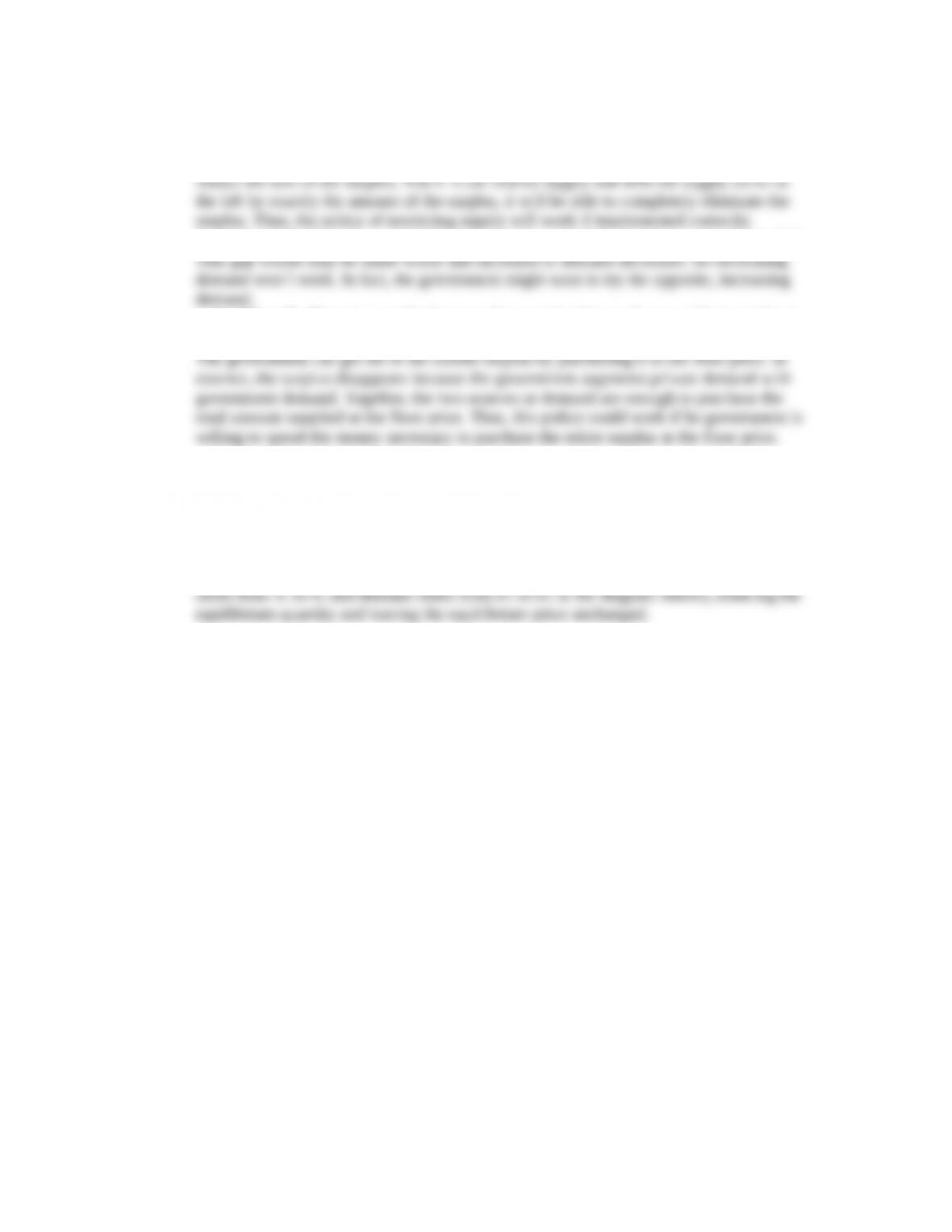
5. Suppose both the demand for olives and the supply of olives decline by equal amounts over
some time period. Use graphical analysis to show the effect on equilibrium price and quantity.
LO7
Answer: The supply and demand curves would shift left by an equal amount (supply
3A-6
Copyright © 2015 McGraw-Hill Education. All rights reserved. No reproduction or distribution without the prior written
consent of McGraw-Hill Education.
Chapter 03 Appendix
6. Governments can use subsidies to increase demand. For instance, the government can pay
farmers to use organic fertilizers rather than traditional fertilizers. That subsidy increases the
demand for organic fertilizer. Consider two industries, one in which supply is nearly vertical and
the other in which supply is nearly horizontal. Assume that firms in both industries would prefer a
higher market equilibrium price because a higher market equilibrium price would mean higher
profits. Which industry would probably spend more resources lobbying the government to
increase the demand for its output? (Assume that both industries have similarly sloped demand
curves.) LO7
a. The industry with a nearly flat supply curve.
b. The industry with a nearly vertical supply curve.
Any demand subsidy will shift the demand curve right. That will cause a larger increase
APPENDIX PROBLEMS
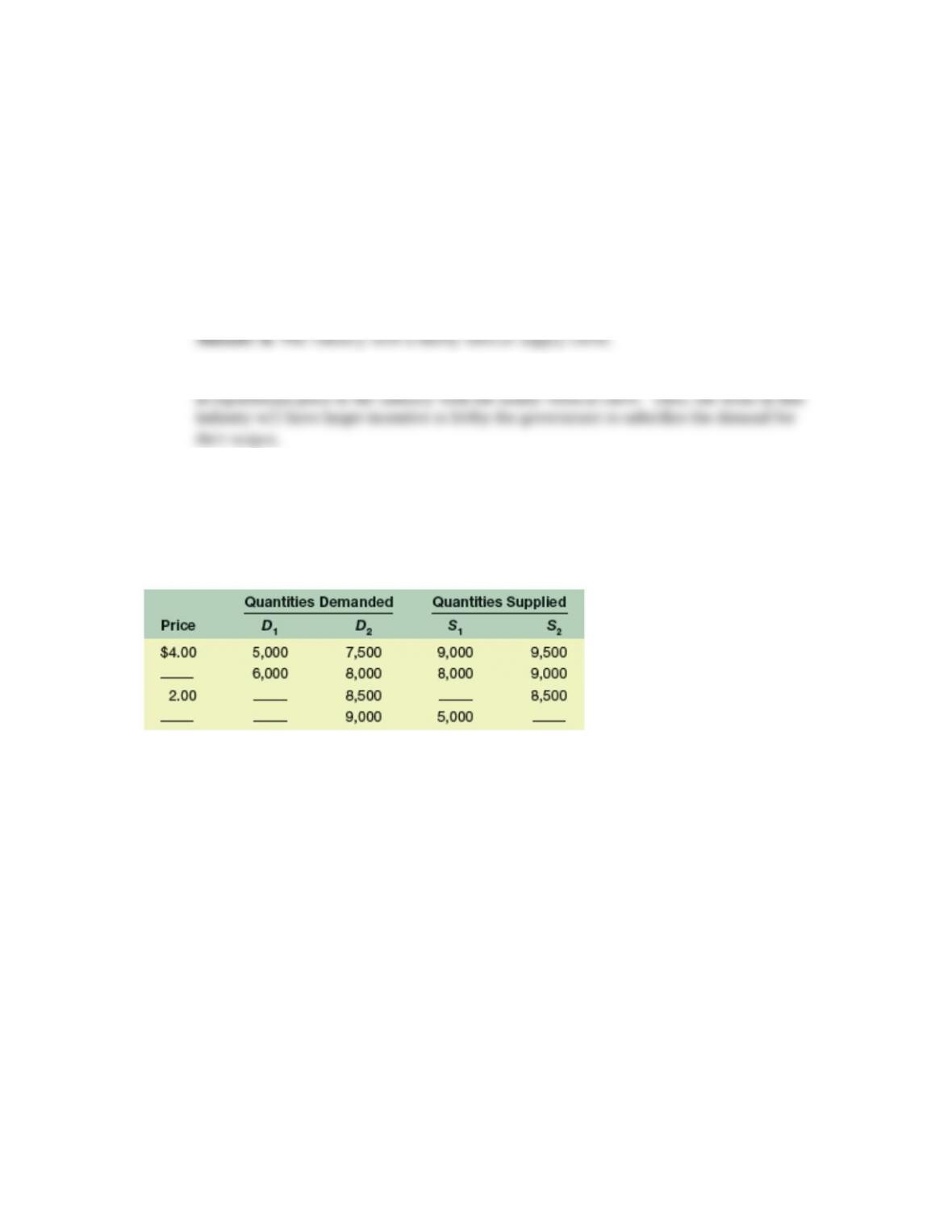
1. Demand and supply often shift in the retail market for gasoline. Here are two demand curves
and two supply curves for gallons of gasoline in the month of May in a small town in Maine.
Some of the data is missing. LO7
a. Use the following facts to fill in the missing data in the table. If demand is D1 and Supply is
S1, the equilibrium quantity is 7000 gallons per month. When demand is D2 and supply is S1, the
equilibrium price is $3.00 per gallon. When demand is D2 and supply is S1, there is an excess
demand of 4000 gallons per month at a price of $1.00 per gallon. If demand is D1 and supply is
S2, the equilibrium quantity is 8000 gallons per month.
b. Compare two equilibriums. In the first, demand is D1 and supply is S1. In the second, demand
is D1 and supply is S2. By how much does the equilibrium quantity change? By how much does
the equilibrium price change?
c. If supply falls from S2 to S1 while demand simultaneously declines from D2 to D1, does the
equilibrium price rise or fall or stay the same? What if only supply falls? What if only demand
falls?
d. Suppose that supply is fixed at S1 and that demand starts at D1. By how many gallons per
month would demand have to increase at each price level such that the equilibrium price per
gallon would be $3.00? $4.00?
3A-7
Copyright © 2015 McGraw-Hill Education. All rights reserved. No reproduction or distribution without the prior written
consent of McGraw-Hill Education.
Chapter 03 Appendix
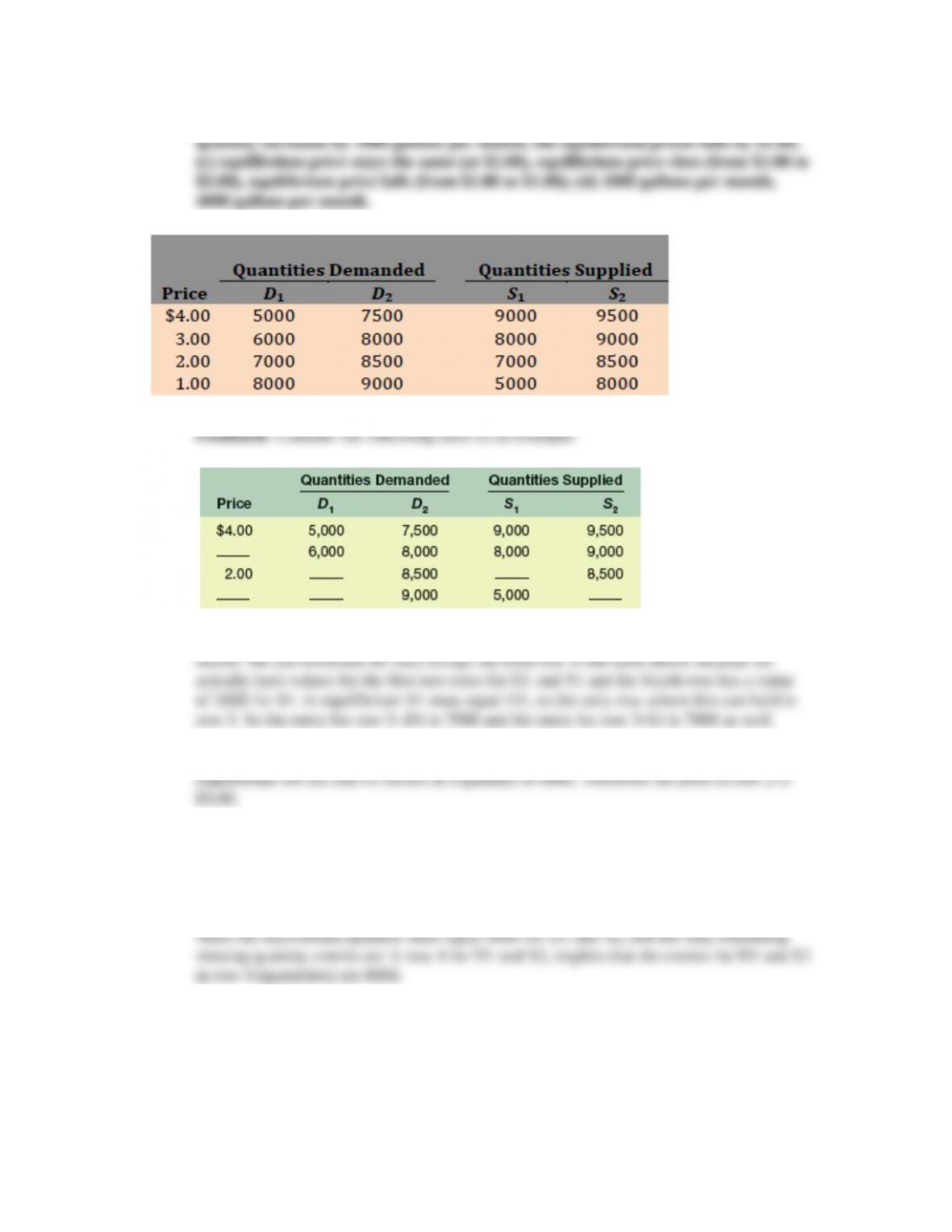
Answers: (a) See the complete table below for the missing values; (b) equilibrium
Part a: If demand is D1 and Supply is S1, the equilibrium quantity is 7000 gallons per
When demand is D2 and supply is S1, the equilibrium price is $3.00 per gallon.
When demand is D2 and supply is S1, there is an excess demand of 4000 gallons per
month at a price of $1.00 per gallon. The excess demand of 4000 occurs in row 4 for D2
and S1. This implies the price in row 4 is $1.00.
If demand is D1 and supply is S2, the equilibrium quantity is 8000 gallons per month.
3A-8
Copyright © 2015 McGraw-Hill Education. All rights reserved. No reproduction or distribution without the prior written
consent of McGraw-Hill Education.
Chapter 03 Appendix
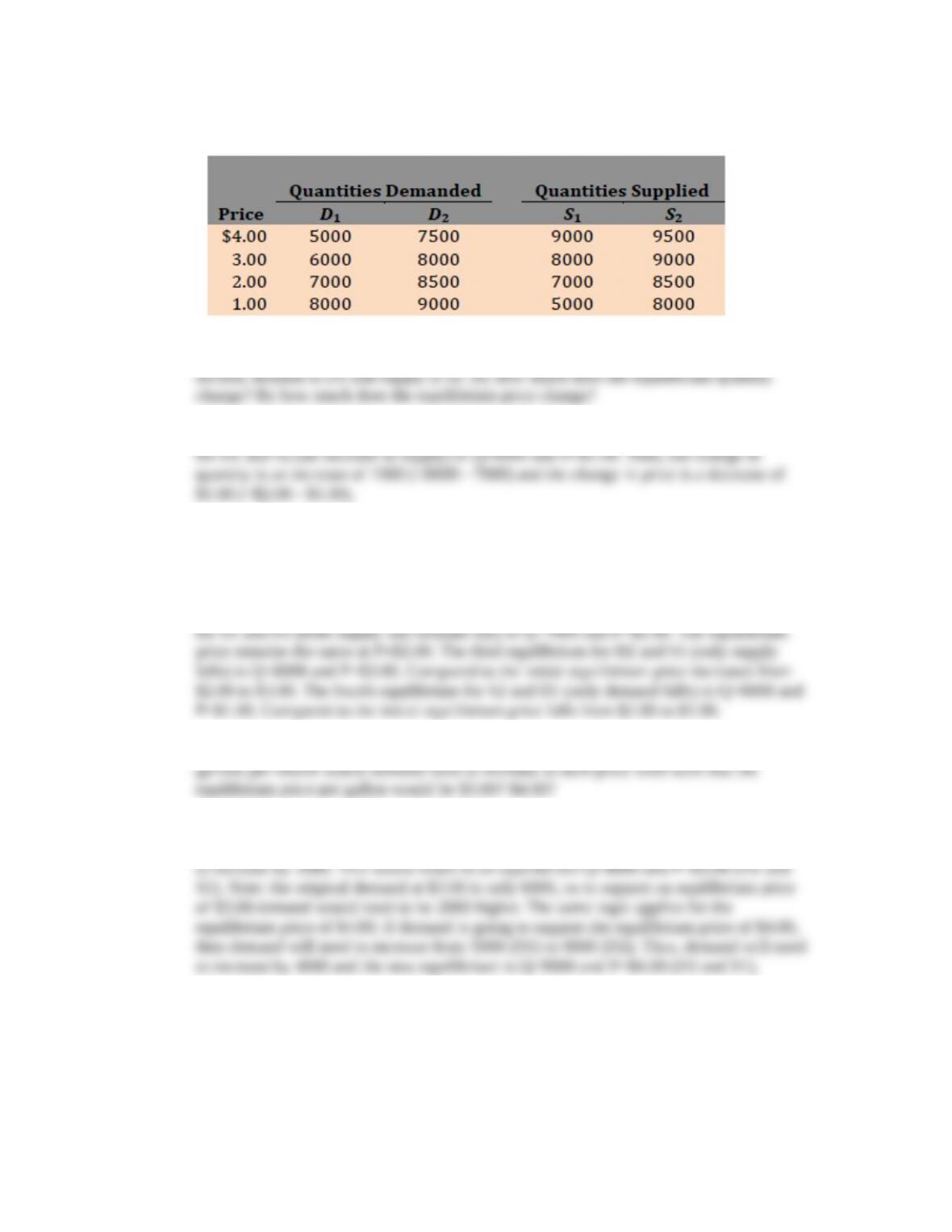
In summary, we have the following table:
Part b: Compare two equilibriums. In the first, demand is D1 and supply is S1. In the
The initial equilibrium for D1 and S1 is Q=7000 and P=$2.00. The second equilibrium
Part c: If supply falls from S2 to S1 while demand declines from D2 to D1, does the
equilibrium price rise or fall or stay the same? What if only supply falls? What if only
demand falls?
The initial equilibrium for S2 and D2 is Q=8500 and P=$2.00. The second equilibrium
Part d: Suppose that supply is fixed at S1 and that demand starts at D1. By how many
Since supply is fixed at S1 and demand starts at D1 the initial equilibrium is Q=7000 and
P=$2.00. For the equilibrium price to increase to $3.00 (from $2.00) demand would need
3A-9
Copyright © 2015 McGraw-Hill Education. All rights reserved. No reproduction or distribution without the prior written
consent of McGraw-Hill Education.
Chapter 03 Appendix
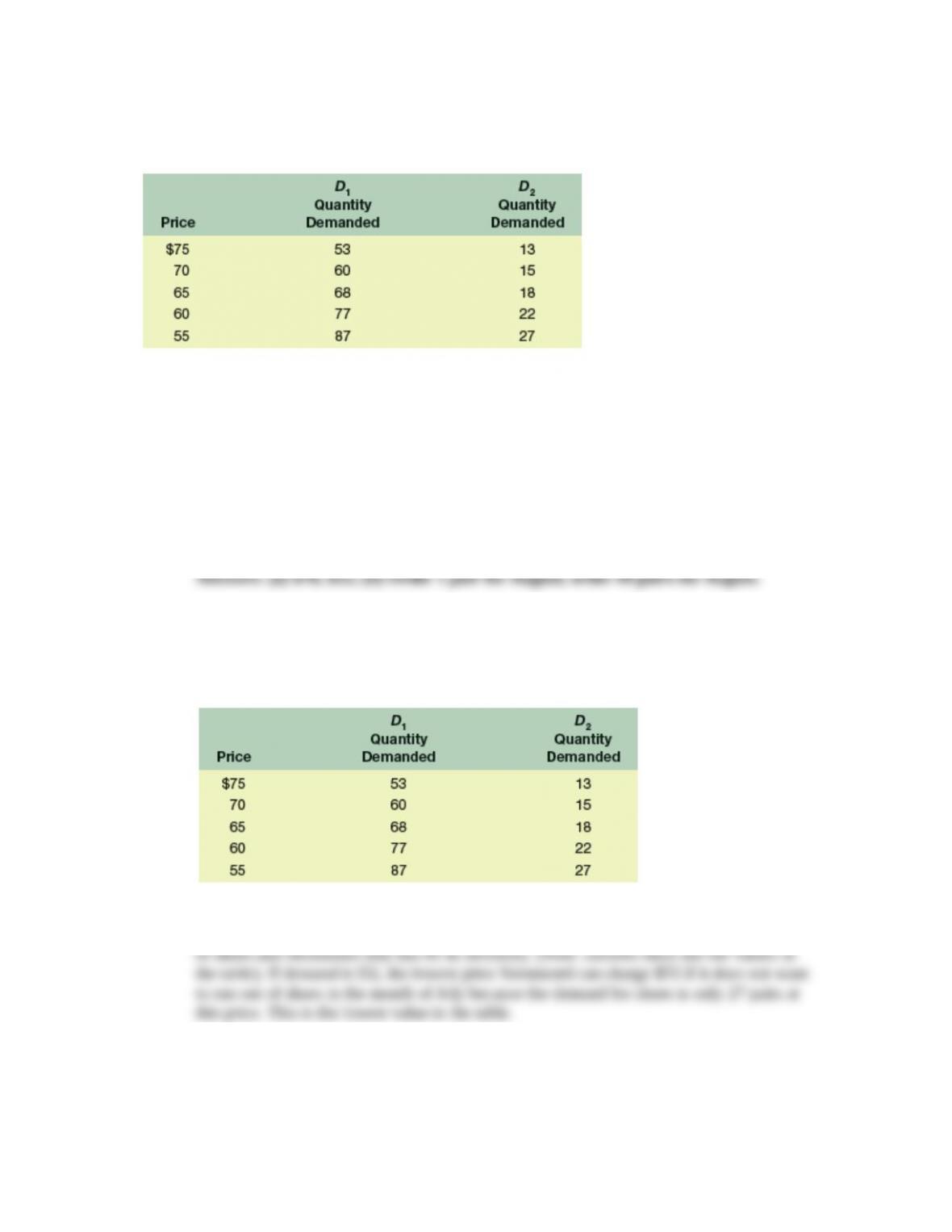
2. The table below shows two demand schedules for a given style of men’s shoes—that is, how
many pairs per month will be demanded at various prices at a men’s clothing store in Seattle
called Stromnord.
Suppose that Stromnord has exactly 65 pairs of this style of shoe in inventory at the start of the
month of July and will not receive any more pairs of this style until at least August first. LO7
a. If demand is D1, what is the lowest price that Stromnord can charge so that it will not run out
of this model of shoes in the month of July? What if demand is D2?
b. If the price of shoes is set at $75 for both July and August and demand will be D2 in July and
D1 in August, how many pairs of shoes should Stromnord order if it wants to end the month of
August with exactly zero pairs of shoes in its inventory? What if the price is set at $55 for both
months?
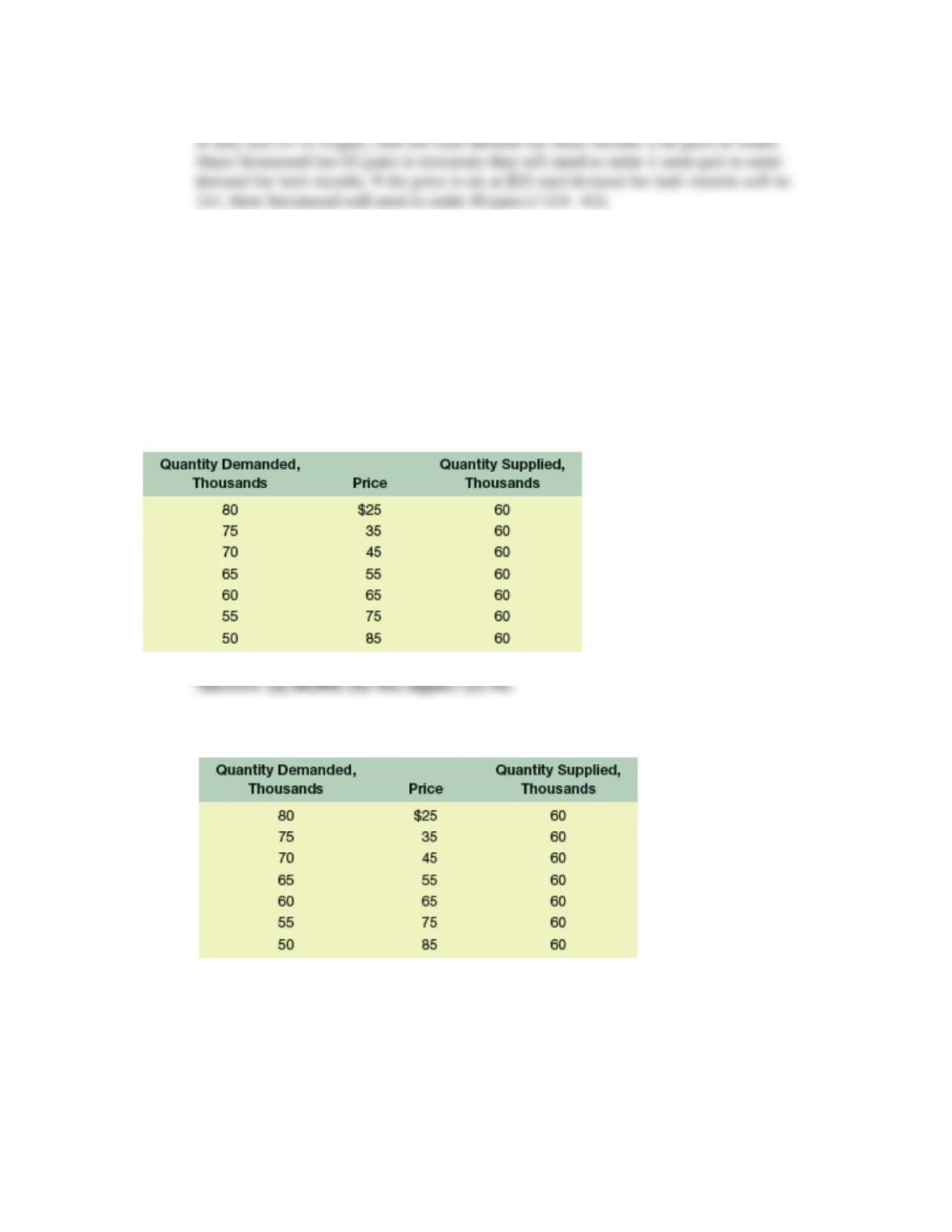
Feedback: Consider the following table and information as an example:
Stromnord has exactly 65 pairs of this style of shoe in inventory at the start of the month
of July and will not receive any more pairs of this style until at least August first.
Part a: If demand is D1, the lowest price Stromnord can charge $70 if it does not want to
run out of shoes in the month of July. A price of $65 would result in a demand of 68 pairs
3A-10
Copyright © 2015 McGraw-Hill Education. All rights reserved. No reproduction or distribution without the prior written
consent of McGraw-Hill Education.
Chapter 03 Appendix
Part b: If the price of shoes is set at $75 for both July and August and demand will be D2
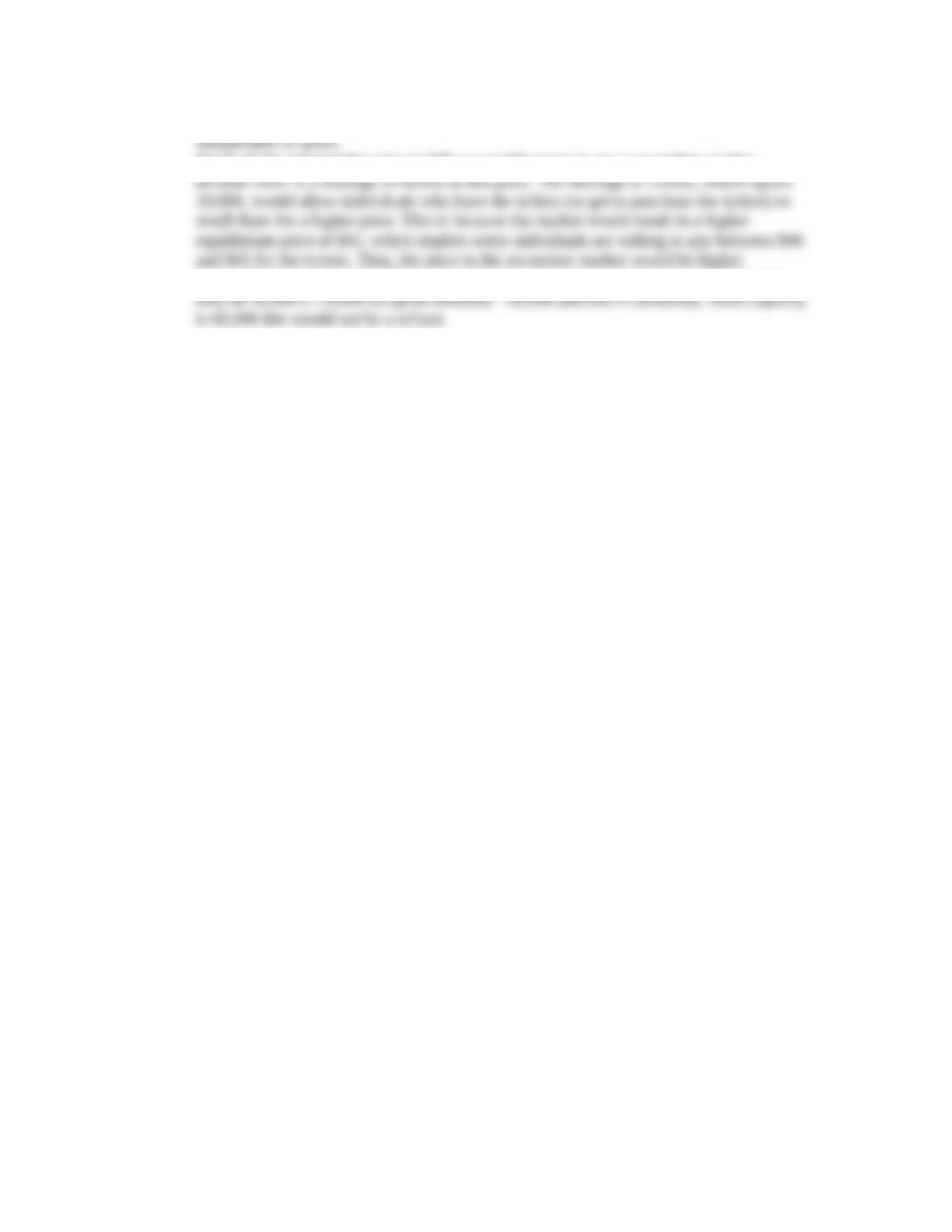
3. Use the table below to answer the questions that follow: LO7
a. If this table reflects the supply of and demand for tickets to a particular World Cup soccer
game, what is the stadium capacity?
b. If the preset ticket price is $45, would we expect to see a secondary market for tickets? Would
the price of a ticket in the secondary market be higher than, the same as, or lower than the price in
the primary (original) market?
c. Suppose for some other World Cup game the quantities of tickets demanded are 20,000 lower
at each ticket price than shown in the table. If the ticket price remains $45, would the event be a
sellout?
Feedback: Consider the following table as an example:
3A-11
Copyright © 2015 McGraw-Hill Education. All rights reserved. No reproduction or distribution without the prior written
consent of McGraw-Hill Education.
Chapter 03 Appendix
Part a: Stadium Capacity is 60,000. We can infer this from the constant supply
Part b: If the preset ticket price is $45 we would expect to see a secondary market
Part c: If demand were 20,000 less at each price, the quantity demanded at $45 would
3A-12
Copyright © 2015 McGraw-Hill Education. All rights reserved. No reproduction or distribution without the prior written
consent of McGraw-Hill Education.