
1) Indifference curves and budget lines can be used to derive an individual’s demand
curve for a product.
2) The U.S. often has a significant surplus in services trade, even though it has a deficit
in goods trade.
3) Broadly defined, labor’s share of national income has been remarkably stable since
1900.
4) According to the inverted-U theory of R&D, other things equal, firms in industries
with concentration ratios around 10 percent will be more technologically progressive
than firms in industries with 50 percent concentration ratios.
5) The economic benefits of forests include provision of wildlife habitats, erosion
prevention, and oxygen production.
6) Firms would rather shrink package sizes than raise prices because consumers will
feel less of a loss from the change in package size.
7) The Patient Protection and Affordable Care Act requires all firms to purchase health
insurance for their employees or pay a $2,000 fine.

8) Without an abundant endowment of natural resources, a nation cannot achieve rapid
economic growth.
9) The income effect of a price-increase for a normal good causes an increase in the
consumption of the good.
10) When a firm increases its output, its average fixed costs will stay constant.
11) The government is like business firm in that it provides goods and services to
households and businesses.
12) Behavioral economics developed as a field of study that looks into how people
make rational decisions based on self-interest.
13) The asymmetric information problem in health care implies that the demand for
health care is a ‘supplier-induced demand”.
14) One effective way that IACs can help DVCs is to lower trade barriers on products
produced by DVCs.

15)
Assumptions: (1) Employers in this market are willing and able to ignore minimum
wage laws; (2) Sd represents the supply of domestic-born (and legal immigrant)
workers; (3) St represents the total supply of workers in this labor market (Sd plus
illegal immigrants); and (4) unless otherwise stated, illegal immigration is not
effectively blocked by the government.
Refer to the given figure and assumptions. How many illegal immigrant workers will be
hired at equilibrium?
A.200,000.
B.250,000.
C.350,000.
D.450,000.
16)
Refer to the above table. If demand decreased by 4 units at each price and supply
decreased by 2 units at each price, what would the new equilibrium price and quantity
be?
A.$3 and 5 units
B.$4 and 4 units
C.$5 and 5 units
D.$6 and 6 units
17)
Refer to the table. In relation to column (3), a change from column (1) to column (2)
would mostly likely be caused by:
A.reduced taste for the good.
B.an increase in input prices.
C.consumers expecting that prices will be lower in the future.
D.government subsidizing production of the good.

18) Why might a company use barter rather than money to make a trade?
A.Barter trade is generally more efficient than money-based trade
B.Barter can enable two firms to trade when their cash flows are limited
C.Money requires a coincidence of wants, barter is more direct
D.Money is efficient only for large transactions, so barter is preferred for smaller
transactions
19) A company has designed an alarm clock that “runs and hides” after going off,
forcing the person to get up and find the alarm clock if he or she wants to shut off the
alarm. According to behavioral economists:
A.it is unlikely to alter people’s tendency to shut off the alarm and ultimately oversleep.
B.the alarm clock keeps people from hitting the snooze button and taking advantage of
the availability heuristic.
C.the alarm clock serves as a precommitment device, helping the user to stick to the
originally planned wake-up time.
D.overconfidence effects will discourage use of such devices.
20) The corporate decision on type and level of R&D activity is difficult because:
A.the interest-rate cost of funds is difficult to estimate.
B.much of corporate R&D is based on the pursuit of science, not on the profit motive.
C.expected returns lie in the future and are highly uncertain.
D.total returns and marginal returns greatly diverge.
21) Empirical studies suggest that the efficiency loss associated with the misallocation
of labor caused by the union wage advantage is:
A.$6 billion per year.
B.about 2 percent of domestic output.
C.less than one-half of 1 percent of domestic output.
D.about 4 percent of domestic output.
22) When the total product curve is falling, the:
A.Marginal product of labor is zero
B.Marginal product of labor is negative

C.Average product of labor is increasing
D.Average product of labor must be negative
23) The total revenue test for elasticity:
A.is equally applicable to both demand and supply.
B.does not apply to demand because price and quantity are inversely related.
C.does not apply to supply because price and total revenue always move together.
D.applies to the short-run supply curve but not to the long-run supply curve.
24) Answer the question on the basis of the following data:
The data indicate that:
A.consumers spend 80 percent of their after-tax incomes.
B.consumers spend 90 percent of their after-tax incomes.
C.a tax reduction will reduce consumption.
D.the relationship between consumption and after-tax income is random.
25) Which statement concerning the kinked demand curve model of oligopoly is false?
A.It addresses the question of price ‘stickiness.”
B.It assumes when one oligopolist raises the price, all others will follow.
C.The portion of the demand curve above the “kink” is more elastic than the portion
below.
D.The firm’s marginal costs can sometimes shift without changing the
profit-maximizing price and output.
26) Lauren makes $150 a day as a bank clerk. She takes two days off work without pay,
to fly to another city to attend the concert of her favorite band. The cost of
transportation and lodging for the trip is $250. The cost of the concert ticket is $50. The
opportunity cost of Lauren’s decision to attend the concert is:
A.$600

B.$450
C.$300
D.$250
27)
Refer to the above graph. A decrease in supply would best be reflected by a change
from:
A.Point 2 to point 1
B.Point 5 to point 1
C.Point 5 to point 2
D.Point 3 to point 6
28) Assume that Abby, Ben, and Clara are the only citizens in a community. A proposed
public good has a total cost of $1000. All three citizens will share an equal portion of
this cost in taxes. The benefit of the public good is $400 each to Abby, Ben, and Clara.
In a majority vote, this proposal will most likely be:
A.Accepted; the public good is produced even though it is economically inefficient
B.Defeated; the public good is not produced even though it would have been efficient to
do so
C.Accepted; the public good is produced which is economically efficient
D.Defeated; the public good is not produced, which is the proper outcome
29) Do unions have a positive or negative effect on economic efficiency?
30) Use marginal-utility analysis to explain why the growing popularity of iPads over
laptop and desktop computers.
31) Describe how a market for externality rights or cap-and-trade system would work in
terms of supply and demand.
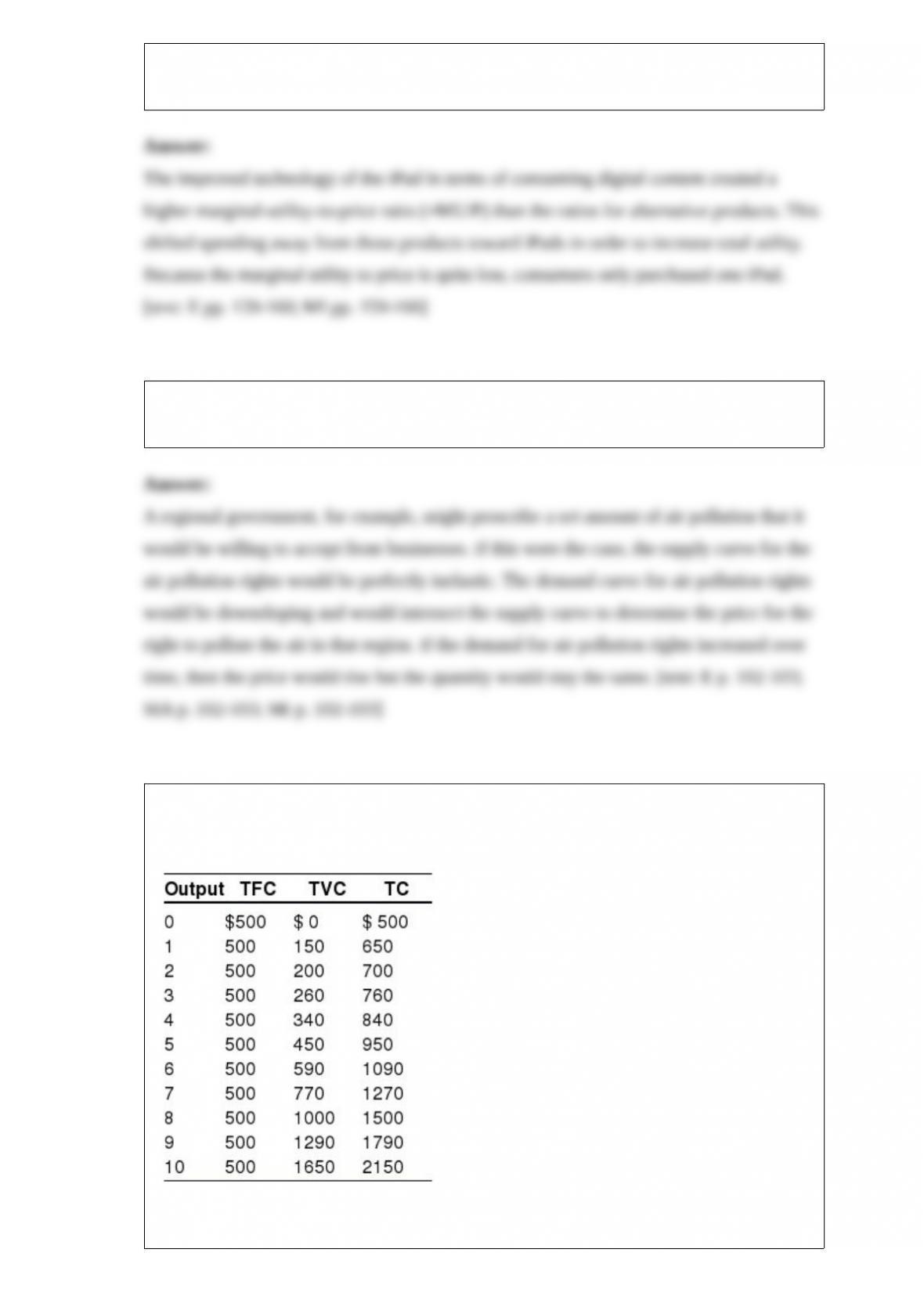
32) Assume that a purely competitive firm has the schedule of costs given in the table
below.
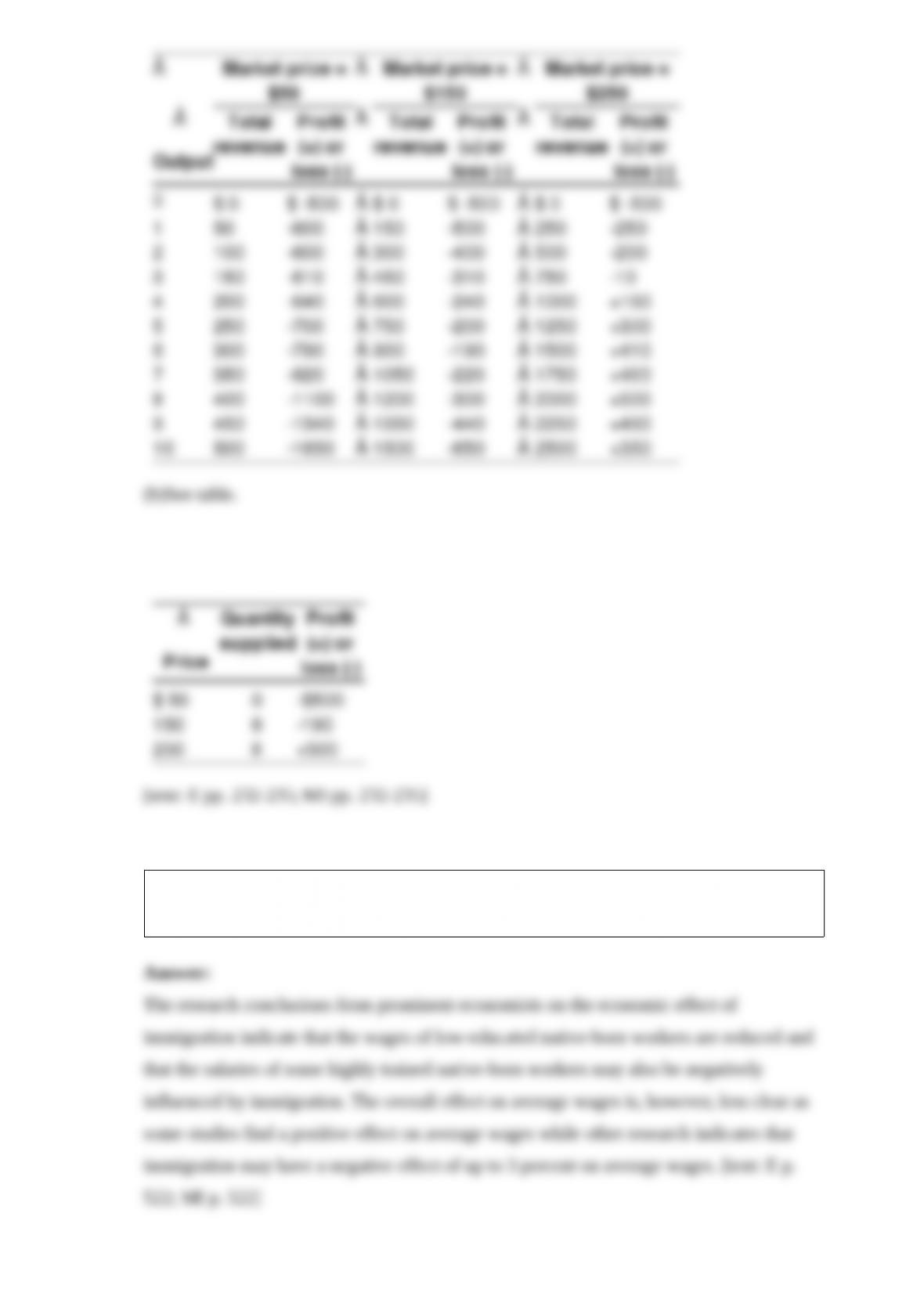
(a) Complete the table below to show the total revenue and total profit of the firm at
each level of output the firm might produce. Assume market prices of $50, $150, and

$250.
(b) Indicate what output the firm would produce and its profits in the following table.
33) Summarize the main research conclusions found by prominent economists on the
economic effects of immigration.

34) What are some of the reasons for the major backflows that occur in most
international migration patterns?