
1)
Refer to the above graph. It shows the total product (TP) curve. At which point is the
marginal product zero?
A.Point a
B.Point b
C.Point c
D.Point d
2) A firm will employ more of an input whose relative price has fallen and, conversely,
will use less of an input whose relative price has risen. Thus, a fall in the price of capital
will increase the relative price of labor and thereby reduce the demand for labor. This
describes the:
A.output effect.
B.substitution effect.
C.idea of derived demand.
D.law of diminishing returns.
3) A major criticism of foreign aid to developing nations is that it:
A.Provides incentives to reduce the role of government
B.Is capital-using rather than capital-saving when it is spent
C.Encourages dependency rather than self-sustained growth
D.Leads to widespread underemployment and unemployment
4) With which of the following countries does the United States have its largest goods
and services deficit?
A.Canada.
B.Germany.
C.Japan.
D.China.

5) A well-tested economic theory is often called:
A.a hypothesis.
B.a prototype.
C.a principle.
D.an anomaly.
6)
Refer to the diagram. This firm will earn only a normal profit if product price is:
A.P1
B.P2
C.P3
D.P4
7)
Refer to the diagrams that show identical marginal utility from income curves for
Singer and Catalano. If a given income of $20,000 is initially distributed so that Singer
receives $15,000 and Catalano $5,000:
A.no judgment can be made as to the effect of a redistribution of income on total utility.
B.this initial distribution of income is maximizing the combined total utility of the two
consumers.
C.the combined total utility of the two consumers can be increased by redistributing
income from Catalano to Singer.
D.the combined total utility of the two consumers can be increased by redistributing
income from Singer to Catalano.
8) One of the special features of the health care market is asymmetric information. This
refers to the following characteristics, except:
A.The doctor (supplier) tells the patient (demander) what to purchase
B.Buyers have little understanding of services they are asked to consume
C.Fee-for-pay arrangements lead to excessive quantities of services prescribed
D.Consumers pay lower out-of-pocket costs
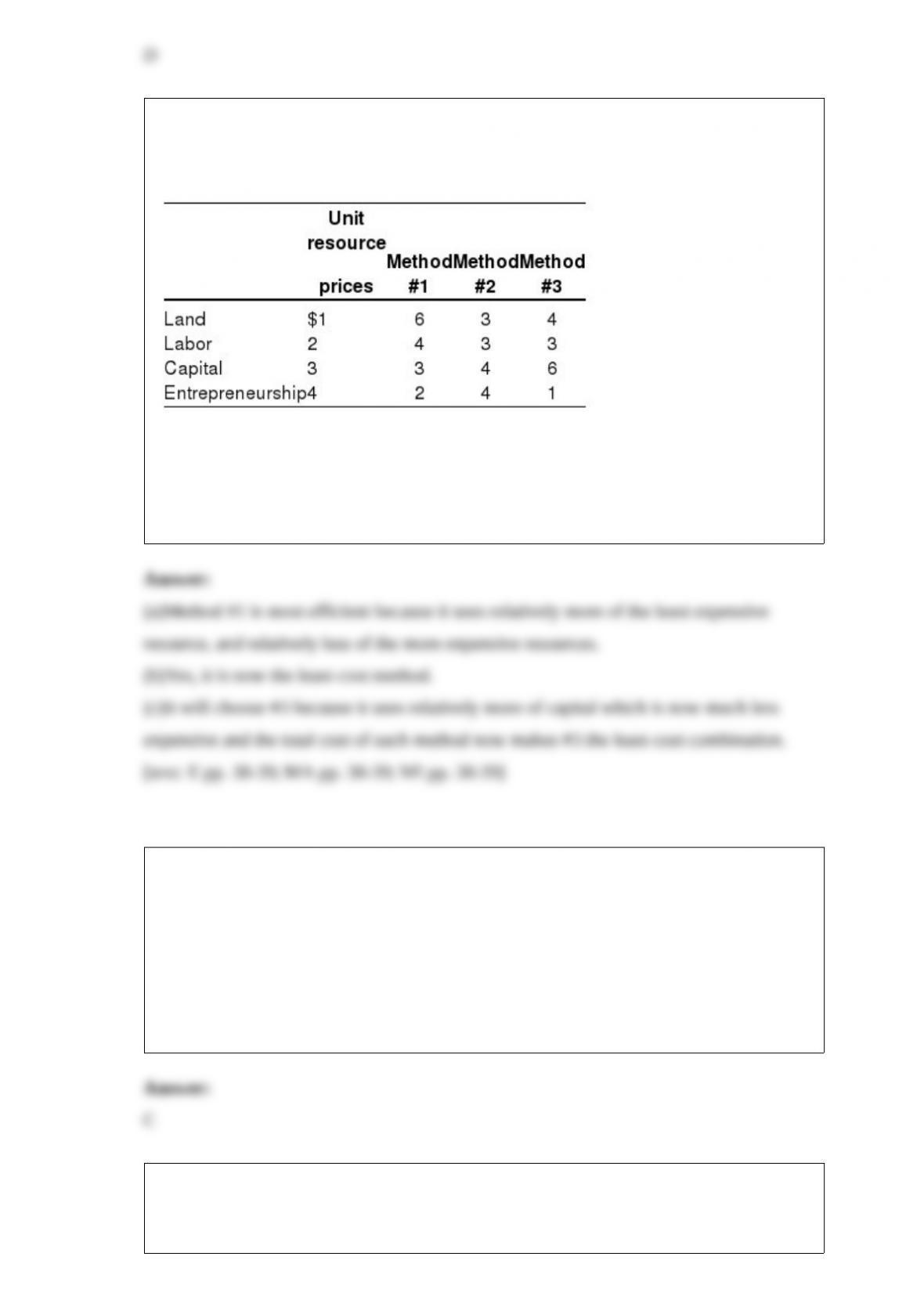
9) Assume that a firm finds that its profits will be maximized (or losses minimized)
when it produces $30 worth of product X. Each of these techniques shown in the
following table will produce exactly $30 worth of X.
(a)Which method is most efficient? Why?
(b)Given the above prices, will the firm adopt a new method which involves 10 units of
land, 3 of labor, 2 of capital, and 2 of entrepreneurial ability?
(c)Suppose the price of capital falls to $1 without any other prices changing. Which of
the methods will the firm now choose? Why?
10) One of the provisions of the PPACA is a personal mandate that all individuals:
A.pay a $1,000 deductible and 20 percent co-pay on all medical care except annual
check-ups or preventative care.
B.contribute at least 30 percent of the total cost of employer-provided health insurance.
C.purchase health insurance for themselves and their dependents unless they are already
covered by government or employer-provided insurance.
D.with preexisting conditions must purchase a specially designated government
insurance plan.
11) Answer the question on the basis of the following information about the cost ratios
for two productsfish (F) and chicken (C)in countries Singsong and Harmony. Assume
that production occurs under conditions of constant costs and these are the only two

nations in the world.
Singsong: 1F = 2C
Harmony: 1F = 4C
Refer to the given information. In Singsong the domestic real cost of each chicken:
A.is fish.
B.is 2 fish.
C.increases with the level of fish caught.
D.decreases with the level of fish caught.
12) In the table below, a monopsonist has the marginal-revenue-product schedule for
labor given in columns 1 and 2, and the supply schedule for labor is given by columns 1
and 3.
Refer to the above table and information. For maximum profits, how many labor-units
will the monopsonist hire and what will be the wage rate paid?
A.2 and $10
B.3 and $11
C.4 and $12
D.5 and $13
13)
Refer to the above graph of a hypothetical market for health care. If there was not
health insurance, the equilibrium price and quantity of health care would be:
A.$20 and 600 units
B.$40 and 450 units
C.$60 and 300 units
D.$80 and 450 units
14) Suppose that a firm successfully introduces a highly profitable new product. If this
new product offers less marginal utility per unit to consumers than existing substitute

products, then the:
A.laws of economics have been violated.
B.new product must have increasing, not diminishing, marginal utility.
C.existing products were being produced at a loss.
D.new product has a lower price than the existing substitute products.
15)
In 2007, immigrants made up a larger portion of the labor force in the U.S. than that in
Canada.
16) Along a linear downward-sloping demand curve, the price elasticity of demand will
be:
A.Greater than one across each price range
B.Less than one across each price range
C.Equal to zero across each price range
D.Different across each price range
17) Identify at least two non-economic reasons used by critics to support their concerns
about illegal immigration.
18) Some economists argue that pure monopolists will purposely avoid the price-output
combination that will maximize their profits. Explain how this less-than-maximum
profit behavior could be rational.
19) Describe the three-step shift known as the demographic transition.
20) Compare and contrast the difference in private and public goods based on the
characteristics of rivalry and exclusion.

21) Why is the overall world population still increasing? What are the expectations for
population growth in the future?