1)
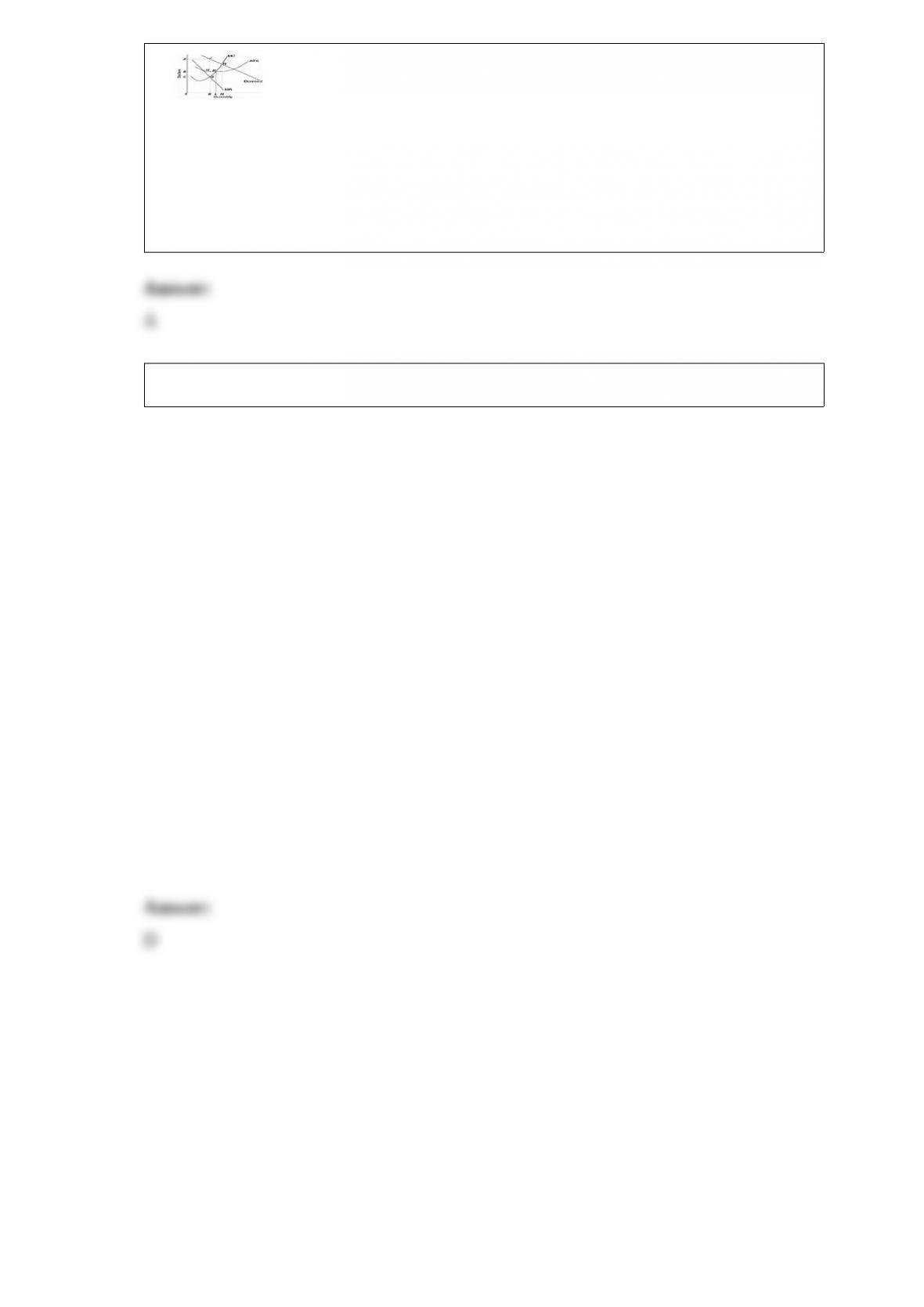
Refer to the diagram. At the profit-maximizing level of output, the firm will realize:
A.an economic profit of ABHJ.
B.an economic profit of ACGJ.
C.a loss of GH per unit.
D.a loss of JH per unit.
2)
Immigration accounts for what percentage of the annual growth in the U.S. labor force in
recent years?
A.About 10 percent
B.About 25 percent
C.About 33 percent
D.About 50 percent
3) The copper, aluminum, cement, and industrial alcohol industries are examples of:
A.interproduct competition.
B.homogeneous oligopoly.
C.monopolistic competition.
D.differentiated oligopoly.
4) For a firm selling its product in an imperfectly competitive market, the marginal
revenue product of labor can be found by:
A.adding marginal product to total product as one more unit of labor is employed.
B.adding marginal revenue to total product as one more unit of labor is employed.
C.multiplying marginal product by product price.
D.multiplying marginal product by marginal revenue.
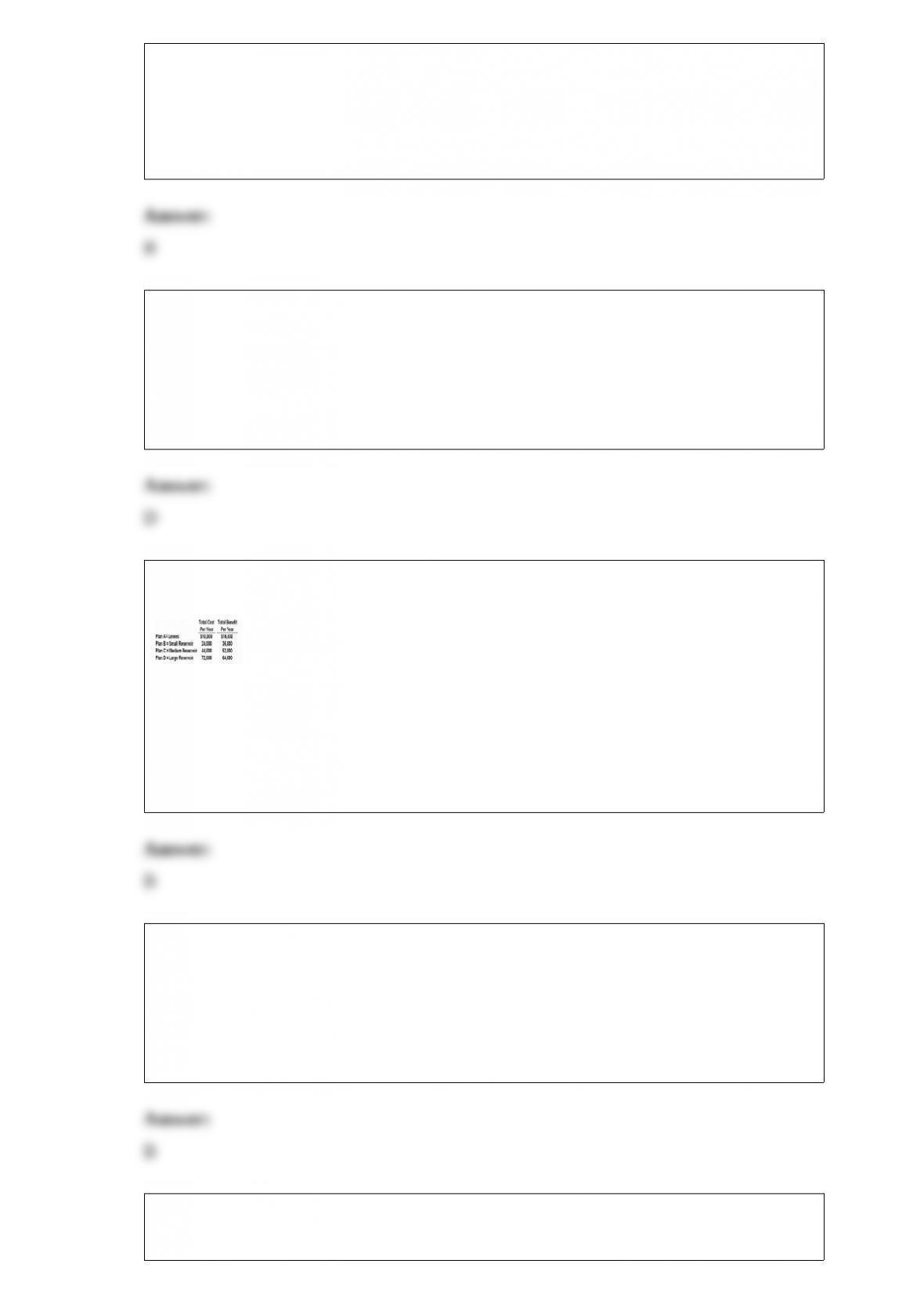
5) The following data are for a series of increasingly extensive flood control projects:
Refer to the data. For Plan D marginal costs and marginal benefits are:
A.$72,000 and $64,000 respectively.
B.$28,000 and $12,000 respectively.
C.$24,000 and $18,000 respectively.
D.$16,000 and $28,000 respectively.
6) A price increase from $43 to $49 results in an increase in quantity supplied from 220
units to 240 units. The price elasticity of supply in this price range is:
A..3
B..67
C.1.50
D.3.33
7) Suppose that a consumer purchases just two goods, X and Y. The slope of the budget
line would indicate the:
A.Opportunity cost of good Y in terms of good X given up for each unit of Y
B.Opportunity cost of good X in terms of good Y given up for each unit of Y
C.Maximum quantity of good Y that the consumer could buy with a given budget
D.Maximum quantity of good X that the consumer could buy with a given budget
8) The total output of a firm will be at a maximum where:
A.MP is at a maximum.
B.AP is at a minimum.
C.MP is zero.
D.AP is at a maximum.
9) The World Trade Organization is the successor to the:
A.General Agreement on Tariffs and Trade (GATT)
B.United Nations Commission on Trade Law (UNCTL)
C.World Customs Organization
D.United Nations Conference on Trade and Development (UNCTAD)
10) Insurance companies use deductibles and copayments to:
A.increase access to health care.
B.reduce health care costs by discouraging overuse of the health care system.
C.prevent small companies from self-insuring their workers.
D.keep government out of the health care insurance industry.
11) A regressive tax means that if someone earning $25,000 pays $5,000, someone
earning $50,000 must pay:
A.Less than $5,000
B.Less than $10,000
C.More than $10,000 but less than $15,000
D.More than $15,000 but less than $20,000