
1) Fiscal policy is more susceptible to politicization than monetary policy.
2) If the minimum efficient scale in an industry is smaller than the size of the market of
that industry, then we would have a natural-monopoly situation.
3) Inventions and innovations can both be patented.
4) Health care costs in the United States have risen absolutely but remained constant as
a percentage of gross domestic product.
5) The U.S. steel industry is an example of homogeneous oligopoly.
6) When a supply-side market failure occurs, the costs are greater than the benefits for
the last unit(s) of output produced.
7) If two resources are complementary, an increase in the price of one will increase the
demand for the other.
8) Because the equilibrium position of a purely competitive seller entails an equality of

price and marginal costs, competition produces an efficient allocation of economic
resources.
9) Payroll taxes account for more than one-third of Federal tax revenues.
10) Successful new products enable consumers to increase the total utility they obtain
from a specific amount of their total spending.
11) An effective antipollution policy from the economic perspective requires that all
pollution be eliminated and banned.
12) One major tenet of behavioral economics is that the human brain is prone to commit
errors in perception.
13) The monopolist’s demand curve is more elastic than the industry demand curve.
14) Insurance policies typically stipulate a deductible amount which the insured must
shoulder; this is to address the problem of:
A.Adverse selection
B.Externalities
C.Moral hazard
D.Public goods
15) The rising demand for health-care industry workers is due to the following factors,
except:
A.Aging of the U.S. population
B.Rising income levels in the U.S.
C.Continued presence of health insurance for U.S. consumers
D.Decreasing prices of labor in the health-care industry
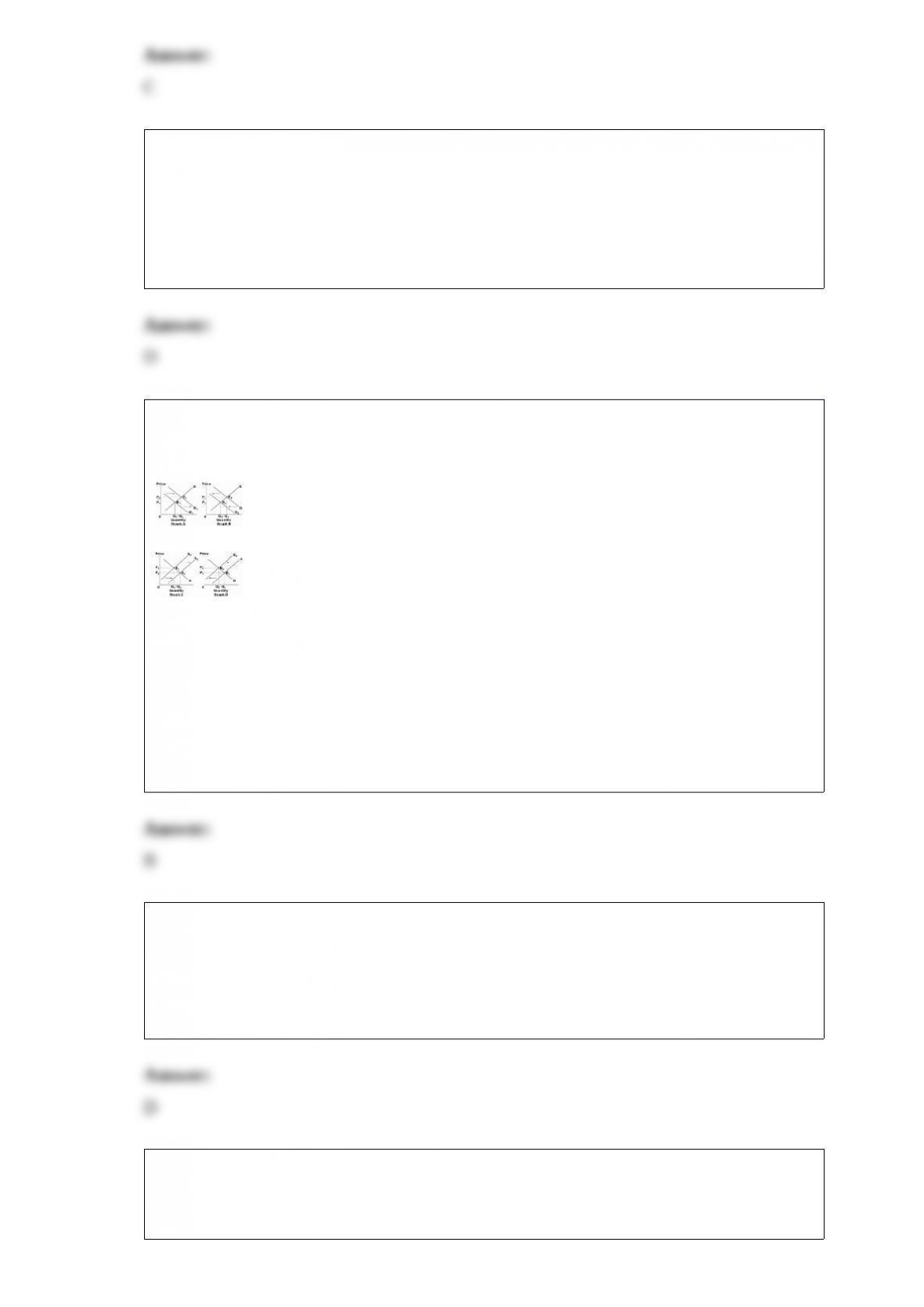
16) Assume that the graphs show a competitive market for the product stated in the
question.
Select the graph above that best shows the change in the market specified in the
following situation: In the market for houses, when consumers experience a substantial
fall in income due to a serious economic recession.
A.Graph A
B.Graph B
C.Graph C
D.Graph D
17) Which of the following statements about payroll taxes is false?
A.They provide funds for Social Security
B.They include Medicare taxes
C.Both employers and employees pay these taxes
D.They are lump-sum taxes not based on wages/salaries
18) A monopolist sells 6 units of a product per day at a unit price of $15. If it lowers
price to $14, its total revenue increases by $22. This implies that its sales quantity
increases by:
A.4 units per day
B.3 units per day
C.2 units per day
D.1 unit per day
19) If a consumer has an income of $200, the price of X is $5, and the price of Y is $10,
the maximum quantity of X the consumer is able to purchase is:
A.5
B.10
C.20
D.40
20) Fisher Mike can catch salmon for $11 per ton and fisher Tony can catch salmon for
$8 per ton. Both Mike and Tony have an individual transferable quota (ITQ) to catch
1000 tons of salmon. The market price of salmon is $13 per ton.
(a)If both Mike and Tony catch fish that year, what will be the profit for Mike and what
will be the profit for Tony?
(b)If next year, Mike trades his quota for the year to Tony, how much should Mike be
paid for the quota to make more than he can by fishing?
(c)Mike decides to trade his ITQ for the year to Tony. What will be the reduction in
fishing cost to society now that only Tony is doing the fishing?
21) A characteristic of a purely competitive labor market would be:
A.”price maker” behavior by the workers
B.”wage taker” behavior by workers
C.Many firms selling the same product
D.Many workers with different skills
22) Suppose the balance on the current account is +$100 billion and the balance on the
capital account is -$1 billion. The balance on the financial account is:
A.+$101 billion.
B.-$100 billion.
C.-$99 billion.
D.-$101 billion.
23) The division of labor means that:
A.labor markets are geographically segmented.
B.unskilled workers outnumber skilled workers.
C.workers specialize in various production tasks.
D.each worker performs a large number of tasks.
24) Which of the following is a major justification for public aid to agriculture in the
United States?
A.The demand for farm products is income elastic
B.Technological progress has greatly reduced the demand for farm products
C.Farmers sell their products in highly imperfect markets and buy resources in highly
competitive markets
D.Farmers are subject to extraordinary hazards that are hard to insure against
25)
Refer to the diagram showing the domestic demand and supply curves for a specific
standardized product in a particular nation. If the world price for this product is $.50,
this nation will experience a domestic:
A.shortage of 160 units, which it will meet with 160 units of imports.
B.shortage of 160 units, which will increase the domestic price to $1.60.
C.surplus of 160 units, which it will export.
D.surplus of 160 units, which will reduce the world price to $1.00.
26) In recent years, the United States has had large:
A.current account surpluses.
B.capital and financial account deficits.
C.balance of trade deficits.
D.balance of payments surpluses.
27) Which of the following would most likely increase income inequality?
A.Improvements in public education.
B.Greater monopoly power among product sellers.
C.Greater equality in the distribution of wealth.
D.Fewer differences in working conditions across occupations.
28) The term allocative efficiency refers to:
A.the level of output that coincides with the intersection of the MC and AVC curves.
B.minimization of the AFC in the production of any good.
C.the production of the product mix most desired by consumers.
D.the production of a good at the lowest average total cost.
29) Suppose that a business incurred implicit costs of $500,000 and explicit costs of $5
million in a specific year. If the firm sold 100,000 units of its output at $50 per unit, its
accounting:
A.profits were $100,000 and its economic profits were zero.
B.losses were $500,000 and its economic losses were zero.
C.profits were $500,000 and its economic profits were $1 million.
D.profits were zero and its economic losses were $500,000.
30) In a market economy, the government’s power to coerce can:
A.undermine economic efficiency by increasing private-sector risk.
B.improve economic efficiency by directing all resources to their most valued uses.
C.reduce private-sector risk and increase economic efficiency.
D.cause significant negative externalities.
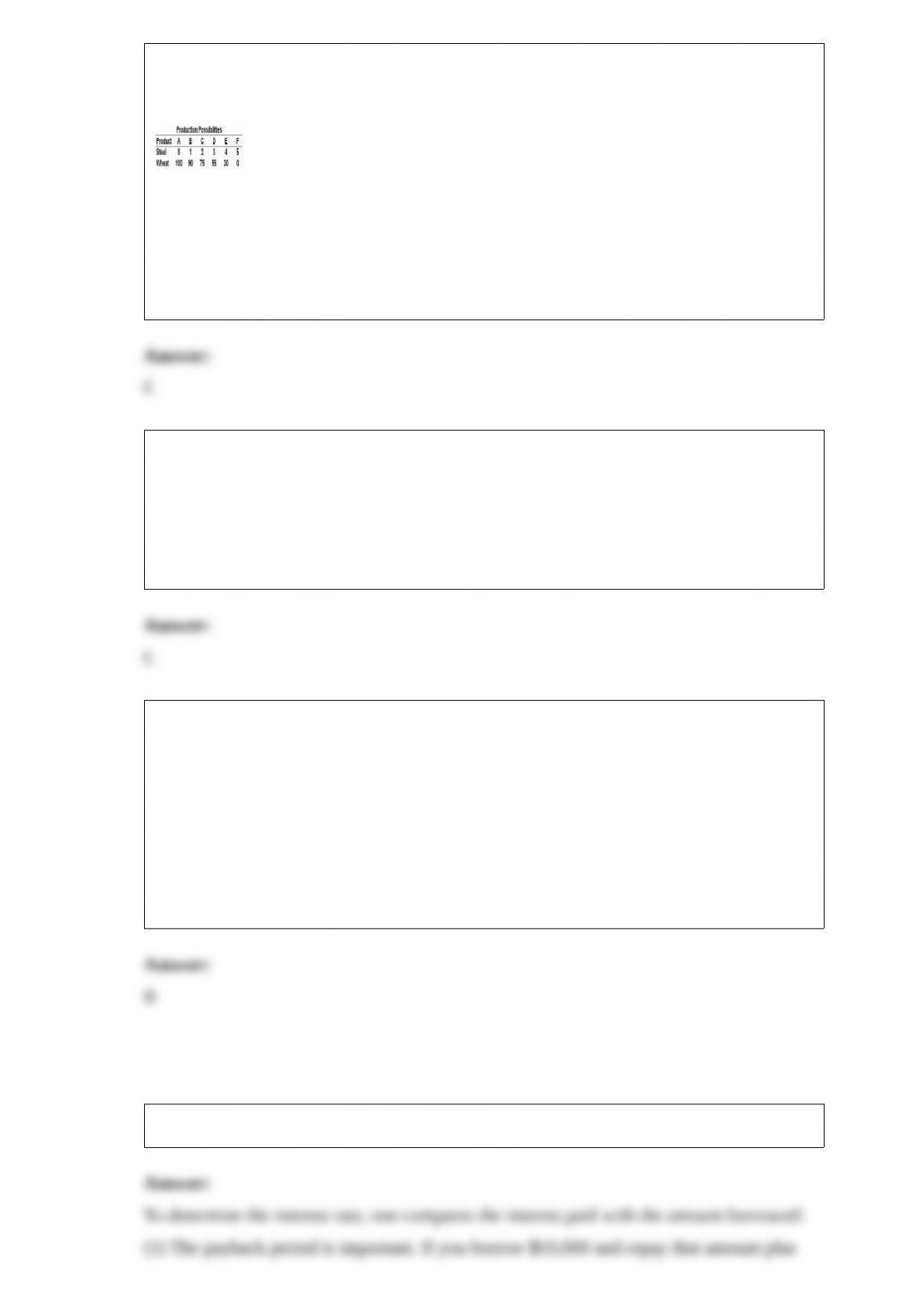
31) A nation can produce two products: steel and wheat. The table below is the nation’s
production possibilities schedule:
Refer to the above table. A change from combination C to B means that:
A.1 unit of steel is given up to get 75 units of wheat
B.2 units of steel are given up to get 75 units of wheat
C.1 unit of steel is given up to get 15 more units of wheat
D.2 units of steel are given up to get 15 more units of wheat
32) All of the following statements apply to a purely competitive market in the long
run, except:
A.In the long run, all inputs are variable in quantity
B.Firms can expand their plant capacities in the long run
C.Total fixed costs remain constant even when output expands in the long run
D.Firms may enter or leave the industry in the long run
33) Assume the price of product Y (the quantity of which is on the vertical axis) is $15
and the price of product X (the quantity of which is on the horizontal axis) is $3. Also
assume that money income is $60. The absolute value of the slope of the resulting
budget line is:
A. 5
B.1/5
C.4
D.20
34) Give five examples showing how different factors affect interest rate calculations.
35) Define the three main categories of businesses.
36) Do you agree or disagree with the statement that: A monopolist always charges the
highest possible price. Explain.
37) A consumer has a daily income of $120 and purchases two products, X and Y. The
price of X is $3 and the price of Y is $4. The following six pairs of points for X and Y
define an indifference schedule: (7,40), (10,30), (15,20), (20,15), (30,10), and (40,8). In
the graph below, draw the budget line and the indifference curve. What amounts of X
and Y will allow the consumer to achieve equilibrium?
38) What economic conditions are necessary to achieve productive efficiency under
pure competition?
39)
40) (Consider This) Evaluate, using behavioral economics, the Stickk.com website,
which sets up financial incentives to help individuals reach their goals.
41) What is the problem with protecting industries in the United States from the
dumping of foreign products on the domestic market?