
1) What do wages paid to factory workers, interest paid on a bank loan, forgone
interest, and the purchase of component parts have in common?
A.None are either implicit or explicit costs.
B.All are opportunity costs.
C.All are implicit costs.
D.All are explicit costs.
2)
Refer to the diagram, representing Slippery Slope Oil Company. What price of oil
would make 15 million barrels the optimal quantity to extract and sell this year?
A.$50.
B.$70.
C.$90.
D.$110.
3) Suppose that salsa manufacturers sell 2 million bottles at $3.50 in one year and 3
million bottles at $3 in the next year. Based on this information, we can conclude that
the:
A.law of supply has been violated.
B.law of demand has been violated.
C.demand for salsa has increased.
D.supply of salsa has increased.
4) The Federal government has tried to eliminate agricultural surpluses by:
A.Decreasing supply and demand
B.Increasing supply and demand
C.Decreasing supply and increasing demand
D.Increasing supply and decreasing demand
5)
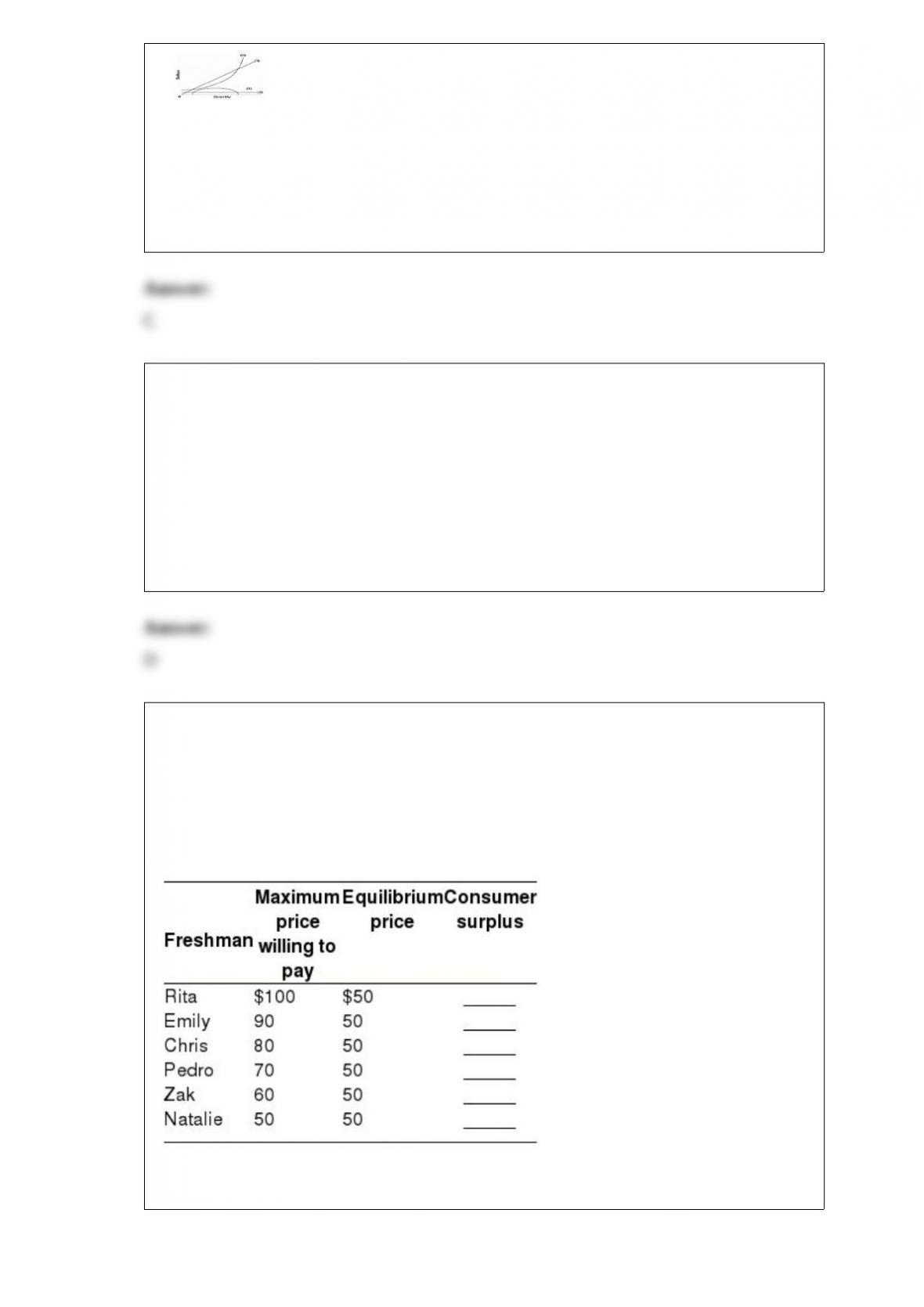
The firm represented by the diagram would maximize its profit where:
A.curves (2) and (1) intersect.
B.curve (1) touches the horizontal axis for the second time.
C.the vertical distance between curves (3) and (4) is the greatest.
D.curves (3) and (4) intersect.
6) Which statement best describes a special-interest issue?
A.It is a program or policy that is adopted during a special session of Congress or a
state legislature
B.It is an issue in which both the supporters and opponents use paid lobbyists to
represent their interests
C.It is a program or policy which one political party strongly supports and other
political parties strongly oppose
D.It is a program or policy in which a large number of people will suffer small costs
and a small number of people will receive large gains
7) At the beginning of the school year, used couches are in high demand among State
University freshman living on the sixth floor of Beta Dormitory. Fortunately for the
freshman, the upperclassmen moving off of the sixth floor are very willing to sell their
used couches. Answer the following questions about the sixth floor used-couch market.
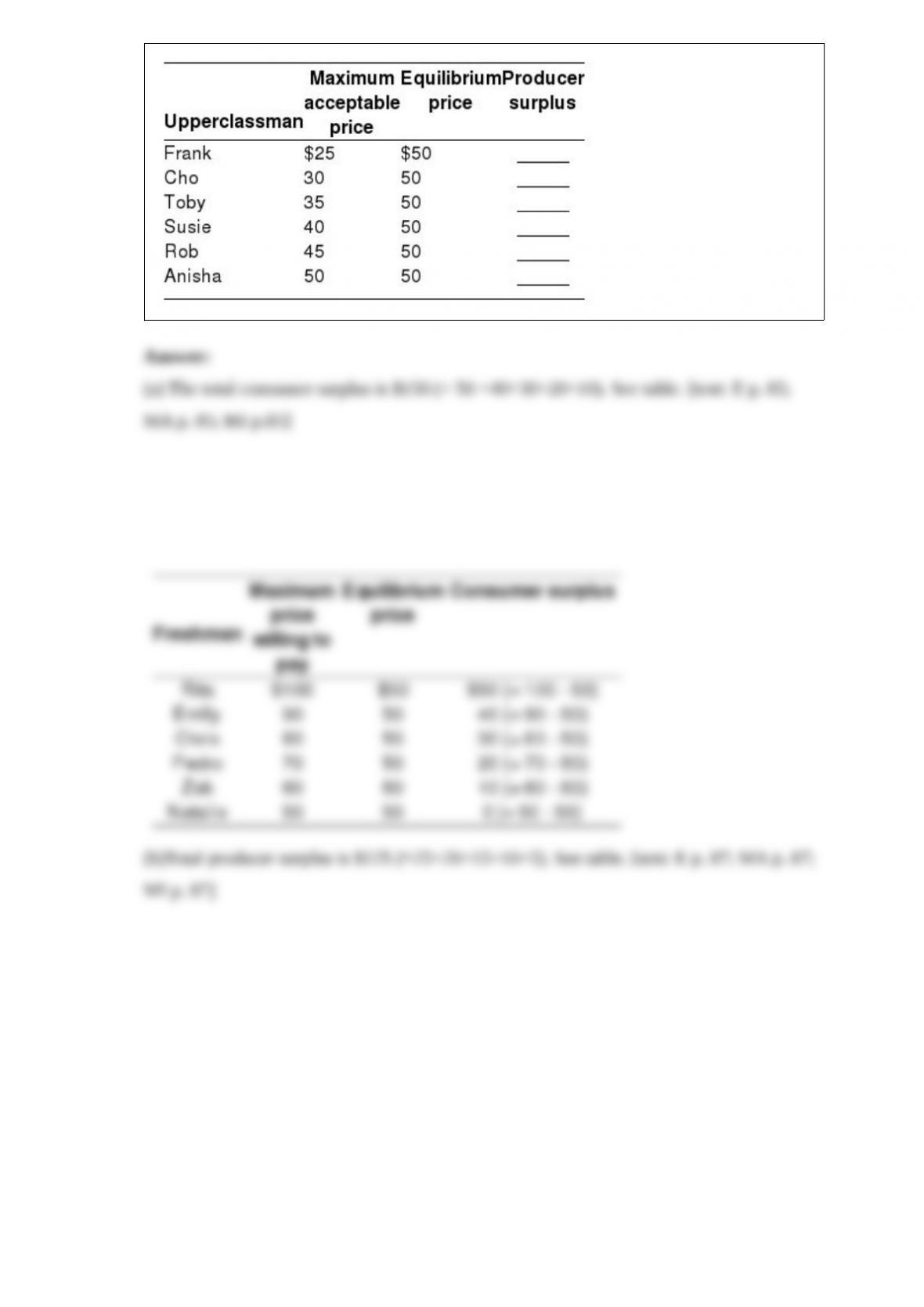
(a) Complete the table below containing the market demand for used couches on the
sixth floor. What is the total consumer surplus?
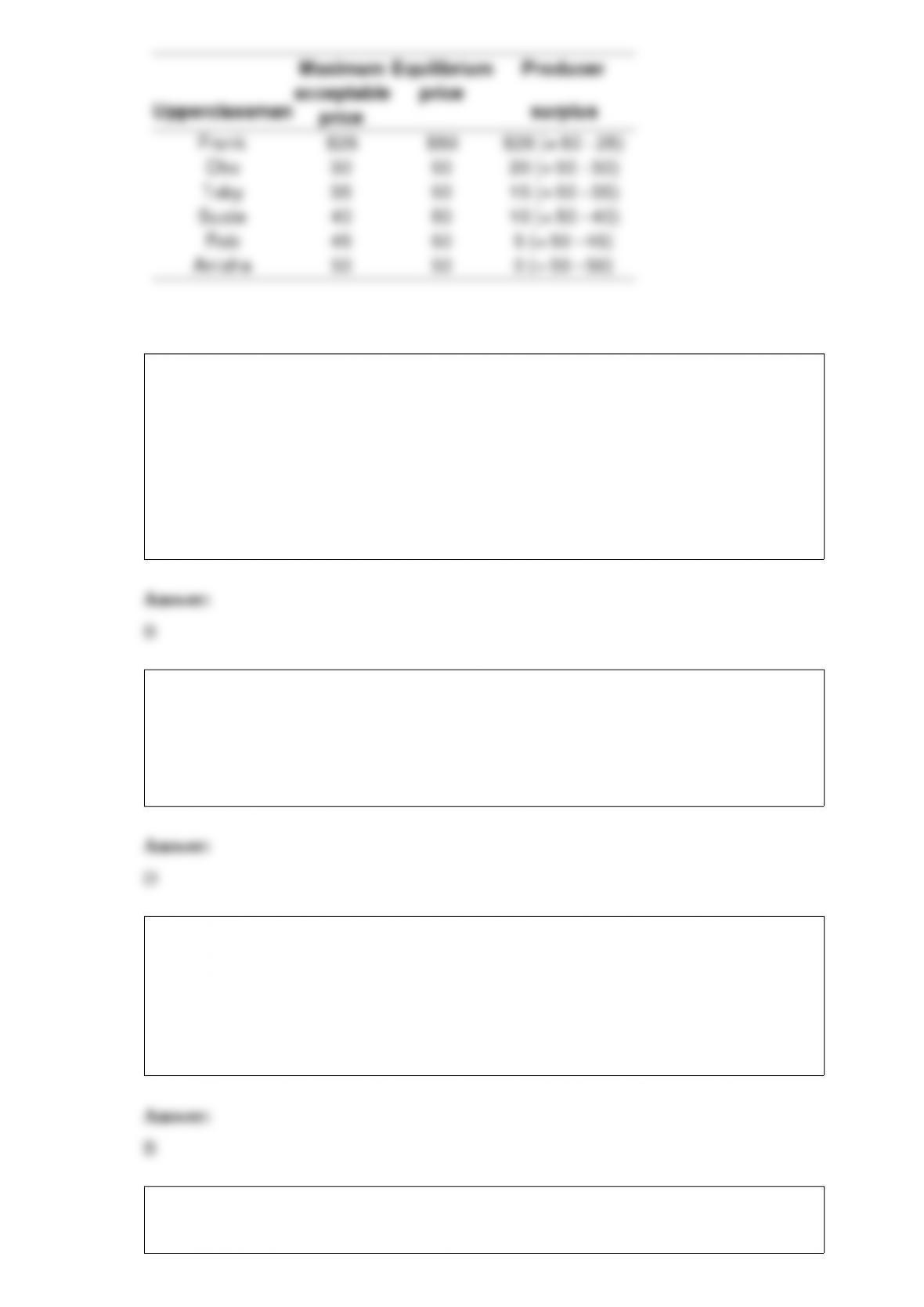
(b) Complete the table below containing the market supply for used couches on the
sixth floor. What is the total producer surplus?
8) The Food, Conservation, and Energy Act of 2008 does not address the fundamental
problem of agricultural subsidies, which is that those subsidies:
A.reduce work incentive for farmers, thus reducing agricultural production.
B.slow the exodus of resources from agriculture, increase production of agricultural
products, and reduce crop prices and market incomes.
C.increase the exodus of resources from agriculture and reduce investments by farmers
in land and equipment.
D.are based on past agricultural production and not on current agricultural production.
9) Which of the following is a source of insurable business risk?
A.Changes in consumer tastes
B.Changes in government policies
C.Economic recession
D.Accidents to employees
10) United States exports, international tourism in the United States, and foreign capital
inflow into the United States all give rise to:
A.Depreciation of the U.S. dollar
B.A supply of foreign currencies to the United States
C.A demand for foreign currencies in the United States
D.Decreased foreign exchange reserves in the United States
11) Export supply curves are __________________; import demand curves are
___________________.
A.horizontal; vertical
B.vertical; horizontal
C.downsloping; upsloping
D.upsloping; downsloping
12) Which of the following is not an example of a market imperfection that might
explain persistent wage differentials within an occupation?
A.Geographic immobility of workers.
B.Discrimination.
C.Noncompeting groups.
D.Poor information about job opportunities and pay.
13) Which of the following is an assumption of theory of consumer behavior described
in this chapter?
A.The consumer’s income increases as prices of goods increase
B.Each good that a consumer consumes has a price
C.The consumer oftentimes is not sure about her preferences
D.Marginal utility increases as more units of a good is consumed
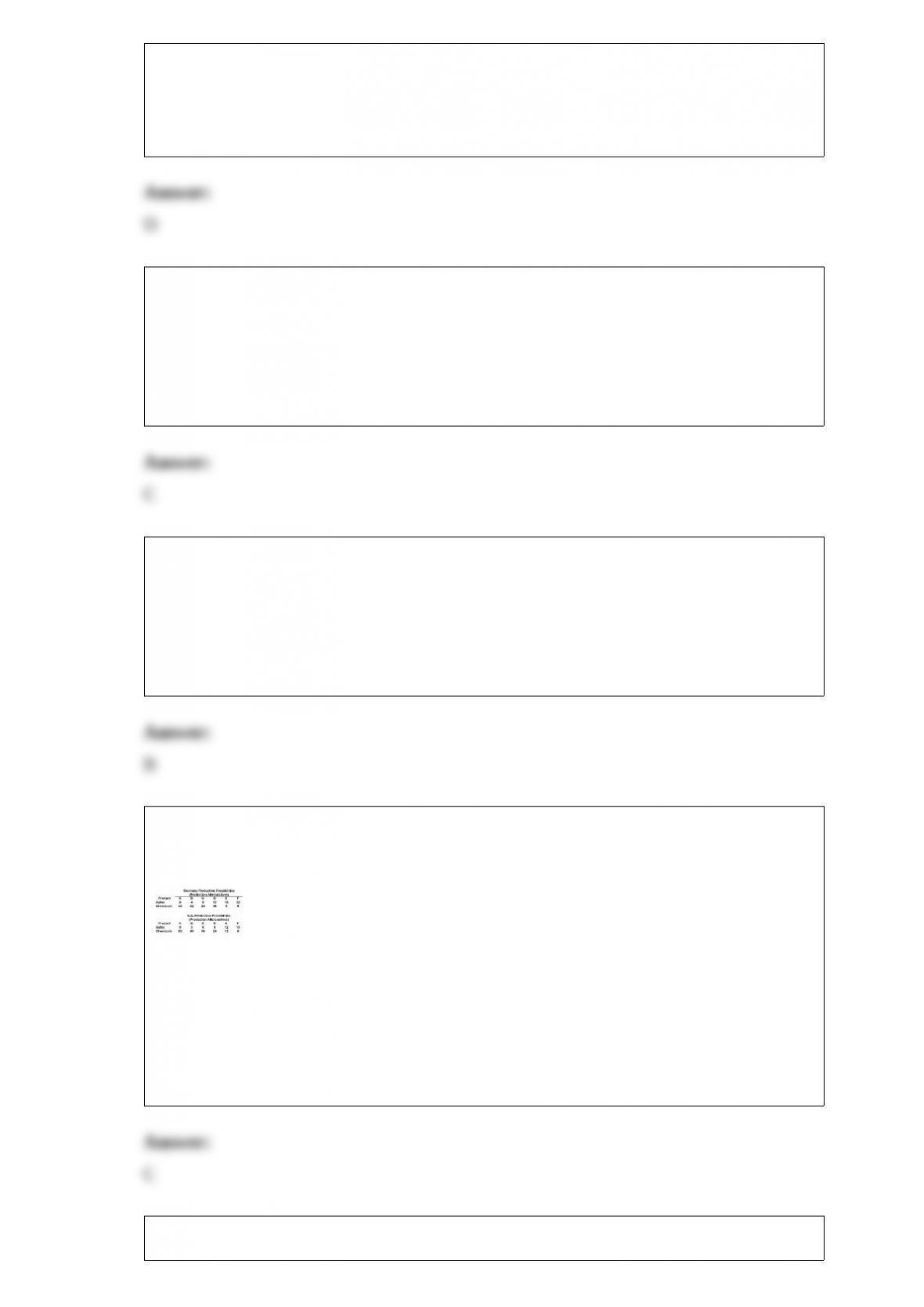
14) Autos and chemicals are in million of units in the following production possibilities
tables:
Refer to the tables above. If Germany and the United States engage in trade, the
mutually-beneficial terms of trade will be between:
A.3 and 4 units of autos for 1 unit of chemicals
B.2 and 4 units of autos for 1 unit of chemicals
C.2 and 4 units of chemicals for 1 unit of autos
D.0.33 and 0.5 units of autos for 1 unit of chemicals
15) Any combination of goods lying outside of the budget line:
A.implies that the consumer is not spending all his income.
B.yields less utility than any point on the budget line.
C.yields less utility than any point inside the budget line.
D.is unattainable, given the consumer’s income.
16) When producers do not have to pay the full cost of producing a product, they tend
to:
A.Over-produce the product because of a demand-side market failure
B.Under-produce the product because of a demand-side market failure
C.Under-produce the product because of a supply-side market failure
D.Over-produce the product because of a supply-side market failure
17) The relationship between the elasticity of product demand and the elasticity of
demand for labor employed in its production is such that, other things being equal:
A.the more elastic the demand for the product, the less elastic the demand for labor.
B.the more elastic the demand for the product, the more elastic the demand for labor.
C.the elasticity of product demand only affects the elasticity of labor demand when the
product market is purely competitive.
D.if product demand is perfectly elastic, labor demand will be perfectly inelastic.
18) When increases in the supply of an agricultural product are much greater than the
increases in demand for it over time, then the price:
A.And quantity of agricultural products will increase
B.And quantity of agricultural products will decrease
C.Of agricultural products will increase, but the quantity will decrease
D.Of agricultural products will decrease, but the quantity will increase
19) A profit-maximizing firm will:
A.expand employment if marginal revenue product exceeds marginal resource cost.
B.reduce employment if marginal revenue product exceeds marginal resource cost.
C.expand employment if marginal revenue product equals marginal resource cost.
D.reduce employment if marginal revenue product equals marginal resource cost.