
1) If the demand for wheat is highly price inelastic, an extraordinarily large crop may
reduce farm incomes.
2) The problems of central planning become less complex as an economy grows in size
over time.
3) Hiring the least-costly combination of resources ensures that profits will be
maximized.
4) When there is allocative efficiency in a market, the buyers’ maximum willingness to
pay for the last unit traded is equal to the sellers’ minimum acceptable price for that
unit.
5) In electricity generation, it is most economically efficient to use a single energy
source.
6) According to the legal cartel theory of regulation, firms desire to have government
regulation because it protects them from competition.
7) Elasticity of resource demand is measured by dividing “percentage change in
resource price” by “percentage change in resource quantity.”

8) Heuristics generally help people make fewer errors in their decisions.
9) The Securities and Exchange Commission’s supervision of Wall Street financial firms
is a possible example of regulatory capture.
10) Health savings accounts (HSAs) have the following characteristics, except:
A.They are available to workers covered by health insurance plans with high
deductibles ($1000 or more) and do not have other first-dollar insurance coverage
B.Contributions to HSAs are tax-deductible
C.Unused funds in HSAs accumulate and remain available for later out-of-pocket
medical expenses
D.Only workers can contribute to HSAs; employers cannot
11)
Refer to the graphs above. Which one shows demand with a price-elasticity coefficient
equal to zero?
A.Graph A
B.Graph B
C.Graph C
D.Graph D
12)
Other things equal:
A.Owners of U.S. businesses benefit from immigration and owners of Mexican businesses
are hurt by emigration

B.Owners of U.S. businesses are hurt by immigration and owners of Mexican businesses
benefit from emigration
C.Owners of U.S. businesses benefit from emigration and owners of Mexican businesses
are hurt by immigration
D.The benefit owners of U.S. businesses receive from immigration is offset by the losses
experienced by owners of Mexican businesses due to emigration
13) Total allowable catch (TAC):
A.explicitly limits the number of days in a season that particular fish may be caught.
B.explicitly limits the number of boats allowed to fish in a particular area.
C.explicitly limits the number or tonnage of fish that can be harvested from a particular
fishery.
D.issues tradable permits limiting the number of fish a particular fisher can catch.
14) When a firm is experiencing diseconomies of scale:
A.It should increase the amount of labor it hires
B.It should lower its price to the competitive level
C.Its average total costs will decline if it reduces its scale of operations
D.It should increase the size of its plant to decrease its average total costs

15) Slopes of lines are especially important in economics because:
A.they measure marginal changes.
B.they always tell us something about profits.
C.positive slopes are always preferred to negative slopes.
D.they always relate to resource and output scarcity.
16)
According to the best evidence, immigration in the U.S.:
A.Raises the wages of low-skilled native-born workers and decreases the salaries of
highly-skilled native born workers
B.Increases the wages of both low-skilled native-born workers and highly-skilled native
born workers
C.Reduces the wages of low-skilled native-born workers and increases the salaries of
highly-skilled native born workers
D.Reduces the wages of low-skilled native-born workers and may decrease the salaries of
highly-skilled native born workers

17) When economists say that health care services are overconsumed, they mean that:
A.rich people buy too much health care and poor people buy too little.
B.some resources now used in the health care industry could produce alternative goods
and services that society values more highly.
C.health care is being purchased in amounts such that marginal benefits exceed
marginal costs.
D.the price of health care is below equilibrium so that quantity demanded exceeds
quantity supplied.
18) When a monopolistically competitive firm is in long-run equilibrium:
A.production takes place where ATC is minimized.
B.marginal revenue equals marginal cost and price equals average total cost.
C.normal profit is zero and price equals marginal cost.
D.economic profit is zero and price equals marginal cost.
19) When the price of movie tickets in a certain town was reduced, the movie-theaters’
revenues did not change. This suggests that the demand for movie tickets in that town
has a price-elasticity coefficient of:
A.1.0
B.Greater than 1
C.0.5
D.Zero
20) An industry comprised of a very large number of sellers producing a standardized
product is known as:
A.monopolistic competition.
B.oligopoly.
C.pure monopoly.
D.pure competition.

21) Suppose a court rules that the ABC Corporation is in violation of the antitrust laws
because it produces 70 percent of the output of its industry. This decision is consistent
with the:
A.U.S. Steel case.
B.Alcoa case.
C.behavioralist approach to antitrust.
D.legal cartel theory of regulation.
22) Assume that a firm’s interest-rate cost-of-funds curve for R&D is perfectly elastic.
Which of the following would increase a firm’s optimal R&D expenditures and, in
equilibrium, leave the expected rate of return on the last dollar of R&D unchanged?
A.A rightward shift of the expected-rate-of-return curve.
B.An upward shift of the interest-rate cost-of-funds curve.
C.A leftward shift of the expected-rate-of-return curve.
D.A downward shift of the interest-rate cost-of-funds curve.
23) Which product is most likely to be the most price elastic?
A.Milk
B.Housing
C.Clothing
D.Automobiles
24) Since 1850, the:
A.supply and demand for productive resources have grown at the same rate.
B.supply of productive resources has grown faster than the demand for those resources.
C.demand for productive resources has grown faster than the supply of those resources.
D.supply of productive resources has increased, while the demand has fallen.
25) The modern view of technological advance is that it:
A.Is the result of random lucky events unrelated to the economic system
B.Requires government R&D spending to keep it going
C.Arises from intense rivalry among individuals and firms within the capitalist system
D.Is a force that is external to the economy to which the economy adjusts

26) Which of the following lists of exchange-rate systems is arranged in proper
historical order, from earliest to most current?
A.Bretton Woods system, gold standard, managed float.
B.Gold standard, managed float, Bretton Woods system.
C.Managed float, Bretton Woods system, gold standard.
D.Gold standard, Bretton Woods system, managed float.
27) What happens in a decreasing-cost industry when some firms leave and the
industry’s output contracts?
A.The average cost will increase
B.The average cost will decrease
C.The total cost will decrease
D.The product price will decrease
28) One of the outcomes for society from product innovation is:
A.More concentration in industry
B.Less scientific research
C.Greater total utility
D.Fewer mergers
29) The following table shows estimated wages and salaries, proprietors income,
corporate profits, interest, rent, and national. income based on these categories.
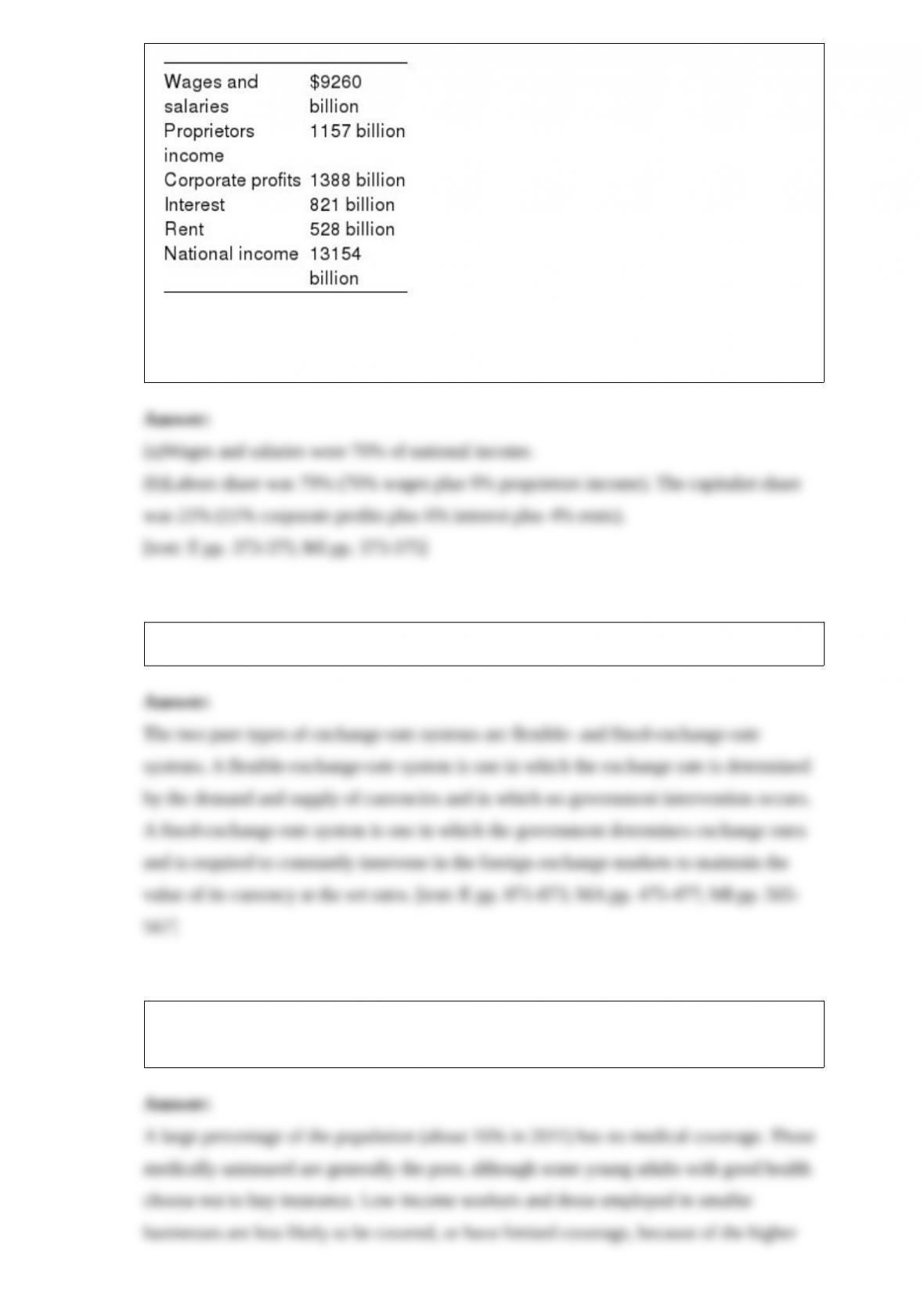
(a)What were wages and salaries as a percentage of national income?
(b)What were labors share of the national income and the capitalists share as a
percentage of national income? Show your calculations.
30) Define the two pure types of exchange-rate systems.
31) Describe the extent and characteristics of the part of the population with limited
access to health care coverage.
32) Tomato Farms is selling tomatoes in a purely competitive market. Its output is 5000
bushels, which sell for $15 a bushel. At this level of output, the marginal cost is $15 a
bushel and average total cost is $14.50 a bushel. Should the firm increase output,
decrease output, or not produce? Why?
33) How do government programs affect the distribution of income in the United
States?
34) What are some measurement issues involved in accurately measuring poverty?