1) The so-called pork-barrel politics refers to congressional members:
A.Trading votes with one another
B.Receiving perks and freebies from businesses trying to sway their votes
C.Paying close attention to the vocal special interest groups
D.Inserting provisions for local narrow projects into comprehensive legislation
2) An employer is prejudiced, prefers to hire white rather than Hispanic workers, and is
willing to pay higher wages to obtain white workers. This illustrates:
A.reverse discrimination.
B.the crowding model.
C.the taste-for-discrimination model.
D.statistical discrimination.
3)
Refer to the above table. In this competitive market, the price and quantity will settle at:
A.$10 and 2,000 units
B.$15 and 1,600 units
C.$20 and 900 units
D.$25 and 1,200 units
4) Which of the following is a measure of the degree of industry concentration?
A.Dow Jones Industrial Index
B.Herfindahl Index
C.Employment Cost Index
D.S&P-500 Index
5) Being “underwater” in one’s home mortgage means that the market value of one’s
house had fallen below:
A.Its value the previous year
B.What is owed in the mortgage loan
C.The purchase price
D.The average home price in the neighborhood
6) Carlos and Darla are playing the dictator game. Carlos is assigned the role of dictator
and given $20 to split between the two of them. Based on previous experiments with
this game, if Carlos is a typical player, behavioral economists would expect:
A.Carlos to keep all of the money for himself.
B.Carlos to give all of the money to Darla.
C.Carlos to split the money evenly with Darla.
D.Carlos to split the money, keeping a little more than half for himself.
7) A competitive firm will maximize profits at that output at which:
A.total revenue exceeds total cost by the greatest amount.
B.total revenue and total cost are equal.
C.price exceeds average total cost by the largest amount.
D.the difference between marginal revenue and price is at a maximum.
8) Government’s unfunded liabilities:
A.result from the political bias toward immediate benefits and deferred costs.
B.result in more efficient policies in an attempt to satisfy these liabilities.
C.are caused primarily by market failures.
D.only occur in democratically elected governments.
9) Which of the following factors is a “demand shifter” for new houses?
A.The price of lumber
B.Wages for construction workers
C.The price of new houses
D.The interest rates on mortgage loans

10) Answer the question on the basis of the following five data sets wherein it is
assumed that the variable shown on the left is the independent variable and the one on
the right is the dependent variable. Assume in graphing these data that the independent
variable is shown on the horizontal axis and the dependent variable on the vertical axis.
Refer to the data sets. Which of the data sets would graph as an upsloping line?
A.1 only.
B.1, 2, and 3 only.
C.4 and 5 only.
D.1, 2, and 5 only.
11) When the price of a product falls, the purchasing power of our money income rises
and thus permits consumers to purchase more of the product. This statement describes:
A.an inferior good.
B.the rationing function of prices.
C.the substitution effect.
D.the income effect.
12) From 1960 to 2012, government transfer payments as a percentage of U.S. output
have:
A.Decreased as a result of improvements in private pension and health insurance plans
B.Increased slightly at about the same rate as population
C.Tripled as a percentage of output
D.Remained approximately constant
13) In recent years, per capita energy use in developed countries such as the United
States has:
A.Increased
B.Decreased
C.
D.Increased and then decreased
14) The trading of votes to secure favorable outcomes on decisions which would
otherwise be defeated is called:
A.Median-voter trading
B.The special-interest effect
C.Political logrolling
D.The paradox of voting
15) Even in a democratic government, elected officials may end up pursuing policies
that go against the preferences of the people due to the following reasons, except:
A.Special-interest effect
B.The invisible hand of the market
C.Limited and bundled choice in elections
D.Majority voting system
16) The situation where a single firm can supply the product to an entire market at a
lower unit cost than if the market were split among a number of competing firms, is
called a:
A.Dominant firm oligopoly
B.Structured market
C.Natural monopoly
D.Trust
17) Suppose a town is considering providing either a tax break to suburban businesses
in the city or public health care in an effort to promote growth in the city. Assume there
are five people living in the city: Jack, Richard, Marie, Susan, and Lewis. Their
willingness to pay for the policies is summarized in the table below.
(a)Which policy would have the greatest gain for the towns citizens?
(b)Suppose that Richard and Marie, the two businesspersons of the town, have been
closely following this debate and decide to lobby for the tax break, as they stand to
make significant gains from the policy. To further cement their effort, they make
contributions to key city councilmembers campaign funds and in the end, they are able
to get the tax breaks passed. What effect does this have on the total benefit for Richard
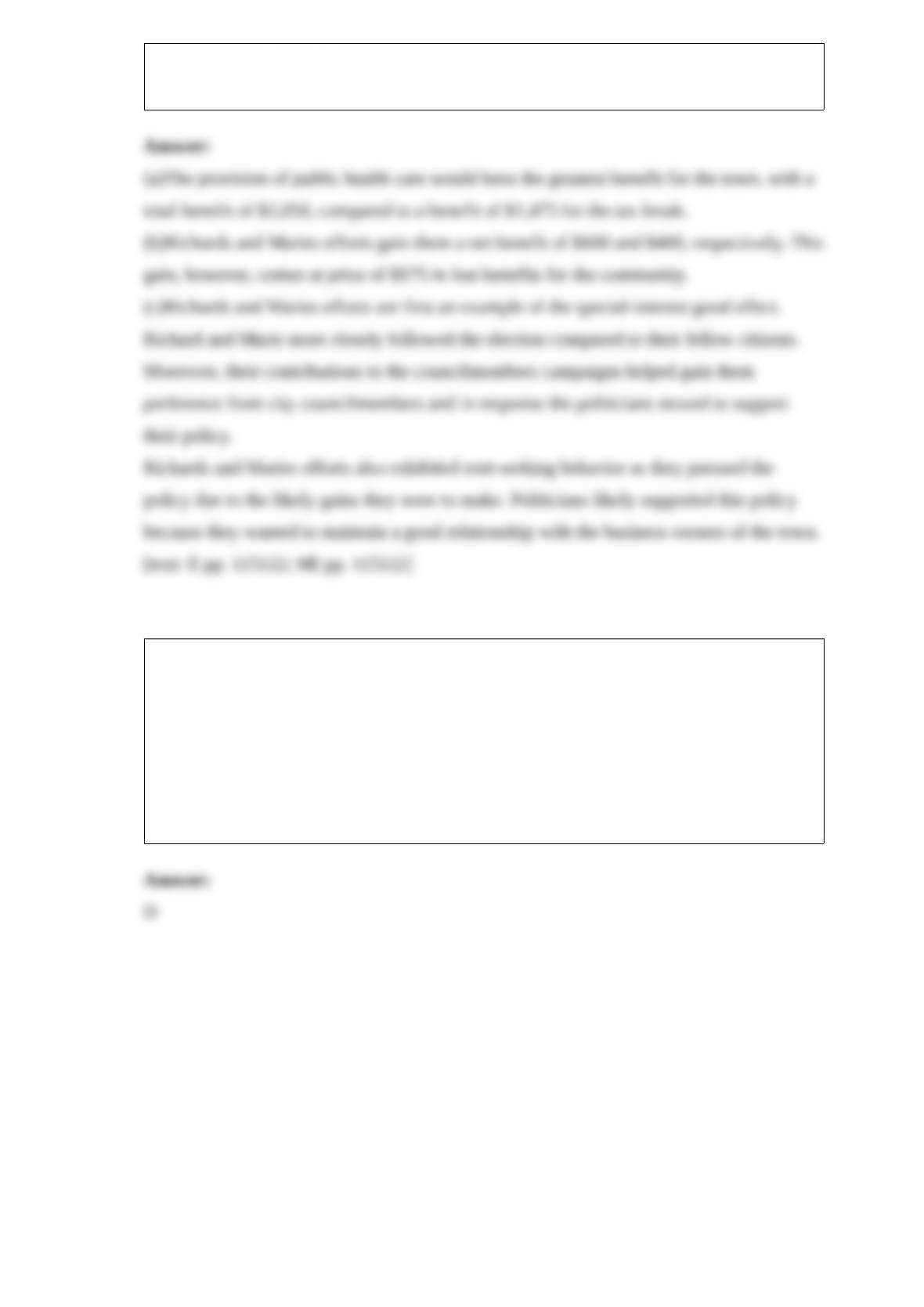
and Marie? For the community as a whole?
(c)What type of government failure does this example illustrate?
18) Other things equal, the relationship between the relative importance of a given type
of labor in a firm’s total costs and the elasticity of demand for that labor is such that the:
A.demand for labor will be elastic only if labor accounts for less than 50 percent of total
costs.
B.demand for labor will be elastic only if labor accounts for 50 percent or more of total
costs.
C.larger the labor cost-total cost ratio, the smaller will be the elasticity of labor demand.
D.larger the labor cost-total cost ratio, the greater will be the elasticity of labor demand.