
1) According to Paul Ehrlich’s 1968 prediction in The Population Bomb, population
growth would result in:
A.Overuse of natural resources leading to famines
B.Stable uses of natural resources creating long-term stability
C.Efficient use of natural resources fostering prosperity
D.Reduced dependence on natural resources leading to growth
2) Lobbying actions that seek government legislation to provide tax breaks to specific
corporations would be an example of:
A.How the median-voter model works
B.How political choices are bundled
C.Rent-seeking behavior
D.The paradox of voting
3) Which of the following is not a reason to predict that farm subsidies might decline in
the future?
A.A declining farm population
B.The special interest effect
C.Pressure to cut the budget deficit
D.Conflicts with free world trade
4) A major criticism of agricultural subsidies is that:
A.They restrict agricultural output but reduce farm incomes when demand is inelastic
B.The principal beneficiaries of these subsidies have been foreign farmers and not
domestic farmers
C.They duplicate other economic policies that are designed to increase the prices for
agricultural products
D.They do not address the misallocation of resources between agriculture and the rest
of the economy
5) The marginal revenue curve of a purely competitive firm:
A.lies below the firm’s demand curve.
B.is downsloping because price must be reduced to sell more output.
C.is horizontal at the market price.
D.has all of these characteristics.
6) At an output of 1,000 units per year, a firm’s variable costs are $5,000 and its average
fixed costs are $3. Its total costs per year are:
A.$10,000
B.$8,000
C.$6,000
D.$5,000
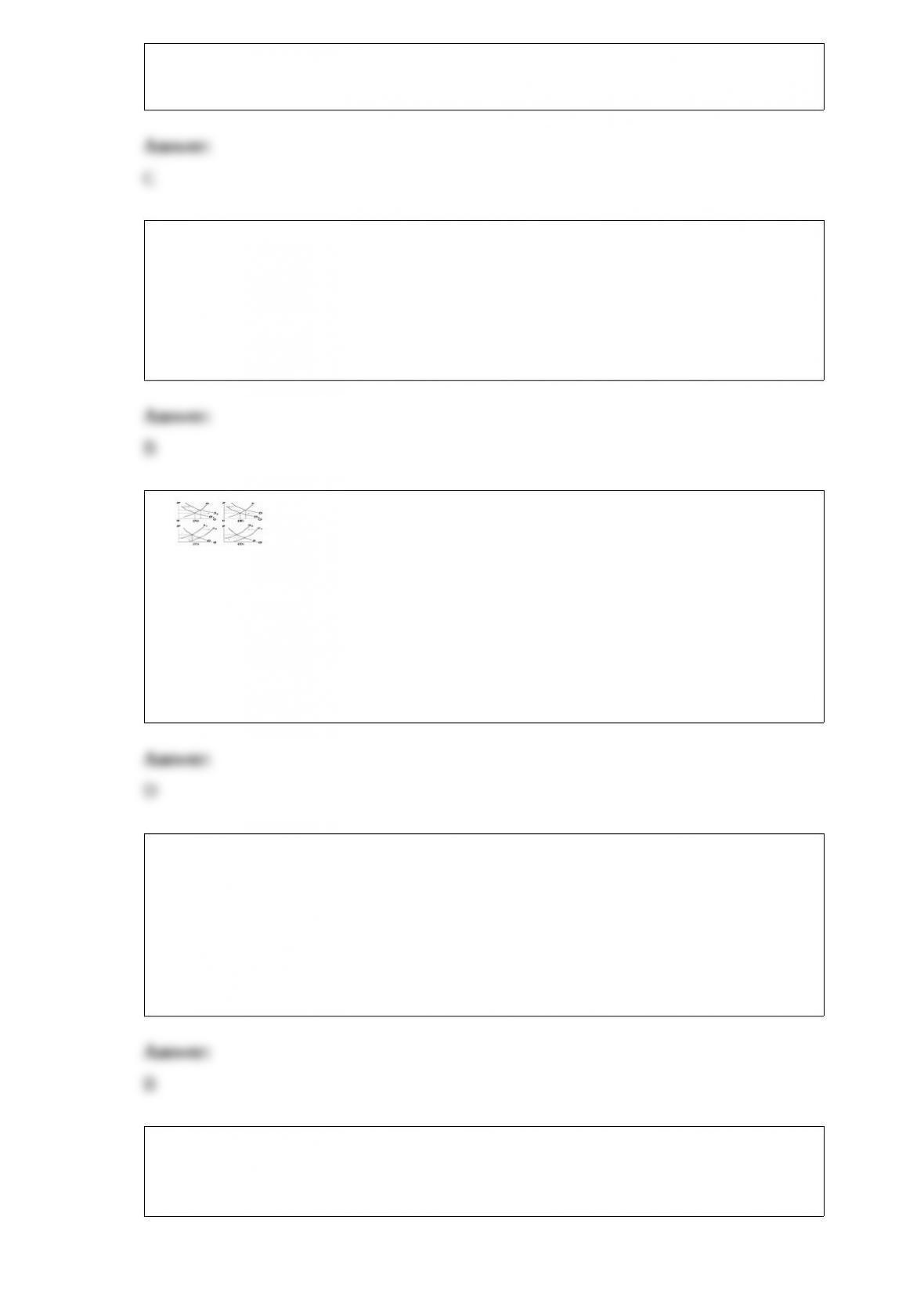
7)
Which of the diagrams illustrates the effect of an increase in automobile worker wages
on the market for automobiles?
A.A only.
B.B only.
C.C only.
D.D only.
8) An oil company has the opportunity to extract oil from a reserve in three years with a
per barrel profit of $70 per barrel. The current market rate of interest is 4 percent. The
present value of this future extraction is about:
A.$55
B.$62
C.$70
D.$72
9) Using the schedules given, plot the demand curve and the supply curve on the below
graph. Label the axes and indicate for each axis the units being used to measure price
and quantity. Then answer the questions.
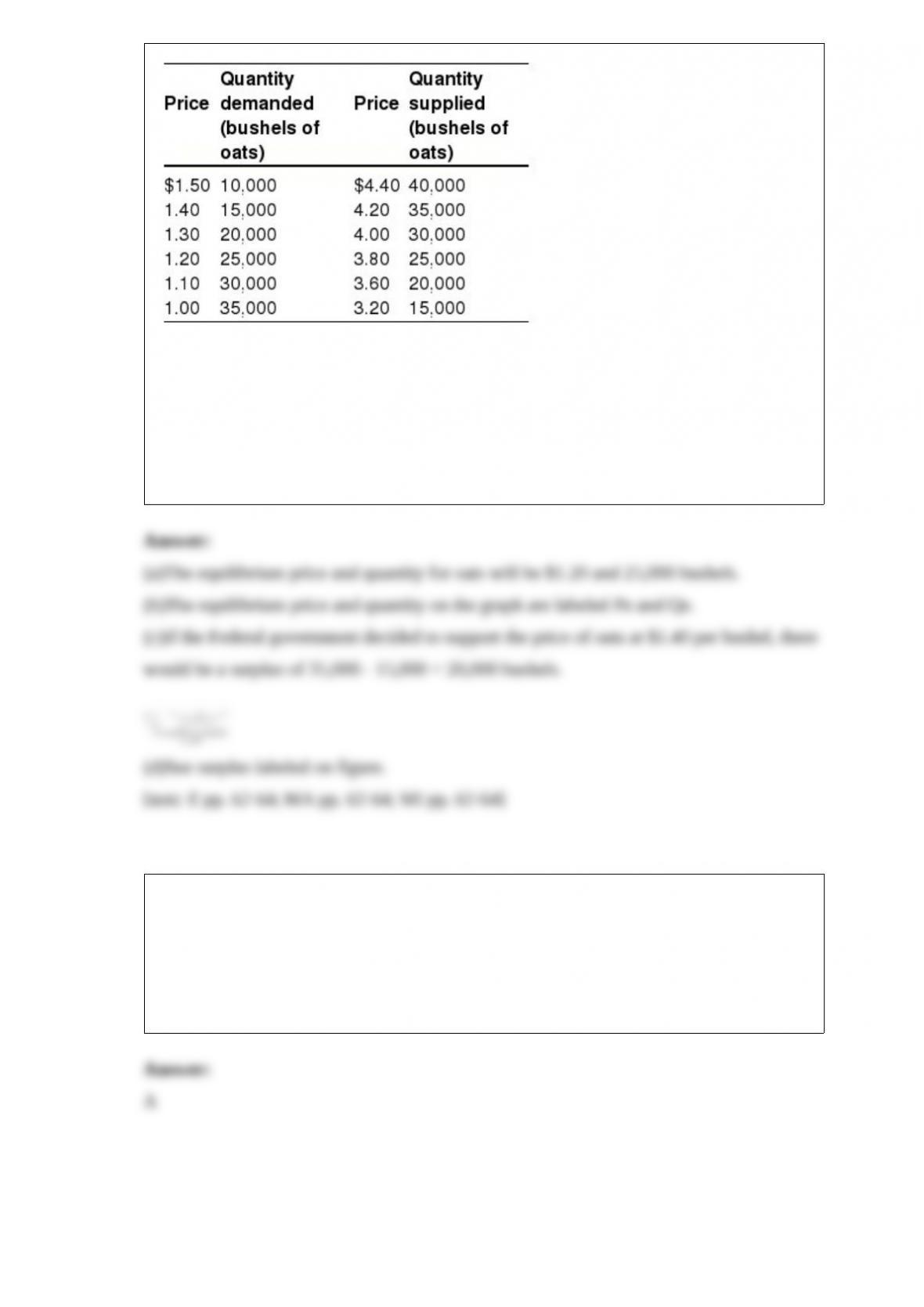
(a)Give the equilibrium price and quantity for oats.
(b)Indicate the equilibrium price and quantity on the graph by drawing lines from the
intersection of the supply and demand curves to the price and quantity axes.
(c)If the Federal government decided to support the price of oats at $1.40 per bushel,
tell whether there would be a surplus or shortage and how much it would be.
(d)Demonstrate your answer to part (c) on your graph being sure to label the quantity
you designated as the shortage or surplus.
10) Suppose that a monopolist calculates that at its present output level, marginal cost is
$4.00 and marginal revenue is $5.00. The firm could increase profits by:
A.Decreasing price and increasing output
B.Increasing price and decreasing output
C.Decreasing price and leaving output unchanged
D.Decreasing output and leaving prices unchanged