
1) In 2005, chief executive officers’ (CEOs’) pay at U.S. firms with around $500 million
in annual sales averaged:
A.$600 thousand.
B.$1.2 million.
C.$2.2 million.
D.$4.5 million.
2) If a regulatory commission wants to provide a natural monopoly with a fair return, it
should establish a price that is equal to:
A.minimum average fixed cost.
B.average total cost.
C.marginal cost.
D.marginal revenue.
3) Which of the following does not illustrate the idea of creative destruction?
A.Digital downloads have shrunk the market for CDs and DVDs
B.Online retail sales have increased, while brick-&-mortar sales have slowed down
C.The opening of a new mall reduces the traffic in another mall
D.A firm has to destroy some of the expired products in its inventory
4) A firm decides to make a $20 million expenditure on research and development that
will create a new product. This product is expected to increase the firm’s revenues by a
total of $24 million in the next year. The firm also estimates that the production cost of
the new product will be $22 million. What is the expected rate of return on this research
and development expenditure?
A.8.3 percent
B.9.1 percent
C.10 percent
D.20 percent
5) Marginal revenue product measures the:
A.amount by which the extra production of one more worker increases a firm’s total
revenue.

B.decline in product price that a firm must accept to sell the extra output of one more
worker.
C.increase in total resource cost resulting from the hire of one extra unit of a resource.
D.increase in total revenue resulting from the production of one more unit of a product.
6) An industry would be likely to lay off workers following:
A.An increase in the price of the firm’s product
B.An increase in the marginal revenue product of labor
C.The imposition of a new minimum wage below the current equilibrium wage
D.A successful attempt by an industrial union to push wages above the marginal
revenue product of labor
7)
Refer to the graphs above for a purely competitive market in the short run. The graphs
suggest that as long run adjustments consequently occur, the firms in the industry will
find that:
A.Profits will increase
B.Profits will decrease
C.Profits will be unchanged
D.Cannot be decided from the information given
8) The law of diminishing returns only applies in cases where:
A.There is increasing scarcity of factors of production
B.The price of extra units of a factor is increasing
C.There is at least one fixed factor of production
D.Capital is a variable input
9) Answer the question on the basis of the following cost data for a purely competitive
seller:

Refer to the data. The marginal cost of the fifth unit of output is:
A.$80.
B.$90.
C.$50.
D.$20.
10) In the United States in 2011, one million BTUs of energy yielded _______ worth of
goods and services (in year 2005 dollars).
A.$17.50
B.$57.90
C.$117.37
D.$136.80
11) In 2011, an unattached individual would be defined as living in poverty if his or her
income was less than:
A.$5,100
B.$11,700
C.$20,400
D.$29,500
12)
The MC curves in the diagram slope upward because of the law of:
A.demand.
B.conservation of matter and energy.
C.diminishing marginal utility.
D.diminishing returns.
13) Technological advance is shown as a(n):

A.movement from a point inside a production possibilities curve to a point on the curve.
B.movement along a production possibilities curve.
C.outward shift of a production possibilities curve.
D.inward shift of a production possibilities curve.
14) When politicians support policies such as imposing punitive tariffs on imports,
which are popular among voters but which also reduce economic efficiency, we refer to
this as:
A.Regulatory capture
B.Voter failure
C.Limited and bundled choice
D.Paradox of voting
15) The question is based on the following table that provides information on the
production of a product that requires one variable input.
Refer to the above table. Diminishing marginal returns sets in with the addition of the:
A.First unit of input
B.Second unit of input
C.Third unit of input
D.Fourth unit of input
16) Assume that the short-run cost and demand data given in the table below confront a
monopolistic competitor selling a given product and engaged in a given amount of
product promotion. Compute the marginal cost and marginal revenue of each unit of
output and enter these figures in the table.
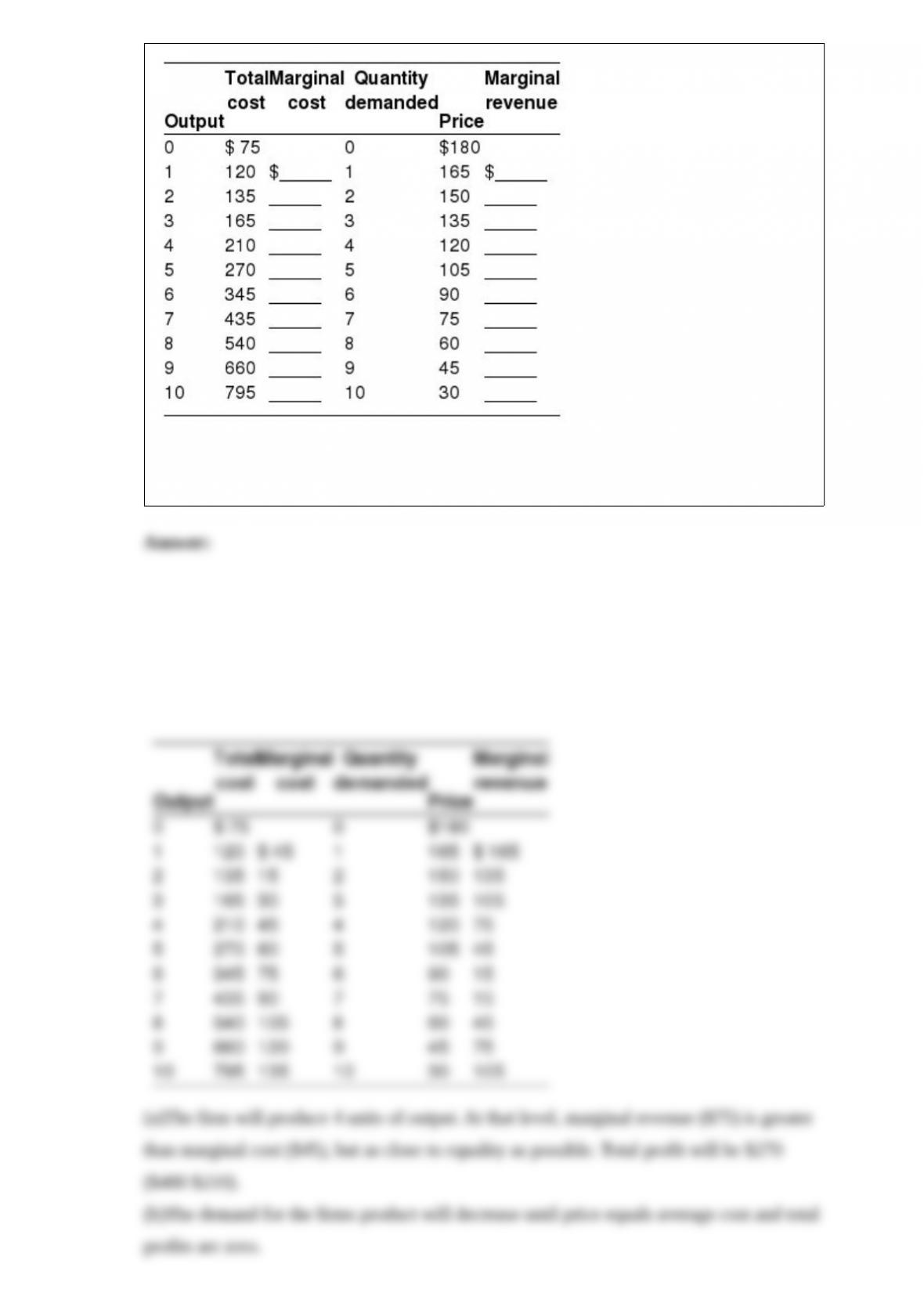
(a)At what output level and at what price will the firm produce in the short run? What
will be the total profit?
(b)What will happen to demand, price, and profit in the long run?

17) The consumer wifi-service providers’ market is best described as a:
A.Monopolistic competition
B.Monopoly
C.Differentiated oligopoly
D.Homogeneous oligopoly
18) The labor demand curve of a firm that sells its product in an imperfectly
competitive market:
A.Is downsloping, solely because of the law of diminishing returns
B.Is downsloping and flatter than the labor demand curve of a firm that sells its product
in a purely competitive market
C.Is upsloping
D.Is downsloping, because of both declining marginal productivity and declining
product prices as quantity increases
19) One major path that leads to growth in both developing nations (DVCs) as well
industrially advanced nations (IACs) is that productive resources must be:
A.Increased at the same rate as the population grows
B.Distributed more equitably across business sectors
C.Reallocated to export industries
D.Used more efficiently
20) Assume that in the short run a firm is producing 100 units of output, has average
total costs of $200, and has average variable costs of $150. The firm’s total fixed costs
are:
A.$5,000.
B.$500.
C.$0.50.
D.$50.