
1) If technology dictates that labor and capital must be used in fixed proportions, an
increase in the price of capital will cause a firm to use:
A.more labor as a consequence of the substitution effect.
B.more labor as a consequence of the output effect.
C.less labor as a consequence of the substitution effect.
D.less labor as a consequence of the output effect.
2) Which group of farmers benefits the least from price supports in agriculture?
A.Those farmers receiving the highest average farm-family income
B.Those farmers receiving the midrange average farm-family income
C.Those farmers receiving the lowest average farm-family income
D.Large corporate farms
3) Answer the question based on the demand and cost schedules for a monopolistically
competitive firm given in the table below.
Refer to the above table. What will be the economic profit or loss for this
monopolistically competitive firm at the profit-maximizing level of output?
A.-$15
B.+$10
C.+$20
D.+$28
4) You observe that when stock prices rise, interest rates soon fall, and therefore
conclude that higher stock prices lead to lower interest rates. This would be an example
of:
A.The fallacy of composition
B.Tradeoff among economic goals
C.The post hoc fallacy
D.The use of loaded terminology
5) Productive efficiency refers to:
A.Cost minimization, where P = minimum ATC
B.Production at a level where P = MC
C.Maximizing profits by producing where MR = MC
D.Setting TR = TC
6)
In the payoff matrix:
A.both firms have a dominant strategy.
B.neither firm has a dominant strategy.
C.Alpha has a dominant strategy, but Beta does not.
D.Beta has a dominant strategy, but Alpha does not.
7)
Refer to the data. The industry characterized by the information is:
A.an oligopoly.
B.a monopolistically competitive industry.
C.a purely competitive industry.
D.a pure monopoly.
8) In the long run:
A.all costs are variable costs.
B.all costs are fixed costs.
C.variable costs equal fixed costs.
D.fixed costs are greater than variable costs.
9) A nation’s official reserves:
A.compensate for differences in the current and capital and financial accounts.
B.consist of all domestic and foreign currency held by a nation’s central bank.
C.are always zero.
D.are always negative.
10) Process innovation refers to:
A.development of new products.
B.implementation of better methods of producing products.
C.first discovery of new scientific principles.
D.widespread imitation of innovations.
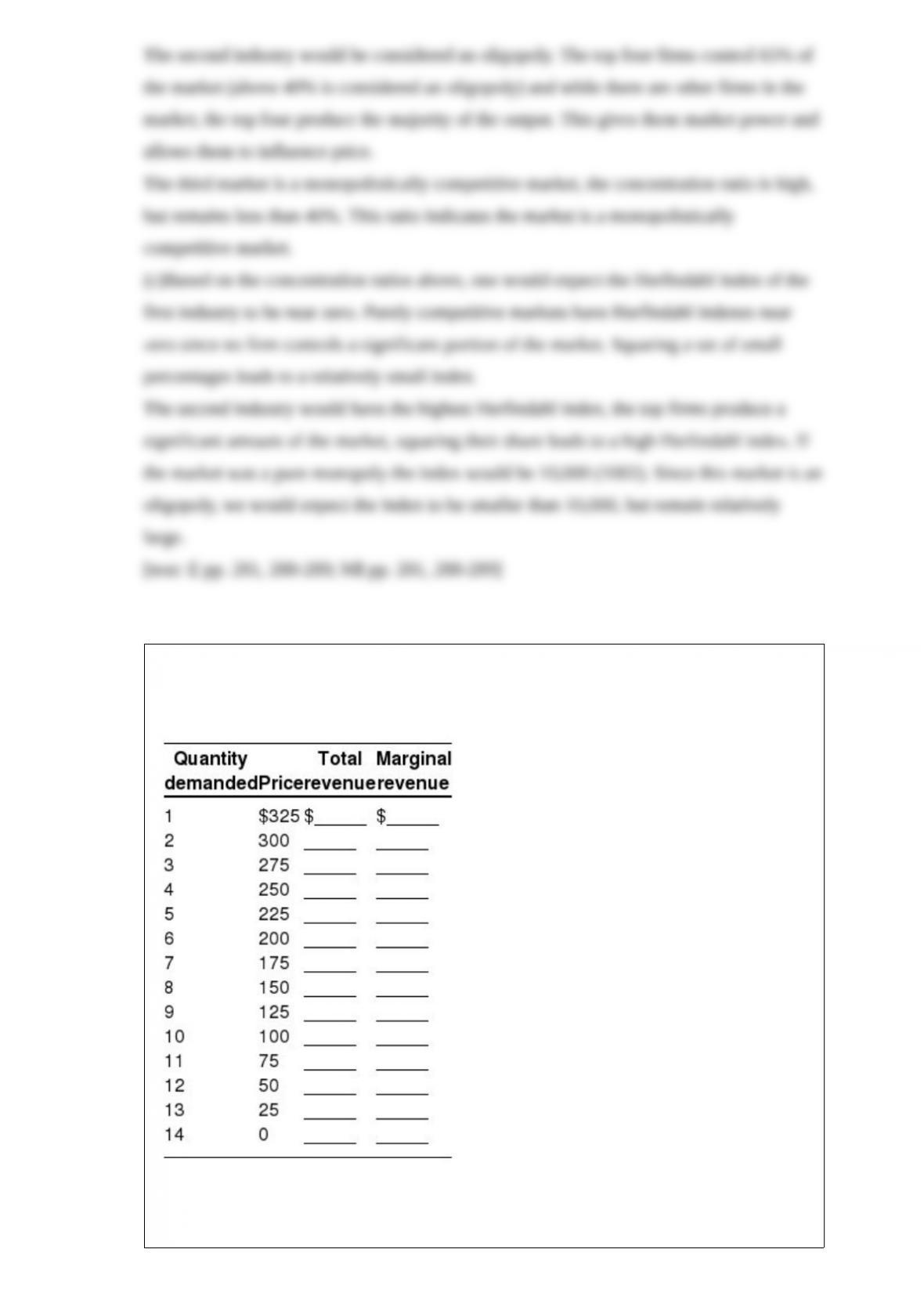
11) The market shares of firms in three different industries are listed in the table below.
Use this information to answer the questions below.
(a)What is the four-firm concentration ratio for the industries above?
(b)Based on your findings, how would you describe each industry: purely competitive,
monopolistically competitive, or an oligopoly? Explain.
(c)Based on the concentration ratio for the above industries, which industry would you
expect to have the lowest Herfindahl index? The highest?
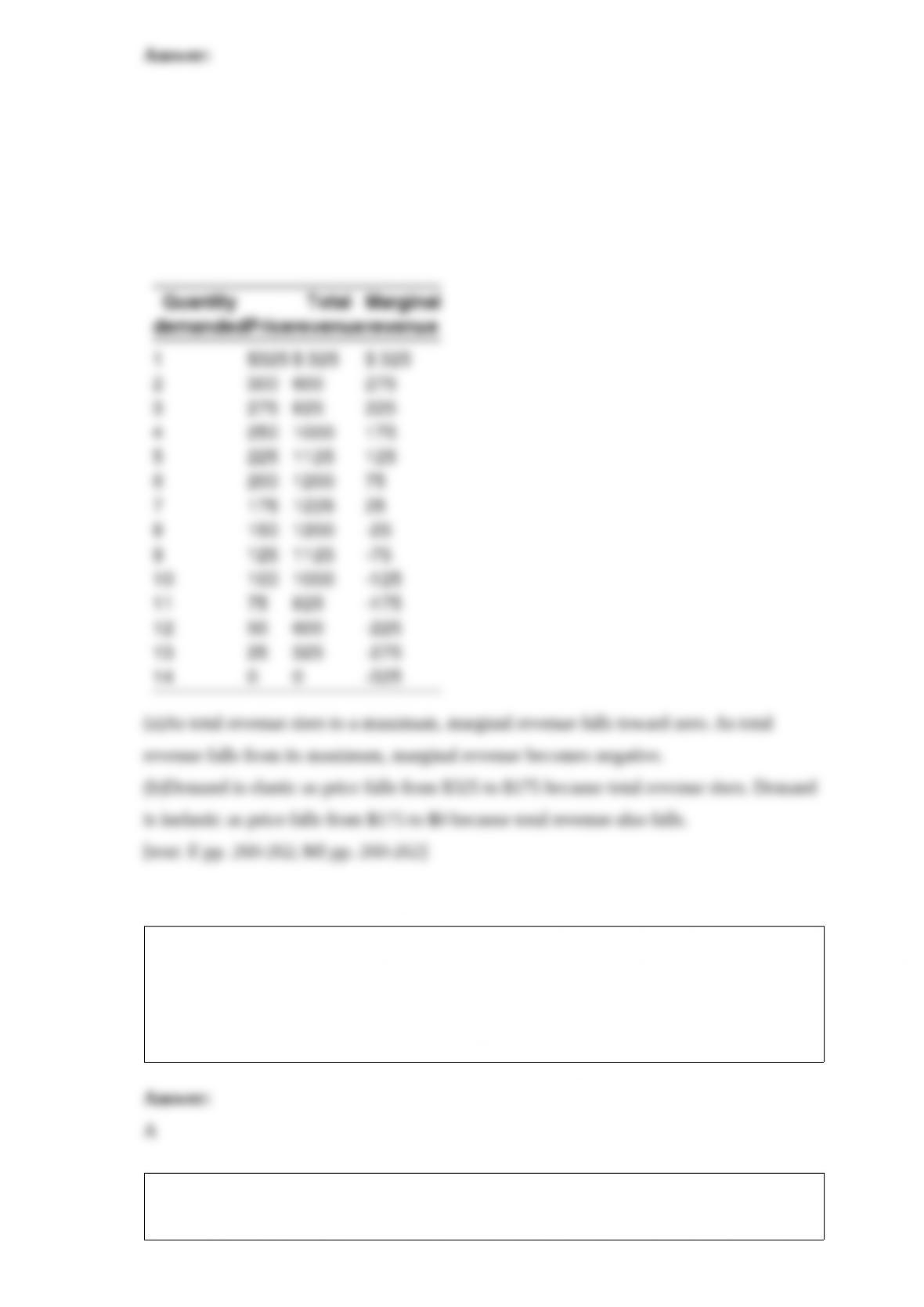
12) The demand schedule for the product produced by a monopolist is given in the table
below. Complete the table by computing total revenue and marginal revenue.
(a)What do the data in the table indicate about the relationship between total revenue
and marginal revenue? Explain.
(b)What do the data in the table indicate about the elasticity of demand?
13) In a labor market characterized by bilateral monopoly, the wage rate will:
A.be logically indeterminate.
B.be established at the level desired by the union.
C.be established at the level desired by the employer.
D.always be established at the competitive level.
14) Suppose firm X implements a new method for extracting copper from
copper-bearing ore. This is an example of:

A.product innovation.
B.process innovation.
C.economics of scale.
D.the inverted-U theory.
15) The higher price of imported products due to trade barriers causes some consumers
to shift their purchases to a domestically-produced product which is now:
A.Lower in price because import competition has risen
B.Higher in price because import competition has risen
C.Higher in price because import competition has declined
D.Lower in price because import competition has declined
16) If a nation has a current account deficit and it does not have to make any
inpayments or outpayments of official reserves, it must have a:
A.surplus in its capital and financial account.
B.balance of payments deficit.
C.balance of payments surplus.
D.deficit in its capital and financial account.
17) Which of the following industries is an illustration of homogeneous oligopoly?
A.Household laundry products.
B.Personal computers.
C.Aluminum.
D.The auto industry.