
1) If price and total revenue are directly related, demand is inelastic.
2) The elasticity of demand for labor varies inversely with the elasticity of demand for
the product it is used to produce.
3) A bilateral monopoly case is a situation where two monopolists in two countries are
selling competing products in the world market.
4) The optimal amount of R&D spending for the firm occurs where its expected return
is equal to the interest-rate cost-of-funds to finance it.
5) Being a “jack-of-all-trades” implies reducing the reliance on the division of labor.
6) In a competitive market, every consumer willing to pay the market price can buy a
product and every producer willing to sell the product at that price can sell it.
7) A curve showing the quintile distribution of a nation’s income is called the Gini
curve.
8) Professor Gullible agreed to cancel the final examination if students promised to
study for it anyway. The concept of moral hazard would predict that it is unlikely that
students will study for the exam.
9) Rent performs an incentive function, but no rationing function.
10) If people tried to produce as much of what they need on their own, then this would
lead to a more efficient use of the economy’s resources.
11)
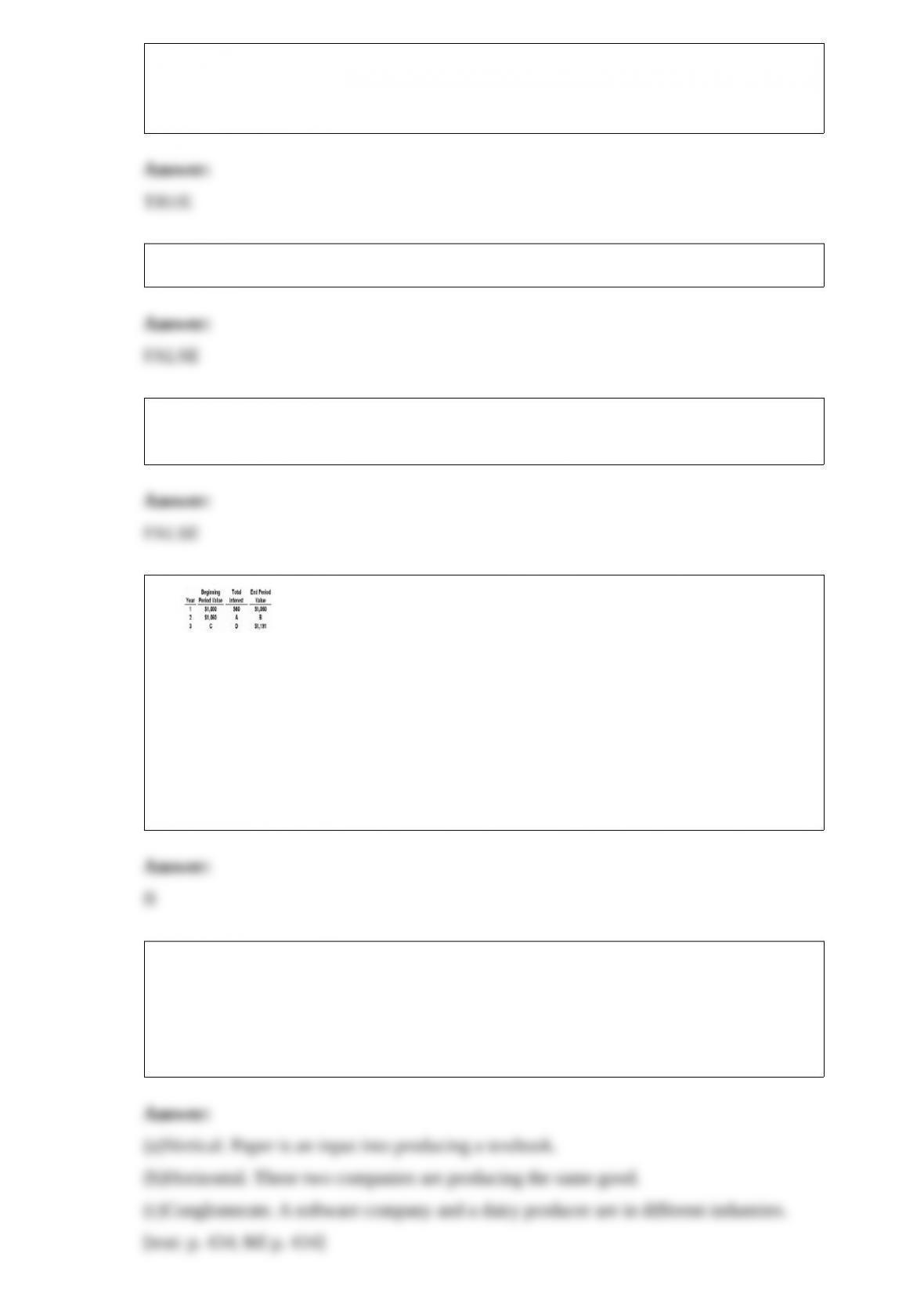
Refer to the table representing Darcy’s bank account. Assuming that $1,000 was
deposited into her account at the beginning of year 1, and no further deposits or
withdrawals were made, how much interest would Darcy receive in Year 2 only?
A.$60.
B.$63.60.
C.$120.
D.$123.60.
12) Describe each of the following merger scenarios using the following terms:
conglomerate, horizontal, vertical.
(a)A textbook publisher merges with a paper company.
(b)Two cell phone companies merge.
(c)A software company merges with a dairy producer.

13) A market basket of goods costs $350 in the United States and 200 pounds in the
United Kingdom. According to the purchasing power parity theory, the exchange rate
should move towards:
A.$0.67 per British pound
B.$1.50 per British pound
C.$0.57 per British pound
D.$1.75 per British pound
14) Assume that Japan and the United States are engaged in a system of flexible
exchange rates.
Refer to the graph above. An increase in the supply of yen will result in:
A.An appreciation of the yen
B.An appreciation of the U.S. dollar
C.A depreciation of the U.S. dollar
D.An increase in the dollar price of yen
15) It is the custom for paper mills located alongside the Layzee River to discharge
waste products into the river. As a result, operators of hydroelectric power-generating
plants downstream along the river find that they must clean up the river’s water before it
flows through their equipment.
Refer to the above information. Which of the following policies would be most
appropriate for dealing with this problem?
A.Levy a tax on the consumers of paper products and use the tax revenues to conduct
research on new energy sources
B.Levy a tax on the consumers of electricity and use the tax revenues to subsidize the
consumers of paper products
C.Levy a tax on the producers of electricity and use the tax revenues to clean up the
river
D.Levy a tax on the producers of paper products and use the tax revenues to clean up
the river

16) If the U.S. dollar appreciates relative to the British pound, then:
A.The pound will appreciate relative to the U.S. dollar
B.The pound will depreciate relative to the U.S. dollar
C.British goods will be more expensive for Americans
D.American goods will be less expensive for the British
17)
Refer to the diagram, assuming that the firm represented is operating on curve TC0. If
the user cost increases by $20 at the beginning of the year, the quantity extracted in the
first year will:
A.remain unchanged.
B.decline by 250
C.decline by 500
D.decline by 1,000
18) Assume that a consumer purchases only two products. Suppose that the consumer’s
money income doubles, and the prices of the two products also double. These changes
in income and prices will result in:
A.A shift of the budget line inward to the left
B.A shift of the budget line outward to the right
C.No change in the budget line
D.An increase in the slope of the budget line
19) In representative democracy, voters are ____________ and politicians are
______________.
A.agents; principals
B.logrollers; principals
C.agents; employees
D.principals; agents

20) According to the marginal-cost-marginal-benefit rule:
A.only government projects (as opposed to private projects) should be assessed by
comparing marginal costs and marginal benefits.
B.the optimal project size is the one for which MB = MC.
C.the optimal project size is the one for which MB exceeds MC by the greatest amount.
D.project managers should attempt to minimize both MB and MC.
21) The larger the coefficient of price elasticity of demand for a product, the:
A.larger the resulting price change for an increase in supply.
B.more rapid the rate at which the marginal utility of that product diminishes.
C.less competitive will be the industry supplying that product.
D.smaller the resulting price change for an increase in supply.
22) The Patient Protection and Affordable Care Act (PPACA) attempts to provide
health-insurance coverage to low-income people through the following, except:
A.Establishing a new government insurance system specifically for the poor
B.Requiring large employers to cover all their employees including the poor
C.Expanding the Medicaid system to cover those whose incomes are less than 133% of
the poverty level
D.Providing subsidies to purchase health insurance to those who must buy insurance
coverage on their own
23) The demand for a necessity whose cost is a small portion of one’s total income is:
A.perfectly price inelastic.
B.perfectly price elastic.
C.relatively price inelastic.
D.relatively price elastic.
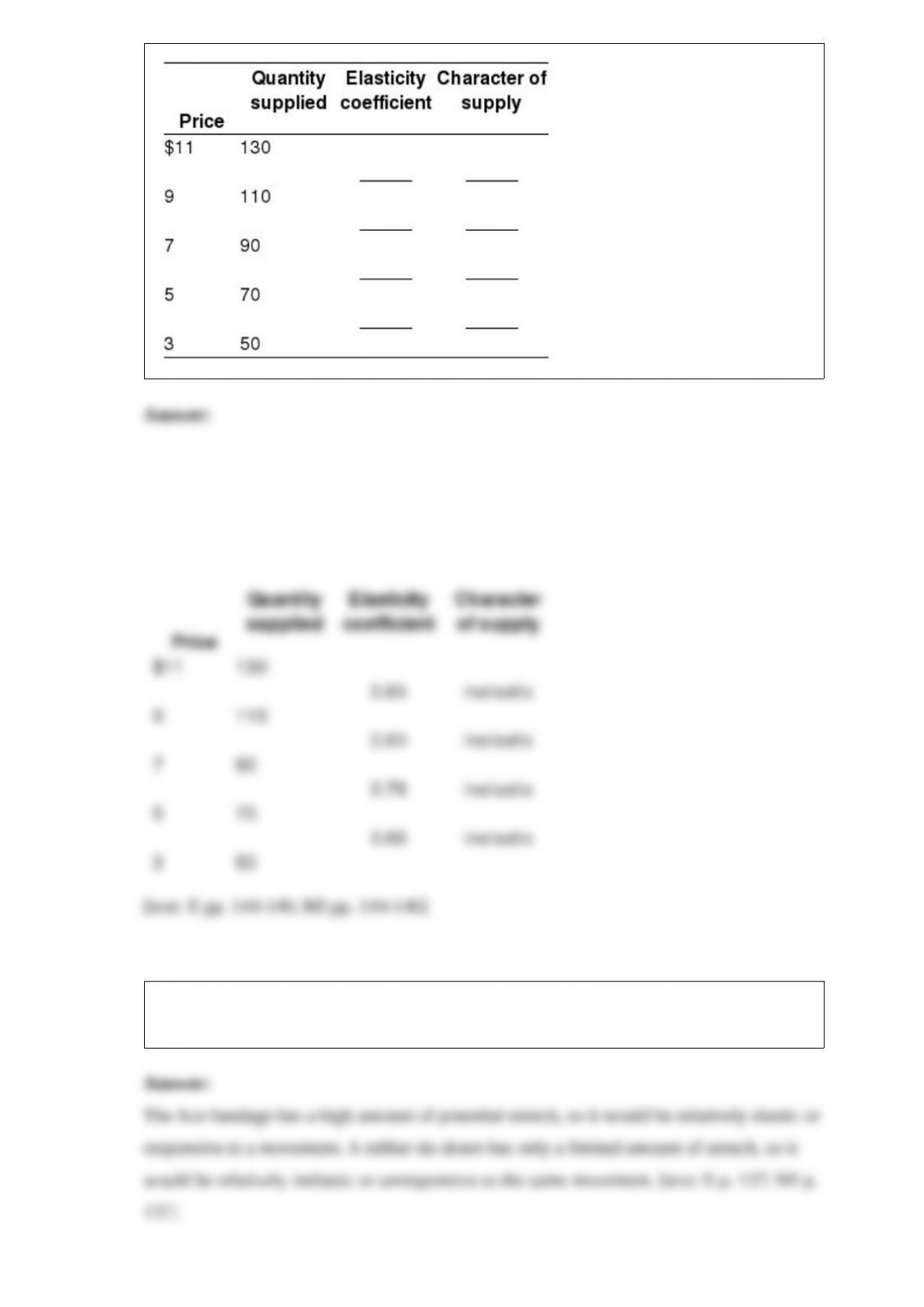
24) Using the supply data in the schedule below, complete the table by computing the
price elasticity of supply coefficients between each set of prices. Indicate whether
supply is elastic, inelastic or unitary at each price.
25) Use an Ace bandage and a rubber tie-down to make an analogy for explaining the
price elasticity of demand.
26) What are two affiliates of the World Bank? What do they do?
27) What is the incentive problem in central planning?
28) Why dont economists use the same cost data as accountants use?
29) Suppose a bridge for automobiles was constructed across a river and all the costs
associated with its construction have been paid. The amount of traffic is such that there
are no foreseeable problems of overcrowding in the use of the bridge. Assume, also,
that the extra cost associated with traffic crossing the bridge is for all practical purposes
equal to zero. What toll should be charged to achieve the most efficient use of the
bridge?
30) A state decides to pass a new law raising the excise tax on cigarettes. What would
be the probable incidence of this new tax?