
1) Junior collects baseball cards. He owns one Felix Hernandez card that sells in most
shops for $15. He is interested in buying a different Felix card that also sells for $15.
According to behavioral economics:
A.Junior should value the two cards equally and be willing to trade one for the other.
B.the availability heuristic will cause Junior to value more highly the card he doesn’t
have.
C.the endowment effect would suggest that Junior would not be willing to trade the
card he has for the card he doesn’t have.
D.prospect theory says he will buy the second card as both have the potential to
appreciate in value.
2) A firm is likely to be a natural monopoly:
A.when the demand for its product or service is inelastic.
B.if it is producing an inferior good.
C.if economies of scale are experienced over the full range of output.
D.because government grants it an exclusive franchise.
3) The income elasticity of demand for food is roughly 1. A consumer’s monthly income
is $2,000, of which 20 percent is spent on food. If the income of this consumer doubles,
the amount she’ll spend on food will be:
A.$400 per month
B.$500 per month
C.$800 per month
D.$1000 per month
4) Suppose a single firm has the marginal revenue product schedule for a particular type
of labor given in the left table. Assume there are 150 firms with the same
marginal-revenue-product schedules for this particular type of labor.
Refer to the above table and information. How many workers will be hired at
equilibrium?
A.300
B.450
C.600

D.750
5) A unit set up by insurance companies that requires hospitals and physicians to
provide discounted prices for their services as a condition for being included in the
insurance plan is a:
A.Preferred provider organization
B.Health maintenance organization
C.Diagnosis-related group system
D.Regional health alliance
6) Which of the following is an illustration of differentiated oligopoly?
A.The aluminum industry.
B.The steel industry.
C.The soft drink industry.
D.Retail stores in large cities.
7) Which of the following is a microeconomic statement?
A.The real domestic output increased by 2.3 percent last year.
B.Unemployment was 6.5 percent of the labor force last year.
C.The price of personal computers declined 4.7 percent last year.
D.The general price level increased by 3.1 percent last year.
8) “Proprietor’s income” refers to income received by:
A.Corporate executives
B.Owners of small unincorporated enterprises
C.Workers hired by small businesses
D.Interns in businesses

9) Daily newspapers have been rising in price in recent years because:
A.wages in the newspaper industry have risen dramatically.
B.the overhead costs have recently been spread over a shrinking number of buyers.
C.capital has replaced virtually all labor used to produce a newspaper.
D.long-standing government subsidies have been removed in most major cities.
10) It is generally agreed that in the long run the cost of private health insurance
provided by employers is:
A.at the expense of business profits.
B.at the expense of real wages.
C.paid by taxpayers through government.
D.included as taxable income for income tax purposes.
11) Which assumption is part of the model of monopolistic competition?
A.Firms make identical or homogeneous products
B.There is no collusion mutual interdependence among firms
C.There are significant barriers to entry into the market
D.Firms have no control over their products’ prices
12)
Refer to the above graphs. (Assume that the pre-migration labor force in Country A is 0d
and that it is 0u in country B.) What result would indicate that worldwide output is
increased as a result of migration?
A.Area aced> area qsut
B.Wage rates have increased in both countries

C.Domestic output has increased in both countries
D.The share of domestic output paid as business income increases in both countries
13) The elasticity of resource demand measures the:
A.responsiveness of workers to changes in wage rates.
B.responsiveness of producers to changes in resource prices.
C.ratio of marginal revenue product to resource price.
D.sensitivity of marginal revenue product to changes in product price.
14) “Deficit spending” refers to a situation where the government:
A.Spends borrowed funds
B.Collects more tax revenues than it spends
C.Does not need to borrow funds
D.Is spending less than the year before
15) Under which of the following situations would a monopolist increase profits by
lowering price (and increasing output):
A.if it discovered that it was producing where MC = MR.
B.if it discovered that it was producing where its MC curve intersects its demand curve.
C.if it discovered that it was producing where MC < MR.
D.under none of these circumstances because a monopolist would never lower price.

16) Which of the following statements is true about illegal immigration?
A.Illegal immigrants are often willing to work for less pay, keeping costs and prices for
consumer goods and services lower.
B.Illegal immigration reduces wages for U.S. workers who are complementary inputs.
C.Illegal immigration tends to reduce wages less for previous immigrants than for
native-born workers.
D.All of these.
17) The upward slope of the supply curve reflects the:
A.principle of specialization in production.
B.law of supply.
C.fact that price and quantity supplied are inversely related.
18)
The shift of the budget line from cd to ab in the figure is consistent with:
A.decreases in the prices of both M and N.
B.an increase in the price of M and a decrease in the price of N.
C.a decrease in money income.
D.an increase in money income.
19) The demand for a resource depends primarily on:
A.the supply of that resource.
B.the demand for the product or service that it helps produce.
C.the price of that input.
D.the elasticity of supply of substitute inputs.
20) A major source of funding of R&D in large, established corporations is:
A.venture capital.
B.dividends.
C.mutual funds.
D.retained earnings.
21) What resource problem is created by negative externalities and what methods are
suggested for dealing with this problem?
22) Evaluate the statement: There is no difference between the labor supply curve for
the single competitive firm and the supply curve in a competitive market for labor.
23) An airline is flying between two cities. The airline has the following costs
associated with the flight:
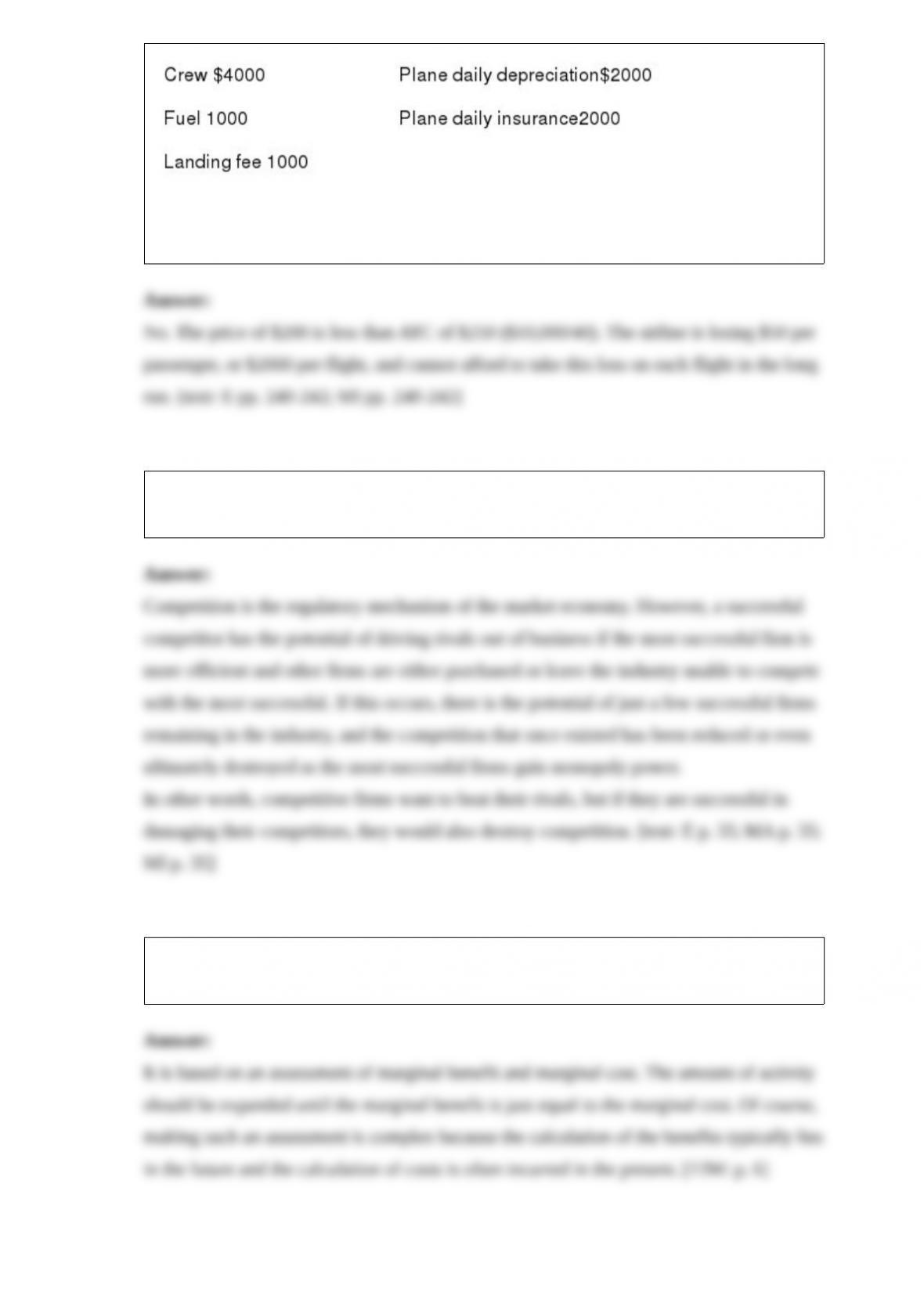
The airline has an average of 40 passengers paying an average of $200 for this flight.
Do you think the airline should be flying between the two cities? Evaluate from a
long-run perspective.
24) The regulatory force in the market system bears the seeds of its own destruction.
Explain and evaluate.
25) What calculation determines the optimal amount of research and development for
the firm? Why is this decision a complex one?
26) In all likelihood highly educated workers are the individuals who would earn high
incomes even if they did not have as much education. Evaluate.
27) Discuss the problem of clear benefits and hidden costs related to government
programs. Why can it result in inefficiency?