
1) Kelly works at an ice cream shop and observes that the number of people buying ice
cream varies greatly from day to day. For a couple of weeks she has recorded the
number of people at the shop each day, as well as the daily temperature. If Kelly is
using the scientific method to better understand ice cream buying habits, her next step is
to:
A.conclude definitively that people buy more ice cream when the temperature rises.
B.state her findings as a well-tested economic principle.
C.use the observed data to form a hypothesis about ice cream buying behavior.
D.throw out the data if it does not show a perfect relationship between buying habits
and the other information she has collected.
2) Two major criticisms of the Bureau of Census data as a portrayal of the degree of
income inequality are that the income concept employed is too:
A.Broad and the income accounting period is too short
B.Narrow and the income accounting period is too long
C.Narrow and the income accounting period is too short
D.Broad and the income accounting period is too long
3) Discrimination that results in minorities being paid less than whites for identical
work would be an example of which explanation for wage differentials?
A.Noncompeting groups
B.Compensating differences
C.Market imperfections
D.Principal-agent problems
4) Consumer’s income = $12
Refer to the data. Suppose the price of new product Z is $10 rather than $1. This
consumer would purchase:
A.some of Z but not as much as if the price were $1.
B.none of Z.
C.less of X, Y, and Z than if the price were $1.
D.more of X, Y, and Z than if the price were $1.

5) Suppose all workers are identical but working for Ajax is more pleasant than
working for Acme. In all other nonwage aspects, the two firms offer the same job
characteristics. We would expect:
A.wage rates at Ajax to be higher than at Acme.
B.wage rates at Ajax to be lower than at Acme.
C.wage rates at Ajax and Acme to be the same.
D.workers at Ajax would have to be monitored more closely than those at Acme.
6)
In the diagram, at $60 million of R&D expenditure, the:
A.expected rate of return exceeds the interest-rate cost of funds.
B.firm is spending an optimal amount on R&D.
C.interest-rate cost of funds exceeds the expected rate of return.
D.expected rate of return on R&D is negative.
7) Which is necessarily true for a purely competitive firm in short-run equilibrium?
A.Marginal revenue minus marginal cost equals zero
B.Price minus average total cost equals zero
C.Total revenue minus total cost equals zero
D.Marginal revenue is zero
8) Increases in the productivity of labor result partly from:
A.the law of diminishing returns.
B.improvements in technology.
C.reductions in wage rates.
D.increases in the quantity of labor.
9) If marginal cost is below average variable cost:
A.Average total cost is increasing but average variable cost is decreasing
B.Both average total cost and average variable cost are decreasing
C.Both average total cost and average variable cost are increasing
D.Average variable cost is less than average fixed cost
10)
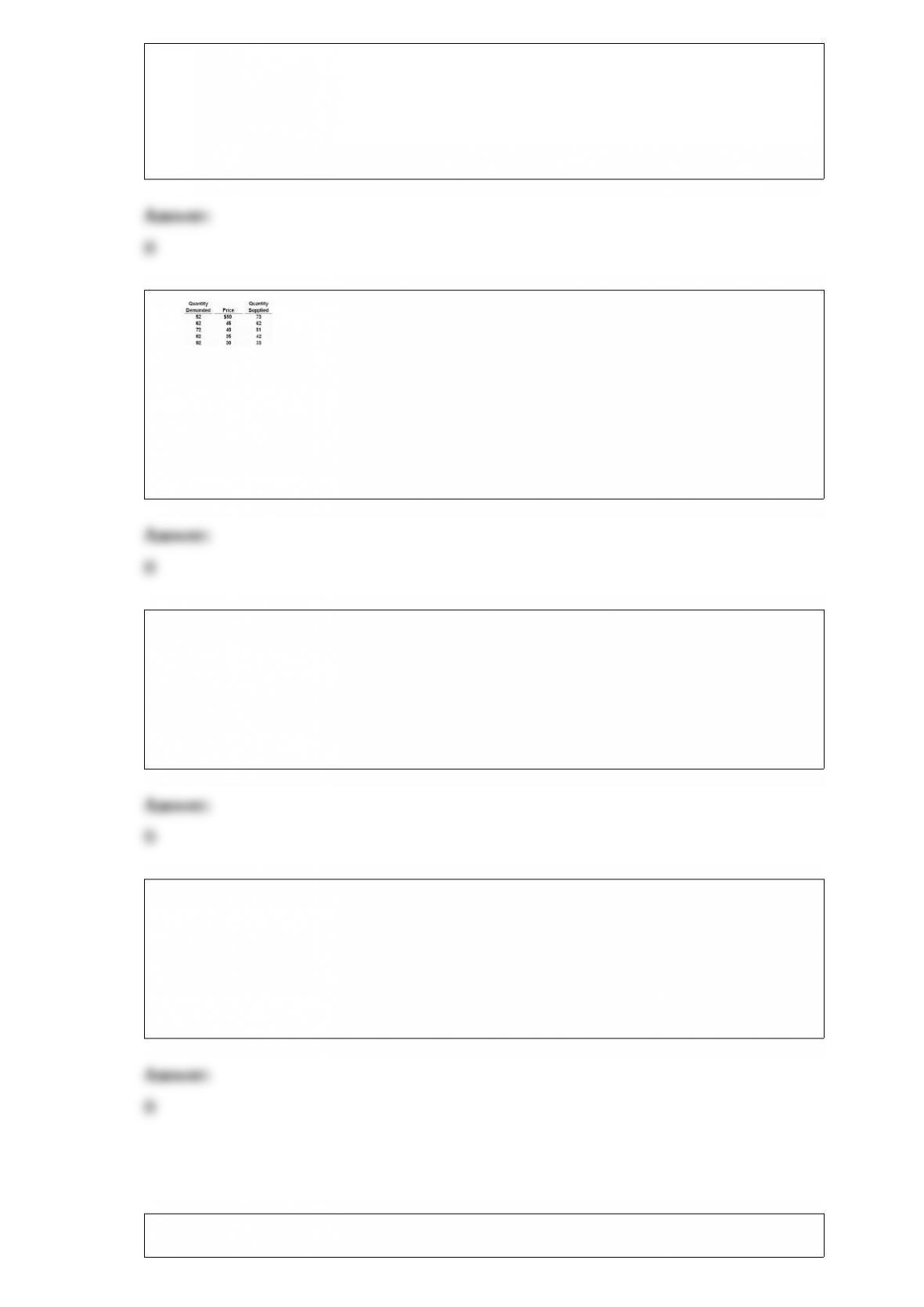
In this market, economists would call a government-set minimum price of $50 a:
A.price ceiling.
B.price floor.
C.equilibrium price.
D.fair price.
11) Professional sports leagues, like the NFL and the NBA, are good examples of
monopsony because:
A.They are dominant providers of sports entertainment
B.They are the only employers of professional athletes in their respective sports
C.They are large corporations owned be small groups
D.They operate large facilities and stadiums
12) Which of the following provides public assistance to those who are blind and
otherwise disabled?
A.Medicare.
B.Supplemental Security Income (SSI).
C.Medicaid.
D.TANF.
13) An excise tax that is applied to an imported product which is not at all produced

domestically is called a(n):
A.Protective tariff
B.Revenue tariff
C.Import quota
D.Nontariff barrier
14) Proponents of the managed floating exchange rate system argue that it has:
A.Added the volatility needed by the exchange rate market
B.Been effective because it is a “non-system” without fixed rules
C.Been sufficiently flexible to weather major economic turbulence
D.Resolved major problems in balance of payments surpluses and deficits
15) A highly active role by government may be needed to promote economic growth in
low-income DVCs because of:
A.a lack of infrastructure.
B.rigid law enforcement in the country.
C.excessive local entrepreneurship.
D.all these reasons.
16) The following are examples of technological breakthroughs that came out of a
government or university laboratory, except:
A.The Internet
B.Genetic engineering
C.Nuclear energy
D.Disposable contact lenses
17) Suppose a purely competitive, increasing-cost industry is in long-run equilibrium.
Now assume that a decrease in consumer demand occurs. After all resulting adjustments
have been completed, the new equilibrium price:
A.and industry output will be less than the initial price and output.
B.will be greater than the initial price, but the new industry output will be less than the
original output.
C.will be less than the initial price, but the new industry output will be greater than the

original output.
D.and industry output will be greater than the initial price and output.