1) In a world with two products, wheat (W) and coffee (C), nation Alpha produces
wheat and nation Beta produces coffee. Nation Alpha prefers an exchange rate of 1W =
2C and nation Beta prefers an exchange rate of 1W = 1C. The exchange rate preferred
by nation:
A.Alpha will prevail if world demand for coffee is great relative to its supply
B.Alpha will prevail if world demand for wheat is weak relative to its supply
C.Beta will prevail if world demand for coffee is great relative to its supply
D.Beta will prevail if world demand for wheat is great relative to its supply
2) Capital flight from the DVCs may be caused by:
A.a fear of government privatization efforts.
B.slow domestic inflation.
C.low rates of domestic taxation.
D.risks of severe fluctuations in exchange rates.
3) The current account section in a nation’s balance of payments includes:
A.its goods exports and imports, and its services exports and imports.
B.foreign purchases of domestic assets.
C.purchases of foreign assets.
D.all of these.
4)
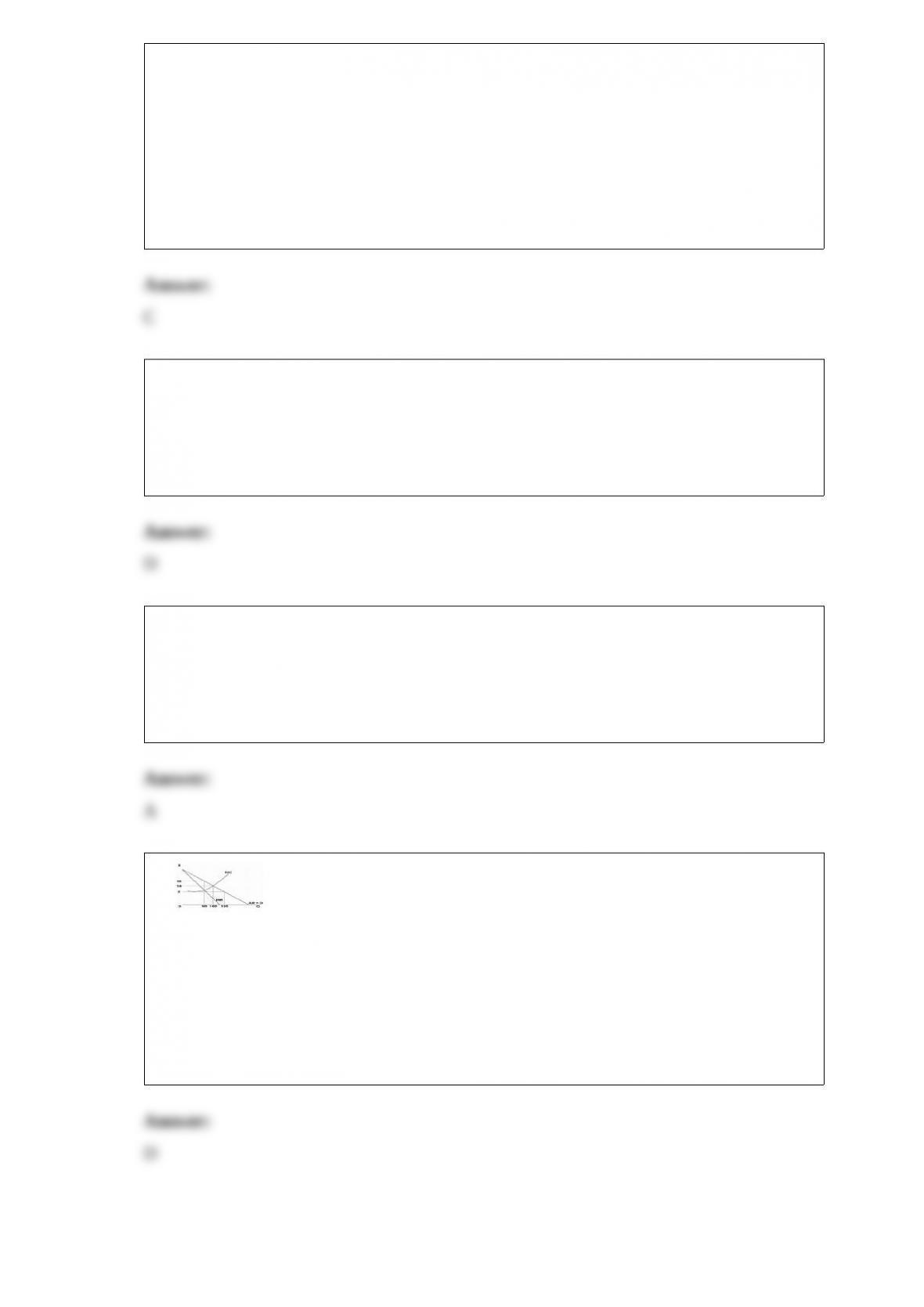
Refer to the graph above for an industry. If the industry were a pure monopoly, the
product price would be:
A.lower than $8
B.$8
C.$14
D.$16
5)
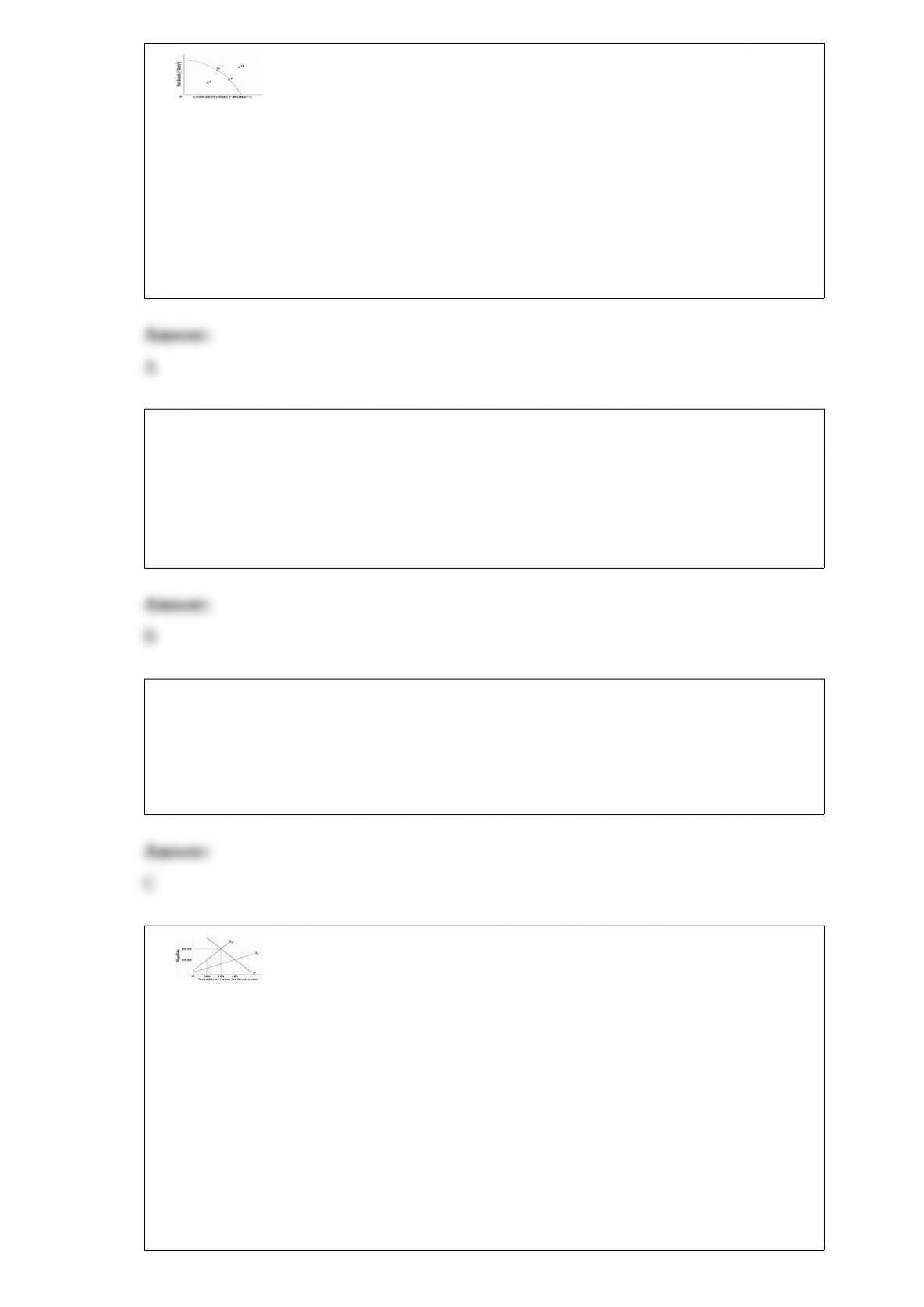
Refer to the production possibilities curve. At the onset of the Second World War, the
Soviet Union was already at full employment. Its economic adjustment from peacetime
to wartime can best be described by the movement from point:
A.c to point b.
B.b to point c.
C.a to point b.
D.c to point d.
6) The market system’s answer to the fundamental question “How will the system
accommodate change?” is essentially:
A.”Through government leadership and direction.”
B.”Through the guiding function of prices and the incentive function of profits.”
C.”Through training and retraining programs.”
D.”Through trial and error.”
7) Discrimination:
A.affects the distribution of domestic output and income, but not its total size.
B.is shown as some point outside of an economy’s production possibilities curve.
C.places the economy at some point inside of its production possibilities curve.
D.affects the total size of domestic output and income but not its distribution.
8)
Assumptions: (1) Employers in this market are willing and able to ignore minimum
wage laws; (2) Sd represents the supply of domestic-born (and legal immigrant)
workers; (3) St represents the total supply of workers in this labor market (Sd plus
illegal immigrants); and (4) unless otherwise stated, illegal immigration is not
effectively blocked by the government.
Refer to the given figure and assumptions. The equilibrium wage and level of
employment are, respectively:
A.$5.50 and 250,000.
B.$5.50 and 350,000.

C.$8.00 and 350,000.
D.$5.50 and 450,000.
9) If the production of a product or service involves external benefits, then the
government can improve efficiency in the market by:
A.Providing a subsidy to correct for an overallocation of resources
B.Providing a subsidy to correct for an underallocation of resources
C.Imposing a corrective tax to correct for an overallocation of resources
D.Imposing a corrective tax to correct for an underallocation of resources
10) Possible reasons for X-inefficiency include the following, except:
A.Managers may have other goals besides maximizing profits
B.Workers may be poorly motivated or poorly supervised
C.Costs of materials may be rising due to tight supply conditions
D.The firm may be lethargic due to the absence of competition
11) When the price of a product rises for an inferior good, the:
A.Income and substitution effects will encourage consumers to purchase more of the
product
B.Income and substitution effects will encourage consumers to purchase less of the
product
C.Substitution effect will encourage consumers to purchase less of the product but the
income effect will encourage them to purchase more
D.Substitution effect will encourage consumers to purchase more of the product but the
income effect will encourage them to purchase less
12) The supply of known Monet paintings is:
A.perfectly elastic.
B.perfectly inelastic.
C.relatively elastic.
D.relatively inelastic.
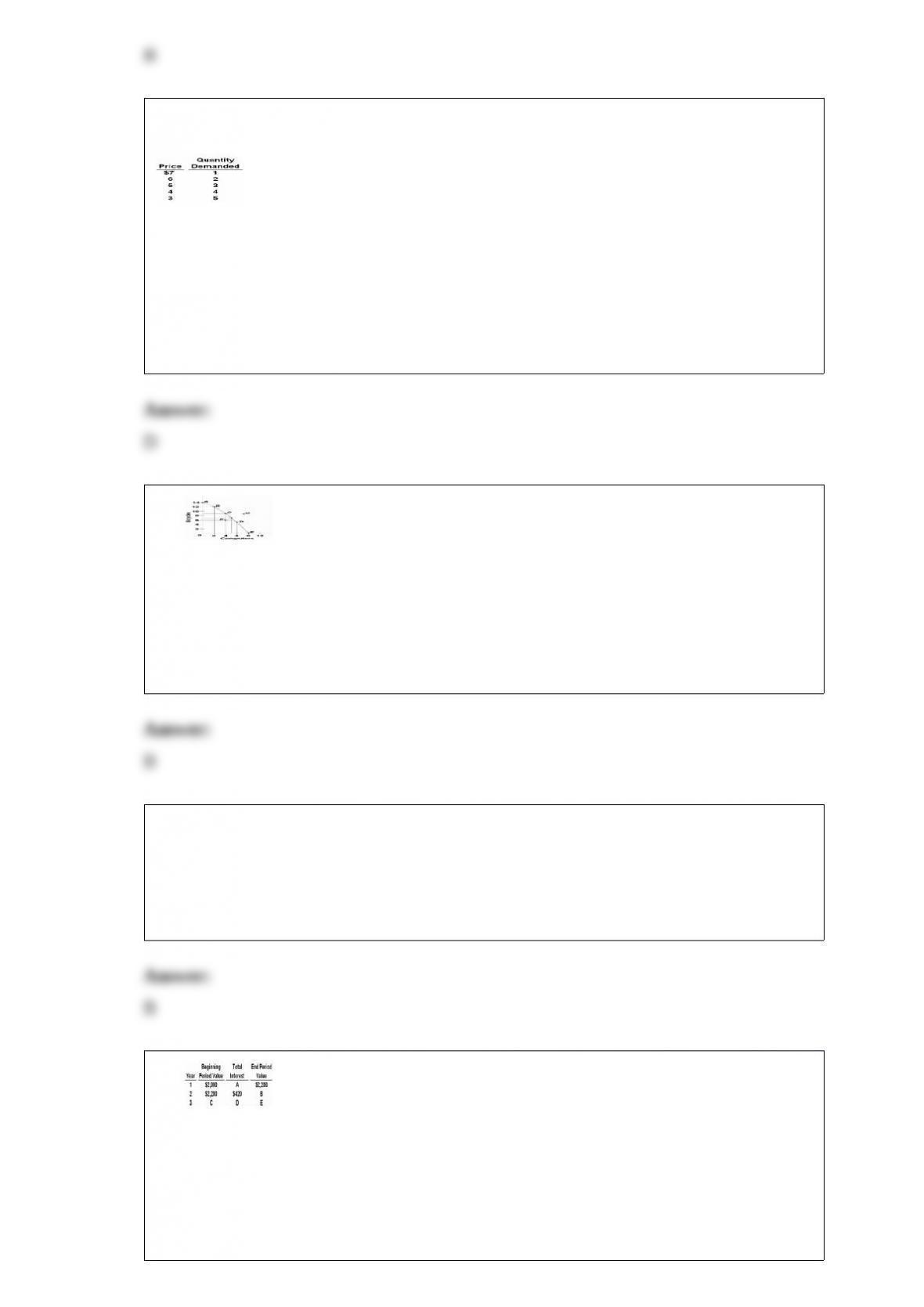
13) Answer the question on the basis of the demand schedule shown below:
Refer to the data. At the point where 3 units are being sold, the coefficient of price
elasticity of demand:
A.cannot be estimated.
B.suggests that the market is purely competitive.
C.is less than unity (one).
D.is greater than unity (one).
14)
Refer to the diagram. The combination of computers and bicycles shown by point G is:
A.attainable but too costly.
B.unattainable given currently available resources and technology.
C.attainable but involves unemployment.
D.irrelevant because it is inconsistent with consumer preferences.
15) In which of the following U.S. industries is the rate of unionization the highest?
A.Construction.
B.Government.
C.Transportation.
D.Agriculture.
16)
Refer to the table representing Kara’s bank account. Assuming that $2,000 was
deposited into her account at the beginning of year 1, and no further deposits or
withdrawals were made, the interest rate Kara is receiving on her account:
A.is 5 percent.
B.is 10 percent.
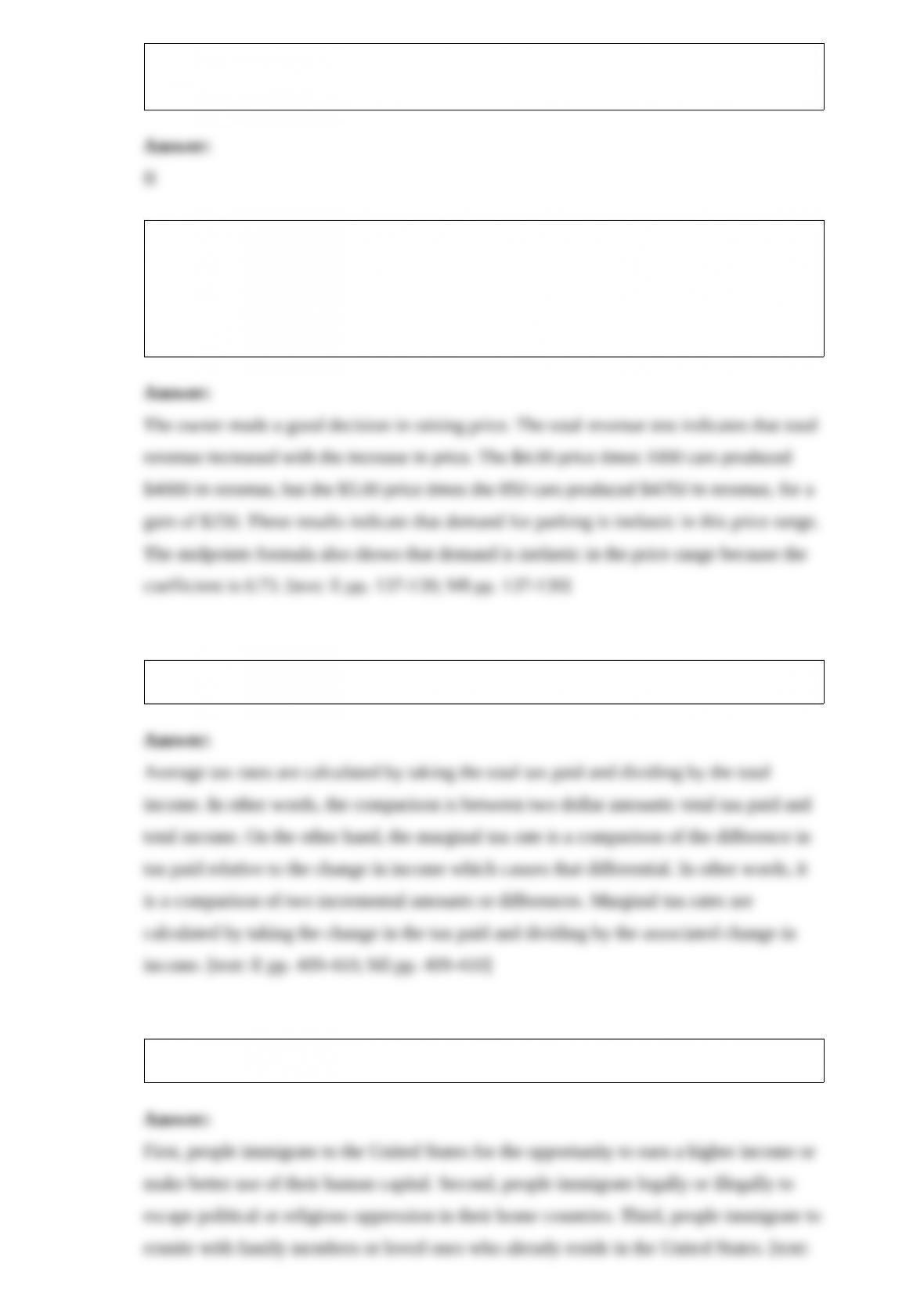
C.is 20 percent.
D.cannot be determined.
17) A gasoline station very near a professional football stadium parks cars on its lot to
make money on game days. Last year it charged $4.00 per car and parked 1000 cars.
This year it raised the parking price to $5.00 and parked 850 cars. Did the station owner
make a good economic decision in raising the parking prices from one year to the next?
Explain.
18) Explain the difference between marginal and average tax rates.
19) State three major reasons why people immigrate to the United States.
20) Why is the effect of a change in price of a substitute good potentially ambiguous?
21) Give three explanations for the law of demand: