
1) If many people in a community get flu shots, the whole community benefits
including those that did not get flu shots. Therefore, not enough people may decide to
get the shots. This is one illustration of:
A.The market allocating resources efficiently
B.Monopoly power due to lack of competition
C.Supply-side market failure
D.Demand-side market failure
2) The basic economic argument for greater income equality is that:
A.an equal distribution of income is the logical outcome of any tax-transfer program.
B.because citizens enjoy political equality, they are also entitled to economic equality.
C.a more equal distribution of income will tend to maximize incentives to work, invest,
and assume risk.
D.a more equal distribution of a given amount of income will increase the total utility
of consumers.
3)
Refer to the table. In relation to column (3), a change from column (2) to column (1)
would indicate a(n):
A.increase in demand.
B.decrease in demand.
C.increase in supply.
D.decrease in supply.
4) The optimal amount of R&D for a firm depends on the following, except:
A.Marginal cost of funds for R&D projects
B.Marginal benefit of R&D projects
C.Expected profitability of R&D projects
D.Amount of funds the firm currently has for R&D projects
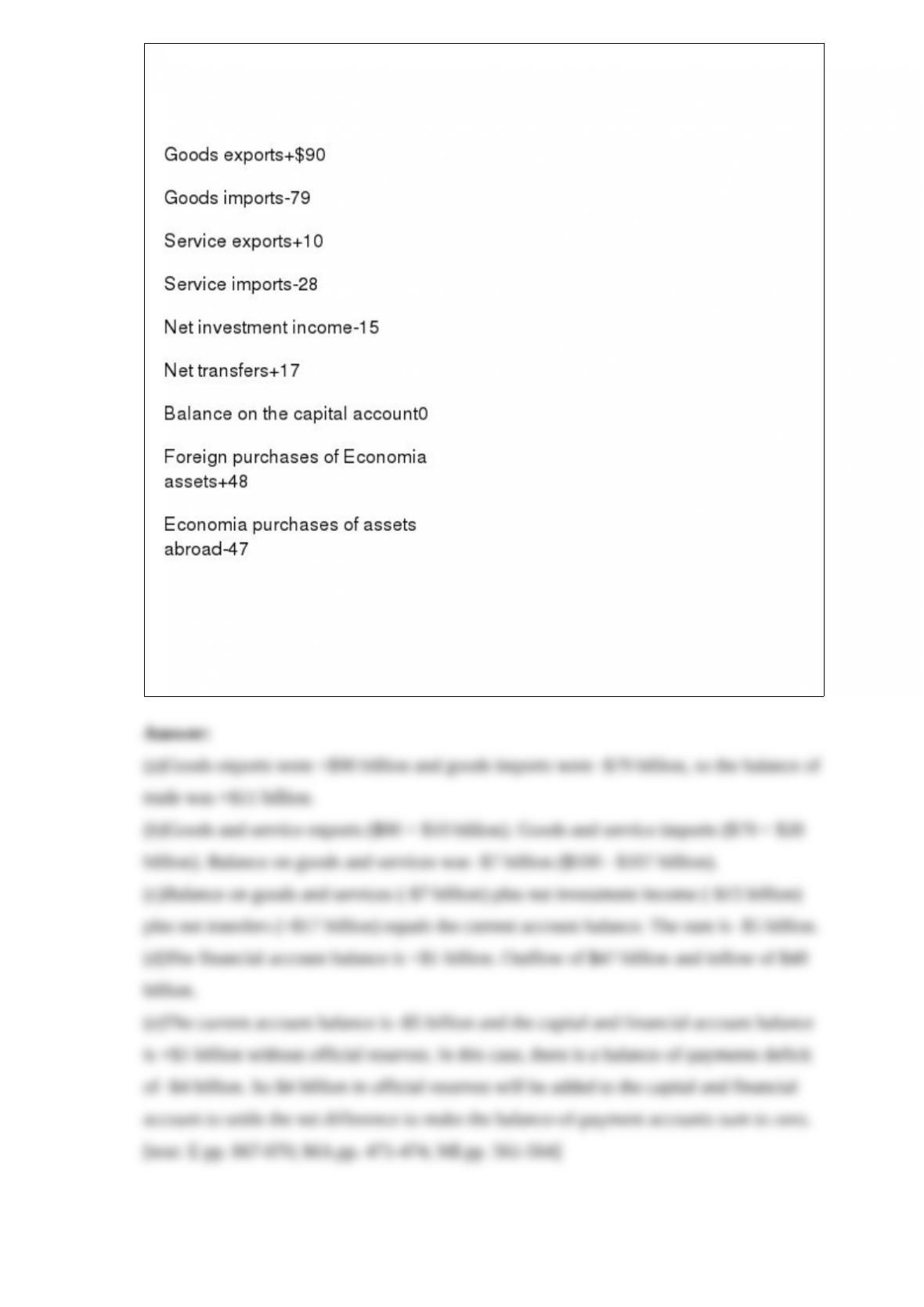
5) Answer the next five questions on the basis of the following hypothetical data for a
hypothetical nation Economia. All numbers are in billions of dollars.
(a)What is the balance of trade?
(b)What is the balance on goods and services?
(c)What is the balance on the current account?
(d)What is the balance on the financial account?
(e)What official reserves will be needed to settle the balance-of-payment accounts?
6) Price supports in agriculture have been criticized because they:
A.have hastened the exodus of labor from agriculture.
B.subsidize consumers at the expense of farmers.
C.help large farmers more than small farmers.
D.create product shortages.
7) Answer the question on the basis of the following demand and cost data for a specific
firm.
Refer to the above data. If columns 1 and 3 are this firm’s demand schedule, the
profit-maximizing level of output will be:
A.3 units
B.4 units
C.5 units
D.6 units
8)
Refer to the figure above. At the equilibrium price of $6, the sellers’ total revenues are
equal to:
A.$300
B.$50
C.$360
D.$150
9)
Refer to the graph. Which of the lines in the diagram represent(s) a progressive tax?
A.Both A and B.
B.D only.
C.C only.
D.B only.

10) The health care market is characterized by:
A.extensive negative externalities.
B.significant positive externalities.
C.perfect knowledge by both buyers and sellers.
D.a perfectly inelastic demand.
11) Which of the following is a predicted result of the increased use of additive
manufacturing (using 3-D printers)?
A.Economies of scale in manufacturing will be eliminated, driving up production costs
and prices.
B.Lower prices of manufactured goods through the elimination of large fixed costs and
transportation costs.
C.Monopolization of manufactured goods industries, as few individuals can afford
additive manufacturing technology.
D.Significant increases in the fixed costs of producing manufactured goods.
12)
Refer to the diagram, representing Slippery Slope Oil Company. How many million
barrels should Slippery Slope extract and sell this year?
A.5
B.10
C.15
D.It cannot be determined with the information given.
13)
If total utility is increasing, marginal utility:
A.is positive but may be either increasing or decreasing.
B.must also be increasing.
C.may be either positive or negative.

D.will be increasing at an increasing rate.
14) Use the following graph to answer question. It shows the extraction costs for TX
Oil Company in the first year in a situation where it will extract oil from a reserve over
two years.
Refer to the above graph. If user costs increase, then the total cost line will:
A.Stay the same and the extraction cost line will shift upward
B.Shift upward and the extraction cost line will shift downward
C.Shift upward and the extraction cost line will shift upward
D.Shift upward and the extraction cost line will stay the same
15)
Suppose that Rosa is considering migration to another country. To move, she will have to
spend $5000 on transportation and $4000 in application and other processing fees. Rosa’s
stream of future earnings in her home country is $500,000. She expects to earn a stream of
future earnings of $800,000 in another country. Based on this information, Rosa will
decide to migrate as long as the implicit costs of leaving her friends and family and
adjusting to a new culture are:
A.Greater than $509,000
B.Less than $300,000
C.Less than $91,000
D.Less than $291,000

16) What are the two characteristics that differentiate private goods from public goods?
A.Rivalry and excludability
B.Negative externality and positive externality
C.Marginal cost and marginal benefit
D.Ownership and usage
17) Health care costs have greatly increased in recent years in the United States. This
fact alone does not establish an overallocation of resources to health care because:
A.the benefits of health care have also greatly increased in recent years.
B.rising medical care prices have inflated health care costs.
C.the marginal cost of health care exceeds the average total cost of health care.
D.negative externalities sometimes result from additional health care spending.
18) The labor demand curve of a firm that sells its product in a purely competitive
market:
A.Is horizontal or perfectly elastic
B.Is downsloping and flatter than the labor demand curve of a firm that sells its product
in an imperfectly competitive (or monopolistic) market
C.Is upsloping
D.Is downsloping and steeper than the labor demand curve of a firm that sells its
product in an imperfectly competitive (or monopolistic) market
19) Interest is the:

A.price paid for the use of money.
B.opportunity cost of time.
C.expectation of a future return on investment.
D.reward for consuming rather than saving.
20)
Refer to the diagram for a monopolistically competitive firm in short-run equilibrium.
This firm’s profit-maximizing price will be:
A.$10.
B.$13.
C.$16.
D.$19.