
1) In the taste-for-discrimination model:
A.a decline in discrimination will reduce the actual African-American-white wage ratio.
B.an increase in collective discrimination coefficients of employers will reduce the
demand for African-American workers, decrease the African-American wage, and
increase African-American employment.
C.firms that discriminate will have lower costs than firms that do not discriminate.
D.competitive forces will tend to reduce discrimination in the very long run.
2) The increase in the productivity of U.S. farmers has caused:
A.More people to be attracted to farming
B.A decrease in the size of the average farm
C.A reduction in the number of people in farming
D.A reduction in the surpluses produced by farmers
3) Suppose the price of the product that labor is producing increases and simultaneously
the price of capital, which is substitutable for labor, decreases. Assuming that the
substitution effect is greater than the output effect, the demand for labor:
A.will increase.
B.will decrease.
C.may either increase or decrease.
D.will not change.
4) An increasing-cost industry is associated with:
A.a perfectly elastic long-run supply curve.
B.an upsloping long-run supply curve.
C.a perfectly inelastic long-run supply curve.
D.an upsloping long-run demand curve.
5)
Refer to the above table. What percentage of households made less than $15,000?

A.5
B.6
C.11
D.23
6) When a purely competitive firm is in long-run equilibrium, price is equal to:
A.Marginal cost, but may be greater or less than average cost
B.Minimum average cost, and also to marginal cost
C.Minimum average cost, but may be greater or less than marginal cost
D.Marginal revenue, but may be greater or less than both average and marginal cost
7) Use the labor demand data on the left and the labor supply data on the right in
answering the following question:
Refer to the given data. The labor supply curve facing firms is:
A.such that it does not intersect the labor demand curve.
B.upsloping.
C.perfectly inelastic.
D.perfectly elastic.
8)
Refer to the above graph. Given the total product curve shown and assuming a
competitive labor market, if a firm can sell widgets for $12, then what is the maximum
amount it will pay the fourth worker each day?
A.$24
B.$48
C.$61
D.$732
9)
Refer to the graph. Which one of the following would cause a move from point b to
point c along short-run average total cost curve ATC1?
A.Diminishing marginal returns.
B.An increase in the wage rate.
C.A decrease in the wage rate.
D.Increasing marginal returns.
10) What product did the Roman citizen Erasmo (c. 130 A.D.) produce and how did he
maintain his trade secret?
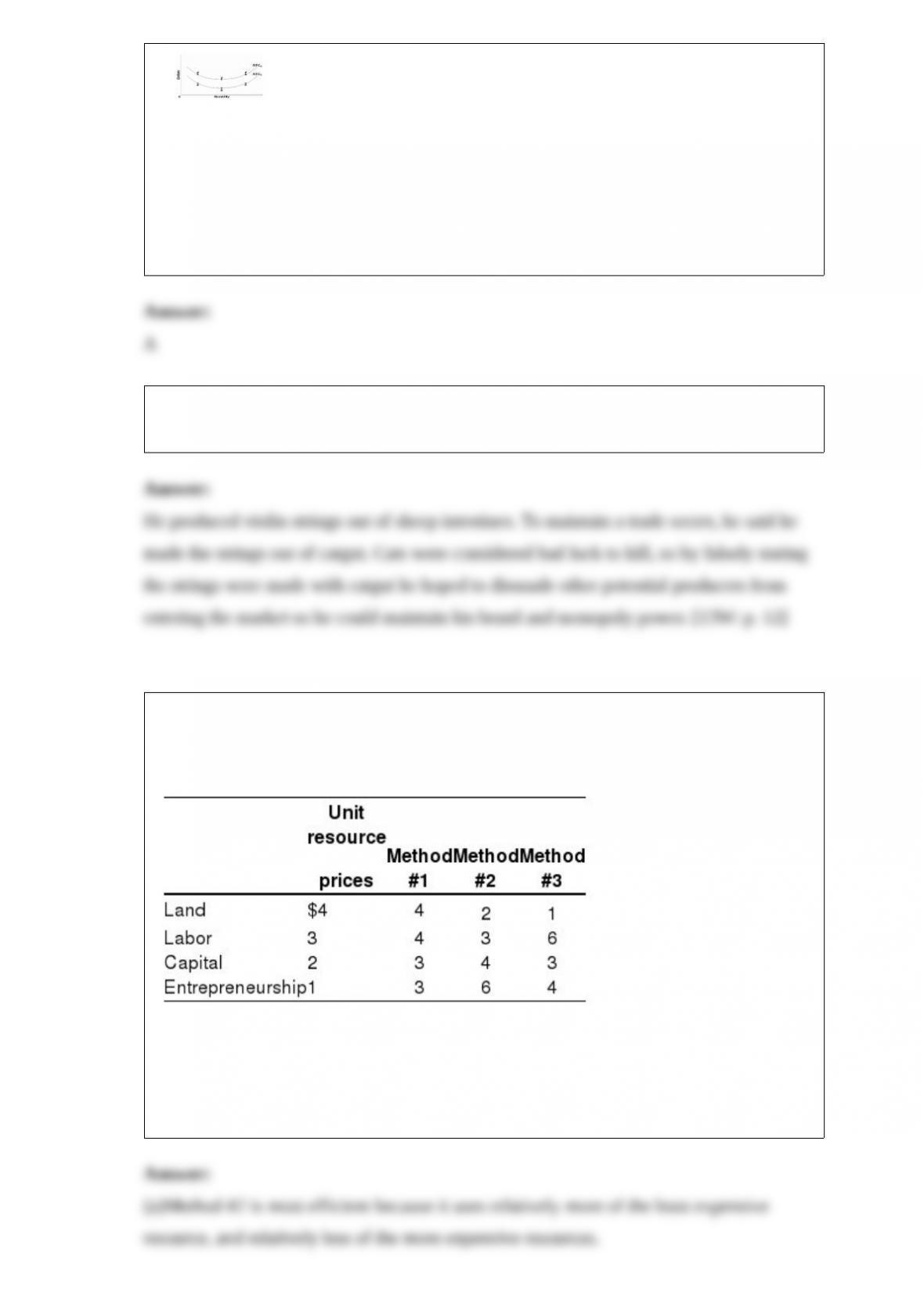
11) Assume that a firm finds that its profits will be maximized (or losses minimized)
when it produces $50 worth of product X. Each of these techniques shown in the
following table will produce exactly $50 worth of X.
(a)Which method is most efficient? Why?
(b)Given the above prices, will the firm adopt a new method which involves 2 units of
land, 2 of labor, 4 of capital, and 8 of entrepreneurial ability?
(c)Suppose the price of labor falls to $1 without any other prices changing. Which of
the methods will the firm now choose? Why?

12) Opponents of land nationalization argue that private ownership:
A.Allows rent to function as an efficient allocation mechanism
B.Is fair in terms of equalizing income distribution
C.Follows the natural order of things in society
D.Is consistent with detailed government planning for land use
13)
The monopolistically competitive firm shown in the figure:
A.is in long-run equilibrium.
B.might realize an economic profit or a loss, depending on its choice of output level.
C.cannot operate profitably in the short run.
D.can realize an economic profit.
14) Determine the effect the following situations will have the exchange rate for the
U.S. dollar.
(a)The United States experiences a recession, reducing imports, while their trading
partners experience an increase in output and incomes.
(b)The Federal Reserve lowers interest rates in the United States, while interest rates in
other countries remain constant.
(c)The demand for U.S. goods declines in other countries.

15)
Relevant economic data for Company Town Mining, Inc., is shown above. The labor
force (including those not now working) of Company Town organizes and demands a
minimum wage, W, for all workers. If Company Town Inc. accepts the offer it will:
A.Pay lower wages
B.Hire more workers
C.Hire fewer workers
D.Hire the same number of workers
16) If the demand for farm products is price inelastic, a good harvest will cause farm
revenues to:
A.increase.
B.decrease.
C.be unchanged.
D.either increase or decrease, depending on what happens to supply.
17)
Refer to the diagram showing the average total cost curve for a purely competitive firm.
At the long-run equilibrium level of output, this firm’s total cost:
A.is $10.
B.is $40.
C.is $400.
D.cannot be determined from the information provided.

18)
Refer to the above diagram. Process innovation will tend to:
A.Shift ATC1 to ATC2
B.Shift ATC2 to ATC1
C.Change output from Q1 to Q2
D.Change output from Q2 to Q1