
1) Assume that the quantities of other resources employed by the firm remain constant.
Refer to the above table. How many units of resource Y would the firm employ at a
price of $50 per unit of Y?
A.2
B.3
C.4
D.5
2)
Some illegal immigrants move back and forth across the U.S.-Mexican border. But in
2012, as many as _____ million immigrants were residing continuously in the U.S.
A.4
B.11
C.20
D.29

3) A breakdown in price leadership leading to successive rounds of price cuts is known
as:
A.limit pricing.
B.a price war.
C.informal pricing.
D.price discrimination.
4)
In a competitive market illustrated by the diagram above, a price floor of $25 per unit
will result in:
A.A shortage of 200 units
B.A surplus of 200 units
C.A surplus of 250 units
D.A shortage of 250 units
5) Which of the following is not considered by demographers to be part of the
three-step demographic transition?
A.Simultaneous low birthrates and death rates.
B.Simultaneous high birthrates and death rates.
C.Low birthrates and high death rates.
D.High birthrates and low death rates.
6) Government’s ability to reduce private-sector economic risks through laws and
regulations would encourage all of the following, except:
A.Higher levels of private economic investment
B.Formation of new businesses
C.Introduction of new products and processes
D.Reduction of private goods and services
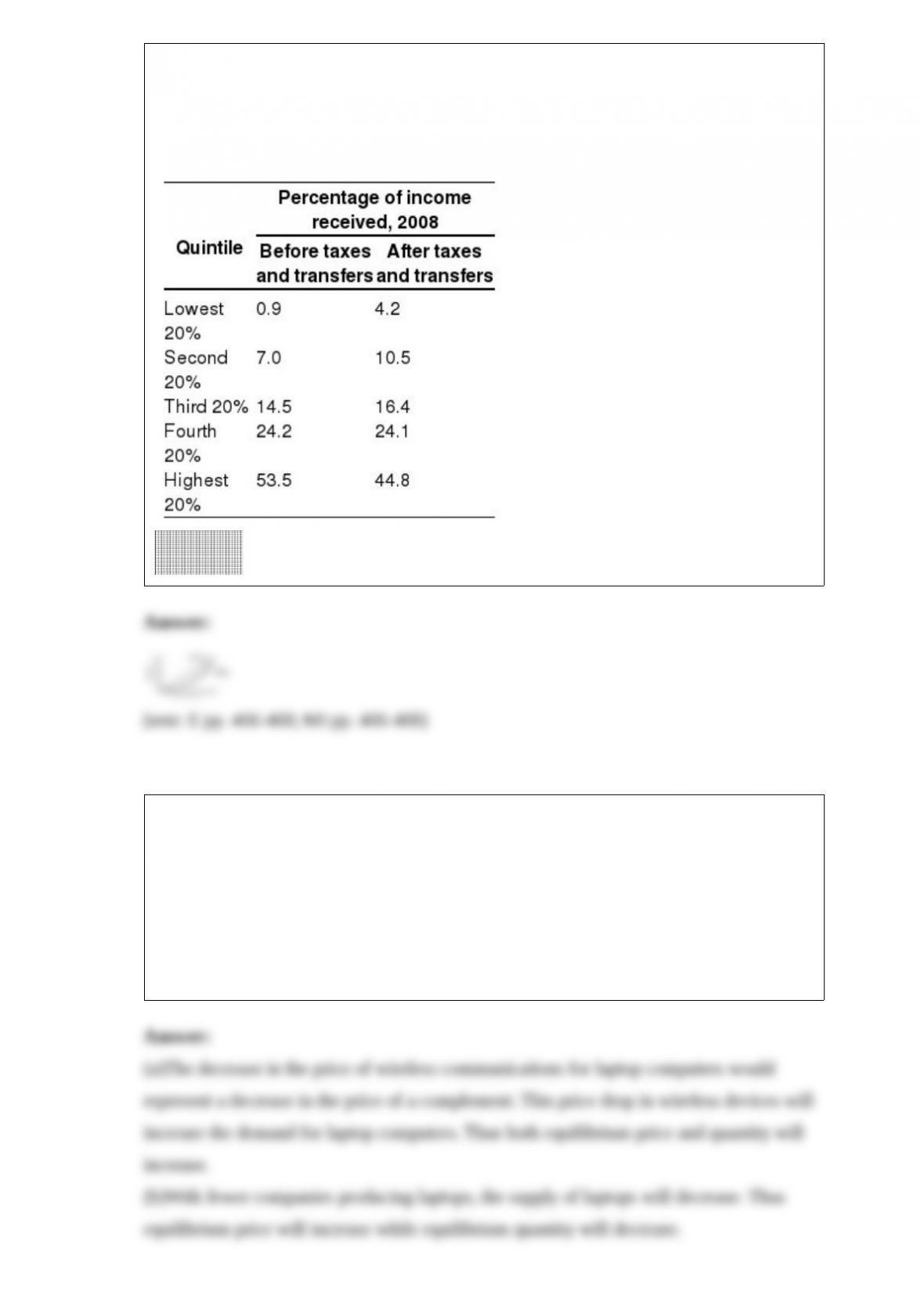
7) The following table shows the percentage of income received by quintile. In the
graph below, draw a Lorenz curve using the before taxes and transfer data and a Lorenz
curve for the after taxes and transfer data. Label the Lorenz curves and each axis of the
graph.
8) What effect will each of the following have upon the equilibrium price and
equilibrium quantity of laptop computers in a competitive market? Explain your
reasoning in each case.
(a)the price decreases for wireless communications devices that consumers like to buy
and attach to laptop computers.
(b)fewer computer companies decide to produce laptop computers.
(c)new technology makes laptop computers cheaper to produce.
(d)the government imposes taxes on computer purchases.

9) In a market system, private ownership of land leads to the following results, except:
A.Private owners will face no cost in using land for one purpose rather than another
B.Land rent would reflect the opportunity cost of land
C.Land would be allocated to its best possible uses
D.It would aid economic growth because land rents would reflect changes in tastes and
technologies
10) Assume there is no way to prevent someone from using an interstate highway,
regardless of whether or not he or she helps pay for it. This characteristic is called:
A.Nonrivalry
B.Nonexcludability
C.Nontaxability
D.Nondiscrimination
11)
12) Which among the following is the strongest determinant of an industry’s
technological progressiveness?
A.The scientific character of its industry and the number of technological opportunities
available.
B.The size of the industry concentration ratio; the lower the ratio, the greater the firm’s
technological progressiveness.
C.The Herfindahl index in the firm’s industry; the higher the index value, the greater the
firm’s technological progressiveness.
D.The amount of retained earnings in the industry.

13) The antitrust laws are based on the:
A.creative destruction view of competition.
B.idea that competition leads to greater economic efficiency than does a monopoly.
C.view that nonprice competition should be strictly regulated by government.
D.view that all negative externalities should be eliminated by government action.
14) The equality-efficiency trade-off refers to:
A.the conflict between risk averters and risk takers.
B.the willingness of Congress to abandon existing welfare programs in favor of a
comprehensive plan to increase education and training for low-income persons.
C.possible conflicts between the goals of economic efficiency and greater income
equality.
D.the difference between the goals of income equality and equality of economic
opportunity.
15) Garrett Hardin’s tragedy of the commons best applies to which of the following
issues?
A.Fracking for oil and natural gas.
B.Government subsidies for alternative energy.
C.Overpopulation.
D.Overfishing in international waters.
16) The table below shows labor-productivity figures in two countries facing constant
costs:
Refer to the table above. Based on the data provided, it can be deduced that:
A.Country A can produce more meat and houses than country B
B.Country A has a comparative advantage in producing houses
C.Country B has the absolute advantage in producing houses
D.Country B has a comparative advantage in producing houses

17) Which type of income contributes the smallest share to total income in the U.S.?
A.Wages
B.Interest
C.Rent
D.Profits
18) When diseconomies of scale occur:
A.the long-run average total cost curve falls.
B.marginal cost intersects average total cost.
C.the long-run average total cost curve rises.
D.average fixed costs will rise.