1) Assume that Abby, Ben, Clara, Joe, and Matt are the only citizens in a community. A
proposed public good has a total cost of $1000. All five citizens will share an equal
portion of this cost in taxes. The benefit of the public good is $220 to Abby, $210 to
Ben, $210 to Clara, $180 to Joe, and $120 to Matt. In a majority vote, this proposal will
most likely be:
A.Accepted; four in favor and one against
B.Defeated; one in favor and four against
C.Accepted; three in favor and two against
D.Defeated; two in favor and three against
2) Consider an oil company that can pump oil from a reserve either this year or next
year. As expected future profits decrease, the extraction quantity this year:
A.Increases due to a higher user cost
B.Increases due to a lower user cost
C.Decreases due to a higher user cost
D.Decreases due to a lower user cost
3) If a regulatory commission wants to establish a socially optimal price for a natural
monopoly, it should select a price:
A.at which the marginal cost curve intersects the demand curve.
B.at which marginal revenue is zero.
C.at which the average total cost curve intersects the demand curve.
D.that corresponds with the equality of marginal cost and marginal revenue.
4) Depict the following scenarios on the graph provided below.
(a)An unexpected drought occurs.
(b)A news special links high fructose corn syrup and diabetes.
(c)Technology increases the yield per acre.
(d)A population boom occurs in the United States.
5) Which of the following factors will make the demand for a product relatively elastic?
A.There are few substitutes
B.The time interval considered is long
C.The good is considered a necessity
D.Purchases of the good require a small portion of consumers’ budgets
6) One major reason why the survival of elephants is threatened is that:
A.Villages near elephants have high unemployment
B.Governments have overtaxed elephant safaris
C.There is a lack of incentive for elephant preservation
D.The number of tourists interested in elephants has declined
7) Which of the following resources is a “free and non-reproducible gift of nature”?
A.Labor
B.Entrepreneurship
C.Capital
D.Land
8) Assume the demand curve for product X shifts to the right. This might be caused by:
A.a decline in income if X is an inferior good.
B.a decline in the price of Z if X and Z are substitute goods.
C.a change in consumer tastes that is unfavorable to X.
D.an increase in the price of Y if X and Y are complementary goods.
9) Proponents of deregulation point to all of the following industries as examples of
successful deregulation except for:
A.airlines.
B.pharmaceuticals.
C.railroads.
D.interstate trucking.
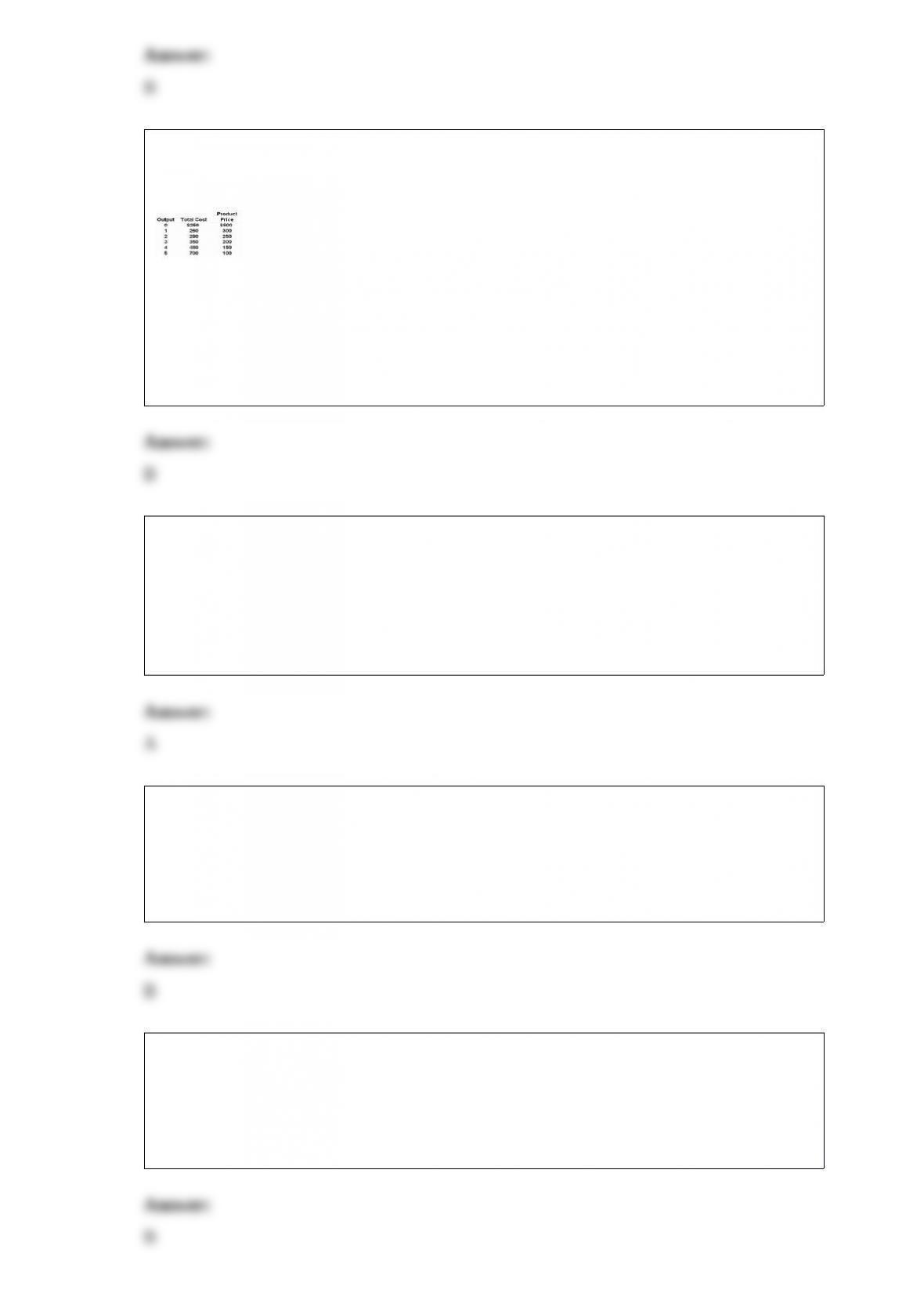
10) Answer the question on the basis of the following information for a pure
monopolist:
At its profit-maximizing output, the given nondiscriminating monopolist:
A.incurs a loss.
B.earns an economic profit of $250.
C.earns a normal profit of $250.
D.earns an economic profit of $150.
11) The demand for agricultural products rises less rapidly than income. This means
that the demand for agricultural products is:
A.income inelastic.
B.income elastic.
C.price inelastic.
D.price elastic.
12) A bilateral monopoly is a situation where a firm is:
A.A monopoly in its product market and is a monopsony in its labor market
B.The only employer of a resource and is acquiring that resource from a single supplier
C.One of only two firms that produce a particular product
D.The only buyer of a resource and also the only seller of a product
13) A government subsidy to the producers of a product:
A.reduces product supply.
B.increases product supply.
C.reduces product demand.
D.increases product demand.
14) Which of the following terms describes a system of subsidized health insurance
available to the aged?
A.Medicare.
B.Supplemental Security Income (SSI).
C.Medicaid.
D.TANF.
15)
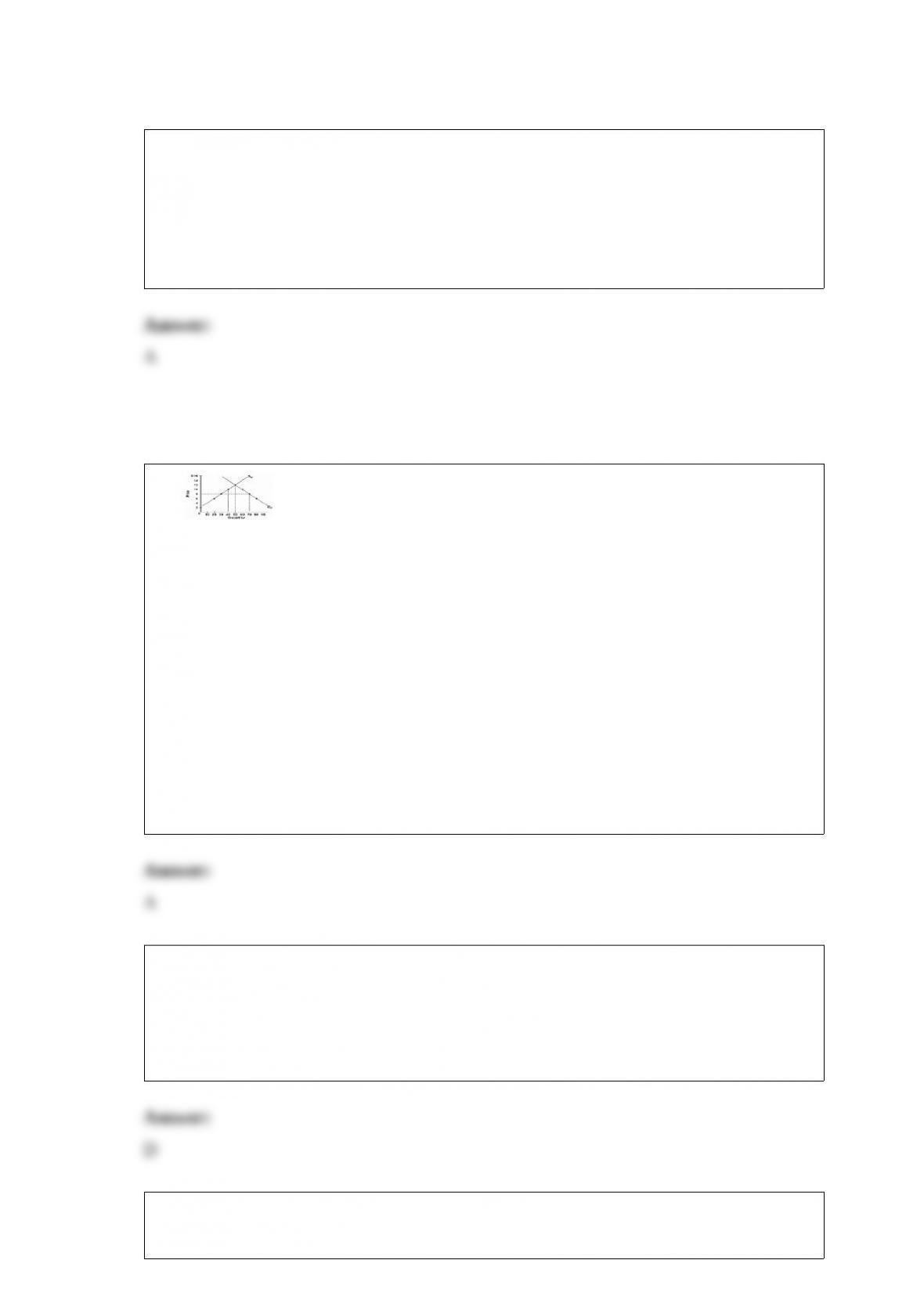
Refer to the graph above, where Sd and Dd are the domestic supply and demand curves
for a product. The world price of the product is $6. If the economy is open to
international trade but a per unit tariff of $4 is imposed, then the total revenue going to
domestic producers would be:
A.$400, the total revenue (after tariff) going to foreign producers would be $120, and
the tariff revenue going to the government would be $80
B.$240, the total revenue (after tariff) going to foreign producers would be $240, and
the tariff revenue going to the government would be $80
C.$400, the total revenue (after tariff) going to foreign producers would be $240, and
the tariff revenue going to the government would be $80
D.$240, the total revenue (after tariff) going to foreign producers would be $120, and
the tariff revenue going to the government would be $120
16) Which of the following is considered a nonrenewable natural resource?
A.Wind.
B.Timber.
C.Oceans.
D.Tin.
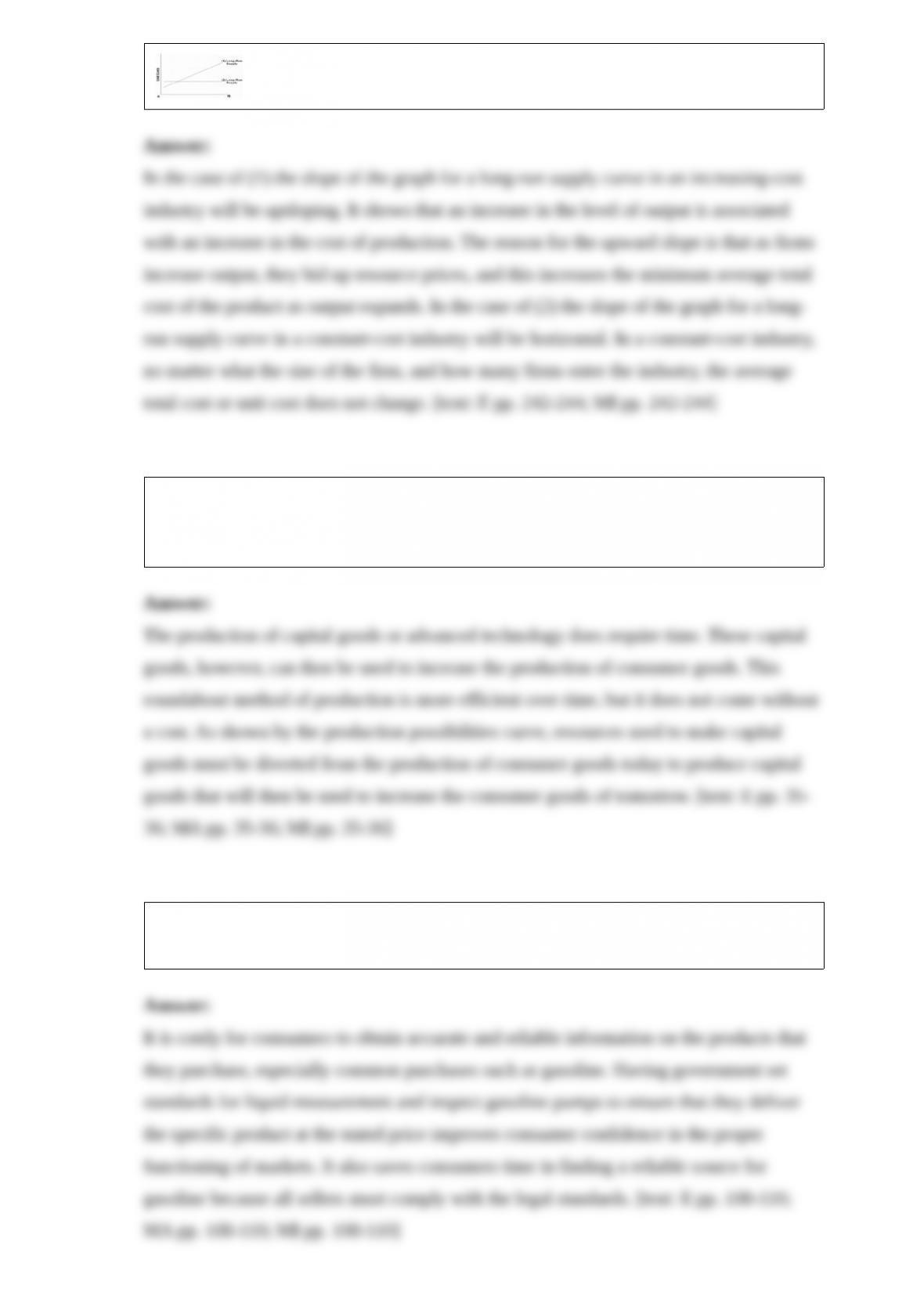
17) Below is a graph of two possible long-run industry supply curves for a purely
competitive industry. Explain why (1) is upsloping and (2) is horizontal.
18) Respond to the following question: Producing capital goods or advanced
technology takes time, so how can that be a more efficient form of production of
consumer goods?
19) Why would the establishment of a system of weights and measures and inspections
by government help market function? Discuss in terms of the market for gasoline.
20) Why is it not sufficient to just compare the marginal utility of two goods when
maximizing utility?
21) Describe and give an example of a dominant strategy.
22) Describe five major sources of government failure.