1) Opportunity costs exist because:
A.the decision to engage in one activity means forgoing some other activity.
B.wants are scarce relative to resources.
C.households and businesses make rational decisions.
D.most decisions do not involve sacrifices or trade-offs.
2) A nation’s capital and financial account:
A.contains inpayment items but not outpayment items.
B.includes service exports and service imports.
C.includes both inpayments and outpayments.
D.includes net investment income and net transfers.
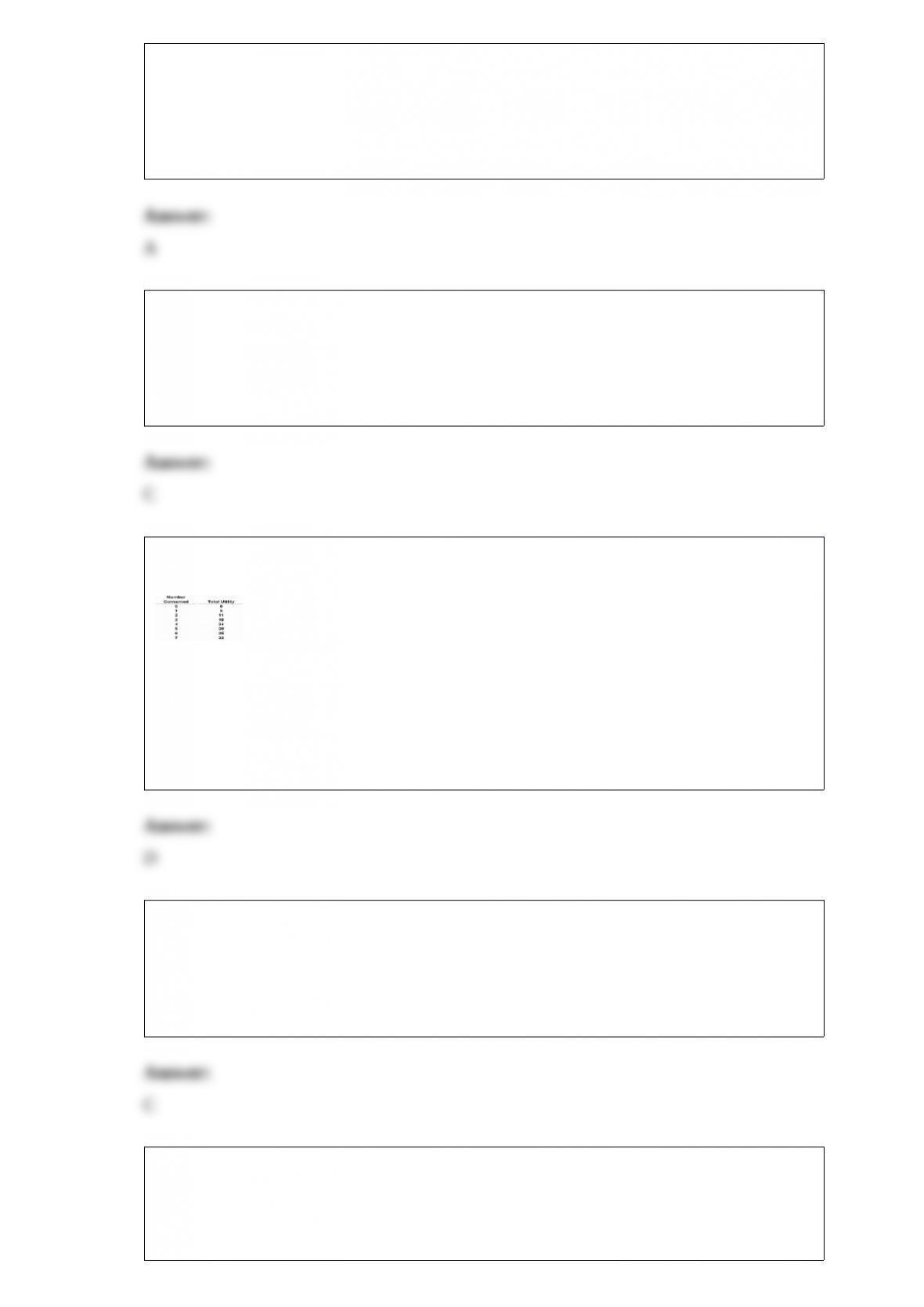
3) The table below shows the utility schedule for a consumer of candy bars.
Refer to the above table. Based on the data in the above table you can conclude that the:
A.Marginal utility of the fourth unit is 96
B.Marginal utility of the third unit is 18
C.Total utility of 2 units is 16
D.Total utility of 6 units is 35
4) In a purely competitive industry, each firm:
A.Determines its own price
B.Produces a differentiated product
C.Can easily enter or exit the industry
D.Engages in various forms of nonprice competition
5) If consumption of a good is subsidized by the government, then the MU/P of that
good among consumers will:
A.Decrease
B.Become negative
C.Increase
D.Not be affected
6) Which of the following is not a valid generalization concerning the relationship
between price and costs for a purely competitive seller in the short run?
A.Price must be at least equal to average total cost.
B.Price times quantity produced must be equal to or greater than total variable cost for
some level of output or the firm will close down in the short run.
C.Price may be equal to, greater than, or less than average total cost.
D.Price must be equal to or greater than minimum average variable cost for the firm to
continue producing.
7) Specialization in production is economically beneficial primarily because it:
A.allows everyone to have a job that he or she likes.
B.permits the production of a larger output with fixed amounts of resources.
C.facilitates trade by bartering.
D.guarantees full employment.
8) Which expression is used to calculate the future value of an amount of money?
A.Present Value x (1 + interest rate)time
B.Present Value/(1 + interest rate)time
C.Present Value x (1 + time)interest rate
D.(1 + interest rate)time/Present Value
9)
Refer to the above graphs. Which graph shows the immediate market period for supply?
A.Graph A
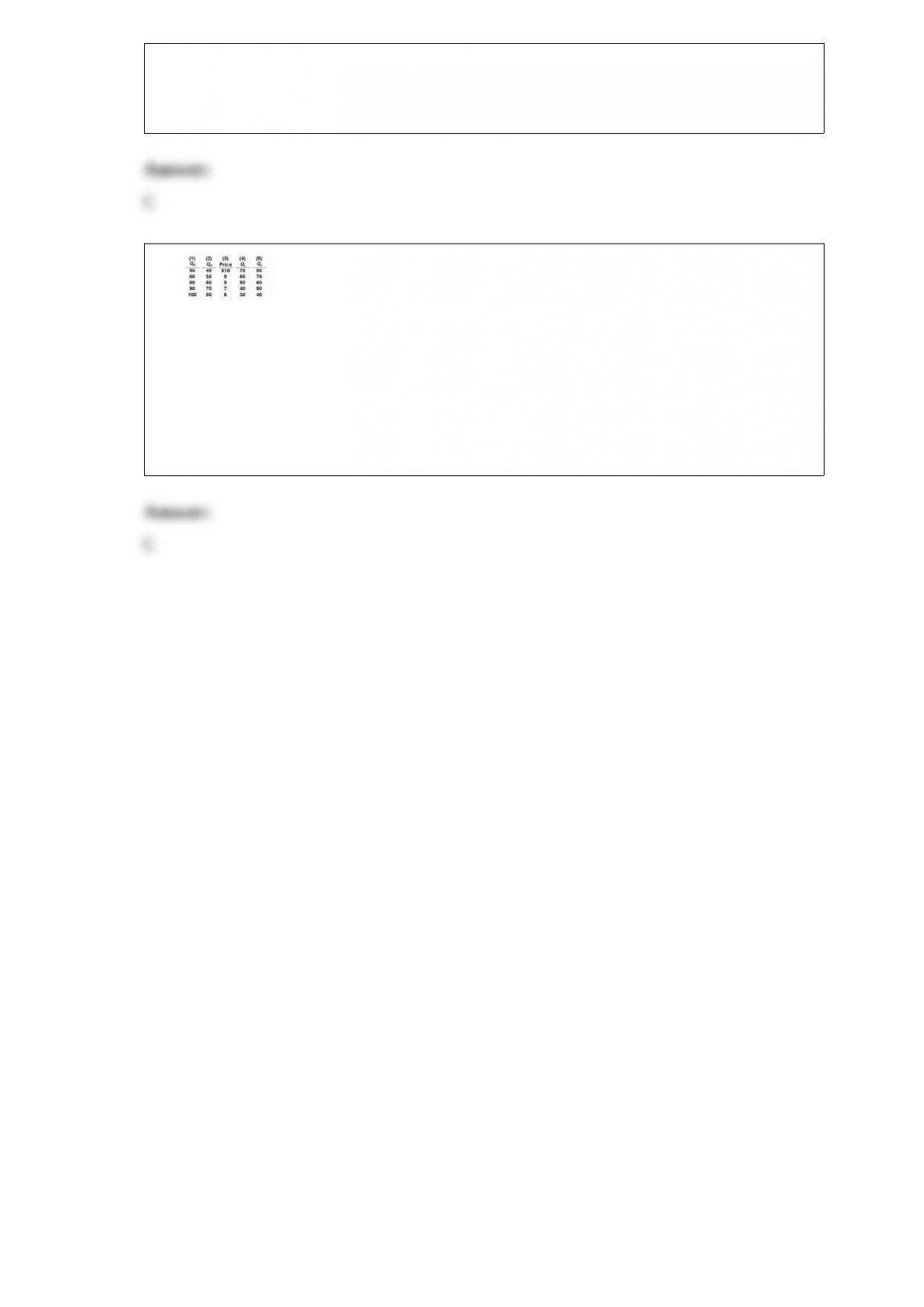
B.Graph B
C.Graph C
D.Graph D
10)
Refer to the table. Suppose that demand is represented by columns (3) and (2) and
supply is represented by columns (3) and (5). If the price were artificially set at $6:
A.the market would clear.
B.a surplus of 40 units would occur.
C.a shortage of 40 units would occur.
D.demand would change from columns (3) and (2) to columns (3) and (1).