
1) An amount of R&D spending that is greater than the optimal amount indicates that
the:
A.Marginal benefit of R&D expenditures is equal to the marginal cost
B.Marginal benefit of R&D expenditures is greater than the marginal cost
C.Interest-rate cost-of-funds is less than the expected rate of return
D.Interest-rate cost-of-funds is greater than the expected rate of return
2)
Refer to the diagram where the numerical data show profits in millions of dollars. Beta’s
profits are shown in the northeast corner and Alpha’s profits in the southwest corner of
each cell. If both firms follow a high-price policy:
A.Alpha will realize a $10 million profit and Beta a $30 million profit.
B.each will realize a $20 million profit.
C.Beta will realize a $10 million profit and Alpha a $30 million profit.
D.each will realize a $15 million profit.
3) An amount of R&D spending that is less than the optimal amount indicates that the:
A.Interest-rate cost-of-funds and expected rate of return are constant
B.Interest-rate cost-of-funds is equal to the expected rate of return
C.Interest-rate cost-of-funds is less than the expected rate of return
D.Interest-rate cost-of-funds is greater than the expected rate of return
4) Productive inputs capable of replacing themselves if harvested at moderate rates are
known as:
A.renewable natural resources.
B.natural capital.
C.nonrenewable natural resources.
D.fossil fuels.
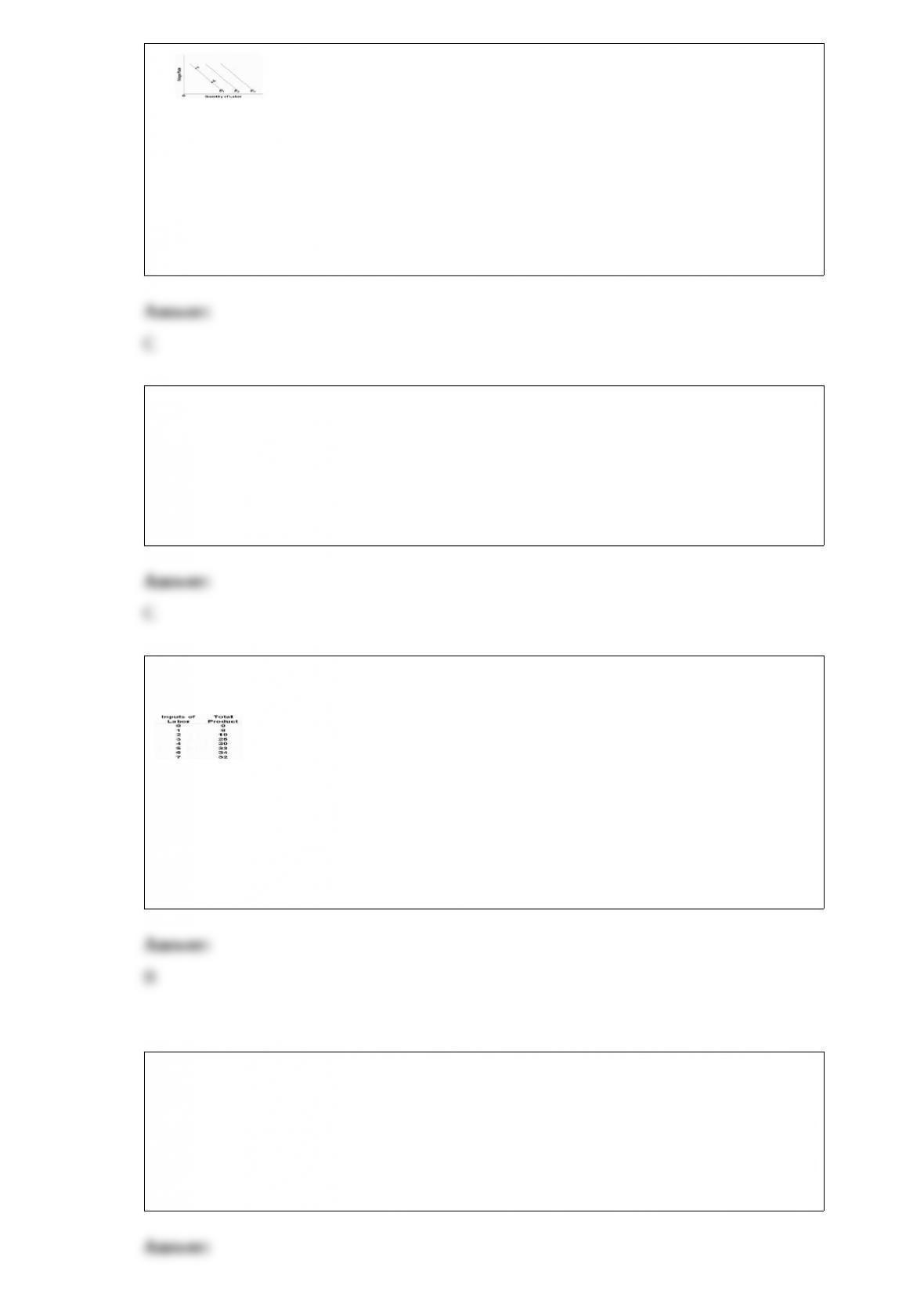
5)
Refer to the graph. Other things equal, an increase in the price of a complementary
resource would cause a:
A.move from a to b on D1
B.shift from D2 to D3
C.shift from D3 to D2
D.move from b to a on D1
6) The amount of revenues that sellers actually receive over and above the minimum
acceptable amount that they are willing to receive for selling a product is called:
A.Production costs
B.Producers’ supply
C.Producer surplus
D.Surplus production
7) Use the following data to answer the question:
Refer to the data. The average product (AP) when two units of labor are hired is:
A.8
B.9
C.10
D.18
8) What idea is best illustrated by the example of Alamo auto rentals offering unlimited
mileage to drivers and the practice being adopted by other auto rental firms?
A.Startups
B.Diffusion
C.Invention
D.Fast-second strategy

9)
Refer to the given data. In maximizing its profit, this firm will employ:
A.2 units of labor.
B.3 units of labor.
C.4 units of labor.
D.5 units of labor.
10) The slope of a straight line can be determined by:
A.comparing the absolute horizontal change to the absolute vertical change between
two points on the line.
B.comparing the absolute vertical change to the absolute horizontal change between
two points on the line.
C.taking the reciprocal of the vertical intercept.
D.comparing the percentage vertical change to the percentage horizontal change
between two points on the line.