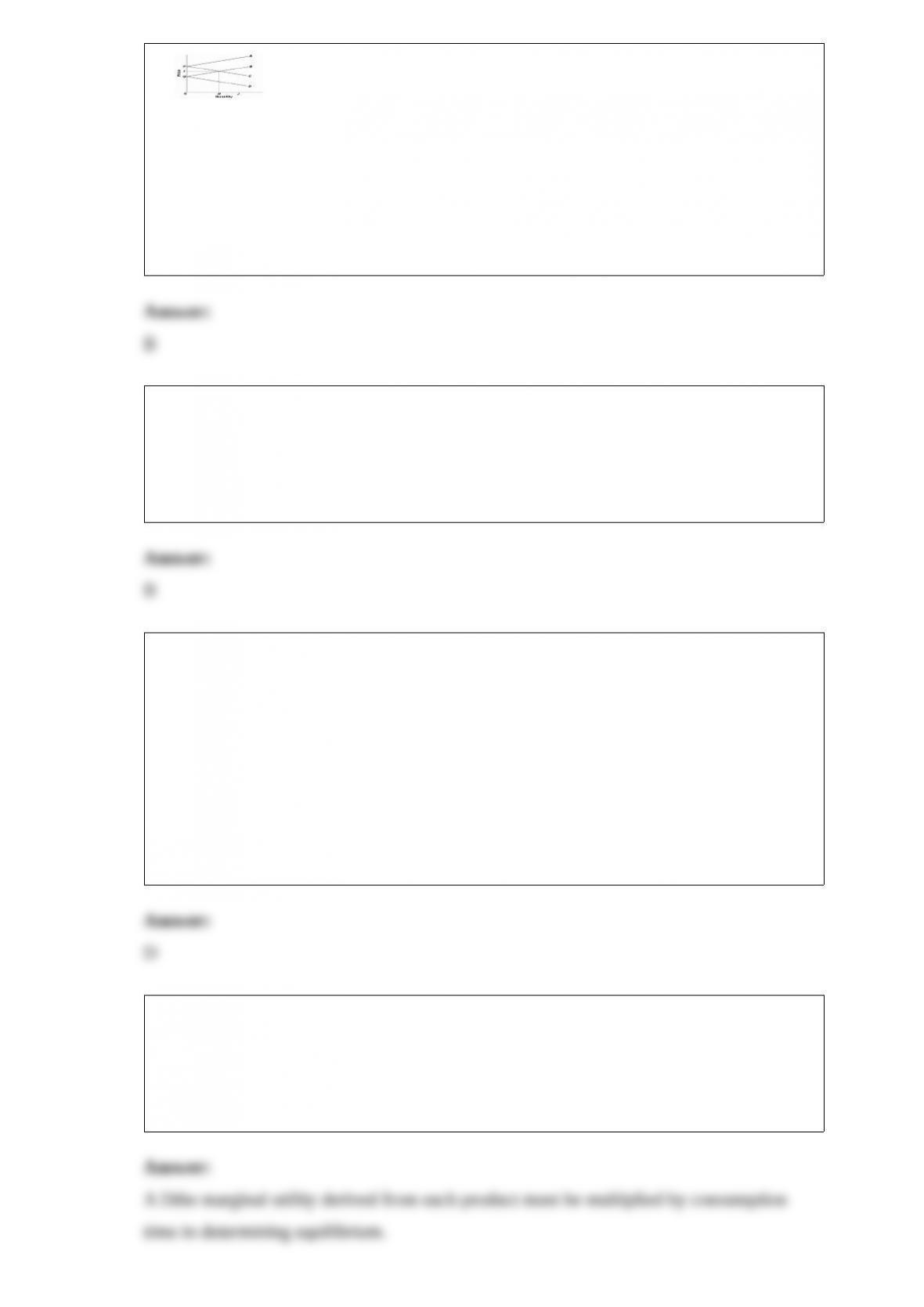
1)
Refer to the diagram pertaining to two nations and a specific product. The equilibrium
world price occurs at:
A.F.
B.I.
C.G.
D.J.
2) The basic purpose of antitrust laws is to:
A.Provide subsidies for American business
B.Limit monopoly power in industry
C.Control prices to protect consumers
D.Enforce laws that restrict competition
3) If a purely competitive firm is currently facing a situation where the price of its
product is lower than the average variable cost, but it believes that the market demand
for its product will increase soon, then:
A.The firm will produce a low level of output in the short run, and leave the industry in
the long run
B.The firm will shut down in the short run, and leave the industry in the long run
C.The firm will produce a low level of output in the short run, but expand its plant in
the long run as demand increases soon
D.The firm will shut down in the short run, but stay in the industry in the long run if it
expects the product price to rise high enough soon
4) In introducing the opportunity cost of time into the theory of consumer behavior, we
find that, all else equal:
A.one should consume less of time-intensive goods.
B.one should consume more of time-intensive goods.
C.the consumer’s equilibrium position is not altered.

5) If a monopolist were to produce in the inelastic segment of its demand curve:
A.total revenue would be at a maximum.
B.marginal revenue would be positive.
C.the firm would not be maximizing profits.
D.it would necessarily incur a loss.
6) The demand for agricultural products:
A.has a price elasticity coefficient of about 0.20 to 0.25.
B.is elastic with respect to income but inelastic with respect to price.
C.has been decreasing about 8 percent per year.
D.has been rising more rapidly than the national income.
7) Marginal revenue is the:
A.change in product price associated with the sale of one more unit of output.
B.change in average revenue associated with the sale of one more unit of output.
C.difference between product price and average total cost.
D.change in total revenue associated with the sale of one more unit of output.
8) If an economy is being “productively efficient,” then that means the economy is:
A.Producing the products most wanted by society
B.Fully employing all economic resources
C.Maximizing the returns to factors of production
D.Using the least costly production techniques
9)
Refer to the diagram. At P4, this firm will:
A.shut down in the short run.
B.produce 30 units and incur a loss.

C.produce 30 units and earn only a normal profit.
D.produce 10 units and earn only a normal profit.
10) All of the following increase the expected rate of return on R&D expenditures
except:
A.patents.
B.trademarks.
C.imitation by others.
D.trade secrets.
11) In the pizza analogy for income distribution, the pizza would shrink because:
A.The burden for the consumer would be greater than the burden for the producer
B.The risk of investment would be greater than the potential return on investment
C.There would be inequitable treatment of people
D.Redistribution would reduce incentives to work
12) Game theory can be used to demonstrate that oligopolists:
A.rarely consider the potential reactions of rivals.
B.experience economies of scale.
C.can increase their profits through collusion.
D.may be either homogeneous or differentiated.
13) Assume that the graphs show a competitive market for the product stated in the
question.
Select the graph above that best shows the change in the market specified in the
following situation: In the market for digital cameras, when the productivity of workers

in the digital camera industry increases.
A.Graph A
B.Graph B
C.Graph C
D.Graph D