1) U.S. exports represent two flows:
A.An outflow of goods or services, and an outflow of payments
B.An inflow of goods or services, and an outflow of payments
C.An outflow of goods or services, and an inflow of payments
D.An inflow of goods or services, and an inflow of payments
2) If economic profits in a particular industry increase, then we would expect:
A.Resources to be diverted away from that industry
B.Firms in that industry to produce less output
C.Firms to enter that industry thus expanding it
D.Consumers to buy less from that industry
3) If labor costs are 60 percent of production costs, then a 15 percent increase in wage
rates would increase production costs by:
A.60 percent
B.45 percent
C.15 percent
D.9 percent
4)
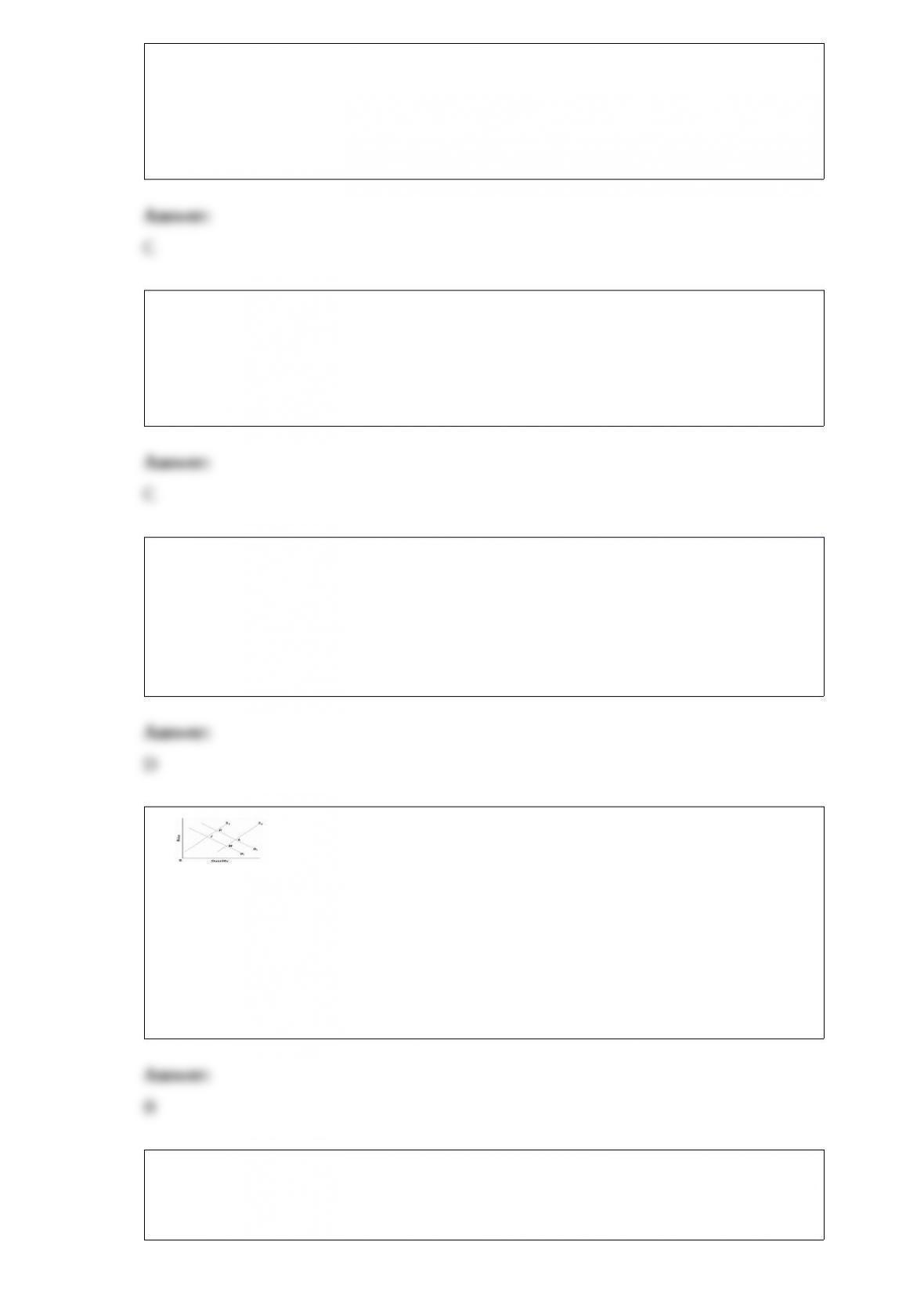
Refer to the diagram, in which S1 and D1 represent the original supply and demand
curves and S2 and D2 the new curves. In this market:
A.the equilibrium position has shifted from M to K.
B.an increase in demand has been more than offset by an increase in supply.
C.the new equilibrium price and quantity are both greater than originally.
D.point M shows the new equilibrium position.
5) Which of the following arguments for farm subsidies is most closely associated with
the parity concept?
A.Although farmers produce necessities for the rest of us, they receive low incomes that
are declining in real terms, and should therefore receive price and income support.
B.Farmers sell their output in purely competitive markets but must buy inputs from
imperfectly competitive firms.
C.Farmers cannot fully insure themselves against the risks unusual to farming, such as
floods, droughts, and pests.
D.The “family farm” is an American institution that should be protected and nurtured.
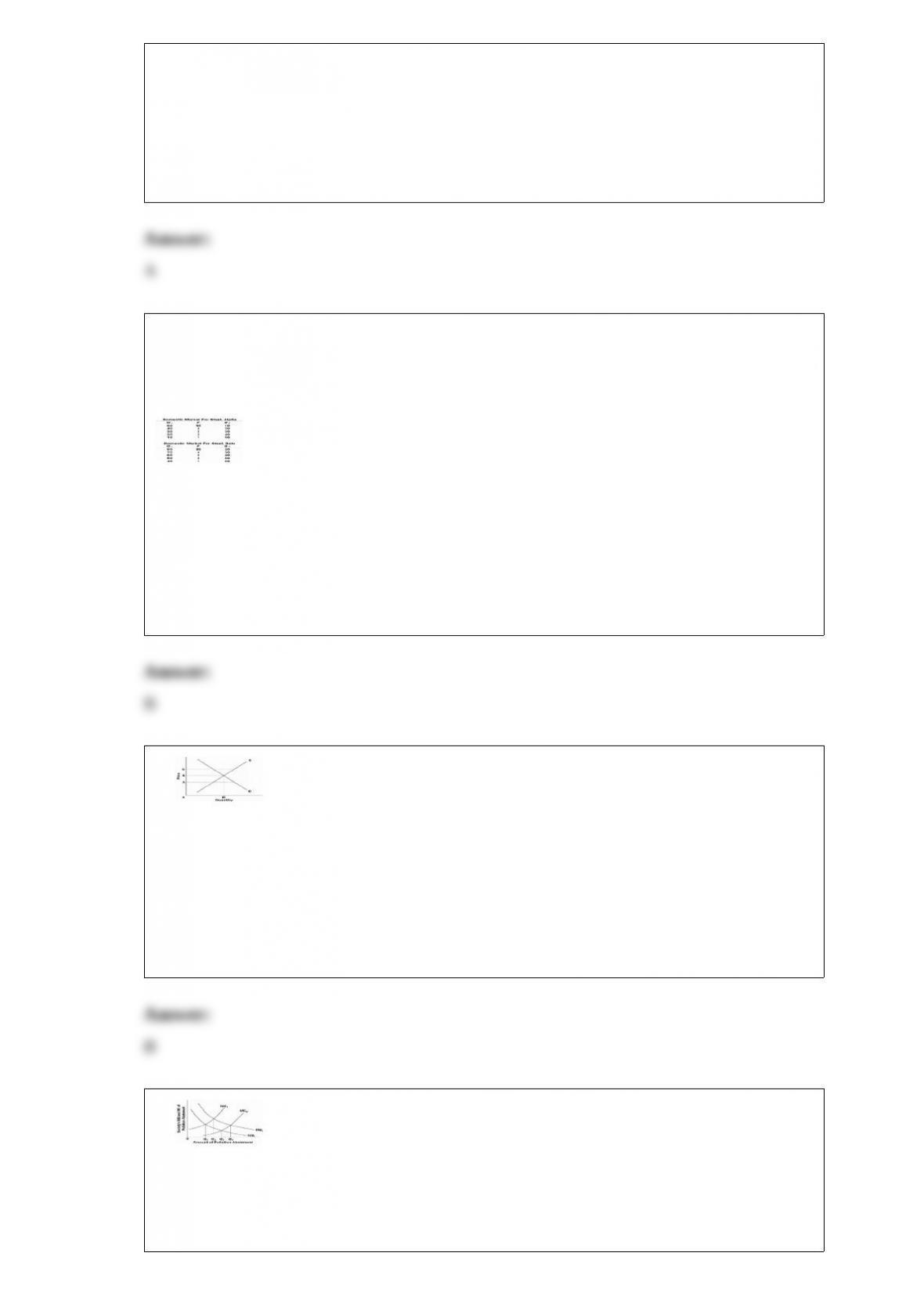
6) Answer the question on the basis of the following data for the hypothetical nations of
Alpha and Beta. Qs is domestic quantity supplied and Qd is domestic quantity
demanded.
Refer to the given data. Assuming that Alpha and Beta are the only two nations in the
world, the equilibrium world price must be lower than $4 because at $4:
A.both nations want to import steel.
B.both nations want to export steel.
C.Beta wants to export more than Alpha.
D.Alpha wants to import more than Beta.
7)
Refer to the diagram. A government price support program to aid farmers is best
illustrated by:
A.quantity E
B.price C
C.price A
D.price B
8)
Refer to the diagram. With MB1 and MC1, society’s optimal amount of pollution
abatement is:
A.Q1.

B.Q2.
C.Q3.
D.Q4.
9) Graphically, producer surplus is measured as the area:
A.under the demand curve and below the actual price.
B.under the demand curve and above the actual price.
C.above the supply curve and above the actual price.
D.above the supply curve and below the actual price.
10) Suppose that at 500 units of output marginal revenue is equal to marginal cost. The
firm is selling its output at $5 per unit and average total cost at 500 units of output is $6.
On the basis of this information, we:
A.can say that the firm should close down in the short run.
B.can say that the firm can produce and realize an economic profit in the short run.
C.cannot determine whether the firm should produce or shut down in the short run.
D.can assume the firm is not using the most efficient technology.
11) An employer whose discrimination coefficient is $4 will:
A.refuse to hire nonpreferred-race workers at any wage rate.
B.hire only nonpreferred-race workers if the actual nonpreferred-preferred wage
differential is $3 an hour.
C.hire only preferred-race workers if the actual nonpreferred-preferred wage differential
is $3 an hour.
D.hire only preferred-race workers if the nonpreferred-preferred wage differential is $4.
12) In a market system, which of the following will eliminate high-cost producers, and
allow only the low-cost producers to survive?
A.Competition
B.Money
C.A sovereign government
D.Specialization