
1) Oligopoly firms may produce either standardized or differentiated products.
2) Price discrimination is illegal in the United States under antitrust regulations.
3)
Refer to the diagrams. Firm B’s average revenue curve coincides with its marginal
revenue curve.
4) Price-fixing is illegal under Section 1 of the Sherman Act.
5) Some economists are now proposing that patents may be detrimental to technological
advance in industries with complicated multiple-component products.
6) Economic rent is the payment made to a resource which has a perfectly inelastic
demand curve.
7) Weak property rights encourage faster extraction than would otherwise maximize the
long-term stream of profits.

8) Diffusion is the first successful commercial introduction of a product, the use of a
new method, or the creation of a new form of business enterprise.
9) Because of the force of law and bureaucratic structure, government accountability is
less of a problem than in the private sector.
10) An empty threat is a statement of coercion that is not believed by the threatened
firm.
11) Investment and R&D decisions by firms are based on nominal interest rates, not
real interest.
12) The demand side, not supply, is the major factor determining how high land’s rent
will be.
13) An industry comprised of a small number of firms, each of which considers the
potential reactions of its rivals in making price-output decisions, is called:
A.monopolistic competition.
B.oligopoly.
C.pure monopoly.
D.pure competition.
14) Which of the following would cause an increase in interest rates in credit markets?

A.A decrease in business demand for credit
B.An increase in the supply of consumer saving
C.An increase in the supply of business saving
D.An increase in consumer demand for credit
15) Which of the following is a true statement?
A.Innovation normally follows invention and precedes diffusion.
B.Invention normally follows diffusion and precedes innovation.
C.Diffusion normally follows invention and precedes innovation.
D.Innovation normally follows diffusion and precedes invention.
16) Roughly how much of health care spending in the U.S. is financed by private and
public insurance?
A.20 percent
B.40 percent
C.60 percent
D.80 percent
17) Which of the following is typically not a problem for low-income DVCs?
A.Capital flight.
B.”Brain drains.”
C.High saving rates that slow aggregate demand growth.
D.Poor infrastructure.
18) Answer the question on the basis of the following cost data:
Refer to the data. The average total cost of five units of output is:
A.$69.
B.$78.
C.$3.
D.$10.
19) In countries like Botswana and Zimbabwe, local villages have been given property
rights over local elephants with the result that elephant populations:
A.have been decimated as villagers try to maximize short-run profit.
B.have grown as villagers have protected the elephants to support their tourist industry.
C.have grown exponentially, with adverse environmental impacts.
D.are in serious decline as ivory prices have risen.
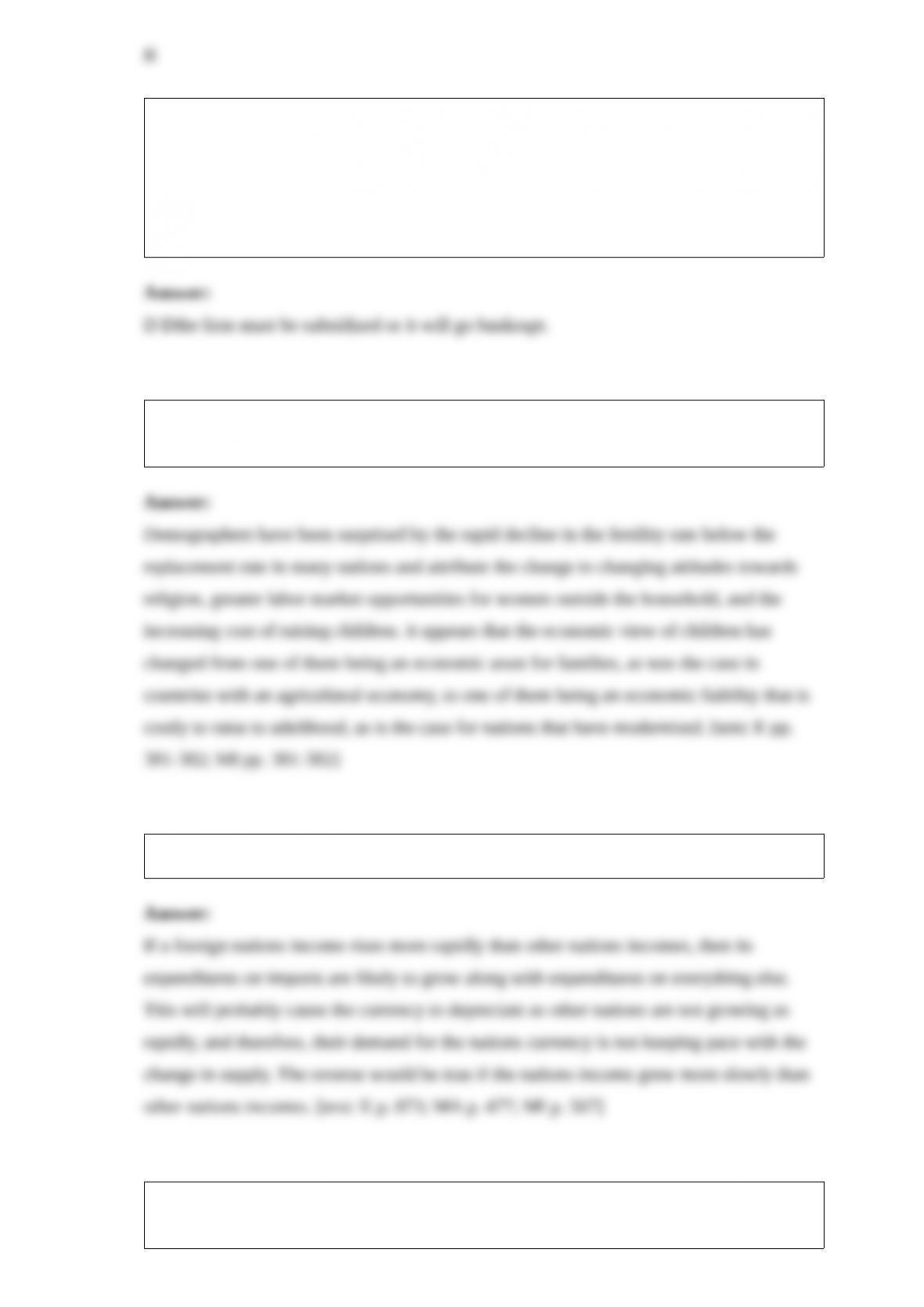
20) Using the schedules given, plot the demand curve and the supply curve on the
below graph. Label the axes and indicate for each axis the units being used to measure
price and quantity. Then answer the questions.
(a)Give the equilibrium price and quantity for wheat.
(b)Indicate the equilibrium price and quantity on the graph by drawing lines from the
intersection of the supply and demand curves to the price and quantity axes.
(c)If the Federal government decided to support the price of wheat at $4.00 per bushel,
tell whether there would be a surplus or shortage and how much it would be.
(d)Demonstrate your answer to part (c) on your graph being sure to label the quantity
you designated as the shortage or surplus.

21)
Refer to the diagram. Other things equal, which of the following positions relative to
PP1 would be the most likely to result in a future production possibilities curve of PP3
rather than PP2?
A.A.
B.B.
C.C.
D.D.
22) The pursuit through government of a “transfer of wealth” at someone else’s expense
refers to:
A.logrolling.
B.rent-seeking behavior.
C.the paradox of voting.
D.the median-voter model.
23) A monopolistically competitive firm is operating at a short-run level of output
where price is $21, average total cost is $15, marginal cost is $13, and marginal revenue
is $13. In the short run this firm should:
A.Reduce product price
B.Increase the level of output
C.Decrease the level of output
D.Make no change in the level of output
24) Which of the following countries had the least corruption, as reported in the Global
Corruption Barometer for 2010-11?
A.Mexico
B.Italy
C.Germany

D.Russia
25) (Consider This) The prisoner’s dilemma reveals that:
A.collusive agreements will always fail.
B.the price leadership model does not work.
C.nonprice competition is more profitable than price competition.
D.sometimes when individuals act independently in their own self-interest, everyone is
worse off than if they had cooperated.
26) About two-thirds of U.S. electricity is generated from:
A.hydroelectric.
B.petroleum.
C.nuclear energy.
D.coal and gas.
27) Critics of the World Trade Organization (WTO) say that liberalized world trade
does all of the following except:
A.produce environmental degradation.
B.allow producers to circumvent labor protections such as workplace safety, child labor
restrictions, and collective bargaining rights.
C.helps developing nations escape from poverty.
D.promote the interests of multinational corporations.
28) Assume a purely competitive constant-cost industry is initially at long-run
equilibrium. Now suppose that a decrease in consumer demand occurs. After all the
long-run adjustments have been completed, the new equilibrium price:
A.And industry output will be less than the initial price and output
B.Will be the same as the initial price, and the output will be less
C.Will be greater than the initial, but the new output will be less
D.Will be less than the initial price, but the new output will be greater
29) If a regulatory commission imposes upon a nondiscriminating natural monopoly a
price that is equal to marginal cost and below average total cost at the resulting output,
then:
A.the firm will realize an economic profit.
B.the firm will earn only a normal profit.
C.allocative efficiency will be worsened.
30) To what factors do demographers attribute the decline in birthrates? How has the
economic view of children changed?
31) Explain how changes in relative income affect the value of a nations currency.
32) Using the below axes draw a graph for a purely competitive firm that is earning
normal profit in the long run. Explain why an entrepreneur may earn an economic profit
and not just a normal profit, even in the long run.
33) Examine regulatory capture in the railroad industry.
34)
35) A vice president of a company argues that the president of the company should raise
workers wages if the president wants less absenteeism. The president says that wages
probably should be cut so that the workers could not afford to miss so much work.
Evaluate the two views using the income and substitution effects in your analysis.
36) Describe the rationale behind supply and demand analysis for public goods.
37) Under competition, workers are paid what they are worth. Explain and evaluate this
statement. Does it follow that the resulting distribution of wage incomes is desirable?
38) Why is there a free-rider problem with public goods?
39) What are the merits and demerits of unemployment compensation as a built-in
stabilizer? Can you think of any changes in unemployment compensation that might
improve its effectiveness as a stabilizing technique?