1) A fishery collapse occurs when the:
A.Fishery goes out of business
B.Fishery is taken over by a government agency
C.Fishery’s population is harvested at a higher rate than it reproduces
D.Fishery’s population reproduces at a higher rate than it’s harvested
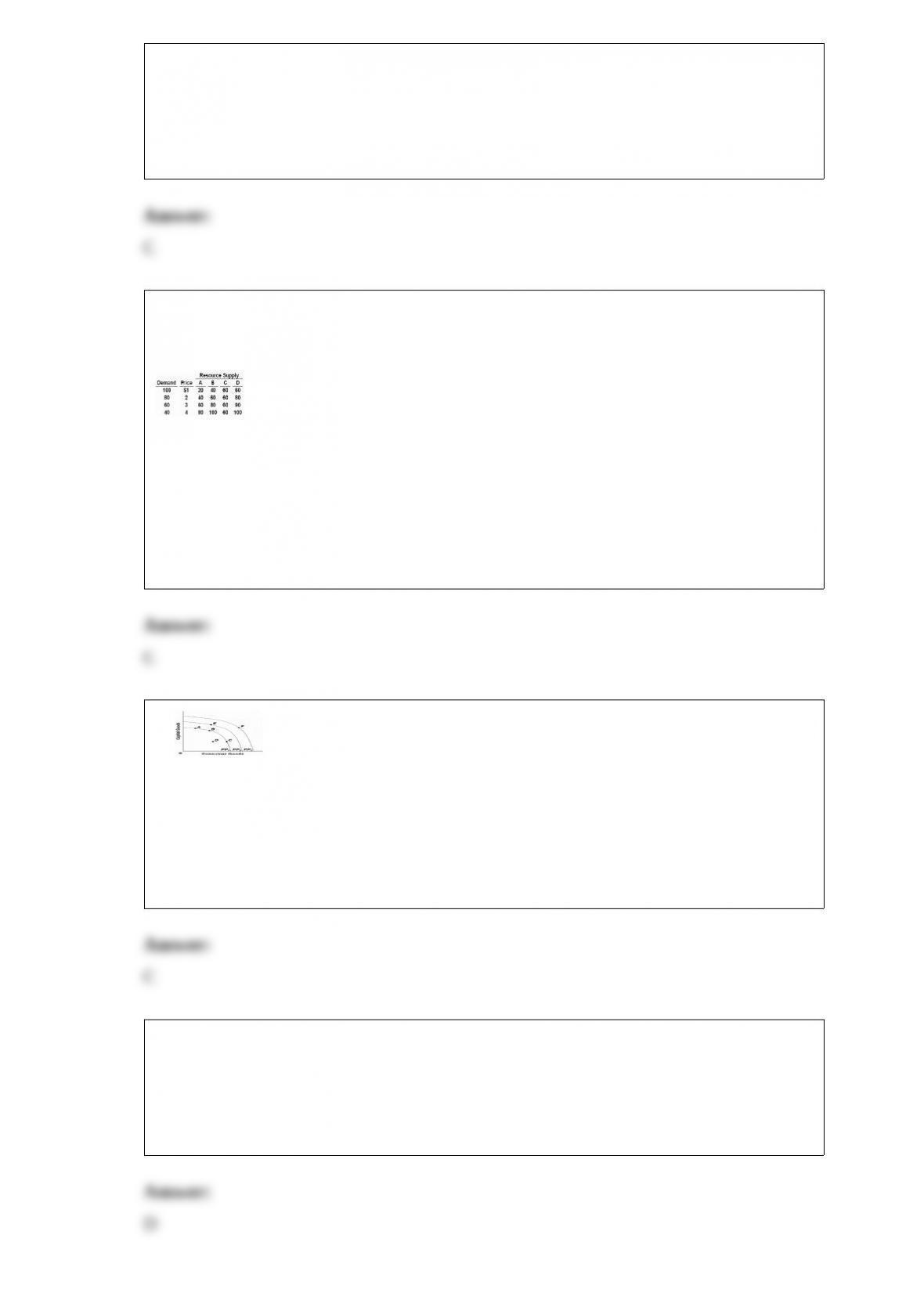
2) Use the following demand schedule and possible supply schedules, A-D, to answer
the question.
Refer to the above schedules. There would be no incentive function performed by price
in which of the given resource supply schedules?
A.A
B.B
C.C
D.D
3)
Refer to the diagram. The concept of opportunity cost is best represented by the:
A.shift of the production possibilities curve from PP1 to PP2.
B.move from B on PP1 to E on PP2.
C.move from B on PP1 to C on PP1.
D.move from D inside PP1 to B on PP1.
4) Which statement concerning monopolistic competition is false?
A.In the long run P = AC > MC
B.Firms may experience losses in the short run
C.Firms differentiate their products, but the products are relatively substitutable
D.Firms may experience positive economic profits in the long run

5) The assertion that “there is no free lunch” means that:
A.there are always trade-offs between economic goals.
B.all production involves the use of scarce resources and thus the sacrifice of
alternative goods.
C.marginal analysis is used in economic reasoning.
D.choices need not be made if behavior is rational.
6)
Refer to the diagrams. The demand for Firm A’s product is:
A.perfectly elastic over all ranges of output.
B.perfectly inelastic over all ranges of output.
C.elastic for prices above $1 and inelastic for prices below $1.
D.inelastic for prices above $1 and elastic for prices below $1.
7) The price elasticity of supply measures how:
A.easily labor and capital can be substituted for one another in the production process.
B.responsive the quantity supplied of X is to changes in the price of X
C.responsive the quantity supplied of Y is to changes in the price of X
D.responsive quantity supplied is to a change in incomes.
8) Answer the question based on the following payoff matrix for a duopoly in which the
numbers indicate the profit from following either an international strategy or a national
strategy.
Refer to the above table. If firm A chooses its dominant strategy and firm B chooses a
strategy that is not dominant, then the payoffs will be
A.$3M for both firms.
B.$17M for both firms.
C.$15 for firm A and $5 for firm B.
D.$5 for firm A and $15 for firm B.

9) Which one of the following is not prohibited by the original Clayton Act?
A.The purchase of the stocks of rival firms that lessens competition.
B.The purchase of the assets of rival firms that lessens competition.
C.An exclusive dealer or tying agreements that lessen competition.
D.Price discrimination that lessens competition.
10) Assume that the coefficient of elasticity of product demand is 0.5 in industry A and
is 3.2 in industry B. Other things equal, labor demand will be:
A.more elastic in industry A than in B.
B.relatively elastic in both industries A and B.
C.more elastic in industry B than in A.
D.relatively inelastic in both industries A and B.
11) Ben says that “an increase in the tax on beer will raise its price.” Holly argues that
“taxes should be increased on beer because college students drink too much.” We can
conclude that:
A.Ben’s statement is normative, but Holly’s is positive.
B.Holly’s statement is normative, but Ben’s is positive.
C.Both statements are normative.
D.Both statements are positive.
12) Given a downsloping demand curve and an upsloping supply curve for a product,
an increase in the price of a substitute good (from the buyer’s perspective) will:
A.increase equilibrium price and quantity.
B.decrease equilibrium price and quantity.
C.increase equilibrium price and decrease equilibrium quantity.
D.decrease equilibrium price and increase equilibrium quantity.
13)
Refer to the diagram. Which line(s) show(s) a negative vertical intercept?
A.C only.
B.Both C and E.
C.B, C, and E.
D.Both B and C.
14) In 2011, the government’s total tax revenue as a percent of total output was highest
in which of the following nations?
A.Germany
B.France
C.United States
D.Mexico
15)
Refer to the table representing Darcy’s bank account. Assuming that $1,000 was
deposited into her account at the beginning of year 1, and no further deposits or
withdrawals were made, the $1,191 value at the end of year 3 represents the:
A.discounted value of the $1,000 deposit made at the beginning of year 1.
B.present value of the $1,000 deposit made at the beginning of year 1.
C.future value of the $1,000 deposit made at the beginning of year 1.
D.present value of the interest earned over the three-year period.