
1) An increase in interest rates:
A.Raises the present value of a future amount
B.Lowers the present value of a future amount
C.Lowers the future value of a present amount
D.Has no effect on present or future amount
2) What happens when technological advance makes available a new highly productive
capital good for which MP/P is greater than for the labor for which it is a substitute
resource?
A.Labor will replace the new capital because labor is now cheaper
B.The new capital will replace labor because it reduces the firms’ costs
C.More of both the new capital and labor will be used because firms are more
productive
D.Less of both the new capital and labor will be used because the firms do not know
how to use the new technology
3) Which statement is correct?
A.In the short run the pure monopolist will maximize total profits by producing at that
level of output where the difference between price and average total cost is greatest
B.In the short run the pure monopolist will charge the highest price it can get for its
product
C.Because of its ability to set its own price, the pure monopolist can increase price and
increase its volume of sales simultaneously
D.Pure monopolists do not always realize positive profits, sometimes they suffer losses
4) Darcy and Rachel live down the hall from each other in the same dorm. Darcy likes
to play her music loudly down the hall, and Rachel finds the music annoying. A Coase
theorem solution for this problem would be for:
A.Darcy and Rachel to negotiate a mutually agreeable level of volume and/or selection
of music.
B.the director of housing to impose a fine on Darcy whenever she plays her music too
loud.
C.the dorm government to set a payment schedule by which Rachel would compensate
Darcy for making her play her music at a lower volume.
D.the college to ban the playing of music in dorms.

5) A person whose income has increased from $10,000 to $20,000 finds that her Federal
marginal tax rate has increased from 18 percent to 22 percent. This is an example of a:
A.Regressive tax
B.Progressive tax
C.Proportional tax
D.Fair tax
6) Which of the following is not characteristic of U.S. agriculture?
A.Productivity has been increasing more slowly in agriculture than in the rest of the
economy.
B.The demand for agricultural commodities increases less than proportionate to
increases in income.
C.Resources in agriculture are relatively immobile.
D.Demand is inelastic with respect to price.
7)
Refer to the table. Suppose that demand is represented by columns (3) and (2) and
supply is represented by columns (3) and (5). If the price were artificially set at $9:
A.the market would clear.
B.a surplus of 20 units would occur.
C.a shortage of 20 units would occur.
D.demand would change from columns (3) and (2) to columns (3) and (1).
8)
Refer to the diagram. The equilibrium points shown in the diagram along with the price
change that produced the shift of the budget line from ab to ac:
A.are consistent with a downsloping demand curve for product K.
B.imply that the consumer’s money income has declined, but his or her real income has
increased.
C.imply consumer irrationality since the dearer product is being substituted for the
cheaper product.
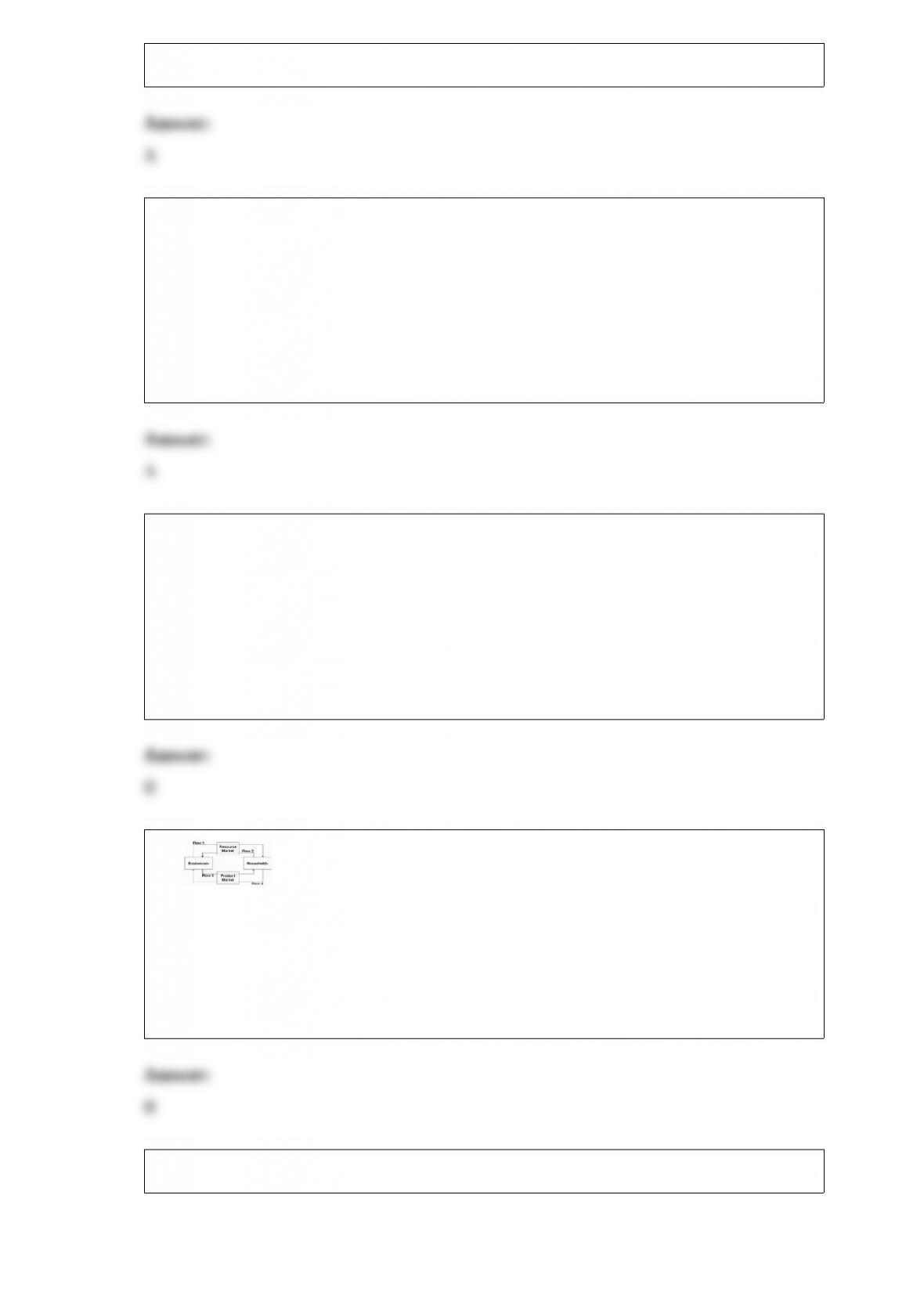
D.suggest that K is an inferior good.
9) Regulatory capture is said to have occurred when which of the following is true?
A.Rules and enforcement in an industry are heavily influenced by the industry being
regulated.
B.One firm controls an entire market, having captured customers away from other
firms.
C.Government imposes excessive regulations in an industry, resulting in inefficiencies.
D.Consumers make all the rules for an industry, forcing firms into inefficient
production methods.
10) Marginal resource cost is:
A.the increase in total resource cost associated with the production of one more unit of
output.
B.the increase in total resource cost associated with the hire of one more unit of the
resource.
C.total resource cost divided by the number of inputs employed.
D.the change in total revenue associated with the employment of one more unit of the
resource.
11)
Refer to the diagram. Flow 2 represents:
A.wage, rent, interest, and profit income.
B.land, labor, capital, and entrepreneurial ability.
C.goods and services.
D.consumer expenditures.
12)
One generally recognized positive effect of illegal immigrants is:

A.Lower costs of products and thus lower prices for consumers
B.Higher demand for social services
C.Reduced average wage rates for workers in some sectors
D.Positive effects on national defense
13) The schedule shows various interest rates, the associated quantity demanded of
loanable funds, and the quantity supplied of loanable funds in billions of dollars at those
interest rates.
Refer to the above table and information. If changes in tax laws make households save
more by $140 billion at each interest rate, then the new equilibrium interest rate would
be:
A.2 percent
B.4 percent
C.8 percent
D.10 percent
14) Which of the following is not a basic characteristic of monopolistic competition?
A.The use of trademarks and brand names.
B.Recognized mutual interdependence.
C.Product differentiation.
D.A relatively large number of sellers.
15) If the price of a fixed factor of production increases by 50 percent, what effect
would this have on the marginal-cost schedule facing a firm?
A.None, because fixed costs do not affect marginal cost
B.Marginal cost would increase by 50 percent
C.Marginal cost would increase by less than 50 percent
D.Marginal cost would increase by more than 50 percent
16) Subsidies for mohair production illustrate:
A.why special-interest effects are often characterized by concentrated benefits and
diffuse costs.
B.why special-interest effects are often characterized by concentrated costs and diffuse
benefits.
C.that larger groups carry greater political weight than smaller groups.
D.the moral hazard problem.
17) The U.S. federal government’s largest unfunded liability is:
A.Medicare.
B.national defense.
C.Social Security.
D.unemployment insurance.
18)
Refer to the given data. If there is neither a union nor a minimum wage, we can
conclude that this firm:
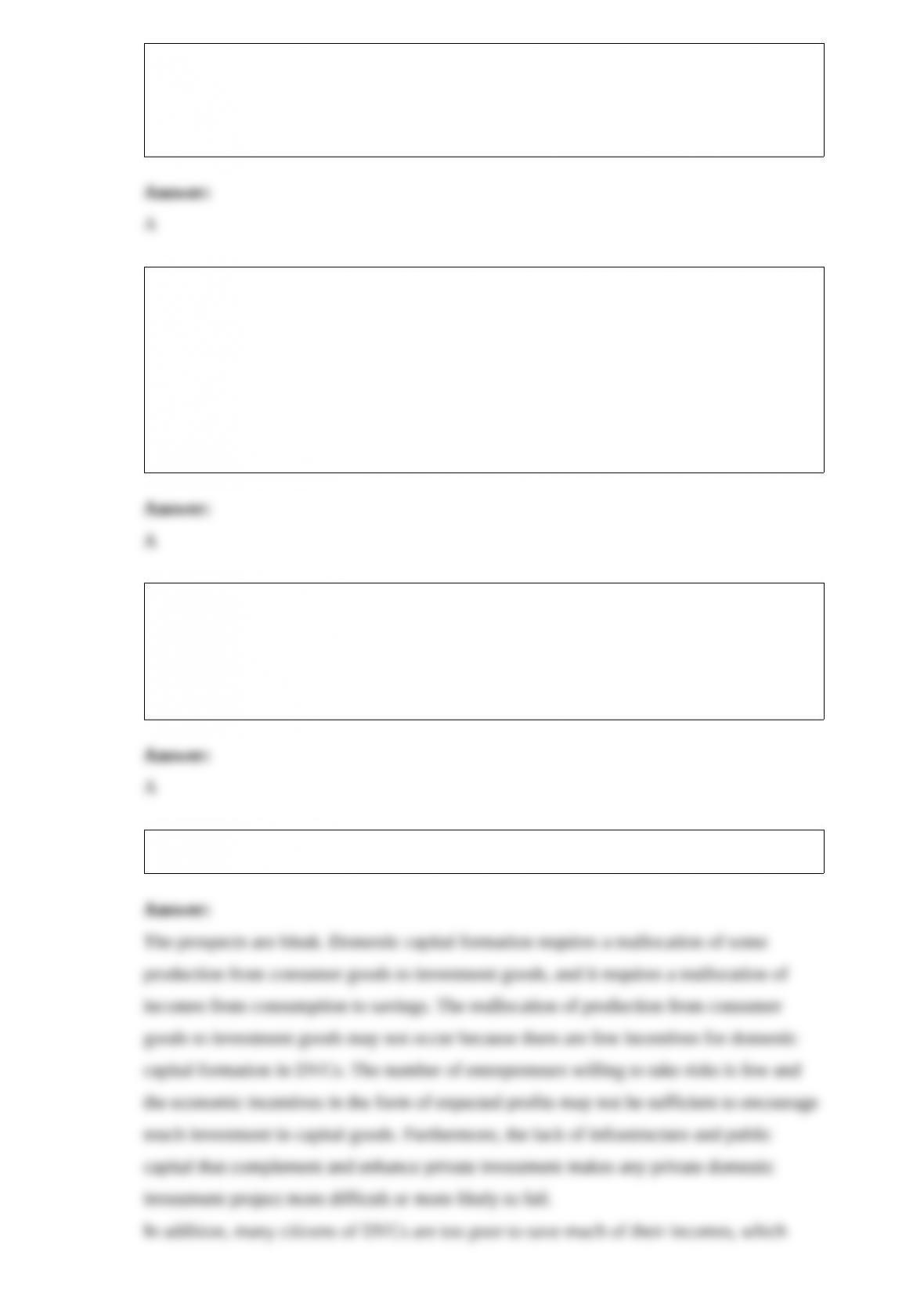
A.”purchases” labor in a purely competitive labor market.
B.is a monopsonist.
C.faces a perfectly inelastic labor supply curve.
D.has a perfectly elastic labor demand curve.
19) Suppose that government imposes a specific excise tax on product X of $2 per unit
and that the price elasticity of demand for X is unitary (coefficient = 1). If the incidence
of the tax is such that the producers of X pay $1.75 of the tax and the consumers pay
$.25, we can conclude that the:
A.supply of X is highly inelastic.
B.supply of X is highly elastic.
C.demand for X is highly inelastic.
D.demand for X is highly elastic.
20) Results of the ultimatum game:
A.affirm the metaphor of the invisible hand.
B.contradict the metaphor of the invisible hand.
C.demonstrate that markets are generally inefficient.
D.suggest that governments are unnecessary.
21) What are the prospects for domestic capital formation in DVCs?
22) What would you expect the concentration ratio and Herfindahl index of the internet
search industry to look like?
23) Explain why government subsidies are not always successful in promoting
alternative energy.
24) Compare changes in the equilibrium price and quantity when demand increase for
an upward sloping supply curve and a vertical supply curve.
25) Describe a recent violation of the Wheeler-Lea Act of 1938.
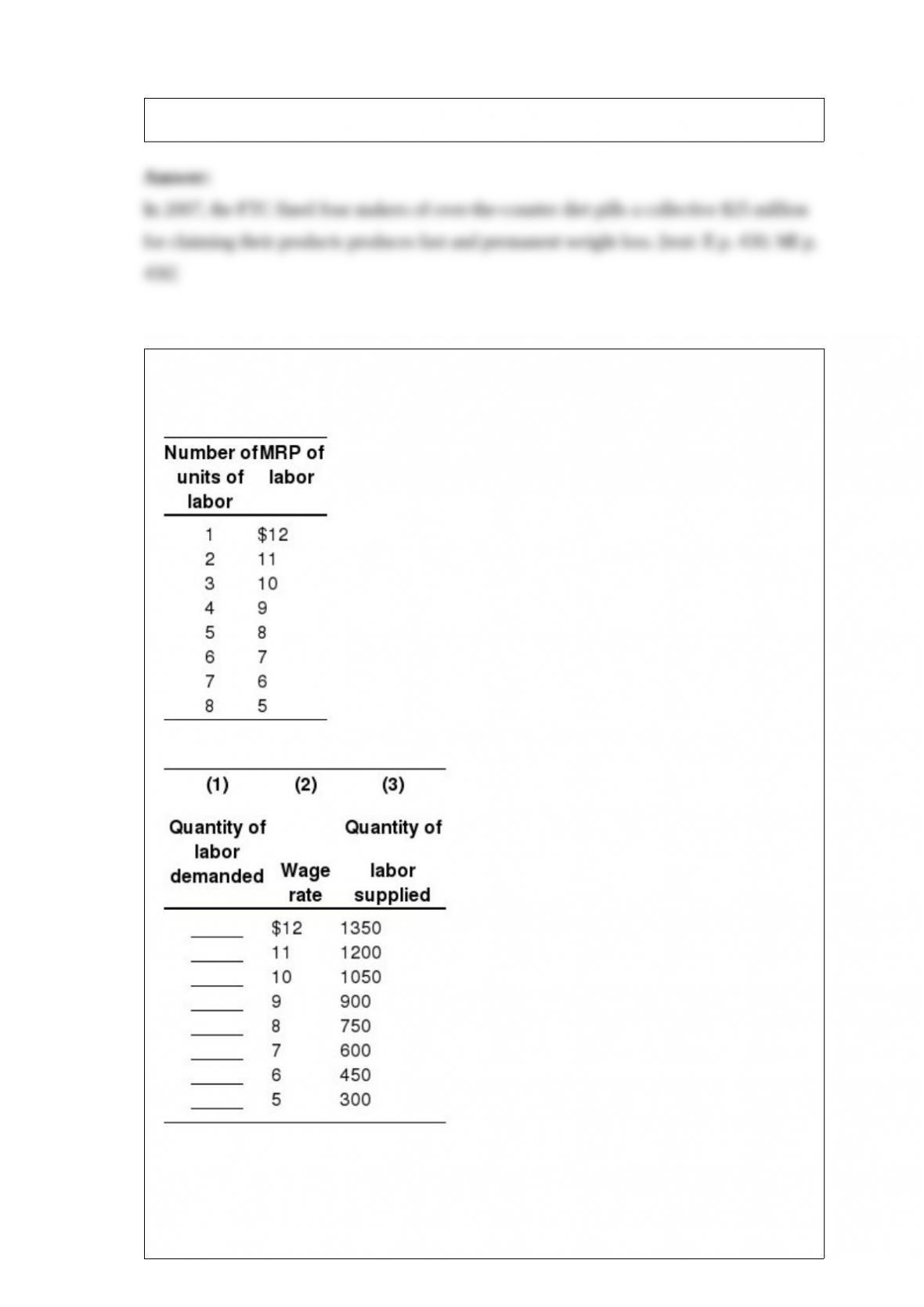
26) Suppose a single firm has the marginal revenue product schedule for a particular
type of labor given in the following table.
(b)What will be the equilibrium wage rate and how many workers will be hired?
(c)What will be the marginal labor cost and wage rate for the individual firm? How
many workers will the firm employ?
(d)How would the imposition of a $9 minimum wage rate change the total amount of
labor hired in this market?
27) What are the limitations to governments role in the economy?
28) Explain what is meant by an appreciation and depreciation of the dollar. What does
it mean if the dollar price of a Swiss franc (SF) decreases from $0.80 = 1 SF to $0.70 =
1 SF? What does it mean if the dollar price of a Swiss franc increased from $0.70 = 1
SF to $0.80 = 1 SF?
29) What is shown by the budget line in a two-product (A and B) case? Describe what
happens when there is a change in income or the price of a product.