Archives
Chapter 1 such as for motion or as determined on different clocks
Chapter: Chapter 1 Learning Objectives: LO 1.1.0 Solve problems related to measuring things, including length. LO 1.1.1 Identify the base quantities in the SI system. LO 1.1.2 Name the most frequently used prefixes for SI units. LO 1.1.3 Change units […]
Chapter 10 2 For Object Rotating About Fixed Axis
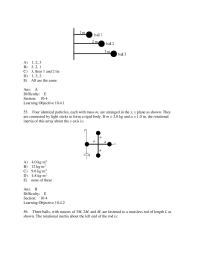
A) 1, 2, 3 B) 3, 2, 1 C) 3, then 1 and 2 tie D) 1, 3, 2 E) All are the same 55. Four identical particles, each with mass m, are arranged in the x, y plane as […]
Chapter 10 Which The following Results Positive Angular Displacement a
Chapter: Chapter 10 Learning Objectives LO 10.1.0 Solve problems related to rotational variables LO 10.1.1 Identify that if all parts of a body rotate around a fixed axis locked together, the body is a rigid body. (This chapter is about […]
Chapter 11 Apply the relationship between the center-of-mass speed
Chapter: Chapter 11 Learning Objectives LO 11.1.0 Solve problems related to rolling as translation and rotation combined. LO 11.1.1 Identify that smooth rolling can be considered as a combination of pure translation and pure rotation. LO 11.1.2 Apply the relationship […]
Chapter 11 paper clip is attached to the rim of a phonograph record
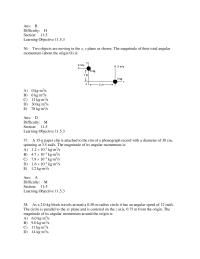
36. Two objects are moving in the x, y plane as shown. The magnitude of their total angular momentum (about the origin O) is: A) 0 kg∙m2/s B) 6 kg∙m2/s C) 12 kg∙m2/s D) 30 kg∙m2/s E) 78 kg∙m2/s Ans: […]
Chapter 12 Explain center of gravity and how it relates to center
Chapter: Chapter 12 Learning Objectives LO 12.1.0 Solve problems related to equilibrium. LO 12.1.1 Distinguish between equilibrium and static equilibrium. LO 12.1.2 Specify the four conditions for static equilibrium. LO 12.1.3 Explain center of gravity and how it relates to […]
Chapter 12 This Indeterminate Situation And The Forces The
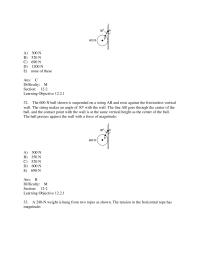
A) 300 N B) 520 N C) 690 N D) 1200 N E) none of these 32. The 600-N ball shown is suspended on a string AB and rests against the frictionless vertical wall. The string makes an angle of […]
Chapter 13 Earth Radii Above Earth then a Its Mass Increases
Chapter: Chapter 13 Learning Objectives LO 13.1.0 Solve problems related to Newton’s law of gravitation. LO 13.1.1 Apply Newton’s law of gravitation to relate the gravitational force between two particles to their masses and their separation. LO 13.1.2 Identify that […]
Chapter 13 Its Perigee Minimum Distance And Apogee Maximum
34. An artificial Earth satellite of mass m is moved from a circular orbit with radius R to a circular orbit with radius 2R. If the mass of the Earth is ME, the work done by the gravitational force is: […]
Chapter 14 equation of continuity to relate the cross-sectional area
Chapter: Chapter 14 Learning Objectives LO 14.1.0 Solve problems related to fluid, density, and pressure LO 14.1.1 Distinguish fluids from solids. LO 14.1.2 When mass is uniformly distributed, relate density to mass and volume. LO 14.1.3 Apply the relationship between […]
Chapter 14 The Cross Sectional Area The Stream
accelerates upward. During the acceleration: A) the cork is immersed more B) the cork is immersed less C) the cork is immersed the same amount D) at first the cork is immersed less but as the elevator speeds up it […]
Chapter 15 Distinguish simple harmonic motion from other types
Chapter: Chapter 15 Learning Objectives LO 15.1.0 Solve problems related to simple harmonic motion. LO 15.1.1 Distinguish simple harmonic motion from other types of periodic motion. LO 15.1.2 For a simple harmonic oscillator, apply the relationship between position x and […]
Chapter 15 The Physical Pendulum Has Extended Mass d The
39. A 0.25-kg block oscillates on the end of the spring with a spring constant of 200 N/m. If the oscillation is started by elongating the spring 0.15 m and giving the block a speed of 3.0 m/s, then the […]
Chapter 16 Sinusoidal Waves Travel Five Identical Strings
Chapter: Chapter 16 Learning Objectives LO 16.1.0 Solve problems related to transverse waves. LO 16.1.1 Identify the three main types of waves. LO 16.1.2 Distinguish between transverse waves and longitudinal waves. LO 16.1.3 Given a displacement function for a traverse […]
Chapter 16 When the tension in the string is doubled the generator produces
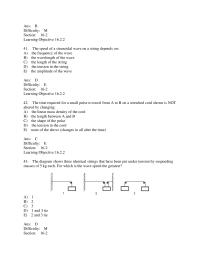
41. The speed of a sinusoidal wave on a string depends on: A) the frequency of the wave B) the wavelength of the wave C) the length of the string D) the tension in the string E) the amplitude of […]
Chapter 17 the sound intensity I at a surface as the ratio
Chapter: Chapter 17 Learning Objectives LO 17.1.0 Solve problems related to speed of sound. LO 17.1.1 Distinguish between a longitudinal wave and a transverse wave. LO 17.1.2 Explain wavefronts and rays. LO 17.1.3 Apply the relationship between the speed of […]
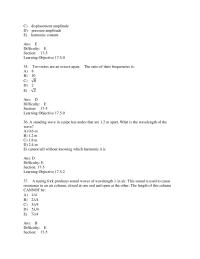
Chapter 17 What is the wavelength of the wave
C) displacement amplitude D) pressure amplitude E) harmonic content 35. Two notes are an octave apart. The ratio of their frequencies is: A) 8 B) 10 C) √8 D) 2 E) √2 Ans: D Difficulty: E Section: 17-5 Learning Objective […]
Chapter 18 Explain the zeroth law of thermodynamics
Chapter: Chapter 18 Learning Objectives LO 18.1.0 Solve problems related to temperature. LO 18.1.1 Identify the lowest temperature as 0 on the Kelvin scale (absolute zero). LO 18.1.2 Explain the zeroth law of thermodynamics. LO 18.1.3 Explain the conditions for […]
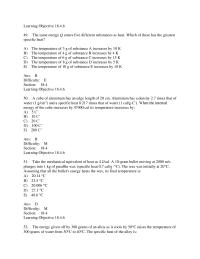
Chapter 18 The same energy Q enters five different substances as heat
Learning Objective 18.4.6 49. The same energy Q enters five different substances as heat. Which of these has the greatest specific heat? A) The temperature of 3 g of substance A increases by 10 K B) The temperature of 4 […]
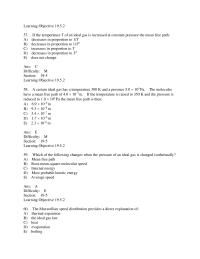
Chapter 19 and the root-mean-square speed are in the order
Learning Objective 19.5.2 57. If the temperature T of an ideal gas is increased at constant pressure the mean free path: A) decreases in proportion to 1/T B) decreases in proportion to 1/T2 C) increases in proportion to T D) […]
Chapter 19 the molar mass M of the molecules in the sample
Chapter: Chapter 19 Learning Objectives LO 19.1.0 Solve problems related to Avogadro’s number. LO 19.1.1 Identify Avogadro’s number NA. LO 19.1.2 Apply the relationship between the number of moles n, the number of molecules N, and Avogadro’s number NA. LO […]
Chapter 2 Apply the relationship between a particle’s average velocity
Chapter: Chapter 2 Learning Objectives LO 2.1.0 Solve problems related to position, displacement, and average velocity to solve problems. LO 2.1.1 Identify that if all parts of an object move in the same direction and at the same rate, we […]
Chapter 2 This Demonstrates That a The Acceleration Gravity Not
46. An object with an initial velocity of 12 m/s west experiences a constant acceleration of 4 m/s2 west for 3 seconds. During this time the object travels a distance of: A) 18 m B) 24 m C) 36 m […]
Chapter 20 a heat engine is a device that extracts energy from its environment
Chapter: Chapter 20 Learning Objectives LO 20.1.0 Solve problems related to entropy. LO 20.1.1 Identify the second law of thermodynamics: If a process occurs in a closed system, the entropy of the system increases for irreversible processes and remains constant […]
Chapter 21 the shell as if all the shell’s charge were concentrated
Chapter: Chapter 21 Learning Objectives LO 21.1.0 Solve problems related to Coulomb’s law. LO 21.1.1 Distinguish between being electrically neutral, negatively charged, and positively charged, and identify excess charge. LO 21.1.2 Distinguish between conductors, nonconductors (insulators), semiconductors, and superconductors. LO […]
Chapter 22 which is a vector quantity and thus has both magnitude
Chapter: Chapter 22 Learning Objectives LO 22.1.0 Solve problems related to the electric field. LO 22.1.1 Identify that at every point in the space surrounding a charged particle, the particle sets up an electric field 𝐸 ⃗ , which is […]
Chapter 23 Charge Distributed Uniformly Throughout Spherical Insulating Shell
Chapter: Chapter 23 Learning Objectives LO 23.1.0 Solve problems related to electric flux. LO 23.1.1 Identify that Gauss’ law relates the electric field at points on a closed surface (real or imaginary, said to be a Gaussian surface) to the […]
Chapter 24 No work is done if the final position of the particle is on
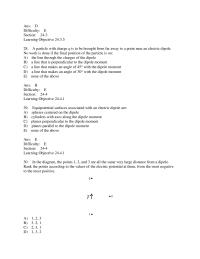
28. A particle with charge q is to be brought from far away to a point near an electric dipole. No work is done if the final position of the particle is on: A) the line through the charges of […]
Chapter 24 The Equipotential Surfaces Associated With Charged
Chapter: Chapter 24 Learning Objectives LO 24.1.0 Solve problems related to electric potential. LO 24.1.1 Identify that the electric force is conservative and thus has an associated potential energy. LO 24.1.2 Identify that at every point in a charged object’s […]
Chapter 25 Sketch a schematic diagram of a circuit with a parallel
Chapter: Chapter 25 Learning Objectives LO 25.1.0 Solve problems related to capacitance. LO 25.1.1 Sketch a schematic diagram of a circuit with a parallel-plate capacitor, a battery, and an open or closed switch. LO 25.1.2 In a circuit with a […]
Chapter 26 the amount of charge that passes the point in a given time
Chapter: Chapter 26 Learning Objectives LO 26.1.0 Solve problems related to electric current. LO 26.1.1 Apply the definition of current as the rate at which charge moves through a point, including solving for the amount of charge that passes the […]
Chapter 27 areal battery with an ideal battery and an explicitly shown resistance
Chapter: Chapter 27 Learning Objectives LO 27.1.0 Solve problems related to single-loop circuits. LO 27.1.1 Identify the action of an emf source in terms of the work it does. LO 27.1.2 For an ideal battery, apply the relationship between the […]
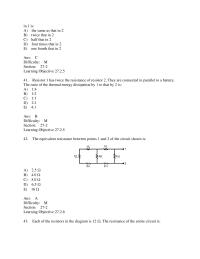
Chapter 27 The equivalent resistance between points 1 and 2 of the circuit shown
in 1 is: A) the same as that in 2 B) twice that in 2 C) half that in 2 D) four times that in 2 E) one fourth that in 2 41. Resistor 1 has twice the resistance of […]
Chapter 28 For a charged particle moving through a uniform magnetic field
Chapter: Chapter 28 Learning Objectives LO 28.1.0 Solve problems related to magnetic fields and the definition of B. LO 28.1.1 Distinguish an electromagnet from a permanent magnet. LO 28.1.2 Identify that a magnetic field is a vector quantity and thus […]
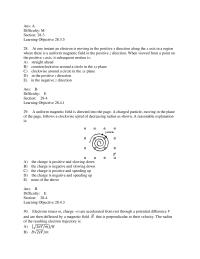
Chapter 28 less massive than the proton and because the electron is negatively
28. At one instant an electron is moving in the positive x direction along the x axis in a region where there is a uniform magnetic field in the positive z direction. When viewed from a point on the positive […]
Chapter 29 magnetic field that it sets up at a given point near the wire
Chapter: Chapter 29 Learning Objectives LO 29.1.0 Solve problems related to magnetic fields due to currents. LO 29.1.1 Sketch a current-length element in a wire and indicate the direction of the magnetic field that it sets up at a given […]
Chapter 3 Add vectors by drawing them in head-to-tail arrangements
Chapter: Chapter 3 Learning Objectives LO 3.1.0 Solve problems related to vectors and their components LO 3.1.1 Add vectors by drawing them in head-to-tail arrangements, applying the commutative and associative laws. LO 3.1.2 Subtract a vector from a second one. […]
Chapter 30 mechanical energy that is lost when eddy currents are created
B) 140 T/s, decreasing C) 140 T/s, increasing D) 420 T/s, decreasing E) 420 T/s, increasing 44. A copper penny slides on a horizontal frictionless table. There is a square region of constant uniform magnetic field perpendicular to the table, […]
Chapter 30 The Circuit Shown Uniform Magnetic Field
Chapter: Chapter 30 Learning Objectives LO 30.1.0 Solve problems related to Faraday’s Law and Lenz’s Law. LO 30.1.1 Identify that the amount of magnetic field piercing a surface (not skimming along the surface) is the magnetic flux Φ through the […]
Chapter 31 Explain the analogy between a block-spring oscillator
Chapter: Chapter 31 Learning Objectives LO 31.1.0 Solve problems related to LC oscillations. LO 31.1.1 Sketch an LC oscillator and explain which quantities oscillate and what constitutes one period of the oscillation. LO 31.1.2 For an LC oscillator, sketch graphs […]
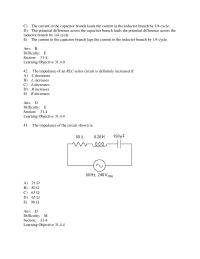
Chapter 31 Resonance Then the Voltage Across Zero the Voltage
C) The current in the capacitor branch leads the current in the inductor branch by 1/4 cycle. D) The potential difference across the capacitor branch leads the potential difference across the inductor branch by 1/4 cycle. E) The current in […]
Chapter 32 change of an electric flux and the associated displacement current
Chapter: Chapter 32 Learning Objectives LO 32.1.0 Solve problems related to Gauss’ law for magnetic fields. LO 32.1.1 Identify that the simplest magnetic structure is a magnetic dipole. LO 32.1.2 Calculate the magnetic flux Φ through a surface by integrating […]
Chapter 32 not at all since it is a charge and not a pole
Learning Objective 32.3.8 40. Which of the following equations, along with a symmetry argument, can be used to calculate the magnetic field between the plates of a charging parallel plate capacitor with circular plates? A) ∮𝐸 ⃗ ∙ 𝑑𝐴 = […]
Chapter 33 Another Pole The Same Length stands Vertically The
D) the radiation pressure stays the same and the radiation force decreases E) the radiation pressure decreases and the radiation force decreases 42. Light with an intensity of 1 kW/m2 falls normally on a surface with an area of 1 […]
Chapter 33 which is related to the cross product of the electric field
aChapter: Chapter 33 Learning Objectives LO 33.1.0 Solve problems related to electromagnetic waves. LO 33.1.1 In the electromagnetic spectrum, identify the relative wavelengths (longer or shorter) of AM radio, FM radio, television, infrared light, visible light, ultraviolet light, x rays, […]
Chapter 34 As an object in air is moved toward the surface from far
39. A concave refracting surface of a medium with index of refraction n produces a real image no matter where an object is placed outside: A) always B) only if the index of refraction of the surrounding medium is less […]
Chapter 34 which type of mirror can produce both real and virtual images
Chapter: Chapter 34 Learning Objectives LO 34.1.0 Solve problems related to images and plane mirrors. LO 34.1.1 Distinguish virtual images from real images. LO 34.1.2 Explain the common roadway mirage. LO 34.1.3 Sketch a ray diagram for the reflection of […]
Chapter 35 explain refraction in terms of the gradual change in the speed
Chapter: Chapter 35 Learning Objectives LO 35.1.0 Solve problems related to light as a wave. LO 35.1.1 Using a sketch, explain Huygens’ principle. LO 35.1.2 With a few simple sketches, explain refraction in terms of the gradual change in the […]
Chapter 36 The Difference Phase For Waves From The top
Chapter: Chapter 36 Learning Objectives LO 36.1.0 Solve problems related to single-slit diffraction. LO 36.1.1 Describe the diffraction of light waves by a narrow opening and an edge, and also describe the resulting interference pattern. LO 36.1.2 Describe an experiment […]
Chapter 36 The spacing between adjacent slits on a diffraction grating
A) the number of slits B) the slit width C) the slit separation D) the order of the line E) the index of refraction 38. A light spectrum is formed on a screen using a diffraction grating. The entire apparatus […]
Chapter 37 Identify that a Galilean transformation is approximately correct
Chapter: Chapter 37 Learning Objectives LO 37.1.0 Solve problems related to simultaneity and time dilation. LO 37.1.1 Identify the two postulates of (special) relativity and the type of frames to which they apply. LO 37.1.2 Identify the speed of light […]
Chapter 37 Its spectrum has an absorption line at a frequency of
C) 740 m, 2.4 s D) 260 m, –0.60 s E) 590 m, –1.4 s 35. Two flashes of light occur simultaneously at t = 0 in reference frame S, one at x = 0 and the other at x […]
Chapter 38 Apply the Heisenberg uncertainty principle for
Chapter: Chapter 38 Learning Objectives LO 38.1.0 Solve problems related to the photon, the quantum of light. LO 38.1.1 Explain the absorption and emission of light in terms of quantized energy and photons. LO 38.1.2 For photon absorption and emission, […]
Chapter 39 Broglie Wavelengths With Those Infinite Well The
Chapter: Chapter 39 Learning Objectives LO 39.1.0 Solve problems related to energies of a trapped electron. LO 39.1.1 Identify the confinement principle: Confinement of a wave (including a matter wave) leads to the quantization of wavelengths and energy values. LO […]
Chapter 4 Neglecting Air Resistance Which One The Following
Chapter: Chapter 4 Learning Objectives: LO 4.1.0 Solve problems related to position and displacement LO 4.1.1 Draw the components of a 2D or 3D position vector of a particle, indicating the components. LO 4.1.2 Determine the direction and magnitude of […]
Chapter 40 For Proton Magnetic Field Calculate The Energy
Chapter: Chapter 40 Learning Objectives LO 40.1.0 Solve problems related to properties of atoms. LO 40.1.1 Discuss the pattern that is seen in a plot of ionization energies versus atomic number Z. LO 40.1.2 Identify that atoms emit and absorb […]
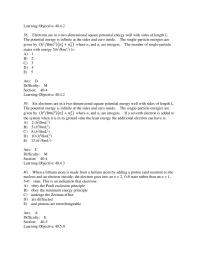
Chapter 40 The potential energy is infinite at the sides and zero inside
Learning Objective 40.4.2 38. Electrons are in a two-dimensional square potential energy well with sides of length L. The potential energy is infinite at the sides and zero inside. The single-particle energies are given by (ℎ2/8𝑚𝐿2)(𝑛𝑥 2+ 𝑛𝑦 2) where […]
Chapter 41 Which one of the following statements concerning electron
Chapter: Chapter 41 Learning Objectives LO 41.1.0 Solve problems related to the electrical properties of metals. LO 41.1.1 Identify the three basic properties of crystalline solids and sketch unit cells for them. LO 41.1.2 Distinguish insulators, metals, and semiconductors. LO […]
Chapter 42 the equations for radioactive decay to determine the age of rocks
Chapter: Chapter 42 Learning Objectives LO 42.1.0 Solve problems related to discovering the nucleus. LO 42.1.1 Explain the general arrangement for Rutherford scattering and what was learned from it. LO 42.1.2 In a Rutherford scattering arrangement, apply the relationship between […]
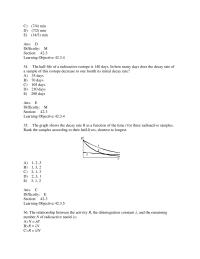
Chapter 42 The half-life of a radioactive isotope is 140 days
C) (7/4) min D) (7/2) min E) (14/3) min 34. The half-life of a radioactive isotope is 140 days. In how many days does the decay rate of a sample of this isotope decrease to one fourth its initial decay […]
Chapter 43 Give The Three Requirements For Thermonuclear Reactor
Chapter: Chapter 43 Learning Objectives LO 43.1.0 Solve problems related to nuclear fission. LO 43.1.1 Distinguish atomic and nuclear burning, noting that in both processes energy is produced because of a reduction of mass. LO 43.1.2 Define the fission process. […]
Chapter 44 The Other Isa Baryon With Strangeness
Chapter: Chapter 44 Learning Objectives LO 44.1.0 Solve problems related to general properties of elementary particles. LO 44.1.1 Identify that a great many elementary particles exist or can be created and that nearly all of them are unstable. LO 44.1.2 […]
Chapter 5 any surface exerts two forces on objects that are in contact with it
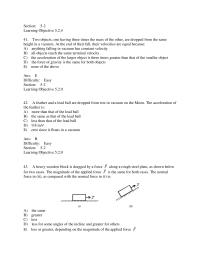
41. Two objects, one having three times the mass of the other, are dropped from the same height in a vacuum. At the end of their fall, their velocities are equal because: A) anything falling in vacuum has constant velocity […]
Chapter 5 Identify that a force is a vector quantity and thus has both
Chapter: Chapter 5 Learning Objectives: LO 5.1.0 Solve problems related to Newton’s first and second laws LO 5.1.1 Identify that a force is a vector quantity and thus has both magnitude and direction and also components. LO 5.1.2 Given two […]
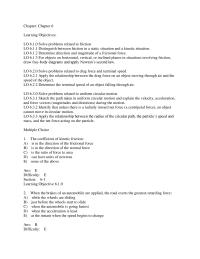
Chapter 6 Shown The Vertical Component The Force Exerted
Chapter: Chapter 6 Learning Objectives: LO 6.1.0 Solve problems related to friction LO 6.1.1 Distinguish between friction in a static situation and a kinetic situation. LO 6.1.2 Determine direction and magnitude of a frictional force. LO 6.1.3 For objects on […]
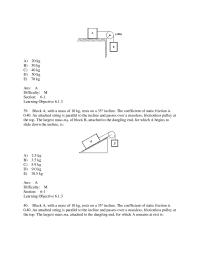
Chapter 6 The Cara Slides Into The Inside The
A) 20 kg B) 30 kg C) 40 kg D) 50 kg E) 70 kg 39. Block A, with a mass of 10 kg, rests on a 35 incline. The coefficient of static friction is 0.40. An attached string is […]
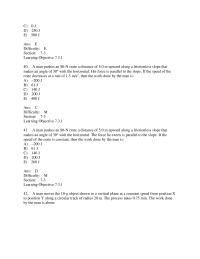
Chapter 7 Ax Where Constant The Work Done Person
C) 0 J D) 250 J E) 500 J 40. A man pushes an 80-N crate a distance of 5.0 m upward along a frictionless slope that makes an angle of 30 with the horizontal. His force is parallel to […]
Chapter 7 the relationship between a particle’s kinetic energy
Chapter: Chapter 7 Learning Objectives LO 7.1.0 Solve problems related to kinetic energy LO 7.1.1 Apply the relationship between a particle’s kinetic energy, mass, and speed. LO 7.1.2 Identify that kinetic energy is a scalar quantity. LO 7.2.0 Solve problems […]
Chapter 8 use a potential-energy graph for that axis and the conservation
Chapter: Chapter 8 Learning Objectives LO 8.1.0 Solve problems related to potential energy LO 8.1.1 Distinguish a conservative force from a nonconservative force. LO 8.1.2 For a particle moving between two points, identify that the work done by a conservative […]
Chapter 8 The potential energy for the interaction between the two atoms
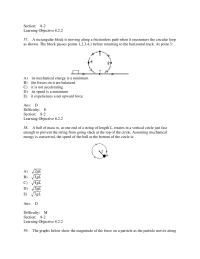
37. A rectangular block is moving along a frictionless path when it encounters the circular loop as shown. The block passes points 1,2,3,4,1 before returning to the horizontal track. At point 3: A) its mechanical energy is a minimum B) […]
Chapter 9 None The Above Statements Are True Ans E difficulty
Chapter: Chapter 9 Learning Objectives LO 9.1.0 Solve problems related to center of mass LO 9.1.1 Given the positions of several particles along an axis or a plane, determine the location of their center of mass. LO 9.1.2 Locate the […]
Chapter 9 They Suffer Completely Inelastic collision The Kinetic Energy
47. A 10-kg block of ice is at rest on a frictionless horizontal surface. A 1.0-N force is applied in an easterly direction for 1.0 s. During this time interval, the block: A) acquires a speed of 1 m/s B) […]