Chapter: Chapter 35
Learning Objectives
LO 35.1.0 Solve problems related to light as a wave.
LO 35.1.1 Using a sketch, explain Huygens’ principle.
LO 35.1.2 With a few simple sketches, explain refraction in terms of the gradual change in the
speed of a wavefront as it passes through an interface at an angle to the normal.
LO 35.1.3 Apply the relationship between the speed of light in vacuum c, the speed of light in a
material v, and the index of refraction of the material n.
LO 35.1.4 Apply the relationship between a distance L in a material, the speed of light in that
material, and the time required for a pulse of the light to travel through L.
LO 35.1.5 Apply Snell’s law of refraction.
LO 35.1.6 When light refracts through an interface, identify that the frequency does not change
but the wavelength and effective speed do.
LO 35.1.7 Apply the relationship between the wavelength in vacuum λ, the wavelength λn in a
material (the internal wavelength), and the index of refraction n of the material.
LO 35.1.8 For light in a certain length of a material, calculate the number of internal
wavelengths that fit into the length.
LO 35.1.9 If two light waves travel through different materials with different indexes of
refraction and then reach a common point, determine their phase difference and interpret the
resulting interference in terms of maximum brightness, intermediate brightness, and darkness.
LO 35.1.10 Apply the learning objectives of Module 17-3 (sound waves there, light waves here)
to find the phase difference and interference of two waves that reach a common point after
traveling paths of different lengths.
LO 35.1.11 Given the initial phase difference between two waves with the same wavelength,
determine their phase difference after they travel through different path lengths and through
different indexes of refraction.
LO 35.1.12 Identify that rainbows are examples of optical interference.
LO 35.2.0 Solve problems related to Young’s interference experiment.
LO 35.2.1 Describe the diffraction of light by a narrow slit and the effect of narrowing the slit.
LO 35.2.2 With sketches, describe the production of the interference pattern in a double-slit
interference experiment using monochromatic light.
LO 35.2.3 Identify that the phase difference between two waves can change if the waves travel
along paths of different lengths, as in the case of Young’s experiment.
LO 35.2.4 In a double-slit experiment, apply the relationship between the path length difference
ΔL and the wavelength λ, and then interpret the result in terms of interference (maximum
brightness, intermediate brightness, and darkness).
LO 35.2.5 For a given point in a double-slit interference pattern, express the path length
difference ΔL of the rays reaching that point in terms of the slit separation d and the angle θ to
that point.
LO 35.2.6 In a Young’s experiment, apply the relationships between the slit separation d, the
light wavelength λ, and the angles θ to the minima (dark fringes) and to the maxima (bright
fringes) in the interference pattern.
LO 35.2.7 Sketch the double-slit interference pattern, identifying what lies at the center and what
the various bright and dark fringes are called (such as “first side maximum” and “third order”).
LO 35.2.8 Apply the relationship between the distance D between a double-slit screen and a
viewing screen, the angle θ to a point in the interference pattern, and the distance y to that point
from the pattern’s center.
LO 35.2.9 For a double-slit interference pattern, identify the effects of changing d or λ and also
identify what determines the angular limit to the pattern.
LO 35.2.10 For a transparent material placed over one slit in a Young’s experiment, determine
the thickness or index of refraction required to shift a given fringe to the center of the
interference pattern.
LO 35.3.0 Solve problems related to interference and double-slit intensity.
LO 35.3.1 Distinguish between coherent and incoherent light.
LO 35.3.2 For two light waves arriving at a common point, write expressions for their electric
field components as functions of time and a phase constant.
LO 35.3.3 Identify that the phase difference between two waves determines their interference.
LO 35.3.4 For a point in a double-slit interference pattern, calculate the intensity in terms of the
phase difference of the arriving waves and relate that phase difference to the angle θ locating that
point in the pattern.
LO 35.3.5 Use a phasor diagram to find the resultant wave (amplitude and phase constant) of two
or more light waves arriving at a common point and use that result to determine the intensity.
LO 35.3.6 Apply the relationship between a light wave’s angular frequency ω and the angular
speed ω of the phasor representing the wave.
LO 35.4.0 Solve problems related to interference from thin films.
LO 35.4.1 Sketch the setup for thin-film interference, showing the incident ray and reflected rays
(slightly slanted for clarity) and identifying the thickness and the three indexes of refraction.
LO 35.4.2 Identify the condition in which a reflection can result in a phase shift, and give the
value of that phase shift.
LO 35.4.3 Identify the three factors that determine the interference of the reflected waves:
reflection shifts, path length difference, and internal wavelength (set by the film’s index of
refraction).
LO 35.4.4 For a thin film, use the reflection shifts and the desired result (the reflected waves are
in phase or out of phase, or the transmitted waves are in phase or out of phase) to determine and
then apply the necessary equation relating the thickness L, the wavelength λ (measured in air),
and the index of refraction n of the film.
LO 35.4.5 For a very thin film in air (with thickness much less than the wavelength of visible
light), explain why the film is always dark.
LO 35.4.6 At each end of a thin film in the form of a wedge, determine and then apply the
necessary equation relating the thickness L, the wavelength λ (measured in air), and the index of
refraction n of the film, and then count the number of bright bands and dark bands across the
film.
LO 35.5.0 Solve problems related to Michelson’s interferometer.
LO 35.5.1 With a sketch, explain how an interferometer works.
LO 35.5.2 When a transparent material is inserted into one of the beams in an interferometer,
apply the relationship between the phase change of the light (in terms of wavelength) and the
material’s thickness and index of refraction.
LO 35.5.3 For an interferometer, apply the relationship between the distance a mirror is moved
and the resulting fringe shift in the interference pattern.
Multiple Choice
1. A “wave front” is a surface of constant:
A) phase
B) frequency
C) wavelength
D) amplitude
E) speed
2. Huygens’ construction can be used only:
A) for light
B) for an electromagnetic wave
C) if one of the media is vacuum (or air)
D) for transverse waves
E) for all of these and other situations
3. Consider (I) the law of reflection and (II) the law of refraction. Huygens’ principle can be
used to derive:
A) only I
B) only II
C) both I and II
D) neither I nor II
E) the question is meaningless because Huygens’ principle is for wave fronts whereas both I
and II concern rays
4. Units of “optical path length” are:
A) m–1
B) m
C) m/s
D) Hz/m
E) m/Hz
5. Interference of light is evidence that:
A) the speed of light is very large
B) light is a transverse wave
C) light is electromagnetic in character
D) light is a wave phenomenon
E) light does not obey conservation of energy
6. If the speed of light is c, and the index of refraction of a material is n, what is the speed of
light in the material?
A) c
B) c/n
C) nc
D) n
E) n/c
7. When light travels from one medium into a different medium with a different index of
refraction,
A) the frequency, wavelength, and speed all change.
B) the frequency and wavelength change but the speed stays the same.
C) the speed and wavelength change but the frequency stays the same.
D) the speed and frequency change but the wavelength stays the same.
E) only the speed changes; the frequency and the wavelength stay the same.
8. If the wavelength of a particular beam of light in vacuum is λ, and the index of refraction of a
material is n, what is the wavelength of the light in the material?
A) λ
B) λ/n
C) nλ
D) n
E) n/λ
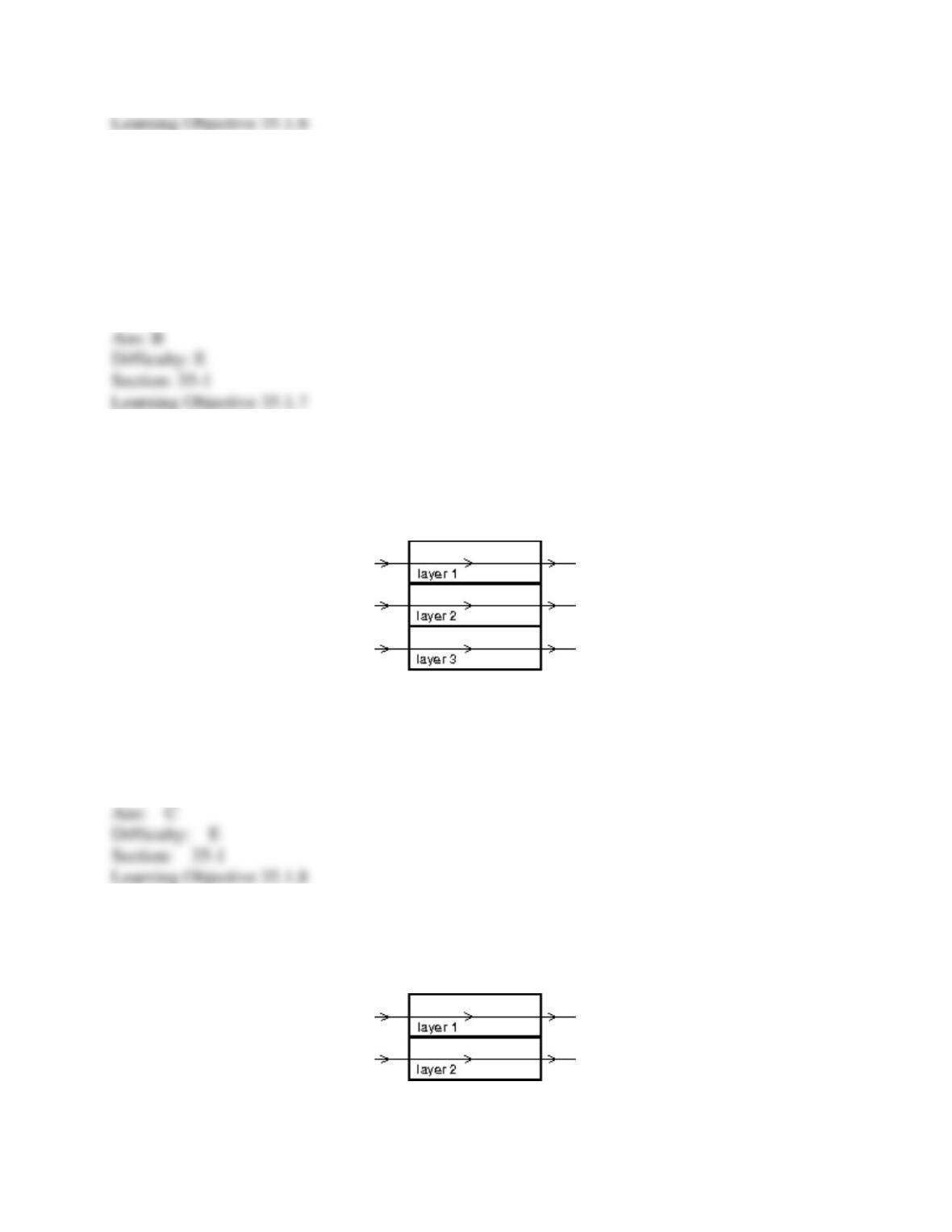
9. The light waves represented by the three rays shown in the diagram all have the same
frequency. 4.7 wavelengths fit into layer 1, 3.2 wavelengths fit into layer 2, and 5.3
wavelengths fit into layer 3. Rank the layers according to the speeds of the waves, least to
greatest.
A) 1, 2, 3
B) 2, 1, 3
C) 3, 1, 2
D) 3, 2, 1
E) 1, 3, 2
10. Two light waves are initially in phase and have the same wavelength, 470 nm. They enter
two different media of identical lengths of 2.50 µm. If n1 = 1.2 and n2 = 1.5, what is the effective
phase difference of the waves when they exit the media?
A) 0 rad
B) 0.6 rad
C) 1.6 rad
D) 3.7 rad
E) 10 rad
11. In a Young’s double-slit experiment the center of a bright fringe occurs wherever waves
from the slits differ in phase by a multiple of:
A) /4
B) /2
C) 3/4
D)
E) 2
12. Two point sources, vibrating in phase, produce an interference pattern in a ripple tank. If
the frequency is increased by 20%, the number of nodal lines:
A) is increased by 20%
B) is increased by 40%
C) remains the same
D) is decreased by 20%
E) is decreased by 40%
13. The phase difference between the two waves which give rise to a dark spot in a Young’s
double-slit experiment is (where m = integer):
A) 2m
B) 2m + /8
C) 2m + /4
D) 2m + /2
E) 2m +
14. The reason there are two slits, rather than one, in a Young’s experiment is:
A) to increase the intensity
B) one slit is for frequency, the other for wavelength
C) to create a path length difference
D) one slit is for 𝐸
⃗
fields, the other is for 𝐵
⃗
fields
E) two slits in parallel offer less resistance
15. In a Young’s double-slit experiment the center of a bright fringe occurs wherever waves
from the slits differ in the distance they travel by a multiple of:
A) a fourth of a wavelength
B) a half a wavelength
C) three-fourths of a wavelength
D) a wavelength
E) none of the above
16. Waves from two slits are in phase at the slits and travel to a distant screen to produce the
third bright fringe of the interference pattern. The difference in the distance traveled by the
waves is:
A) half a wavelength
B) a wavelength
C) three halves of a wavelength
D) two wavelengths
E) three wavelengths
17. Waves from two slits are in phase at the slits and travel to a distant screen to produce the
second minimum of the interference pattern. The difference in the distance traveled by the
wave is:
A) half a wavelength
B) a wavelength
C) three halves of a wavelength
D) two wavelengths
E) three wavelengths
18. A monochromatic light source illuminates a double slit and the resulting interference
pattern is observed on a distant screen. Let d be the center-to-center slit spacing, a the individual
slit width, D the screen-to-slit distance, and ℓ the adjacent dark line spacing in the interference
pattern. The wavelength of the light is then:
A) 𝑑ℓ/𝐷
B) ℓ𝑑/𝒶
C) da/D
D) ℓ𝐷/𝒶
E) 𝐷𝑑/ℓ
19. In a Young’s double-slit experiment, the slit separation is doubled. To maintain the same
fringe spacing on the screen, the screen-to-slit distance D must be changed to:
A) D/2
B) 𝐷/√2
C) 𝐷√2
D) 2D
E) 4D
20. In a Young’s double-slit experiment, light of wavelength 500 nm illuminates two slits
which are separated by 1 mm. The separation between adjacent bright fringes on a screen 5 m
from the slits is:
A) 0.10 cm
B) 0.25 cm
C) 0.50 cm
D) 1.0 cm
E) none of the above
21. In a Young’s double-slit experiment, the separation between slits is d and the screen is a
distance D from the slits. D is much greater than d and is the wavelength of the light. The
number of bright fringes per unit length on the screen is:
A) Dd/
B) D/d
C) D/d
D) /Dd
E) d/D
22. In a Young’s double-slit experiment, the slit separation is doubled. This results in:
A) an increase in fringe intensity
B) a decrease in fringe intensity
C) a halving of the wavelength
D) a halving of the fringe spacing
E) a doubling of the fringe spacing
23. In an experiment to measure the wavelength of light using a double slit, it is found that the
fringes are too close together to easily count them. To spread out the fringe pattern, one could:
A) halve the slit separation
B) double the slit separation
C) double the width of each slit
D) halve the width of each slit
E) none of these
24. Light from a point source X contains only blue and red components. After passing through
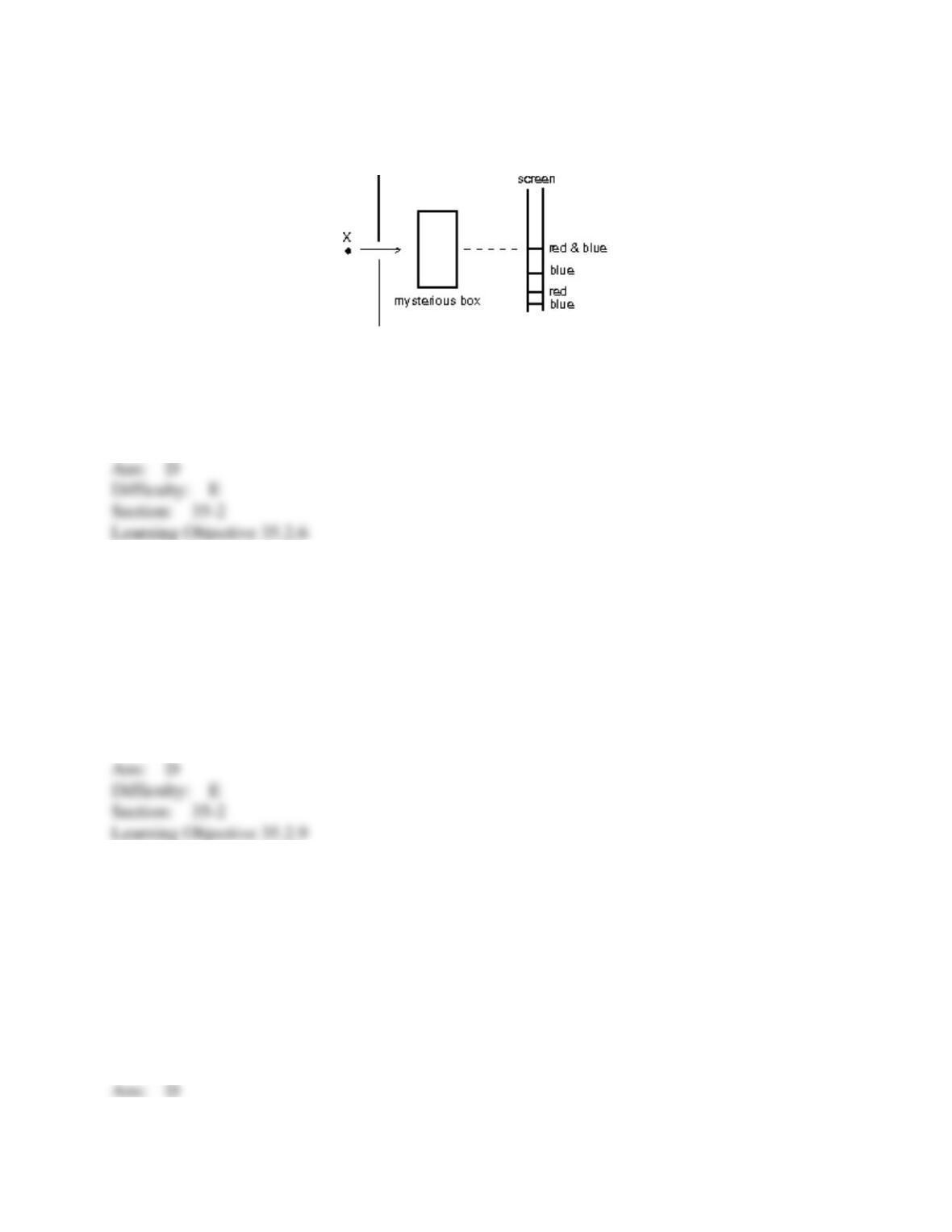
a mysterious box, the light falls on a screen. Red and blue hands are observed as shown. The box
must contain:
A) a lens
B) a mirror
C) a prism
D) a double slit
E) a blue and red filter
25. Light from a small region of an ordinary incandescent bulb is passed through a yellow filter
and then serves as the source for a Young’s double-slit experiment. Which of the following
changes would cause the interference pattern to be more closely spaced?
A) Use slits that are closer together
B) Use a light source of lower intensity
C) Use a light source of higher intensity
D) Use a blue filter instead of a yellow filter
E) Move the light source further away from the slits
26. In a Young’s double-slit experiment, a thin sheet of mica is placed over one of the two slits.
As a result, the center of the fringe pattern (on the screen) shifts so that the center is now
occupied by what was the 30th dark band. The wavelength of the light in this experiment is 480
nm and the index of the mica is 1.60. The mica thickness is:
A) 0.009 mm
B) 0.012 mm
C) 0.014 mm
D) 0.024 mm
E) 0.062 mm
27. One of the two slits in a Young’s experiment is painted over so that it transmits only
one-half the intensity of the other slit. As a result:
A) the fringe system disappears
B) the bright fringes get brighter and the dark ones get darker
C) the fringes just get dimmer
D) the dark fringes just get brighter
E) the dark fringes get brighter and the bright ones get darker
28. In a Young’s experiment, it is essential that the two beams:
A) have exactly equal intensity
B) be exactly parallel
C) travel equal distances
D) come originally from the same source
E) be composed of a broad band of frequencies
29. If two light waves are coherent:
A) their amplitudes are the same
B) their frequencies are the same
C) their wavelengths are the same
D) their phase difference is constant
E) the difference in their frequencies is constant
30. To obtain an observable double-slit fringe pattern:
A) the light must be incident normally on the slits
B) the light must be monochromatic
C) the light must consist of plane waves
D) the light must be coherent
E) the screen must be far away from the slits
31. A light wave with an electric field amplitude of E0 and a phase constant of zero is to be
combined with one of the following waves. Which of these combinations produces the greatest
intensity?
A) wave A has an amplitude of E0 and a phase constant of zero
B) wave B has an amplitude of E0 and a phase constant of
C) wave C has an amplitude of 2E0 and a phase constant of zero
D) wave D has an amplitude of 2E0 and a phase constant of
E) wave E has an amplitude of 3E0 and a phase constant of
32. A light wave with an electric field amplitude of 2E0 and a phase constant of zero is to be
combined with one of the following waves. Which of these combinations produces the least
intensity?
A) wave A has an amplitude of E0 and a phase constant of zero
B) wave B has an amplitude of E0 and a phase constant of
C) wave C has an amplitude of 2E0 and a phase constant of zero
D) wave D has an amplitude of 2E0 and a phase constant of
E) wave E has an amplitude of 3E0 and a phase constant of
33. Binoculars and microscopes are frequently made with coated optics by adding a thin layer
of transparent material to the lens surface as shown, in order to improve light transmission. One
wants:
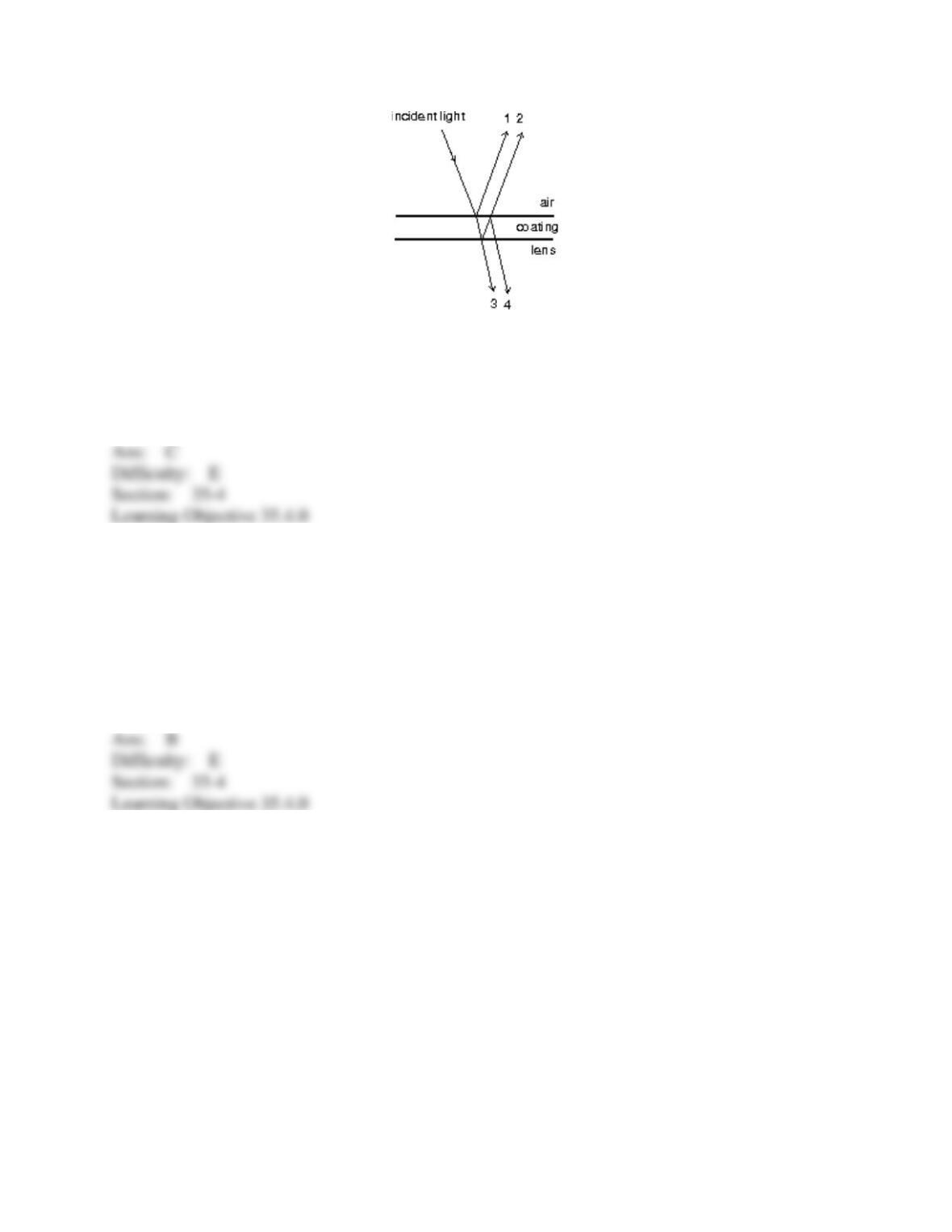
A) constructive interference between waves 1 and 2
B) destructive interference between waves 3 and 4
C) constructive interference between waves 3 and 4
D) the coating to be more transparent than the lens
E) the speed of light in the coating to be less than that in the lens
34. Monochromatic light, at normal incidence, strikes a thin film in air. If denotes the
wavelength in the film, what is the thinnest film in which the reflected light will be a maximum?
A) much less than
B) /4
C) /2
D) 3/4
E)
35. Three experiments involving a thin film (in air) are shown. If t denotes the film thickness
and denotes the wavelength of the light in the film, which experiments will produce
constructive interference as seen by the observer?
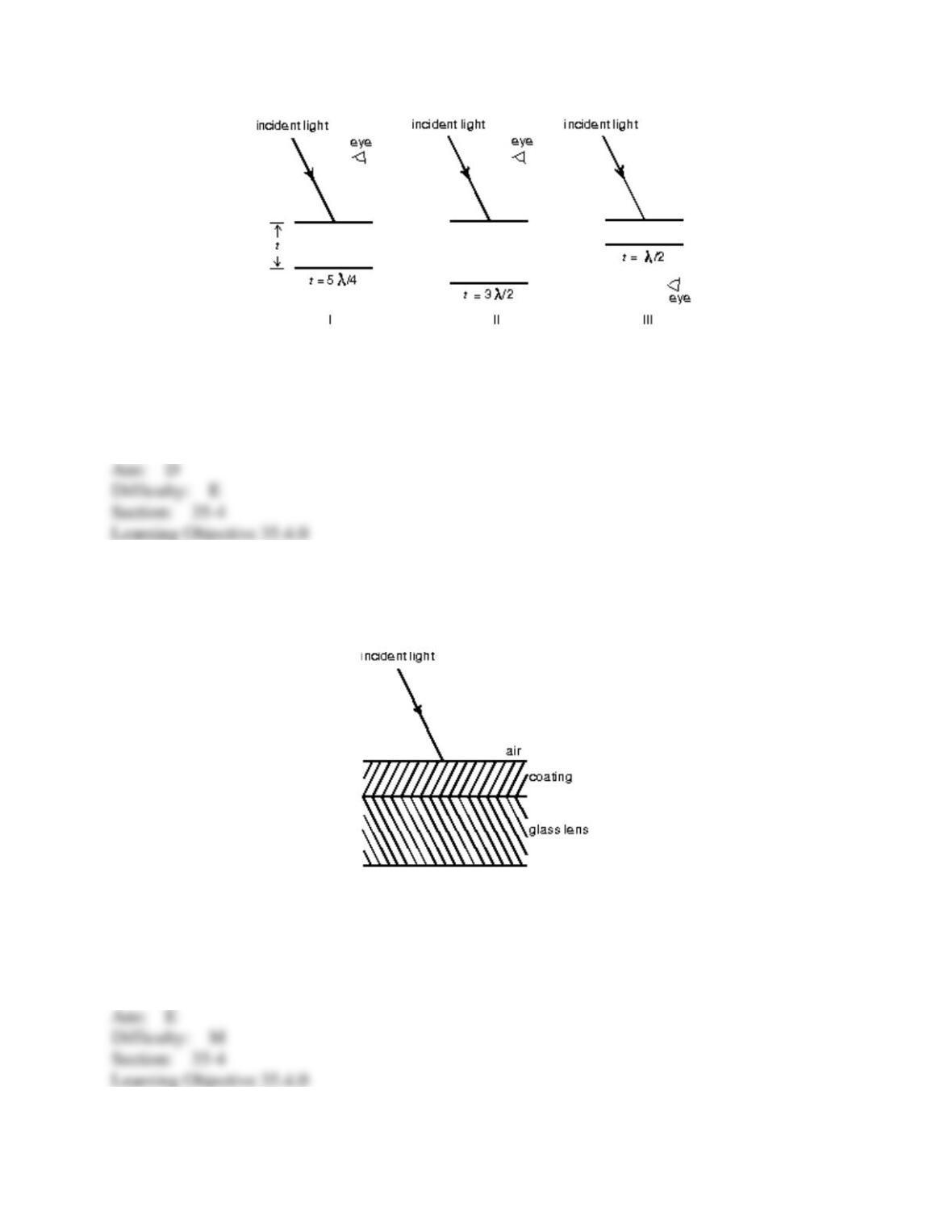
A) I only
B) II only
C) III only
D) I and III only
E) II and III only
36. A lens with a refractive index of 1.5 is coated with a material of refractive index 1.2 in
order to minimize reflection. If denotes the wavelength of the incident light in air, what is the
thinnest possible such coating?
A) 0.5
B) 0.417
C) 0.3
D) 0.25
E) 0.208
37. A glass (n = 1.6) lens is coated with a thin film (n = 1.3) to reduce reflection of certain
incident light. If is the wavelength of the light in the film, the least film thickness is:
A) less than /4
B) /4
C) /2
D)
E) more than
38. The three factors that determine the interference of reflected waves from a thin film are:
A) incoming wavelength, speed of light in vacuum, thickness of the film
B) shifts in wavelength on reflection, path length difference, index of refraction of the film
C) incoming wavelength, index of refraction of the external medium, index of refraction of the
film
D) shifts in wavelength on reflection, index of refraction of the film, speed of light in vacuum
E) path length difference, thickness of the film, index of refraction of the film
39. A soap film is illuminated by white light normal to its surface. The index of refraction of
the film is 1.50. Wavelengths of 480 nm and 800 nm and no wavelengths between are intensified
in the reflected beam. The thickness of the film is:
A) 1.5 10–5 cm
B) 2.4 10–5 cm
C) 3.6 10–5 cm
D) 4.0 10–5 cm
E) 6.0 10–5 cm
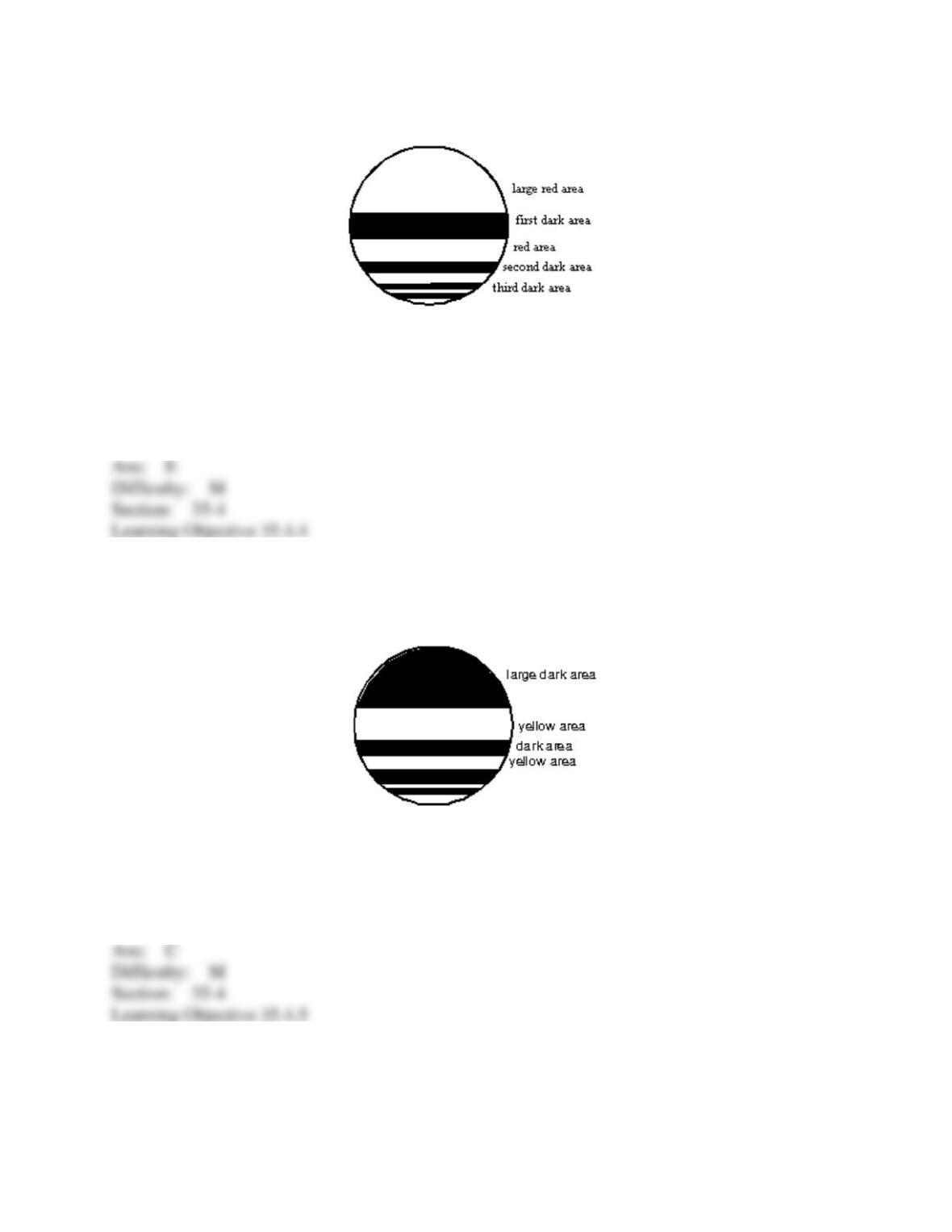
40. Red light is viewed through a thin vertical soap film. At the third dark area shown, the
thickness of the film, in terms of the wavelength within the film, is:
A) /4
B) /2
C)
D) 3/4
E) 5/4
41. Yellow light is viewed by reflection from a thin vertical soap film. Let be the wavelength
of the light within the film. Why is there a large dark space at the top of the film?
A) no light is transmitted through this part of the film
B) the film thickness there is /4
C) the light reflected from exactly one of the two surfaces undergoes a 180 phase change
D) the film is too thick in this region for thin film formulas to apply
E) the reflected light is in the infrared
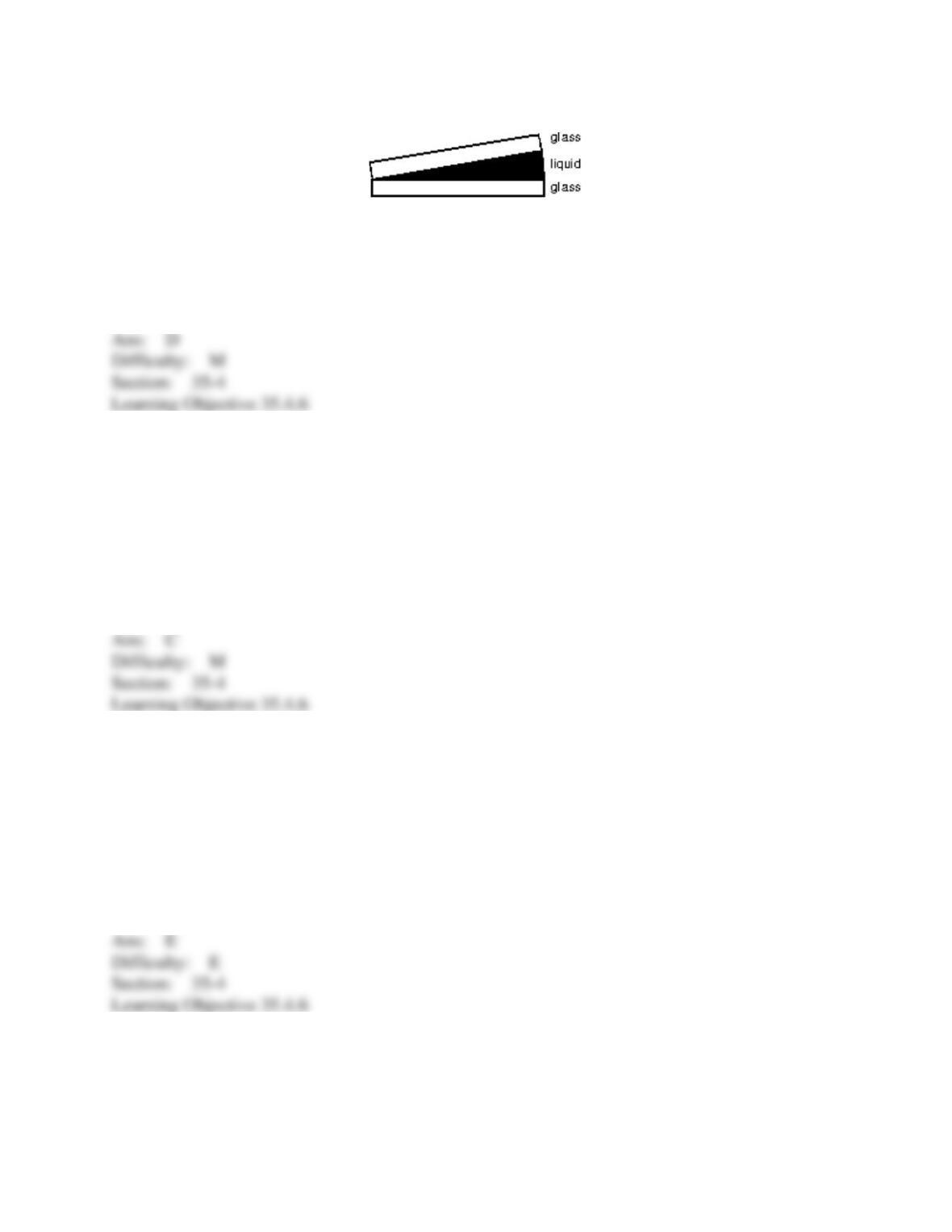
42. A liquid of refractive index n = 4/3 replaces the air between a fixed wedge formed from
two glass plates as shown. As a result, the spacing between adjacent dark bands in the
interference pattern:
A) increases by a factor of 4/3
B) increases by a factor of 3
C) remains the same
D) decreases to 3/4 of its original value
E) decreases to 1/3 of its original value
43. In a thin film experiment, a wedge of air is used between two glass plates. If the
wavelength of the incident light in air is 480 nm, how much thicker is the air wedge at the 16th
dark fringe than it is at the 6th?
A) 240 nm
B) 480 nm
C) 2400 nm
D) 4800 nm
E) none of these
44. An air wedge is formed from two glass plates which are in contact at their left edges. There
are ten dark bands when viewed by reflection using monochromatic light. The left edge of the
top plate is now slowly lifted until the plates are parallel. During this process:
A) the dark bands crowd toward the right edge
B) the dark bands remain stationary
C) the dark bands crowd toward the left edge
D) the dark bands spread out, disappearing off the right edge
E) the dark bands spread out, disappearing off the left edge
45. An air wedge is formed using two glass plates that are in contact along their left edge.
When viewed by highly monochromatic light, there are exactly 4001 dark bands in the reflected
light. The air is now evacuated (with the glass plates remaining rigidly fixed) and the number of
dark bands decreases to exactly 4000. The index of refraction of the air is:
A) 0.00025
B) 0.00050
C) 1.00025
D) 1.00050
E) 1.00000, by definition
46. A thin film with an index of refraction of 1.60 is placed in one of the beams of a Michelson
interferometer. If this causes a shift of 8 bright fringes in the pattern produced by light of
wavelength 580 nm, what is the thickness of the film?
A) 1.5 µm
B) 2.9 µm
C) 3.9 µm
D) 7.7 µm
E) 16 µm
47. In a Michelson interferometer, in order to shift the pattern by half a fringe, one of the mirrors
at the end of an arm must be moved by:
A) one wavelength
B) half a wavelength
C) one-quarter wavelength
D) It depends on the wavelength.
E) It depends on which mirror is moved.