28. A particle with charge q is to be brought from far away to a point near an electric dipole.
No work is done if the final position of the particle is on:
A) the line through the charges of the dipole
B) a line that is perpendicular to the dipole moment
C) a line that makes an angle of 45 with the dipole moment
D) a line that makes an angle of 30 with the dipole moment
E) none of the above
29. Equipotential surfaces associated with an electric dipole are:
A) spheres centered on the dipole
B) cylinders with axes along the dipole moment
C) planes perpendicular to the dipole moment
D) planes parallel to the dipole moment
E) none of the above
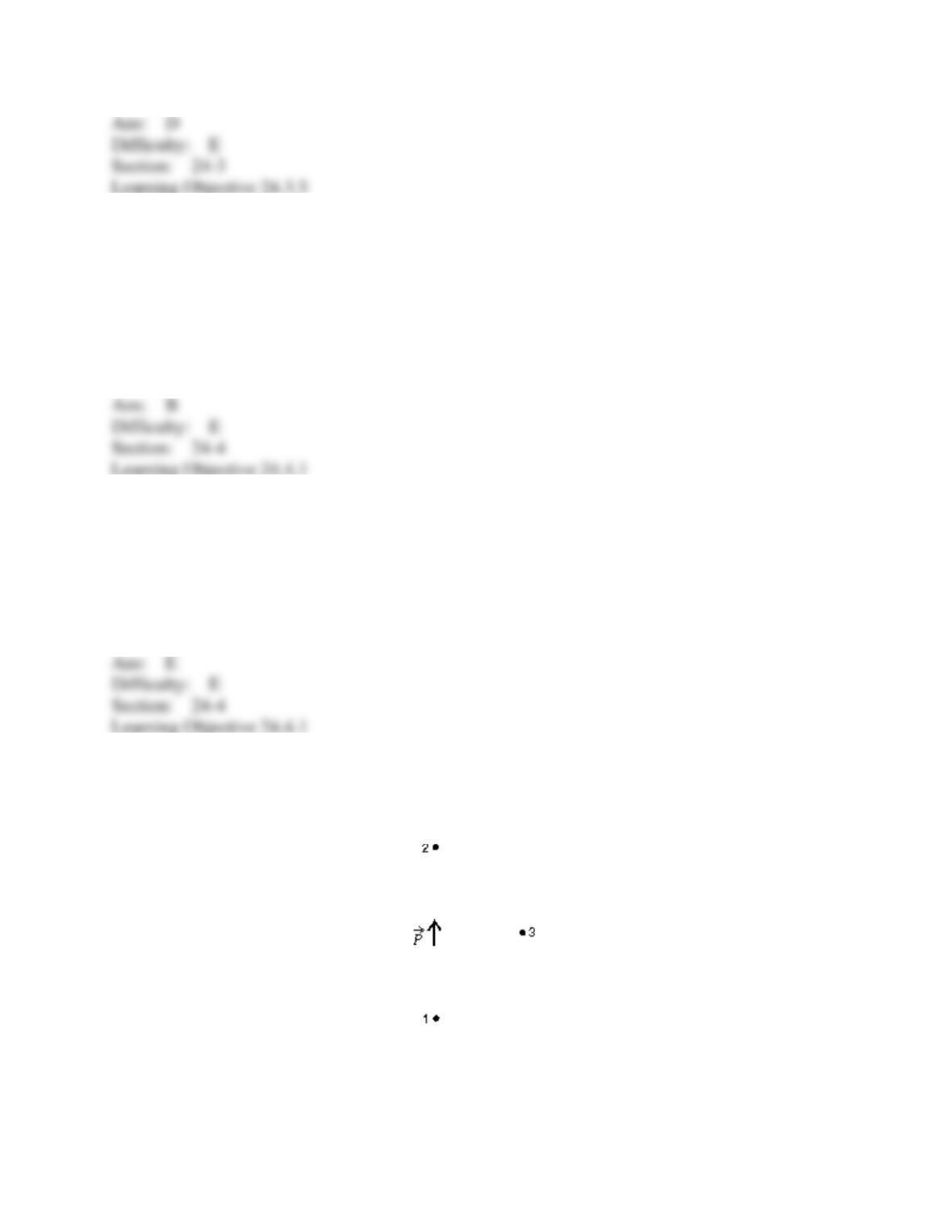
30. In the diagram, the points 1, 2, and 3 are all the same very large distance from a dipole.
Rank the points according to the values of the electric potential at them, from the most negative
to the most positive.
A) 1, 2, 3
B) 3, 2, 1
C) 2, 3, 1
D) 1, 3, 2
E) 1 and 2 tie, then 3
31. Compared to the magnitude of the electric potential far from a point charge, the magnitude of
the electric potential far from an electric dipole:
A) decreases more slowly with distance
B) decreases more quickly with distance
C) increases more slowly with distance
D) increases more quickly with distance
E) varies in the same way with distance
32. A wire carrying a charge density of λ C/m is bent into a circle of radius r. What is the electric
potential at the center of the circle?
A) λ/4πε0r
B) λ/4πε0
C) λ/4ε0
D) λ/2ε0
E) λ/ε0
33. The electric potential in a certain region of space is given by V = –7.5x2 + 3x, where V is in
volts and x is in meters. In this region the equipotential surfaces are:
A) planes parallel to the x axis
B) planes parallel to the yz plane
C) concentric spheres centered at the origin
D) concentric cylinders with the x axis as the cylinder axis
E) unknown unless the charge is given
34. The electric potential at a certain point is given by V = –7.5x2 + 3x, where V is in volts and x
is in meters. What is the electric field at that point?
A) 𝐸
⃗
= (15x – 3)𝑖̂
B) 𝐸
⃗
= (–15x + 3)𝑖̂
C) 𝐸
⃗
= (–2.5x3 + 1.5 x2)𝑖̂
D) 𝐸
⃗
= (2.5x3 – 1.5 x2)𝑖̂
E) 𝐸
⃗
= 0
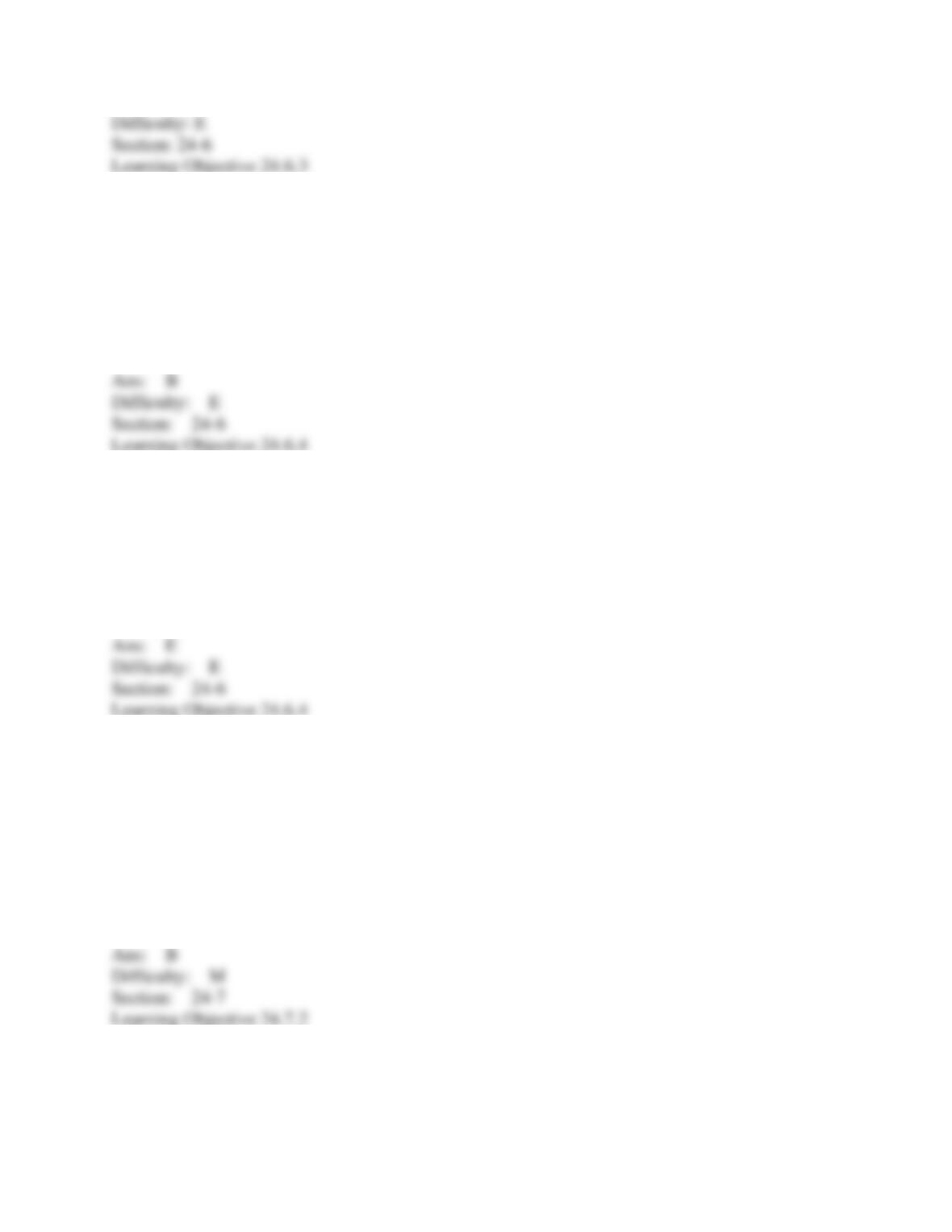
35. The graph shows the electric potential as a function of x in a certain region. What is the x
component of the electric field in this region if Vs = 50 V?
A) 250 V/m
B) 40 V/m
C) 10 V/m
D) –40 V/m
E) –250 V/m
36. A geologist measures the Earth’s electric field near the surface, and finds that equipotential
lines 100 V apart are at a distance of 75 cm from each other. Assuming the electric field is
uniform, what is its magnitude?
A) 130 V/m
B) 100 V/m
C) 75 V/m
D) 1.3 V/m
E) 0.75 V/m
37. In a certain region of space the electric potential increases uniformly from east to west and
does not vary in any other direction. The electric field:
A) points east and varies with position
B) points east and does not vary with position
C) points west and varies with position
D) points west and does not vary with position
E) points north and does not vary with position
38. Choose the correct statement:
A) A proton tends to go from a region of low potential to a region of high potential
B) The potential of a negatively charged conductor must be negative
C) If 𝐸
⃗
= 0 at a point P then V must be zero at P
D) If V = 0 at a point P then 𝐸
⃗
must be zero at P
E) None of the above is correct
39. A particle with a charge of 5.5 10–6 C is 3.5 cm from a particle with a charge of –2.3
10–8 C. The potential energy of this two-particle system, relative to the potential energy at
infinite separation, is:
A) 3.3 10–2 J
B) –3.3 10–2 J
C) 9.3 10–1 J
D) –9.3 10–1 J
E) 0 J
40. A particle with a charge of 5.5 10–8C is fixed at the origin. A particle with a charge of
–2.3 10–8C is moved from x = 3.5 cm on the x axis to y = 4.3 cm on the y axis. The change in
potential energy of the two-particle system is:
A) 3.1 10–3 J
B) –3.1 10–3 J
C) 6.0 10–5 J
D) –6.0 10–5 J
E) 0 J
41. A particle with a charge of 5.5 10–8C charge is fixed at the origin. A particle with a
charge of–2.3 10–8C charge is moved from x = 3.5 cm on the x axis to y = 3.5 cm on the y axis.
The change in the potential energy of the two-charge system is:
A) 3.2 10–4 J
B) –3.2 10–4 J
C) 9.3 10–3 J
D) –9.3 10–3 J
E) 0 J
42. Three particles lie on the x axis: particle 1, with a charge of 1 10–8 C is at x = 1 cm,
particle 2, with a charge of 2 10–8 C, is at x = 2 cm, and particle 3, with a charge of −3 10–8
C, is at x = 3 cm. The potential energy of this arrangement, relative to the potential energy for
infinite separation, is:
A) +4.9 10–4 J
B) −4.9 10–4 J
C) +8.5 10–4 J
D) −8.5 10–4 J
E) 0 J
43. Two identical particles, each with charge q, are placed on the x axis, one at the origin and
the other at x = 5 cm. A third particle, with charge –q, is placed on the x axis so the potential
energy of the three-particle system is the same as the potential energy when they are all infinitely
far apart. Its x coordinate is:
A) 13 cm
B) 2.5 cm
C) 7.5 cm
D) 10 cm
E) –5 cm
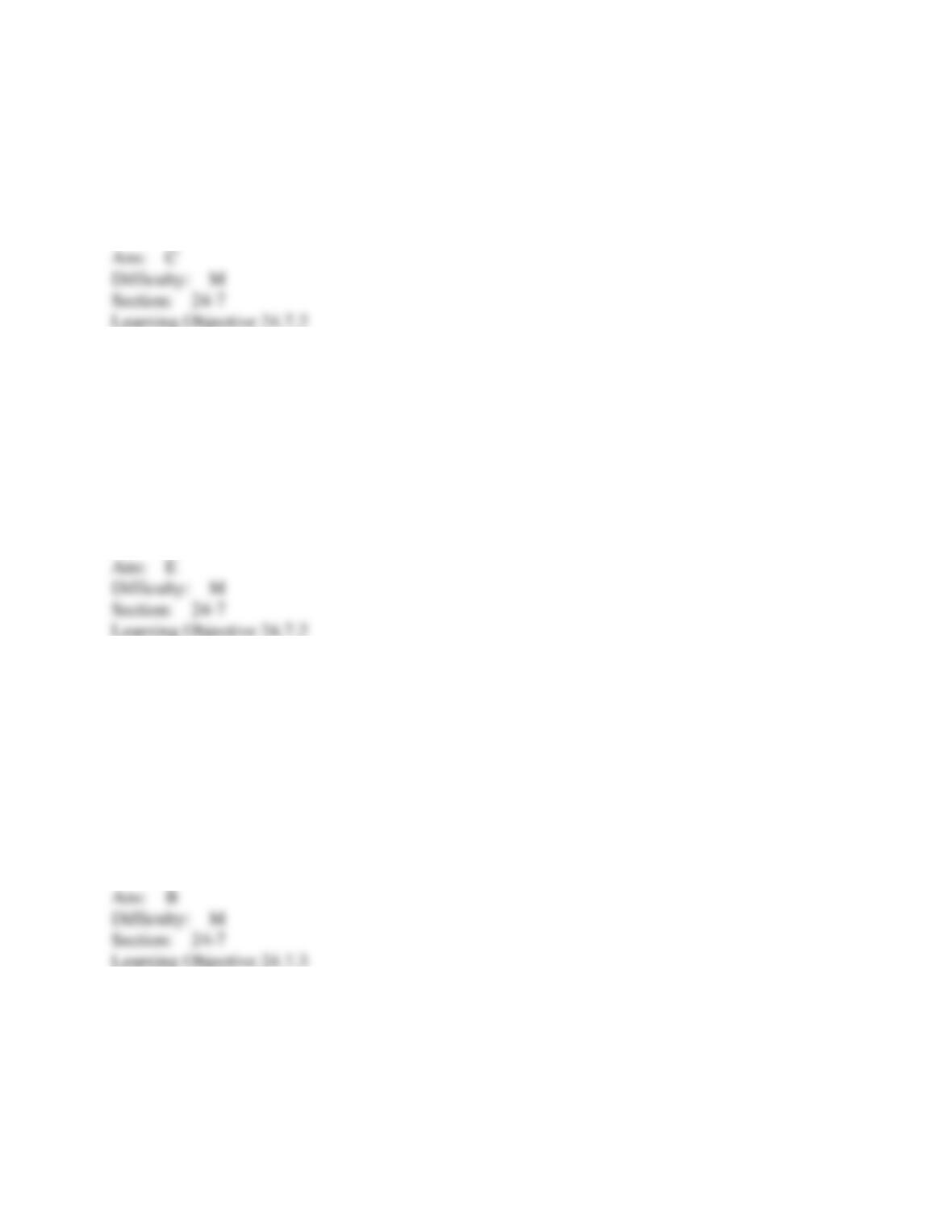
44. Three possible configurations for an electron e and a proton p are shown below. Take the
zero of potential to be at infinity and rank the three configurations according to the potential at S,
from most negative to most positive.
A) 1, 2, 3
B) 3, 2, 1
C) 2, 3, 1
D) 1 and 2 tie, then 3
E) 1 and 3 tie, then 2
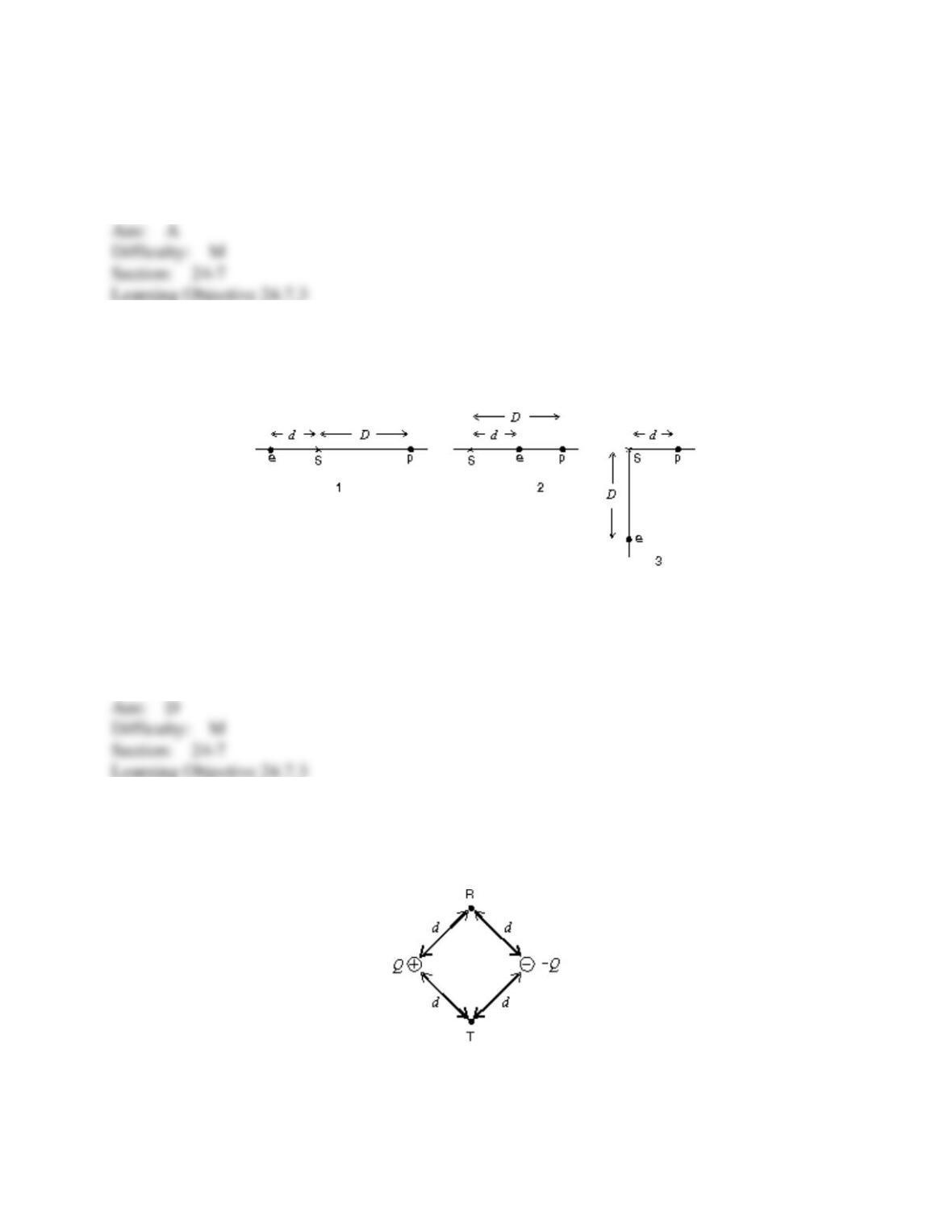
45. Points R and T are each a distance d from each of two particles with charges of equal
magnitudes and opposite signs as shown. If k = 1/40, the work required to move a particle with
negative charge q from R to T is:
A) 0
B) kqQ/d2
C) kqQ/d
D) 𝑘𝑞𝑄/(√2𝑑)
E) kQq/(2d)
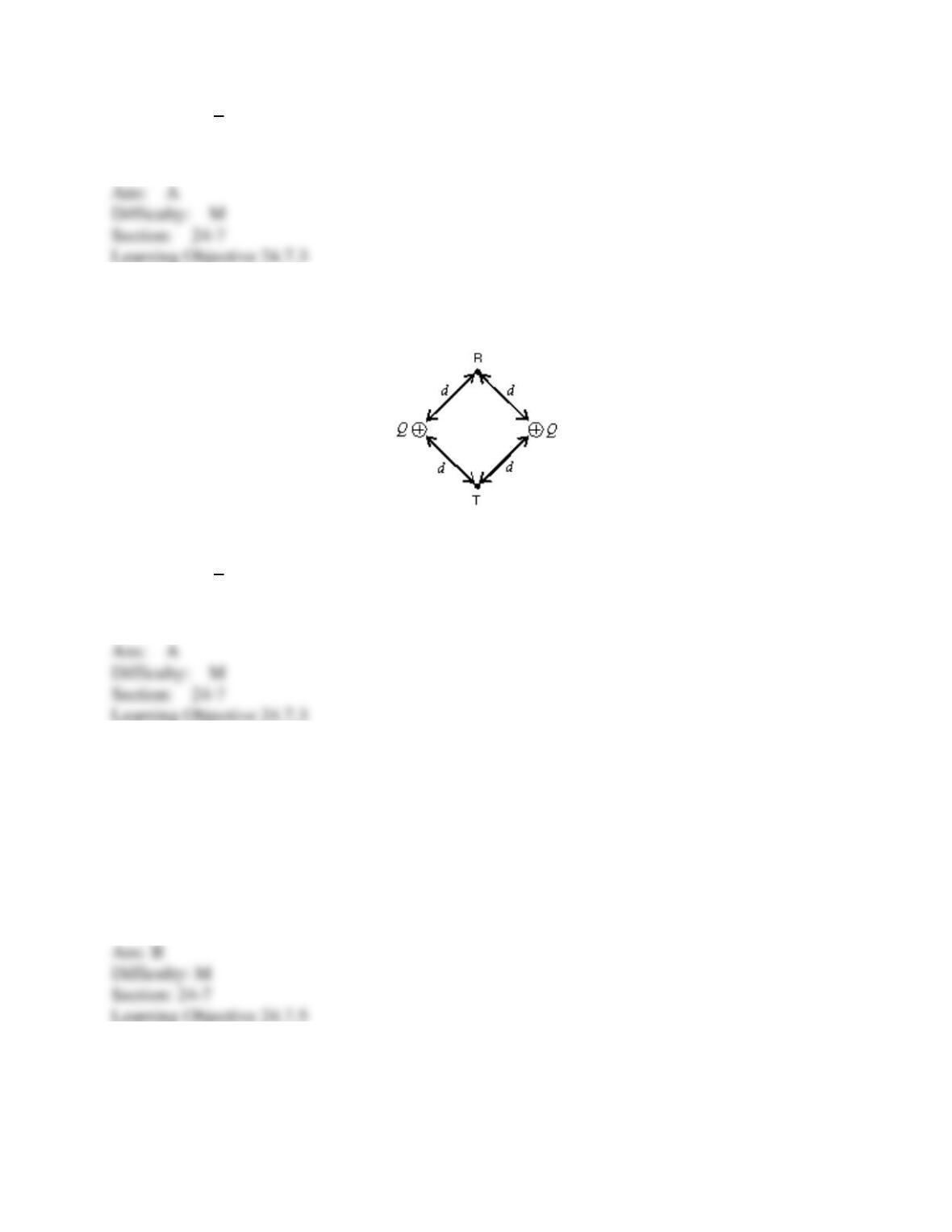
46. Points R and T are each a distance d from each of two equal positive charges as shown. If k
= 1/40, the work required to move a particle with a charge q from R to T is:
A) 0
B) kQq/d2
C) kQq/d
D) 𝑘𝑞𝑄/(√2𝑑)
E) kQq/(2d)
47. An electric dipole consists of two equal and opposite charged particles of mass 1.2 g and
charge 3.7 µC separated by 1.7 mm. What is the escape speed of the positive charge – that is,
how much speed would you have to give it so it would escape the other charge?
A) 200 m/s
B) 350 m/s
C) 6600 m/s
D) 7.1 x 10⁴ m/s
E) 2.0 x 10⁵ m/s
48. Two conducting spheres, one having twice the diameter of the other, are separated by a
distance large compared to their diameters. The smaller sphere (1) has charge q and the larger
sphere (2) is uncharged. If the spheres are connected by a long thin wire and come to
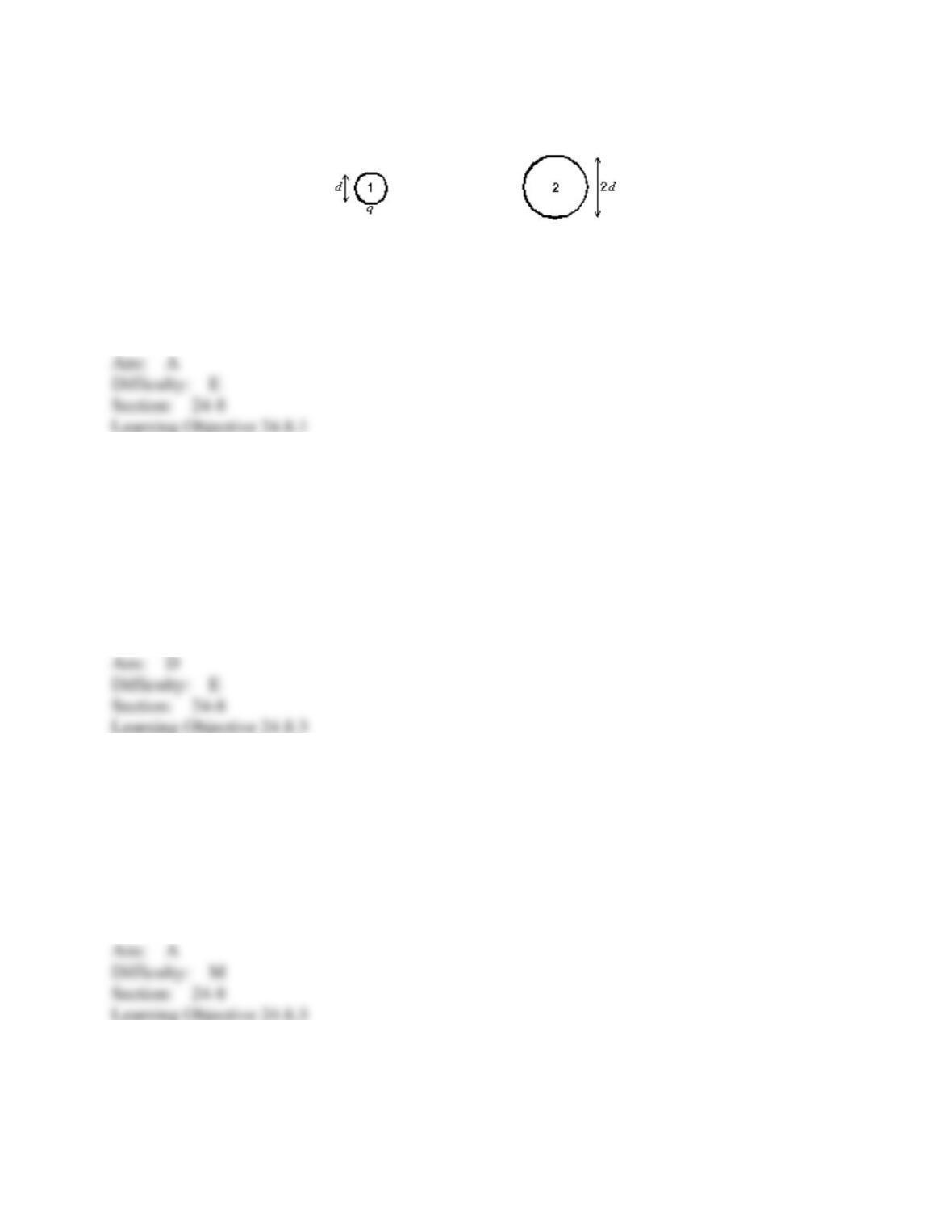
equilibrium:
A) 1 and 2 have the same potential
B) 2 has twice the potential of 1
C) 2 has half the potential of 1
D) 1 and 2 have the same charge
E) all of the charge is dissipated
49. A conducting sphere with radius R is charged until the magnitude of the electric field just
outside its surface is E. The electric potential of the sphere, relative to the potential for away,
is:
A) 0
B) E/R
C) E/R2
D) ER
E) ER2
50. A 5-cm radius conducting sphere has a charge density of 2 10–6 C/m2 on its surface. Its
electric potential, relative to the potential far away, is:
A) 1.1 104 V
B) 2.2 104 V
C) 2.3 105 V
D) 3.6 105 V
E) 7.2 106 V
51. A hollow metal sphere is charged to a potential V. The potential at its center is:
A) V
B) 0
C) –V
D) 2V
E) V
52. Two conducting spheres are far apart. The smaller sphere carries a total charge of Q. The
larger sphere has a radius that is twice that of the smaller and is neutral. After the two spheres are
connected by a conducting wire, the charges on the smaller and larger spheres, respectively, are:
A) Q/2 and Q/2
B) Q/3 and 2Q/3
C) 2Q/3 and Q/3
D) 0 and Q
E) 2Q and –Q
53. A solid metal sphere carries a charge of 5 10–9 C and is at a potential of 400 V, relative to
the potential far away. The potential at the center of the sphere is:
A) 400 V
B) –400 V
C) 2 10–6 V
D) 0 V
E) none of these
54. A 5-cm radius isolated conducting sphere is charged so its potential is +100 V, relative to
the potential far away. The charge density on its surface is:
A) +2.2 10–7 C/m2
B) –2.2 10–7 C/m2
C) +3.5 10–7 C/m2
D) –3.5 10–7 C/m2
E) +1.8 10–8 C/m2
55. A conducting sphere has charge Q and its electric potential is V, relative to the potential far
away. If the charge is doubled to 2Q, the potential is:
A) V
B) 2V
C) 4V
D) V/2
E) V/4