Chapter: Chapter 13
Learning Objectives
LO 13.1.0 Solve problems related to Newton’s law of gravitation.
LO 13.1.1 Apply Newton’s law of gravitation to relate the gravitational force between two
particles to their masses and their separation.
LO 13.1.2 Identify that a uniform spherical shell of matter attracts a particle that is outside the
shell as if all the shell’s mass were concentrated as a particle at its center.
LO 13.1.3 Draw a free-body diagram to indicate the gravitational force on a particle due to
another particle or a uniform, spherical distribution of matter.
LO 13.2.0 Solve problems related to gravitation and the principle of superposition.
LO 13.2.1 If more than one gravitational force acts on a particle, draw a free-body diagram
showing those forces, with the tails of the force vectors anchored on the particle.
LO 13.2.2 If more than one gravitational force acts on a particle, find the net force by adding the
individual forces as vectors.
LO 13.3.0 Solve problems related to gravitation near earth’s surface.
LO 13.3.1 Distinguish between the free-fall acceleration and the gravitational acceleration.
LO 13.3.2 Calculate the gravitational acceleration near but outside a uniform, spherical
astronomical body.
LO 13.3.3 Distinguish between measured weight and the magnitude of the gravitational force.
LO 13.4.0 Solve problems related to gravitation inside earth.
LO 13.4.1 Identify that a uniform shell of matter exerts no net gravitational force on a particle
located inside it.
LO 13.4.2 Calculate the gravitational force that is exerted on a particle at a given radius inside
a nonrotating uniform sphere of matter.
LO 13.5.0 Solve problems related to gravitational potential energy.
LO 13.5.1 Calculate the gravitational potential energy of a system of particles (or uniform
spheres that can be treated as particles).
LO 13.5.2 Identify that if a particle moves from an initial point to a final point while
experiencing a gravitational force, the work done by that force (and thus the change in
gravitational potential energy) is independent of the path taken.
LO 13.5.3 Using the gravitational force on a particle near an astronomical body (or some
second body that is fixed in place), calculate the work done by the force when the body moves.
LO 13.5.4 Apply the conservation of mechanical energy (including gravitational potential
energy) to a particle moving relative to an astronomical body (or some second body that is fixed
in place).
LO 13.5.5 Explain the energy requirements for a particle to escape from an astronomical body
(usually assumed to be a uniform sphere).
LO 13.5.6 Calculate the escape speed of a particle in leaving an astronomical body.
LO 13.6.0 Solve problems related to planets and satellites: Kepler‘s laws.
LO 13.6.1 Identify Kepler’s three laws.
LO 13.6.2 Identify which of Kepler’s laws is equivalent to the law of conservation of
momentum.
LO 13.6.3 On a sketch of an elliptical orbit, identify the semimajor axis, the eccentricity, the
perihelion, the aphelion, and the focal points.
LO 13.6.4 For an elliptical orbit, apply the relationship between the semimajor axis, the
eccentricity, the perihelion, and the aphelion.
LO 13.6.5 For an orbiting natural or artificial satellite, apply Kepler’s relationship between the
orbital period and radius and the mass of the astronomical body being orbited.
LO 13.7.0 Solve problems related to satellites: orbits and energy.
LO 13.7.1 For a satellite in a circular orbit around an astronomical body, calculate the
gravitational potential energy, the kinetic energy, and the total energy.
LO 13.7.2 For a satellite in an elliptical orbit, calculate the total energy.
LO 13.8.0 Solve problems related to Einstein and gravitation.
LO 13.8.1 Explain Einstein’s principle of equivalence.
LO 13.8.2 Identify Einstein’s model for gravitation as being due to the curvature of spacetime.
Multiple Choice
1. In the formula F = Gm1m2/r2, the quantity G:
A) depends on the local value of g
B) is used only when the Earth is one of the two masses
C) is greatest at the surface of the Earth
D) is a universal constant of nature
E) is related to the Sun in the same way that g is related to the Earth
2. Suitable units for the gravitational constant G are:
A) kgm/s2
B) m/s2
C) Ns/m
D) kgm/s
E) m3/(kgs2)
3. The gravitational constant G has the derived units
A) Nm
B) Nm/kg
C) Nkg/m
D) Nm2/kg2
E) Nkg2/m2
4. The mass of an object:
A) is slightly different at different locations on the Earth
B) is a vector
C) is independent of the acceleration due to gravity
D) is the same for all objects of the same size and shape
E) can be measured directly and accurately on a spring scale
5. The magnitude of the acceleration of a planet in orbit around the Sun is proportional to:
A) the mass of the planet
B) the mass of the Sun
C) the distance between the planet and the Sun
D) the reciprocal of the distance between the planet and the Sun
E) the product of the mass of the planet and the mass of the Sun
6. Earth exerts a gravitational force on the Moon, keeping it in its orbit. The reaction to this
force, in the sense of Newton’s third law, is:
A) the centripetal force on the Moon
B) the nearly circular orbit of the Moon
C) the gravitational force exerted on Earth by the Moon
D) the tides due to the Moon
E) the apple hitting Newton on the head
7. Let F1 be the magnitude of the gravitational force exerted on the Sun by Earth and F2 be the
magnitude of the force exerted on Earth by the Sun. Then:
A) F1 is much greater than F2
B) F1 is slightly greater than F2
C) F1 is equal to F2
D) F1 is slightly less than F2
E) F1 is much less than F2
8. An astronaut on the Moon simultaneously drops a feather and a hammer. The fact that they
land together shows that:
A) no gravity forces act on a body in a vacuum
B) the acceleration due to gravity on the Moon is less than g on the Earth
C) in the absence of air resistance all bodies at a given location fall with the same acceleration
D) the feather has a greater weight on the Moon than on Earth
E) G = 0 on the Moon
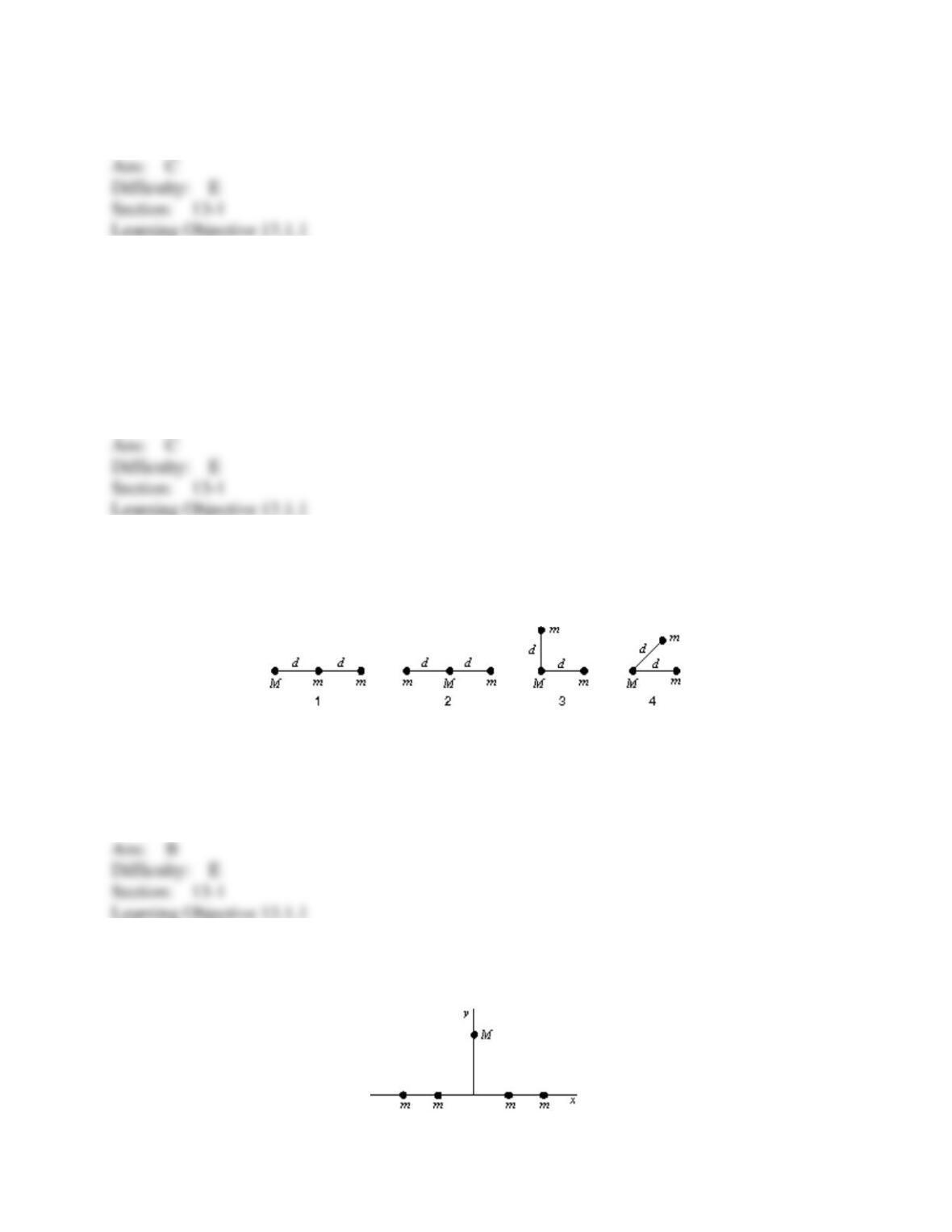
9. Three particles, two with mass m and one mass M, might be arranged in any of the four
configurations known below. Rank the configurations according to the magnitude of the
gravitational force on M, least to greatest.
A) 1, 2, 3, 4
B) 2, 1, 3, 4
C) 2, 1, 4, 3
D) 2, 3, 4, 2
E) 2, 3, 2, 4
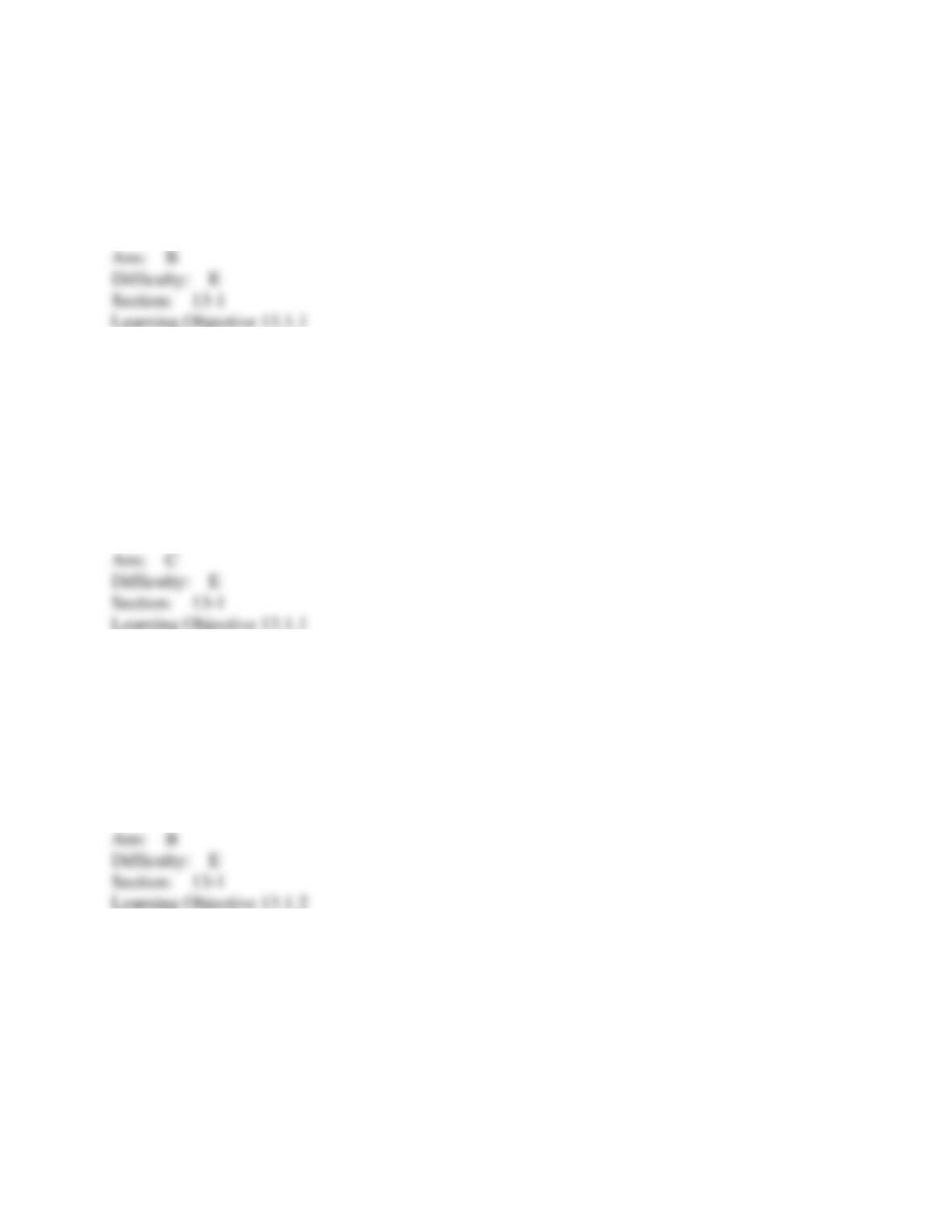
10. Four particles, each with mass m, are arranged symmetrically about the origin on the x axis.
A fifth particle, with mass M, is on the y axis. The direction of the gravitational force on M is:
A)
B)
C)
D) →
E) none of these directions
11. A spherical shell has inner radius R1, outer radius R2, and mass M, distributed uniformly
throughout the shell. The magnitude of the gravitational force exerted on the shell by a point
mass particle of m a distance d from the center, outside the outer radius, is:
A) 0
B) 𝐺𝑀𝑚/𝑅1
2
C) GMm/d2
D) 𝐺𝑀𝑚/(𝑅2
2− 𝑑2)
E) GMm/(R1 – d)2
12. Let M denote the mass of Earth and let R denote its radius. The ratio g/G at Earth’s surface
is:
A) R2/M
B) M/R2
C) MR2
D) M/R
E) R/M
13. An object at the surface of Earth (at a distance R from the center of Earth) weighs 90 N. Its
weight at a distance 3R from the center of Earth is:
A) 10 N
B) 30 N
C) 90 N
D) 270 N
E) 810 N
14. An object is raised from the surface of Earth to a height of two Earth radii above Earth.
Then:
A) its mass increases and its weight remains constant
B) both its mass and weight remain constant
C) its mass remains constant and its weight decreases
D) both its mass and its weight decrease
E) its mass remains constant and its weight increases
15. The approximate value of g at an altitude above Earth equal to one Earth diameter is:
A) 9.8 m/s2
B) 4.9 m/s2
C) 2.5 m/s2
D) 1.9 m/s2
E) 1.1 m/s2
16. A mass m is located at the origin; a second mass m is at x = d. A third mass m is above the
first two so the three masses form an equilateral triangle. What is the net gravitational force on
the third mass?
A) 2Gm2/d2
B) Gm2/d2
C)
3
Gm2/d2
D)
3
Gm2/2d2
E) Gm2/2d2
17. An artificial satellite of the Earth releases a bomb. Neglecting air resistance, the bomb will:
A) strike Earth under the satellite at the instant of release
B) strike Earth under the satellite at the instant of impact
C) strike Earth ahead of the satellite at the instant of impact
D) strike Earth behind the satellite at the instant of impact
E) never strike Earth
18. An astronaut finishes some work on the outside of his satellite, which is in circular orbit
around the Earth. He leaves his wrench outside the satellite. If there is no air resistance, the
wrench will:
A) fall directly down to the Earth
B) continue in orbit at reduced speed
C) continue in orbit with the satellite
D) fly off tangentially into space
E) spiral down to the Earth
19. Suppose you have a pendulum clock which keeps correct time on Earth (acceleration due to
gravity = 9.8 m/s2). Without changing the clock, you take it to the Moon (acceleration due to
gravity = 1.6 m/s2). For every hour interval (on Earth) the Moon clock will record:
A) (9.8/1.6) h
B) 1 h
C) √9.8/1.6 h
D) (1.6/9.8) h
E) √1.6/9.8 h
20. If Earth were to rotate only 100 times per year about its axis:
A) airplanes flying west to east would make better time
B) we would fly off Earth’s surface
C) our apparent weight would slightly increase
D) Earth’s atmosphere would float into outer space
E) our apparent weight would slightly decrease
21. Mars has a mass of about 0.1075 times the mass of Earth and a diameter of about 0.533
times the diameter of Earth. The acceleration of a body falling near the surface of Mars is
about:
A) 0.30 m/s2
B) 1.4 m/s2
C) 2.0 m/s2
D) 3.7 m/s2
E) 26 m/s2
22. The mass of a hypothetical planet is 1/100 that of Earth and its radius is 1/4 that of Earth. If
a person weighs 600 N on Earth, what would he weigh on this planet?
A) 24 N
B) 48 N
C) 96 N
D) 192 N
E) 600 N
23. A rocket ship is coasting toward a planet. Its captain wishes to know the value of g at the
surface of the planet. This may be inferred by:
A) measuring the apparent weight of one of the crew
B) measuring the apparent weight of an object of known mass in the ship
C) measuring the diameter of the planet
D) measuring the density of the planet
E) observing the ship’s acceleration and correcting for the distance from the center of the planet
24. An astronaut in an orbiting space-craft feels “weightless” because she:
A) is beyond the range of gravity
B) is pulled outwards by centrifugal force
C) has no acceleration
D) has the same acceleration as the space-craft
E) is outside Earth’s atmosphere
25. A spherical shell has inner radius R1, outer radius R2, and mass M, distributed uniformly
throughout the shell. The magnitude of the gravitational force exerted on the shell by a point
mass m a distance d from the center, inside the inner radius, is:
A) 0
B) 𝐺𝑀𝑚/𝑅1
2
C) GMm/d2
D) 𝐺𝑀𝑚/(𝑅2
2− 𝑑2)
E) GMm/(R1 – d)2
26. A particle might be placed
1. inside a uniform spherical shell of mass M, but not at the center
2. inside a uniform spherical shell of mass M, at the center
3. outside a uniform spherical shell of mass M, a distance r from the center
4. outside a uniform solid sphere of mass M, a distance 2r from the center
Rank these situations according to the magnitude of the gravitational force on the particle, least
to greatest.
A) All tie
B) 1, 2, 3, 4
C) 1 and 2 tie, then 3 and 4 tie
D) 1 and 2 tie, then 3, then 4
E) 1 and 2 tie, then 4, then 3
27. A spring scale, calibrated in newtons, is used to weigh sugar. If it were possible to weigh
sugar at the following locations, where will the buyer get the most sugar to a newton?
A) At the north pole
B) At the equator
C) Near the center of Earth
D) On the Moon
E) On Jupiter
28. Of the following where would the weight of an object be the least?
A) 2000 miles above Earth’s surface
B) At the north pole
C) At the equator
D) At the center of Earth
E) At the south pole
29. The mass density of a certain planet has spherical symmetry but varies in such a way that
the mass inside every spherical surface with center at the center of the planet is proportional to
the radius of the surface. If r is the distance from the center of the planet to a point mass inside
the planet, the gravitational force on the mass is:
A) not dependent on r
B) proportional to r2
C) proportional to r
D) proportional to 1/r
E) proportional to 1/r2
30. A spherical shell has inner radius R1, outer radius R2, and mass M, distributed uniformly
throughout the shell. The magnitude of the gravitational force exerted on the shell by a point
particle of mass m, located a distance d from the center, outside the inner radius and inside the
outer radius, is:
A) 0
B) GMm/d2
C) 𝐺𝑀𝑚/(𝑅2
3− 𝑑3)
D) 𝐺𝑀𝑚(𝑑3− 𝑅1
3)/𝑑2(𝑅2
3− 𝑅1
3)
E) 𝐺𝑀𝑚/(𝑑3− 𝑅1
3)
31. Each of the four corners of a square with edge a is occupied by a point mass m. There is a
fifth mass, also m, at the center of the square. To remove the mass from the center to a point far
away the work that must be done by an external agent is given by:
A) 4Gm2/a
B) –4Gm2/a
C) 4√2𝐺𝑚2/𝑎
D) −4√2𝐺𝑚2/𝑎
E) 4Gm2/a2
32. Two particles, each of mass m, are a distance d apart. To bring a third particle, with mass
2m, from far away to a resting point midway between the two particles, an external agent must
do work equal to:
A) 4Gm2/d
B) –4Gm2/d
C) 8Gm2/d
D) –8Gm2/d
E) zero
33. An artificial Earth satellite is moved from a circular orbit with radius R to a circular orbit
with radius 2R. During this move:
A) The gravitational force does no work.
B) The gravitational force does positive work.
C) The gravitational force does negative work.
D) The work done by the gravitational force cannot be determined without knowing the path of
the satellite.
E) The work done by the gravitational force cannot be determined without knowing what force
caused the satellite to change its orbit.