Chapter: Chapter 25
Learning Objectives
LO 25.1.0 Solve problems related to capacitance.
LO 25.1.1 Sketch a schematic diagram of a circuit with a parallel-plate capacitor, a battery, and
an open or closed switch.
LO 25.1.2 In a circuit with a battery, an open switch, and an uncharged capacitor, explain what
happens to the conduction electrons when the switch is closed.
LO 25.1.3 For a capacitor, apply the relationship between the magnitude of charge q on either
plate (“the charge on the capacitor”), the potential difference V between the plates (“the potential
across the capacitor”), and the capacitance C of the capacitor.
LO 25.2.0 Solve problems related to calculating the capacitance.
LO 25.2.1 Explain how Gauss’ law is used to find the capacitance of a parallel-plate capacitor.
LO 25.2.2 For a parallel-plate capacitor, a cylindrical capacitor, a spherical capacitor, and an
isolated sphere, calculate the capacitance.
LO 25.3.0 Solve problems related to capacitors in parallel and in series.
LO 25.3.1 Sketch schematic diagrams for a battery and (a) three capacitors in parallel and (b)
three capacitors in series.
LO 25.3.2 Identify that capacitors in parallel have the same potential difference, which is the
same value that their equivalent capacitor has.
LO 25.3.3 Calculate the equivalent capacitance of several capacitors in parallel.
LO 25.3.4 Identify that the total charge stored on parallel capacitors is the sum of the charges
stored on the individual capacitors.
LO 25.3.5 Identify that capacitors in series have the same charge, which is the same value that
their equivalent capacitor has.
LO 25.3.6 Calculate the equivalent capacitance of several capacitors in series.
LO 25.3.7 Identify that the potential applied to capacitors in series is equal to the sum of the
potentials across the individual capacitors.
LO 25.3.8 For a circuit with a battery and some capacitors in parallel and some in series,
simplify the circuit in steps by finding equivalent capacitors, until the charge and potential on the
final equivalent capacitor can be determined, and then reverse the steps to find the charge and
potential on the individual capacitors.
LO 25.3.9 For a circuit with a battery, an open switch, and one or more uncharged capacitors,
determine the amount of charge that moves through a point in the circuit when the switch is
closed.
LO 25.3.10 When a charged capacitor is connected in parallel to one or more uncharged
capacitors, determine the charge and potential difference on each capacitor when equilibrium is
reached.
LO 25.4.0 Solve problems related to energy stored in an electric field.
LO 25.4.1 Explain how the work required to charge a capacitor results in the potential energy of
the capacitor.
LO 25.4.2 For a capacitor, apply the relationship between the potential energy U, the

capacitance C, and the potential difference V.
LO 25.4.3 For a capacitor, apply the relationship between the potential energy, the internal
volume, and the internal energy density.
LO 25.4.4 For any electric field, apply the relationship between the potential energy density u
in the field and the field’s magnitude E.
LO 25.4.5 Explain the danger of sparks in airborne dust.
LO 25.5.0 Solve problems related to capacitor with a dielectric.
LO 25.5.1 Identify that capacitance is increased if the space between the plates is filled with a
dielectric material.
LO 25.5.2 For a capacitor, calculate the capacitance with and without a dielectric.
LO 25.5.3 For a region filled with a dielectric material with a given dielectric constant κ, identify
that all electrostatic equations containing the permittivity constant ε0 are modified by multiplying
that constant by the dielectric constant to get κε0.
LO 25.5.4 Name some of the common dielectrics.
LO 25.5.5 In adding a dielectric to a charged capacitor, distinguish the results for a capacitor (a)
connected to a battery and (b) not connected to a battery.
LO 25.5.6 Distinguish polar dielectrics from nonpolar dielectrics.
LO 25.5.7 In adding a dielectric to a charged capacitor, explain what happens to the electric field
between the plates in terms of what happens to the atoms in the dielectric.
LO 25.6.0 Solve problems related to dielectrics and Gauss’ law.
LO 25.6.1 In a capacitor with a dielectric, distinguish free charge from induced charge.
LO 25.6.2 When a dielectric partially or fully fills the space in a capacitor, find the free charge,
the induced charge, the electric field between the plates (if there is a gap, there is more than one
field value), and the potential between the plates.
Multiple Choice
1. The units of capacitance are equivalent to:
A) J/C
B) V/C
C) J2/C
D) C/J
E) C2/J
2. A farad is the same as a:
A) J/V
B) V/J
C) C/V
D) V/C
E) N/C
3. A parallel-plate capacitor C has a charge Q. The actual charges on its plates are:
A) Q, Q
B) Q/2, Q/2
C) Q, –Q
D) Q/2, –Q/2
E) Q, 0
4. Each plate of a capacitor stores a charge of magnitude 1 mC when a 100-V potential
difference is applied. The capacitance is:
A) 5
F
B) 10
F
C) 50
F
D) 100
F
E) none of these
5. To charge a 1-F capacitor with 2 C requires a potential difference of:
A) 0.2 V
B) 0.5 V
C) 2 V
D) 5 V
E) none of these
6. If the charge on a parallel-plate capacitor is doubled:
A) the capacitance is halved
B) the capacitance is doubled
C) the electric field is halved
D) the electric field is doubled
E) the surface charge density is not changed on either plate
7. The capacitance of a parallel-plate capacitor with plate area A and plate separation d is given
by:
A) 0d/A
B) 0d/2A
C) 0A/d
D) 0A/2d
E) d/0
8. The capacitance of a parallel-plate capacitor is:
A) proportional to the plate area
B) proportional to the charge stored
C) independent of any material inserted between the plates
D) proportional to the potential difference of the plates
E) proportional to the plate separation
9. The plate areas and plate separations of five parallel plate capacitors are
capacitor 1: area A0, separation d0
capacitor 2: area 2A0, separation 2d0
capacitor 3: area 2A0, separation d0/2
capacitor 4: area A0/2, separation 2d0
capacitor 5: area A0, separation d0/2
Rank these according to their capacitances, least to greatest.
A) 1, 2, 3, 4, 5
B) 5, 4, 3, 2, 1
C) 5, then 3 and 4 tie, then 1, then 2
D) 4, then 1 and 2 tie, then 5, then 3
E) 3, then 5, then 1 and 2 tie, then 4
10. The capacitance of a parallel-plate capacitor can be increased by:
A) increasing the charge
B) decreasing the charge
C) increasing the plate separation
D) decreasing the plate separation
E) decreasing the plate area
11. If both the plate area and the plate separation of a parallel-plate capacitor are doubled, the
capacitance is:
A) doubled
B) halved
C) unchanged
D) one-fourth the original
E) quadrupled
12. If the plate area of an isolated charged parallel-plate capacitor is doubled:
A) the electric field is doubled
B) the potential difference is halved
C) the charge on each plate is halved
D) the surface charge density on each plate is doubled
E) none of the above
13. If the plate separation of an isolated charged parallel-plate capacitor is doubled:
A) the electric field is doubled
B) the potential difference is halved
C) the charge on each plate is halved
D) the surface charge density on each plate is doubled
E) none of the above
14. Pulling the plates of an isolated charged capacitor apart:
A) increases the capacitance
B) increases the potential difference
C) does not affect the potential difference
D) decreases the potential difference
E) does not affect the capacitance
15. A parallel-plate capacitor has a plate area of 0.2 m2 and a plate separation of 0.1 mm. To
obtain an electric field of 2.0 106 V/m between the plates, the magnitude of the charge on each
plate should be:
A) 3.5 10–6 C
B) 7.1 10–6 C
C) 1.4 10–5 C
D) 1.8 10–5 C
E) 8.9 10–5 C
16. A parallel-plate capacitor has a plate area of 0.2 m2 and a plate separation of 0.1 mm. If the
charge on each plate has a magnitude of 4 10–6 C the potential difference across the plates is
approximately:
A) 0 V
B) 4 10–2 V
C) 2 102 V
D) 2 105 V
E) 4 108 V

17. The capacitance of a spherical capacitor with inner radius a and outer radius b is
proportional to:
A) a/b
B) b – a
C) b2 – a2
D) ab/(b – a)
E) ab/(b2 – a2)
18. The capacitance of a single isolated spherical conductor with radius R is proportional to:
A) R
B) R2
C) 1/R
D) 1/R2
E) none of these
19. The capacitance of a cylindrical capacitor can be increased by:
A) decreasing both the radius of the inner cylinder and the length
B) increasing both the radius of the inner cylinder and the length
C) increasing the radius of the outer cylindrical shell and decreasing the length
D) decreasing the radius of the inner cylinder and increasing the radius of the outer cylindrical
shell
E) only by decreasing the length
20. Two conducting spheres have radii of R1 and R2 with R1 greater than R2. If they are far
apart the capacitance is proportional to:
A) R1R2/(R1 – R2)
B) 𝑅2
2− 𝑅1
2
C) (R1 – R2)/R1R2
D) 𝑅2
2+ 𝑅1
2
E) none of these
21. A parallel-plate capacitor has a plate area of 0.3 m2 and a plate separation of 0.1 mm. If the
charge on each plate has a magnitude of 5 10–6 C then the force exerted by one plate on the
other has a magnitude of about:
A) 5 N
B) 9 N
C) 1 104 N
D) 9 105 N
E) 2 107 N
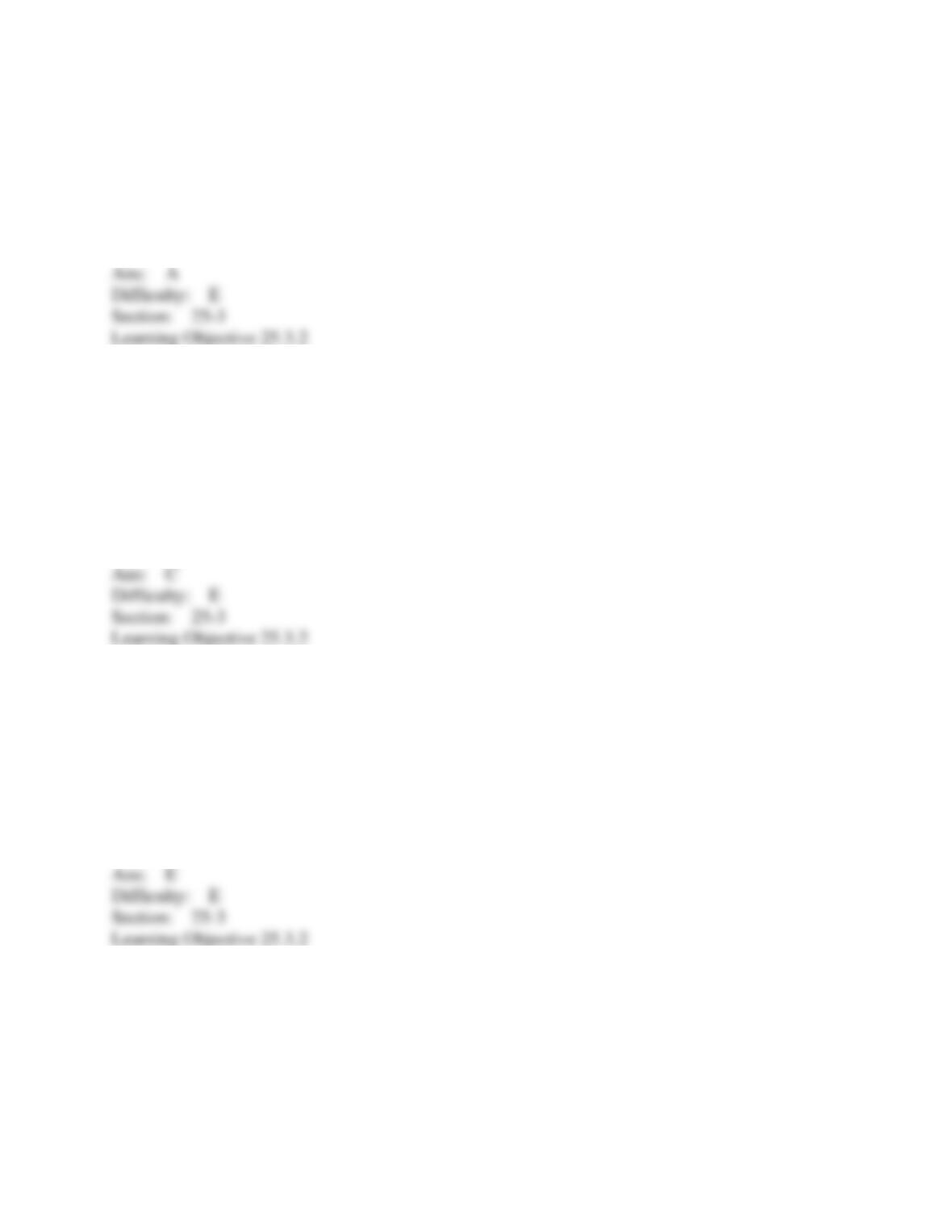
22. Each of the four capacitors shown is 500
F. The voltmeter reads 1000V. The
magnitude of the charge on each capacitor plate is:
A) 0.2 C
B) 0.5 C
C) 20 C
D) 50 C
E) none of these
23. Two parallel-plate capacitors with the same plate area but different capacitance are
connected in parallel to a battery. Both capacitors are filled with air. The quantity that is the
same for both capacitors when they are fully charged is:
A) potential difference
B) energy density
C) electric field between the plates
D) charge on the positive plate
E) plate separation
24. Two parallel-plate capacitors with different plate separation but the same capacitance are
connected in series to a battery. Both capacitors are filled with air. The quantity that is NOT the
same for both capacitors when they are fully charged is:
A) potential difference
B) stored energy
C) electric field between the plates
D) charge on the positive plate
E) dielectric constant
25. Two parallel-plate capacitors with different capacitance but the same plate separation are
connected in series to a battery. Both capacitors are filled with air. The quantity that is the same
for both capacitors when they are fully charged is:
A) potential difference
B) stored energy
C) energy density
D) electric field between the plates
E) charge on the positive plate
26. Capacitor C1 and C2 are connected in parallel. The equivalent capacitance is given by:
A) C1C2/(C1 + C2)
B) (C1 + C2)/C1C2
C) 1/(C1 + C2)
D) C1/C2
E) C1 + C2
27. A battery is used to charge a parallel combination of two identical capacitors. If the
potential difference across the battery terminals is V and the total charge Q flows through the
battery during the charging process then the charge on the positive plate of each capacitor and
the potential difference across each capacitor are:
A) Q/2 and V/2, respectively
B) Q and V, respectively
C) Q/2 and V, respectively
D) Q and V/2, respectively
E) Q and 2V, respectively
28. A 2-
F and a 1-
F capacitor are connected in series and a potential difference is applied
across the combination. The 2-
F capacitor has:
A) twice the charge of the 1-
F capacitor
B) half the charge of the 1-
F capacitor
C) twice the potential difference of the 1-
F capacitor
D) half the potential difference of the 1-
F capacitor
E) none of the above
29. A 2-
F and a 1-
F capacitor are connected in parallel and a potential difference is applied
across the combination. The 2-
F capacitor has:
A) twice the charge of the 1-
F capacitor
B) half the charge of the 1-
F capacitor
C) twice the potential difference of the 1-
F capacitor
D) half the potential difference of the 1-
F capacitor
E) none of the above
30. Capacitors C1 and C2 are connected in series and a potential difference is applied to the
combination. If the capacitor that is equivalent to the combination has the same potential
difference, then the charge on the equivalent capacitor is the same as:
A) the charge on C1
B) the sum of the charges on C1 and C2
C) the difference of the charges on C1 and C2
D) the product of the charges on C1 and C2
E) none of the above
31. Capacitors C1 and C2 are connected in series. The equivalent capacitance is given by:
A) C1C2/(C1 + C2)
B) (C1 + C2)/C1C2
C) 1/(C1 + C2)
D) C1/C2
E) C1 + C2
32. Two identical capacitors are connected in series and two, each identical to the first, are
connected in parallel. The equivalent capacitance of the series connection is ________ the
equivalent capacitance of parallel connection.
A) twice
B) four times
C) half
D) one fourth
E) the same as
33. A 2-
F and a 1-
F capacitor are connected in series and charged from a battery. They store
charges P and Q, respectively. When disconnected and charged separately using the same
battery, they have charges R and S, respectively. Then:
A) R > S > Q = P
B) P > Q > R = S
C) R > P = Q > S
D) R = P > S = Q
E) R > P > S = Q
34. Capacitors C1 and C2 are connected in parallel and a potential difference is applied to the
combination. If the capacitor that is equivalent to the combination has the same potential
difference, then the charge on the equivalent capacitor is the same as:
A) the charge on C1
B) the sum of the charges on C1 and C2
C) the difference of the charges on C1 and C2
D) the product of the charges on C1 and C2
E) none of the above
35. A battery is used to charge a series combination of two identical capacitors. If the
potential difference across the battery terminals is V and total charge Q flows through the battery
during the charging process then the charge on the positive plate of each capacitor and the
potential difference across each capacitor are:
A) Q/2 and V/2, respectively
B) Q and V, respectively
C) Q/2 and V, respectively
D) Q and V/2, respectively
E) Q and 2V, respectively
36. Two identical capacitors, each with capacitance C, are connected in parallel and the
combination is connected in series to a third identical capacitor. The equivalent capacitance of
this arrangement is:
A) 2C/3
B) C
C) 3C/2
D) 2C
E) 3C
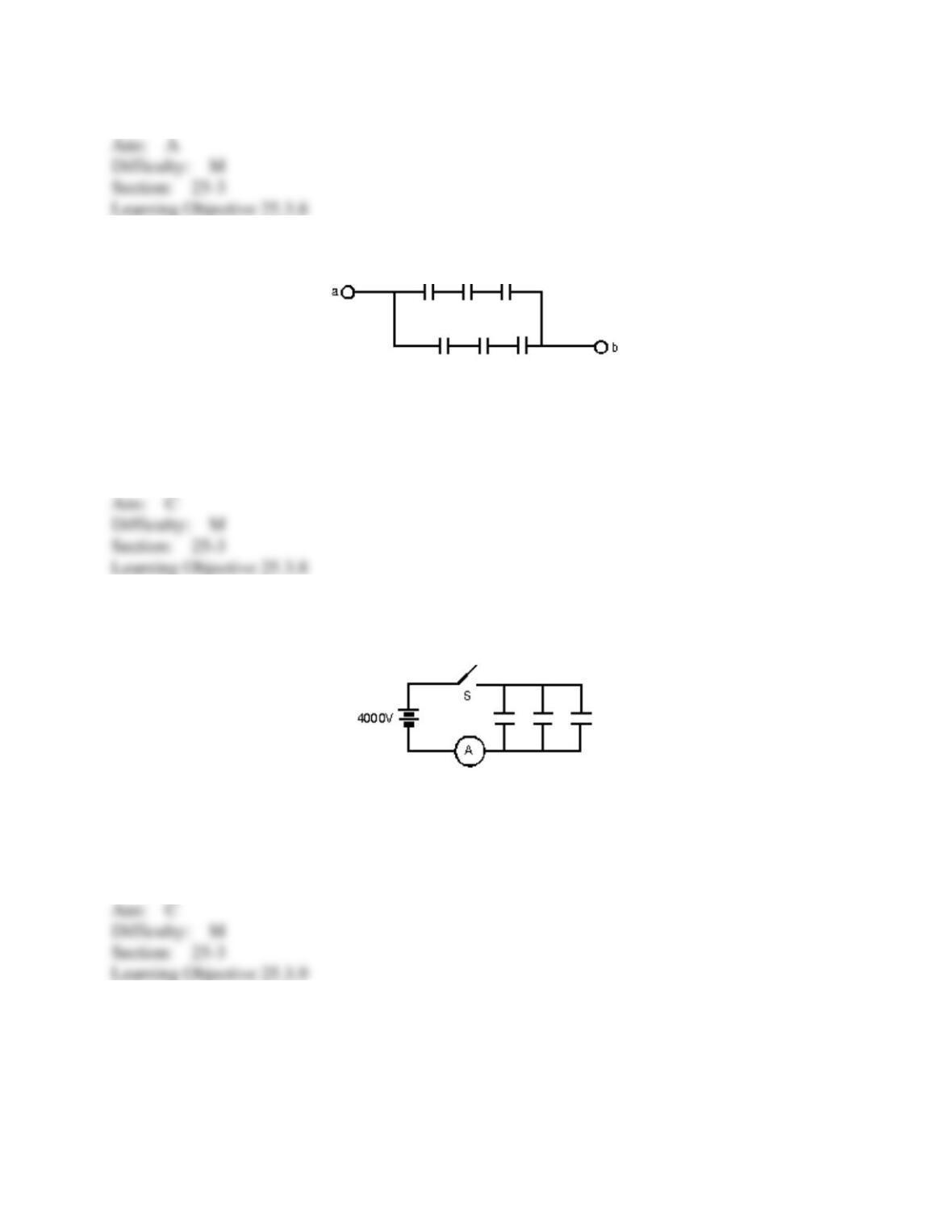
37. The diagram shows six 6-
F capacitors. The capacitance between points a and b is:
A) 1
F
B) 3
F
C) 4
F
D) 6
F
E) 9
F
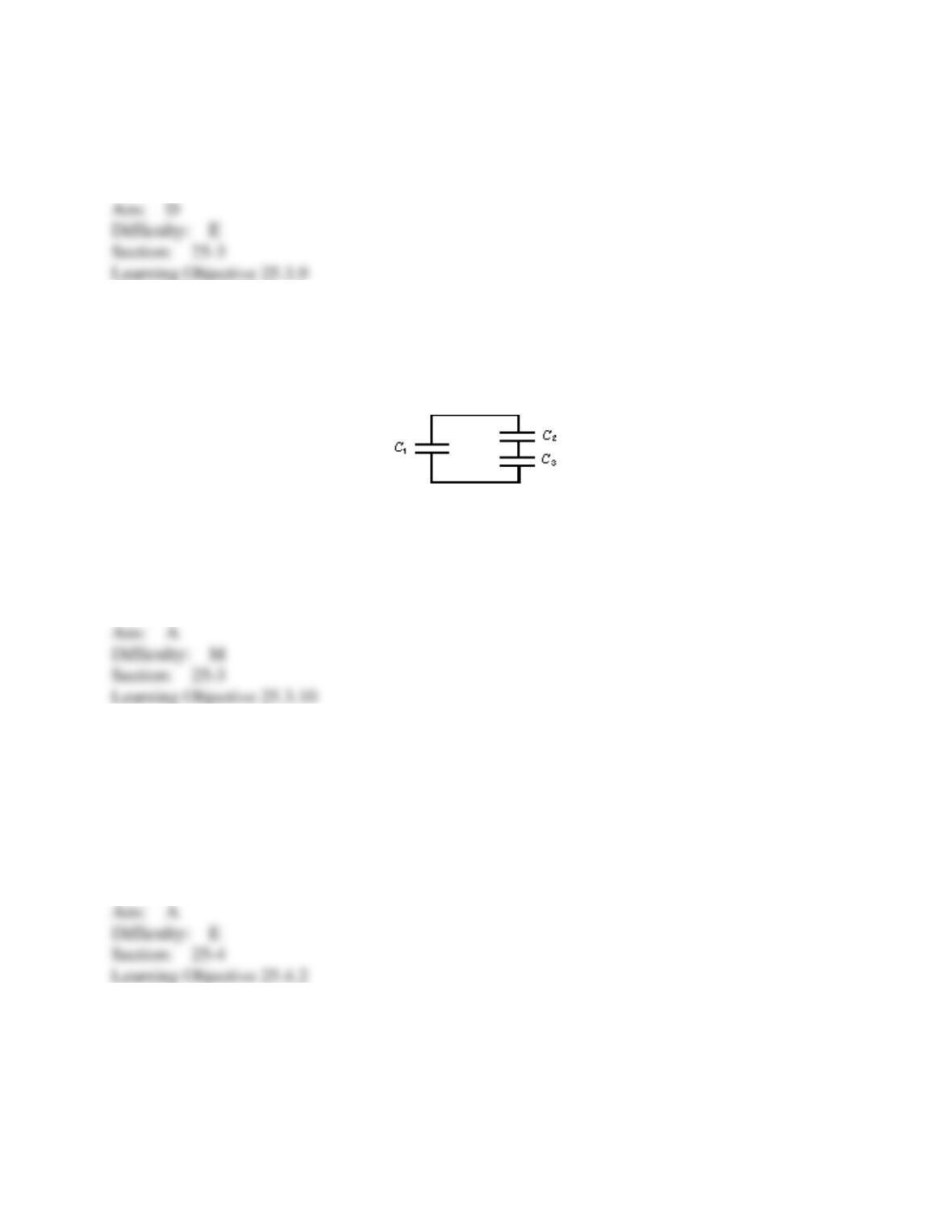
38. Each of the three 25-
F capacitors shown is initially uncharged. How many coulombs of
charge pass through the ammeter A after the switch S is closed?
A) 0.033 C
B) 0.10 C
C) 0.30 C
D) 10 C
E) none of these
39. Two parallel-plate capacitors with the same plate separation but different capacitance are
connected in parallel to a battery. Both capacitors are filled with air. The quantity that is NOT
the same for both capacitors when they are fully charged is:
A) potential difference
B) energy density
C) electric field between the plates
D) charge on the positive plate
E) dielectric constant
40. Capacitor C1 is connected alone to a battery and charged until the magnitude of the charge
on each plate is 4.0 10−8 C. Then it is removed from the battery and connected to two other
capacitors C2 and C3, as shown. The charge on the positive plate of C1 is then 1.0 10−8 C.
The charges on the positive plates of C2 and C3 are:
A) q2 = 3.0 10−-8 C and q3 = 3.0 10−8 C
B) q2 = 2.0 10−8 C and q3 = 2.0 10−8 C
C) q2 = 5.0 10−8 C and q3 = 1.0 10−8 C
D) q2 = 3.0 10−8 C and q3 = 1.0 10−8 C
E) q2 = 1.0 10−8 C and q3 = 3.0 10−8 C
41. Let Q denote charge, V denote potential difference and U denote stored energy. Of these
quantities, capacitors in series must have the same:
A) Q only
B) V only
C) U only
D) Q and U only
E) V and U only
42. Let Q denote charge, V denote potential difference and U denote stored energy. Of these
quantities, capacitors in parallel must have the same:
A) Q only
B) V only
C) U only

D) Q and U only
E) V and U only
43. A 20-µF capacitor is charged to 200 V. Its stored energy is:
A) 4000 J
B) 4 J
C) 0.4 J
D) 0.1 J
E) 0.004 J
44. A charged capacitor stores 10 C at 40 V. Its stored energy is:
A) 400 J
B) 200 J
C) 4 J
D) 2.5 J
E) 1.25 J
45. A 2-
F and a 1-
F capacitor are connected in series and charged by a battery. They store
energies P and Q, respectively. When disconnected and charged separately using the same
battery, they have energies R and S, respectively. Then:
A) R > P > S > Q
B) P > Q > R > S
C) R > P > Q > S
D) P > R > S > Q
E) R > S > Q > P
46. Capacitors A and B are identical. Capacitor A is charged so it stores 4 J of energy and
capacitor B is uncharged. The capacitors are then connected in parallel. The total stored energy
in the capacitors is now:
A) 16 J
B) 8 J
C) 4 J
D) 2 J
E) 1 J
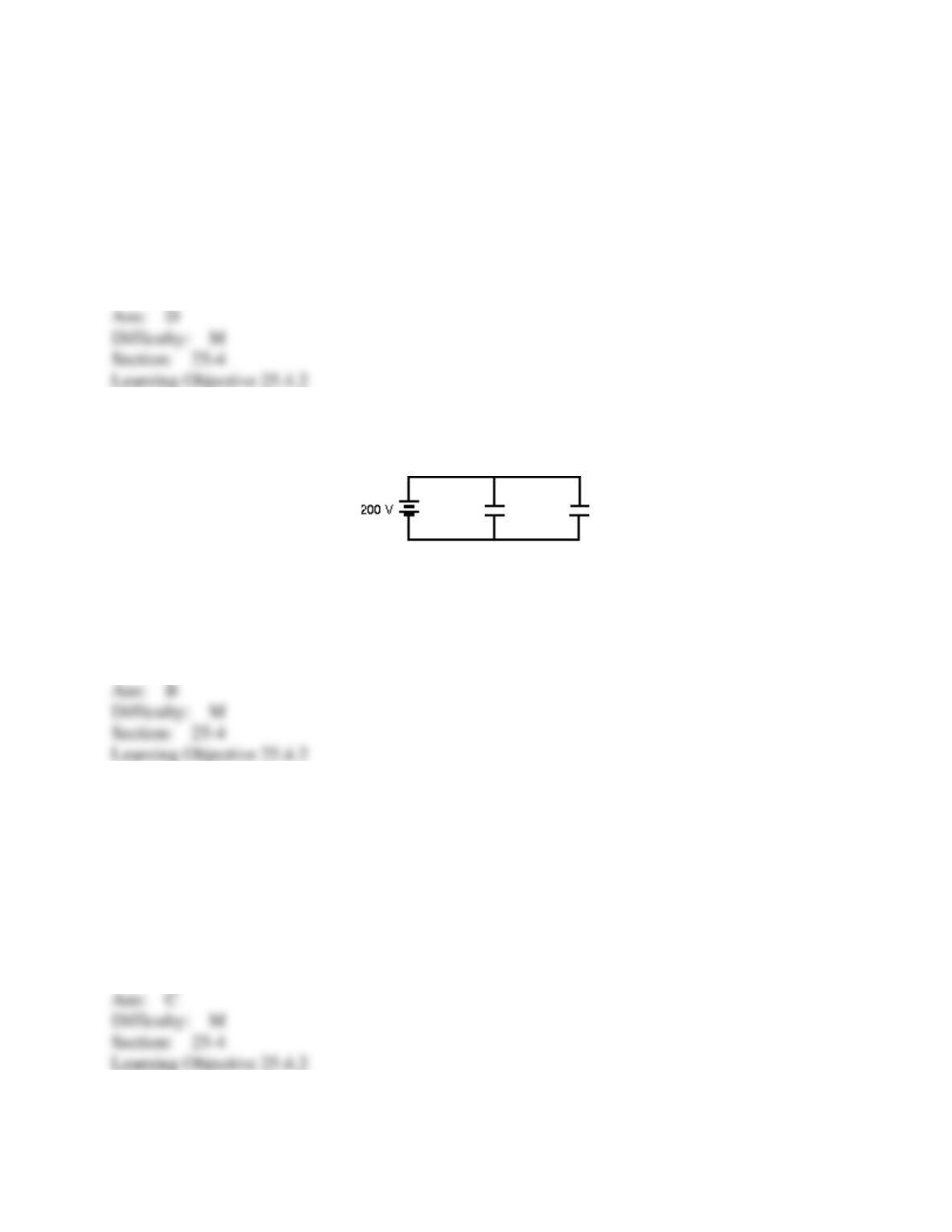
47. To store a total of 0.040 J of energy in the two identical capacitors shown, each should
have a capacitance of:
A) 0.50
F
B) 1.0
F
C) 1.5
F
D) 2.0
F
E) 4.0
F
48. A certain capacitor has a capacitance of 5.0
F. After it is charged to 5
C and isolated, the
plates are brought closer together so its capacitance becomes 10
F. The work done by the agent
is about:
A) 0 J
B) 1.25 10–6 J
C) −1.25 10–6 J
D) 8.3 10–7 J
E) −8.3 10–7 J
49. A battery is used to charge a parallel-plate capacitor, after which it is disconnected. Then
the plates are pulled apart to twice their original separation. This process will double the:
A) capacitance
B) surface charge density on each plate
C) stored energy
D) electric field between the two places
E) charge on each plate
50. A parallel-plate capacitor has a plate area of 0.30 m2 and a plate separation of 0.10 mm. If the
charge on each plate has a magnitude of 5.0 10–6 C, what is the energy density in its electric
field?
A) 0.16 J/m3
B) 3.5 J/m3
C) 7.8 J/m3
D) 16 J/m3
E) 24 J/m3
51. The quantity (1/2)0E2 has the dimensions of:
A) energy/farad
B) energy/coulomb
C) energy
D) energy/volume
E) energy/volt
52. There are approximately 10 explosions in the US every year due to agricultural grain (corn
and soybean) dust. Why is corn dust so dangerous?
A) Corn contains a lot of oil and is therefore very flammable.
B) Grain elevators use a lot of flammable material while processing the corn.
C) Corn dust has a lot of surface area and can be ignited by even a very small spark, which can
be created simply by a person walking around.
D) Due to the presence of lots of agricultural material, grain elevators are especially rich in
oxygen.

E) Workers are not careful about where they throw their cigarette butts, and sometimes set the
corn on fire.
53. An air-filled parallel-plate capacitor has a capacitance of 1 pF. The plate separation is then
doubled and a wax dielectric is inserted, completely filling the space between the plates. As a
result, the capacitance becomes 2 pF. The dielectric constant of the wax is:
A) 0.25
B) 0.50
C) 2.0
D) 4.0
E) 8.0
54. One of the materials listed below is to be placed between two identical metal sheets, with
no air gap, to form a parallel-plate capacitor. Which produces the greatest capacitance?
A) material of thickness 0.1 mm and dielectric constant 2
B) material of thickness 0.2 mm and dielectric constant 3
C) material of thickness 0.3 mm and dielectric constant 2
D) material of thickness 0.4 mm and dielectric constant 8
E) material of thickness 0.5 mm and dielectric constant 11
55. Which of the following is not a dielectric?
A) silicon
B) germanium
C) polystyrene
D) titanium
E) paper
56. A dielectric slab is slowly inserted between the plates of a parallel plate capacitor while the
capacitor is connected to a battery. As it is being inserted:
A) the capacitance, the potential difference between the plates, and the charge on the positive
plate all increase
B) the capacitance, the potential difference between the plates, the charge on the positive plate
all decrease
C) the potential difference between the plates increases, the charge on the positive plate
decreases, and the capacitance remains the same
D) the capacitance and the charge on the positive plate decrease but the potential difference
between the plates remains the same
E) the capacitance and the charge on the plate increase but the potential difference between the
plates remains the same
57. A parallel-plate capacitor, with air dielectric, is charged by a battery, after which the
battery is disconnected. A slab of glass dielectric is then slowly inserted between the plates. As it
is being inserted:
A) a force repels the glass out of the capacitor
B) a force attracts the glass into the capacitor
C) no force acts on the glass
D) a net charge appears on the glass
E) the glass makes the plates repel each other
58. What is the difference between a polar dielectric and a nonpolar dielectric?
A) A polar dielectric has a permanent electric field.
B) A nonpolar dielectric never has an internal electric field.
C) The molecules of a polar dielectric have a permanent electric dipole moment.
D) A nonpolar dielectric can have an induced electric field in any direction.
E) A polar dielectric is always aligned with the Earth’s electric field.
59. What happens to the atoms in a dielectric when it is placed between the plates of a charged

capacitor?
A) They begin to conduct electricity.
B) They create an induced electric field that is in the opposite direction of the field due to the
charges on the plates.
C) They create an induced electric field that is in the same direction as the field due to the
charges on the plates.
D) They completely cancel the electric field due to the charges on the plates.
E) They rotate so their positive ends are towards the positively charged plate.
60. An air-filled capacitor is charged, and then a dielectric is inserted. As a result, there is an
induced charge on the dielectric. What is the difference between induced charge and free charge?
A) There is no difference.
B) Induced charge does not result in a net charge on the dielectric.
C) Induced charge is smaller than free charge.
D) Free charge creates an electric field, but induced charge does not.
E) Free charge creates an electric potential, but induced charge does not.
61. Two capacitors are identical except that one is filled with air and the other with oil. Both
capacitors carry the same charge. The ratio of the electric fields Eair/Eoil is:
A) between 0 and 1
B) 0
C) 1
D) between 1 and infinity
E) infinite