Chapter: Chapter 4
Learning Objectives:
LO 4.1.0 Solve problems related to position and displacement
LO 4.1.1 Draw the components of a 2D or 3D position vector of a particle, indicating the
components.
LO 4.1.2 Determine the direction and magnitude of a position vector from its components, and
vice versa.
LO 4.1.3 Apply the relationship between a particle’s displacement vector and its initial and final
position vectors.
LO 4.2.0 Solve problems related to average velocity and instantaneous velocity
LO 4.2.1 Identify that velocity is a vector quantity and thus has both magnitude and direction and
also has components.
LO 4.2.2 Draw the components of a 2D or 3D velocity vector of a particle, indicating the
components.
LO 4.2.3 In magnitude-angle and unit-vector notations, relate a particle’s initial and final
position vectors, the time interval between those positions, and the particle’s average velocity
vector.
LO 4.2.4 Given a particle’s position vector as a function of time, determine its (instantaneous)
velocity vector.
LO 4.3.0 Solve problems related to average acceleration and instantaneous acceleration
LO 4.3.1 Identify that acceleration is a vector quantity and thus has both magnitude and direction
and also has components.
LO 4.3.2 Draw the components of a 2D or 3D acceleration vector of a particle, indicating the
components.
LO 4.3.3 Given the initial and final velocity vectors of a particle and the time interval between
those velocities, determine the average acceleration vector in magnitude-angle and unit-vector
notations.
LO 4.3.4 Given a particle’s velocity vector as a function of time, determine its (instantaneous)
acceleration vector.
LO 4.3.5 For each dimension of motion, apply the constant-acceleration equations (Chapter 2) to
relate acceleration, velocity, position, and time.
LO 4.4.0 Solve problems related to projectile motion
LO 4.4.1 On a sketch of the path taken in projectile motion, explain the magnitudes and
directions of the velocity and acceleration components during the flight.
LO 4.4.2 Given the launch velocity in either magnitude-angle or unit-vector notation, calculate
the particle’s position, displacement, and velocity at a given instant during the flight.
LO 4.4.3 Given data for an instant during the flight, calculate the launch velocity.
LO 4.5.0 Solve problems related to uniform circular motion
LO 4.5.1 Sketch the path taken in uniform circular motion and explain the velocity and
acceleration vectors (magnitude and direction) during the motion.
LO 4.5.2 Apply the relationships between the radius of the circular path, the period, the particle’s
speed, and the particle’s acceleration magnitude.
LO 4.6.0 Solve problems related to relative motion in one dimension
LO 4.6.1 Apply the relationship between a particle’s position, velocity, and acceleration as
measured from two reference frames that move relative to each other at constant velocity and
along a single axis.
LO 4.7.0 Solve problems related to relative motion in two dimensions
LO 4.7.1 Apply the relationship between a particle’s position, velocity, and acceleration as
measured from two reference frames that move relative to each other at constant velocity and in
two dimensions.
Multiple Choice
1. Which of the following is a scalar quantity?
A) Speed
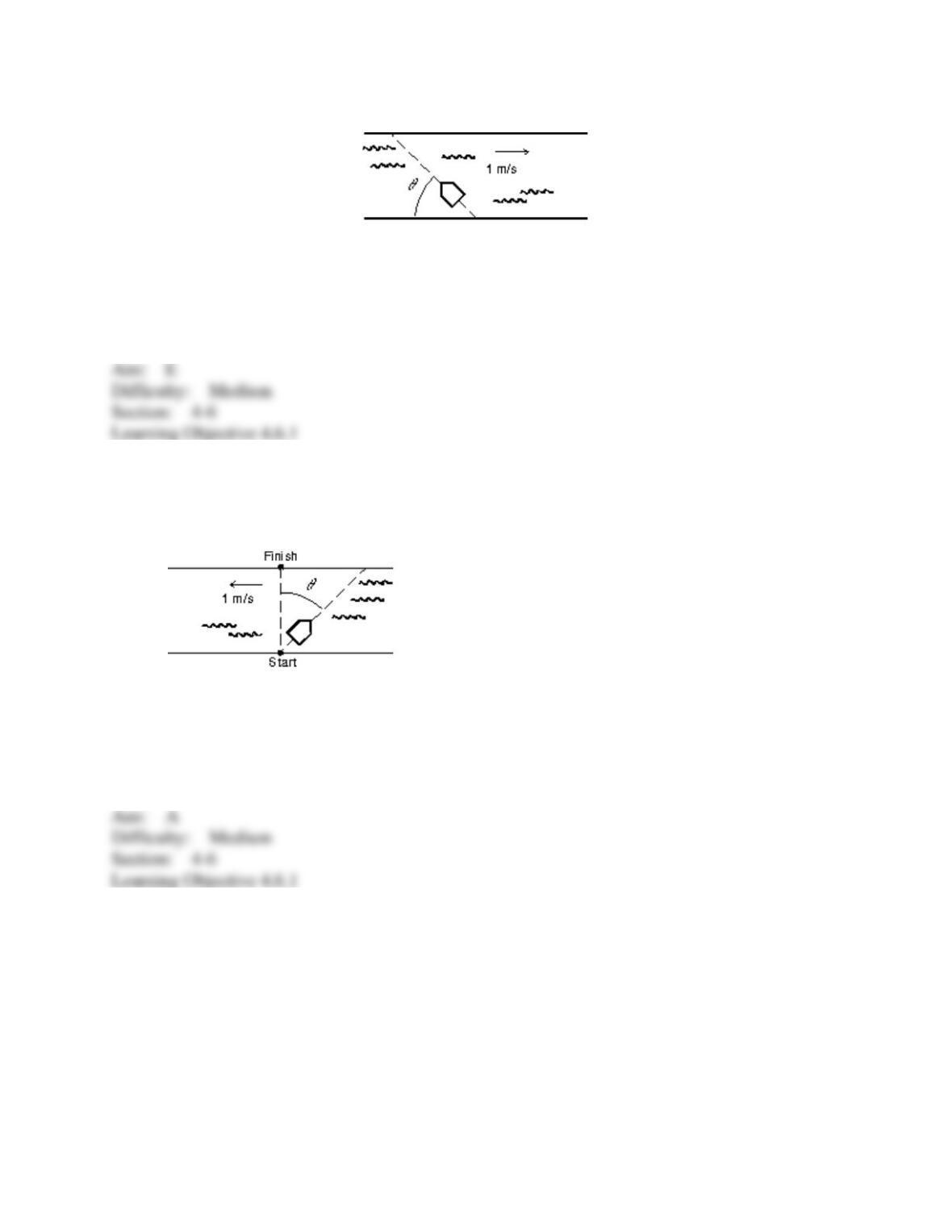
B) Velocity
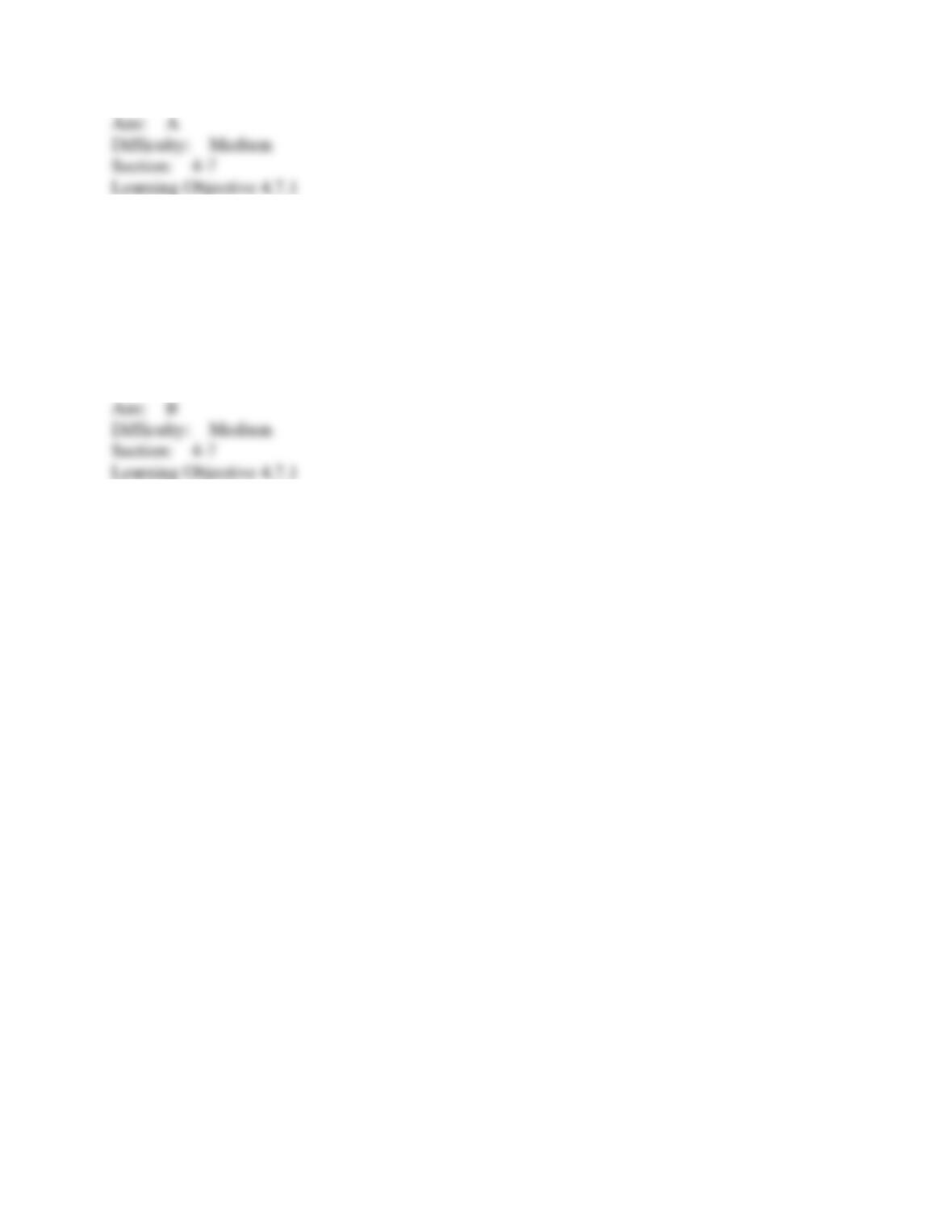
C) Displacement
D) Acceleration
E) None of these
2. Velocity is defined as:
A) rate of change of position with time
B) position divided by time
C) rate of change of acceleration with time
D) a speeding up or slowing down
E) change of position
3. Which of the following is a vector quantity?
A) Mass
B) Density
C) Speed
D) Temperature
E) None of these
4. Sally starts from home, walks 300 m east and then 500 m south, and arrives at her school.
How far, in a straight line, is Sally’s school from her home?
A) 300 m
B) 500 m
C) 580 m
D) 640 m
E) 800 m
5. From your window you can see a high-rise building several blocks away. You check the map
and see that the building is 560 m away from you in a straight line, in a direction 30° south of
east. However, the roads are all east-west and north-south. If you want to walk from your house
to the building, how far in each direction do you have to walk?
A) 480 m east and 280 m south
B) 280 m east and 480 m south
C) 280 m east and 280 m south
D) 480 m east and 50 m south
E) cannot be determined without looking at the streets on the map
6. A particle goes from x = –2 m, y = 3 m, z = 1 m to x = 3 m, y = –1 m, z = 4 m. Its
displacement is:
A) (1 m)𝑖̂ + (2 m)𝑗̂ + (5 m)𝑘
̂
B) (5 m)𝑖̂ − (4 m)𝑗̂ + (3 m)𝑘
̂
C) −(5 m)𝑖̂ + (4 m)𝑗̂ − (3 m)𝑘
̂
D) −(1 m)𝑖̂ − (2 m)𝑗̂ − (5 m)𝑘
̂
E) −(5 m)𝑖̂ − (2 m)𝑗̂ − (3 m)𝑘
̂
7. A jet plane in straight horizontal flight passes over your head. When it is directly above you,
the sound seems to come from a point behind the plane in a direction 30 from the vertical. The
speed of the plane is:
A) the same as the speed of sound
B) half the speed of sound
C) three-fifths the speed of sound
D) 0.866 times the speed of sound
E) twice the speed of sound
8. What is the difference between speed and velocity?
A) Speed is the magnitude of velocity; velocity is a vector and has both magnitude and direction.
B) There is no difference.
C) Speed is the rate at which something moves, while velocity is the direction in which it moves.
D) Speed is used when describing motion in one dimension, while velocity is used when
describing motion in two dimensions.
E) Speed is the rate at which velocity changes.
9. An object moves from x = –2.1 m, y = 3.7 m, z = 1.4 m to x = 3.3 m, y = –1.1 m, z = 4.2 m in a
time of 5.3 s. What is its average velocity?
A) (0.23 m/s)𝑖̂ + (0.49 m/s)𝑗̂ + (0.53 m/s)𝑘
̂
B) (5.4 m/s)𝑖̂ − (4.8 m/s)𝑗̂ + (2.8 m/s)𝑘
̂
C) (1.0 m/s)𝑖̂ − (0.91 m/s)𝑗̂ + (0.53 m/s)𝑘
̂
D) (1.0 m/s)𝑖̂ + (0.91 m/s)𝑗̂ + (1.1 m/s)𝑘
̂
E) −(1.0 m/s)𝑖̂ + (0.91 m/s)𝑗̂ + (0.53 m/s)𝑘
̂
10. An object moves from x = –2.1 m, y = 3.7 m to x = 3.3 m, y = –1.1 m in a time of 5.3 s. What
is its average velocity?
A) 7.2 m/s, 32° below the positive x-axis
B) 2.5 m/s, 48° below the positive x-axis
C) 1.4 m/s, 42° below the positive x-axis
D) 4.9 m/s, 76° below the positive x-axis
E) 0.92 m/s, 14° below the positive x-axis
11. The position of an object as a function of time is given in meters by x = (at + bt2)𝑖̂ + (ct)𝑗̂.
What is its velocity as a function of time?
A) v = (a + b)𝑖̂ + (c)𝑗̂
B) v = (a + 2b)𝑖̂ + (c)𝑗̂
C) v = (a + 2bt)𝑖̂ + (c)𝑗̂
D) v = b𝑖̂
E) v = 2b𝑖̂
12. A plane traveling north at 200 m/s turns and then travels south at 200 m/s. The change in its
velocity is:
A) 0 m/s
B) 200 m/s north
C) 200 m/s south
D) 400 m/s north
E) 400 m/s south
13. Acceleration is defined as:
A) rate of change of position with time
B) speed divided by time
C) rate of change of velocity with time
D) a speeding up or slowing down
E) change of velocity
14. Which of the following is NOT an example of accelerated motion?
A) Vertical component of projectile motion
B) Circular motion at constant speed
C) A swinging pendulum
D) Earth’s motion about sun
E) Horizontal component of projectile motion
15. An object has a velocity of (5.4 m/s)𝑖̂ − (4.8 m/s)𝑗̂. Over a period of 1.3 s, its velocity
changes to (1.7 m/s)𝑖̂ + (5.9 m/s)𝑗̂. What is its acceleration?
A) −(3.7 m/s)𝑖̂ + (11 m/s)𝑗̂
B) −(2.8 m/s)𝑖̂ + (8.2 m/s)𝑗̂
C) (3.7 m/s)𝑖̂ + (11 m/s)𝑗̂
D) (2.8 m/s)𝑖̂ + (8.2 m/s)𝑗̂
E) −(2.8 m/s)𝑖̂ + (1.1 m/s)𝑗̂
16. The velocity of an object as a function of time is given by v = (12.5t − 7.2t2)𝑖̂ + (4.3t3)𝑗̂.
What is its acceleration as a function of time?
A) a = (12.5 − 14.4t)𝑖̂ + (12.9t2)𝑗̂
B) a = (−7.2)𝑖̂ + (4.3t)𝑗̂
C) a = (5.3t)𝑖̂ + (12.9t2)𝑗̂
D) a = (−7.2)𝑖̂ + (8.6t)𝑗̂
E) a = (−14.4t)𝑖̂ + (4.3t2)𝑗̂
17. An object is at rest at x = 0 m, y = 0 m. It accelerates at a rate of (−3.2 m/s2)𝑖̂ + (8.6 m/s2)𝑗̂.
After accelerating for 4.7 seconds its coordinates are:
A) x = −15 m, y = 40 m
B) x = −35 m, y = 95 m
C) x = −24 m, y = 170 m
D) x = −70 m, y = 190 m
E) x = −48 m, y = 340 m
18. Two bodies are falling with negligible air resistance, side by side, above a horizontal plane.
If one of the bodies is given an additional horizontal acceleration during its descent, it:
A) strikes the plane at the same time as the other body
B) strike the plane earlier than the other body
C) has the vertical component of its velocity altered
D) has the vertical component of its acceleration altered
E) follows a straight line path along the resultant acceleration vector
19. The velocity of a projectile equals its initial velocity added to:
A) a constant horizontal velocity
B) a constant vertical velocity
C) a constantly increasing horizontal velocity
D) a constantly increasing downward velocity
E) a constant velocity directed at the target
20. Identical guns fire identical bullets horizontally at the same speed from the same height
above level planes, one on the Earth and one on the Moon. Which of the following three
statements is/are true?
I. The horizontal distance traveled by the bullet is greater for the Moon.
II. The flight time is less for the bullet on the Earth.
III. The velocities of the bullets at impact are the same.
A) III only
B) I and II only
C) I and III only
D) II and III only
E) I, II, III
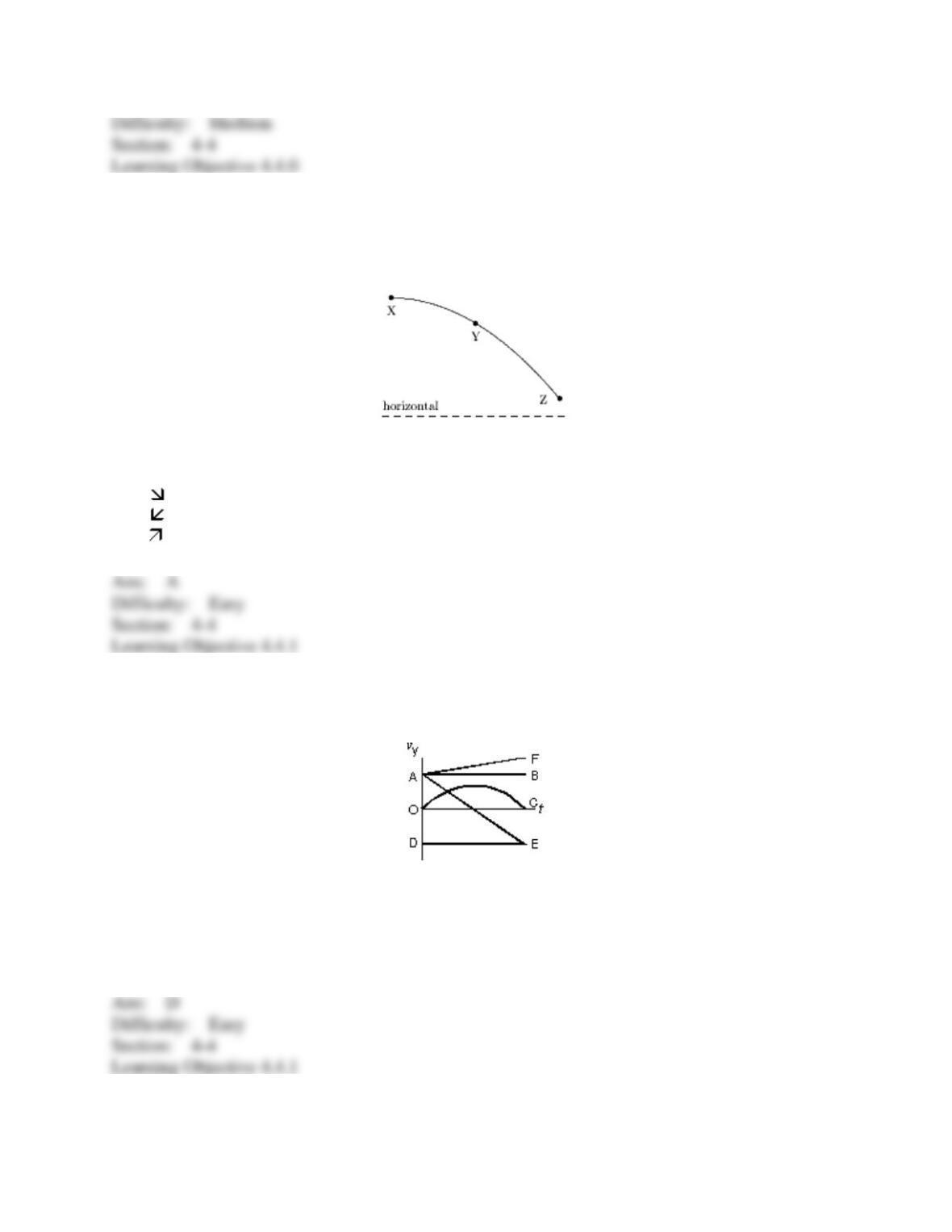
21. A stone is thrown horizontally and follows the path XYZ shown. The direction of the
acceleration of the stone at point Y is:
A)
B) →
C)
D)
E)
22. Which of the curves on the graph below best represents the vertical component vy versus t
for a projectile fired at an angle of 45 above the horizontal?
A) OC
B) DE
C) AB
D) AE
E) AF
23. A bullet shot horizontally from a gun:
A) strikes the ground much later than one dropped vertically from the same point at the same
instant
B) never strikes the ground
C) strikes the ground at approximately the same time as one dropped vertically from the same
point at the same instant
D) travels in a straight line
E) strikes the ground much sooner than one dropped from the same point at the same instant
24. A bomber flying in level flight with constant velocity drops a bomb before it is over the
target. Neglecting air resistance, which one of the following is NOT true?
A) The bomber is over the target when the bomb strikes
B) The acceleration of the bomb is constant
C) The horizontal velocity of the plane equals the vertical velocity of the bomb when it hits the
target
D) The bomb travels in a curved path
E) The time of flight of the bomb is independent of the horizontal speed of the plane
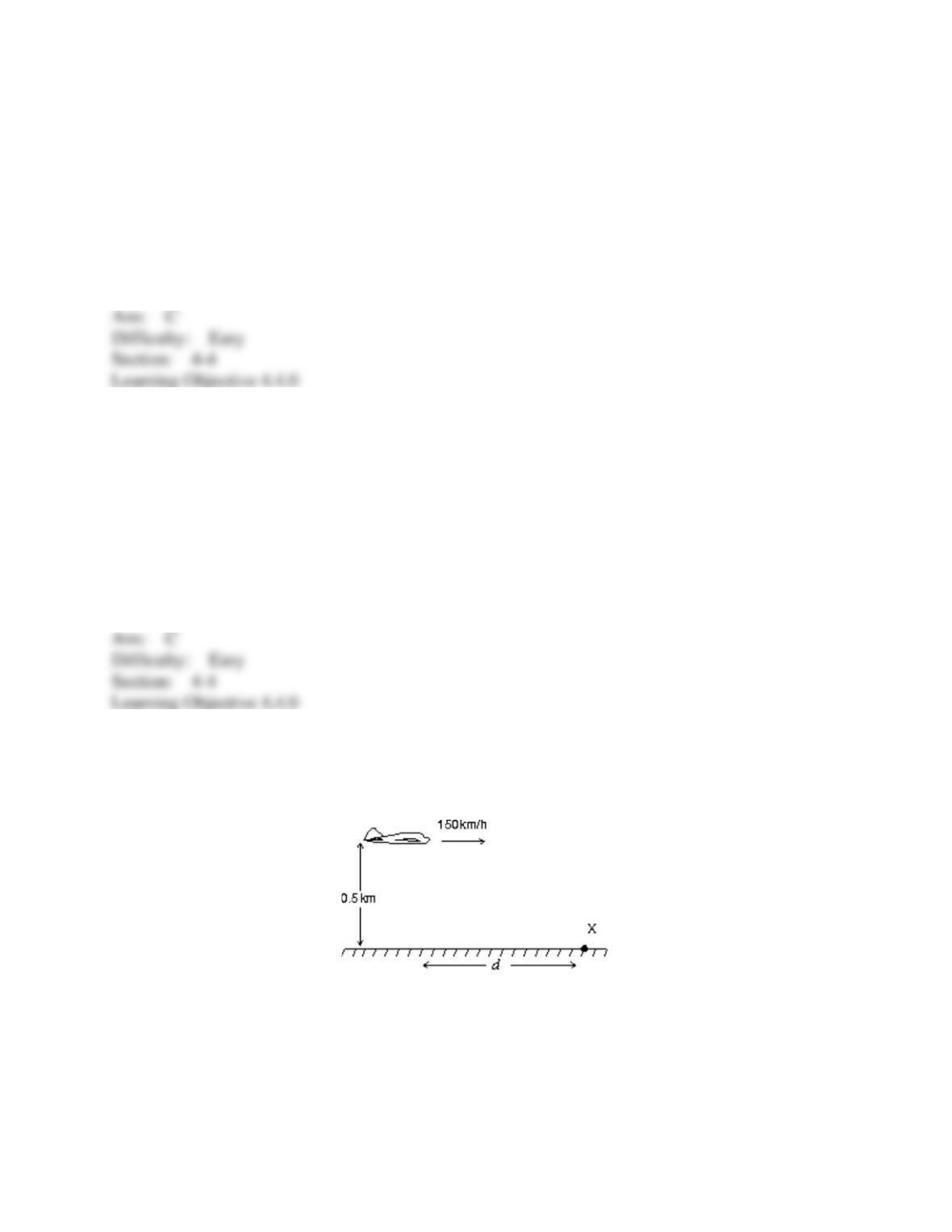
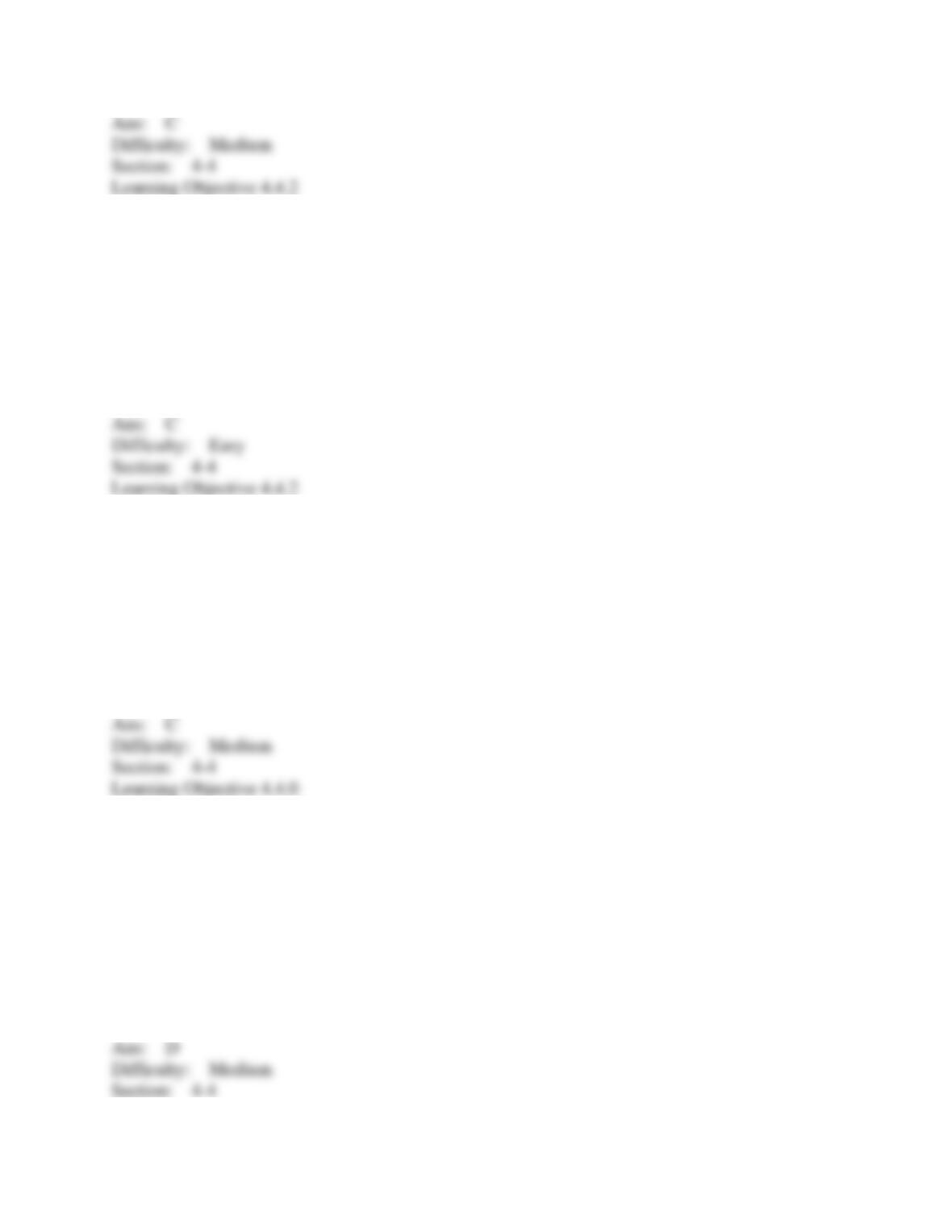
25. The airplane shown is in level flight at an altitude of 0.50 km and a speed of 150 km/h. At
what distance d should it release a heavy bomb to hit the target X? Take g = 10 m/s2.
A) 150 m
B) 295 m
C) 417 m
D) 1500 m
E) 15,000 m
26. An object is shot from the back of a railroad flatcar moving at 40 km/h on a straight
horizontal road. The launcher is aimed upward, perpendicular to the bed of the flatcar. The object
falls:
A) in front of the flatcar
B) behind the flatcar
C) on the flatcar
D) either behind or in front of the flatcar, depending on the initial speed of the object
E) to the side of the flatcar
27. A stone is thrown outward from the top of a 59.4-m high cliff with an upward velocity
component of 19.5 m/s. How long is the stone in the air? Assume that it lands on the ground
below the cliff, and that the ground below the cliff is flat.
A) 4.00 s
B) 5.00 s
C) 6.00 s
D) 7.00 s
E) 8.00 s
28. A large cannon is fired from ground level over level ground at an angle of 30 above the
horizontal. The muzzle speed is 980 m/s. Neglecting air resistance, the projectile will travel what
horizontal distance before striking the ground?
A) 4.3 km
B) 8.5 km
C) 43 km
D) 85 km
E) 170 km
29. A boy on the edge of a vertical cliff 20 m high throws a stone horizontally outwards with a
speed of 20 m/s. It strikes the ground at what horizontal distance from the foot of the cliff? Use g
= 10 m/s2
A) 10 m
B) 40 m
C) 50 m
D) 50√5 m
E) none of these
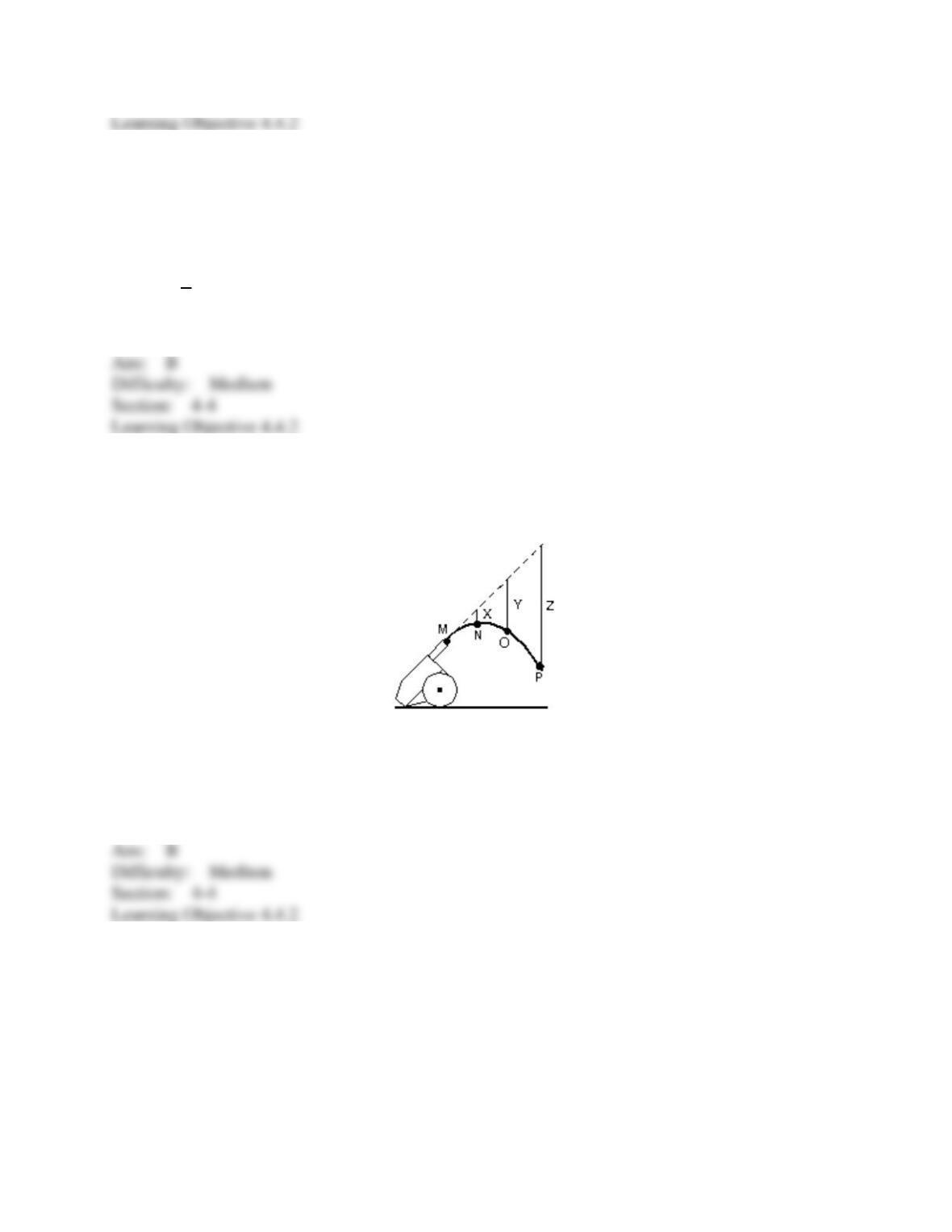
30. A cannon fires a projectile as shown. The dashed line shows the trajectory in the absence of
gravity; points MNOP correspond to the position of the projectile at one second intervals. If g =
10 m/s2, the lengths X,Y,Z are:
A) 5 m, 10 m, 15 m
B) 5 m, 20 m, 45 m
C) 10 m, 40 m, 90 m
D) 10 m, 20 m, 30 m
E) 0.2 m, 0.8 m, 1.8 m
31. A dart is thrown horizontally toward X at 20 m/s as shown. It hits Y 0.1 s later. The
distance XY is:
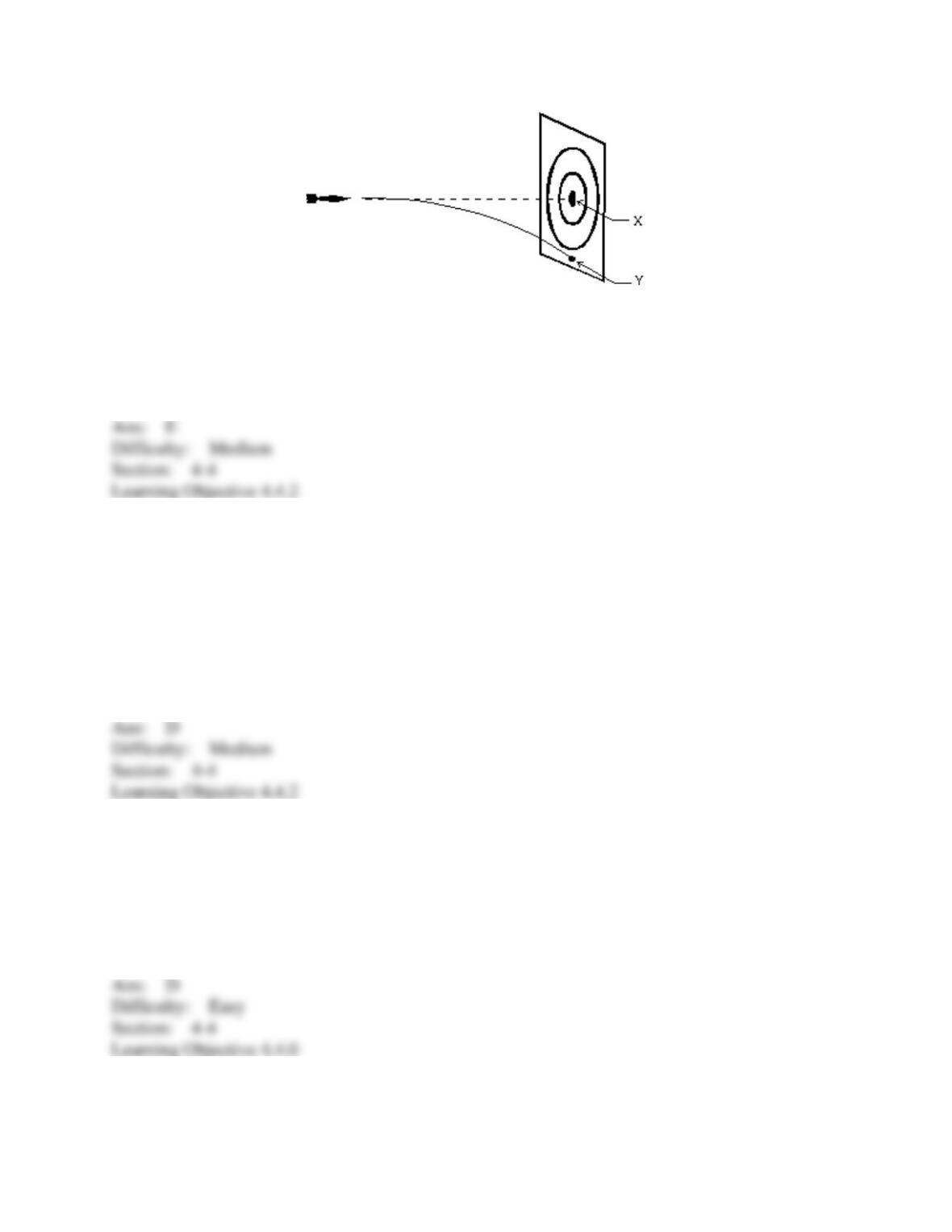
A) 2 m
B) 1 m
C) 0.5 m
D) 0.1 m
E) 0.05 m
32. A projectile is fired over level ground with an initial velocity that has a vertical component
of 20 m/s and a horizontal component of 30 m/s. Using g = 10 m/s2, the distance from launching
to landing points is:
A) 40 m
B) 60 m
C) 80 m
D) 120 m
E) 180 m
33. A stone thrown from the top of a tall building follows a path that is:
A) circular
B) made of two straight line segments
C) hyperbolic
D) parabolic
E) a straight line
34. Two projectiles are in flight at the same time. The acceleration of one relative to the other:
A) is always 9.8 m/s2
B) can be as large as 19.6 m/s2
C) can be horizontal
D) is zero
E) none of these
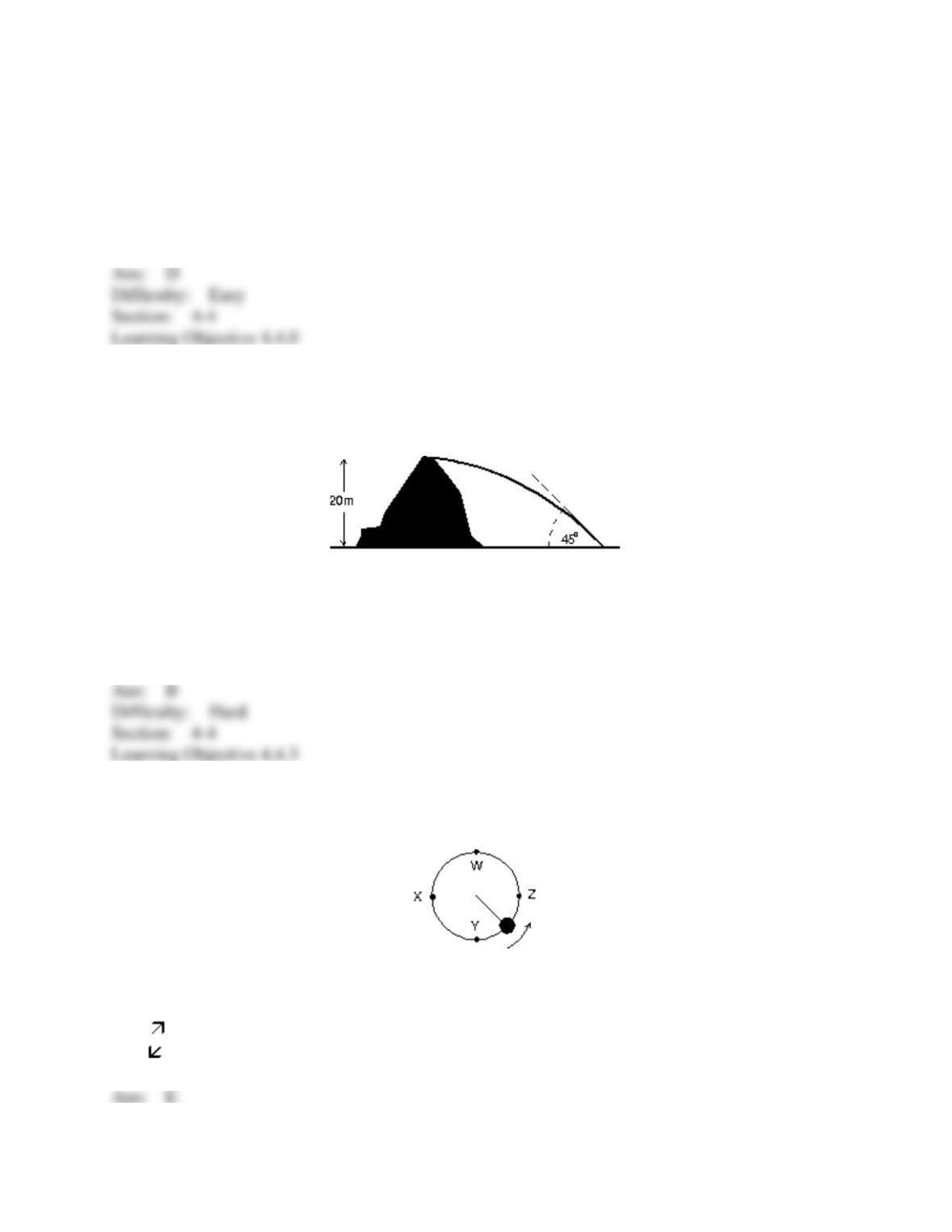
35. A ball is thrown horizontally from the top of a 20-m high hill. It strikes the ground at an
angle of 45. With what speed was it thrown? Use g = 10 m/s2.
A) 14 m/s
B) 20 m/s
C) 28 m/s
D) 32 m/s
E) 40 m/s
36. An object, tied to a string, moves in a circle at constant speed on a horizontal surface as
shown. The direction of the displacement of this object, as it travels from W to X is:
A)
B)
C)
D)
E)
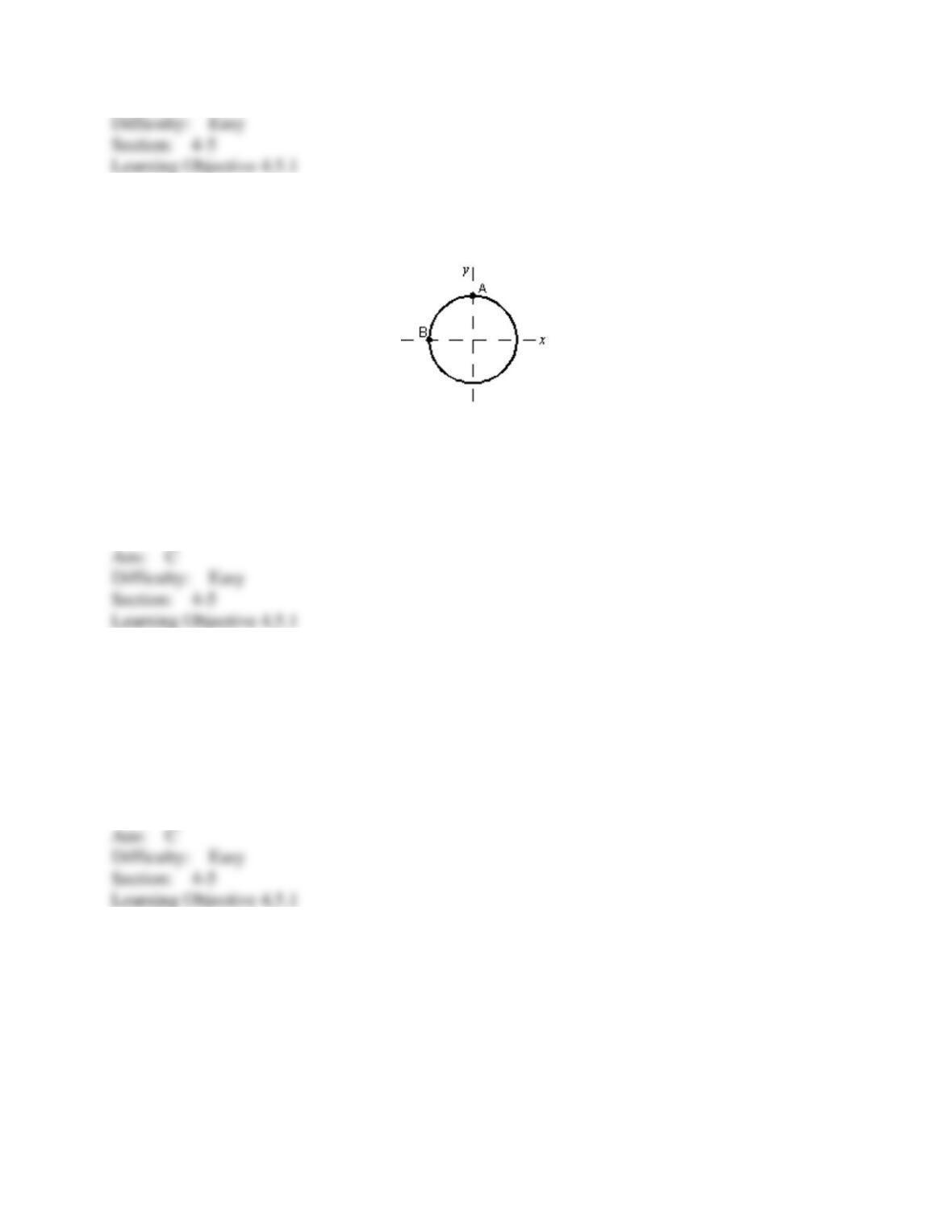
37. A toy racing car moves with constant speed around the circle shown below. When it is at
point A its coordinates are x = 0, y = 3m and its velocity is (6 m/s)𝑖̂. When it is at point B its
velocity and acceleration are:
A) −(6 m/s)𝑗̂ and (12 m/s2)𝑖̂, respectively
B) (6 m/s)𝑗̂ and −(12 m/s2)𝑖̂, respectively
C) (6 m/s)𝑗̂ and (12 m/s2)𝑖̂, respectively
D) (6 m/s)𝑖̂ and (12 m/s2)𝑗̂, respectively
E) (6 m/s)𝑗̂ and 0 m/s2, respectively
38. A particle moves at constant speed in a circular path. The instantaneous velocity and
instantaneous acceleration vectors are:
A) both tangent to the circular path
B) both perpendicular to the circular path
C) perpendicular to each other
D) opposite to each other
E) none of the above
39. An airplane makes a gradual 90 turn while flying at a constant speed of 200 m/s. The
process takes 20.0 seconds to complete. For this turn the magnitude of the average acceleration
of the plane is:
A) 0 m/s2
B) 40 m/s2
C) 20 m/s2
D) 14 m/s2
E) 10 m/s2
40. An airplane is flying north at 500 km/h. It makes a gradual 180 turn at constant speed,
changing its direction of travel from north through east to south. The process takes 40 s. The
average acceleration of the plane for this turn is:
A) 12.5 km/hs, north
B) 12.5 km/hs, east
C) 12.5 km/hs, south
D) 25 km/hs, north
E) 25 km/hs, south
41. An object is moving on a circular path of radius meters at a constant speed of 4.0 m/s.
The time required for one revolution is:
A) 2/2 s
B) 2/2 s
C) /2 s
D) 2/4 s
E) 2/ s
42. A stone is tied to a string and whirled at constant speed in a horizontal circle. The speed is
then doubled without changing the length of the string. Afterward the magnitude of the
acceleration of the stone is:
A) the same
B) twice as great
C) four times as great
D) half as great
E) one-fourth as great
43. Two objects are traveling around different circular orbits with constant speed. They both
have the same acceleration but object A is traveling twice as fast as object B. The orbit radius
for object A is _______ the orbit radius for object B.
A) one-fourth
B) one-half
C) the same as
D) twice
E) four times
44. A stone is tied to a 0.50-m string and whirled at a constant speed of 4.0 m/s in a vertical
circle. Its acceleration at the top of the circle is:
A) 9.8 m/s2, up
B) 9.8 m/s2, down
C) 8.0 m/s2, down
D) 32 m/s2, up
E) 32 m/s2, down
45. A stone is tied to a 0.50-m string and whirled at a constant speed of 4.0 m/s in a vertical
circle. The acceleration at the bottom of the circle is:
A) 9.8 m/s2, up
B) 9.8 m/s2, down
C) 8.0 m/s2, up
D) 32 m/s2, up
E) 32 m/s2, down
46. A car rounds a 20-m radius curve at a speed of 10 m/s. The magnitude of its acceleration is:
A) 0 m/s2
B) 0.20 m/s2
C) 5.0 m/s2
D) 40 m/s2
E) 400 m/s2
47. For a biological sample in a 1.0-m radius centrifuge to have a centripetal acceleration of
25g its speed must be:
A) 11 m/s
B) 16 m/s
C) 50 m/s
D) 122 m/s
E) 245 m/s
48. A girl jogs around a horizontal circle with a constant speed. She travels one fourth of a
revolution, a distance of 25 m along the circumference of the circle, in 5.0 s. The magnitude of
her acceleration is:
A) 0.31 m/s2
B) 1.3 m/s2
C) 1.6 m/s2
D) 3.9 m/s2
E) 6.3 m/s2
49. A stone is tied to the end of a string and is swung with constant speed around a horizontal
circle with a radius of 1.5 m. If it makes two complete revolutions each second, its acceleration
is:
A) 0.24 m/s2
B) 2.4 m/s2
C) 24 m/s2
D) 240 m/s2
E) 2400 m/s2
Learning Objective 4.5.2
50. A Ferris wheel with a radius of 8.0m makes 1 revolution every 10 s. When he is at the top,
essentially a diameter above the ground, he releases a ball. How far from the point on the ground
directly under the release point does the ball land?
A) 0 m
B) 1.0 m
C) 8.0 m
D) 9.1 m
E) 16 m
51. A boat is able to move through still water at 20 m/s. It makes a round trip to a town 3.0 km
upstream. If the river flows at 5 m/s, the time required for this round trip is:
A) 120 s
B) 150 s
C) 200 s
D) 300 s
E) 320 s
52. A motor boat can travel at 10 km/h in still water. A river flows at 5 km/h west. A boater
wishes to cross from the south bank to a point directly opposite on the north bank. At what angle
must the boat be headed?
A) 27 E of N
B) 30 E of N
C) 45 E of N
D) 60 E of N
E) depends on the width of the river
53. A boy wishes to cross a river in the shortest possible time, without necessarily landing
directly across from his starting point. He can row at 2 m/s in still water and the river is flowing
at 1 m/s. At what angle should he point the bow (front) of his boat?
A) 30
B) 45
C) 60
D) 63
E) 90
54. A girl wishes to swim across a river to a point directly opposite as shown. She can swim at
2 m/s in still water and the river is flowing at 1 m/s. At what angle with respect to the line
joining the starting and finishing points should she swim?
A) 30
B) 45
C) 60
D) 63
E) 90
55. A boat is traveling upstream at 14 mph with respect to a river that is flowing at 6 mph (with
respect to the ground). A man runs directly across the boat, from one side to the other, at 6 mph
(with respect to the boat). The speed of the man with respect to the ground is:
A) 10 mph
B) 14 mph
C) 18.5 mph
D) 21 mph
E) 26 mph
56. A ferry boat is sailing at 12 km/h 30 W of N with respect to a river that is flowing at 6.0
km/h E. As observed from the shore, the ferry boat is sailing:
A) 30 E of N
B) due N
C) 30 W of N
D) 45 E of N
E) none of these