Chapter: Chapter 2
Learning Objectives
LO 2.1.0 Solve problems related to position, displacement, and average velocity to solve
problems.
LO 2.1.1 Identify that if all parts of an object move in the same direction and at the same rate, we
can treat the object as if it were a (point-like) particle. (This chapter is about the motion of such
objects.)
LO 2.1.2 Identify that the position of a particle is its location as read on a scaled axis, such as an
x axis.
LO 2.1.3 Apply the relationship between a particle’s displacement and its initial and final
positions.
LO 2.1.4 Apply the relationship between a particle’s average velocity, its displacement, and the
time interval for that displacement.
LO 2.1.5 Apply the relationship between a particle’s average speed, the total distance it moves,
and the time interval for the motion.
LO 2.1.6 Given a graph of a particle’s position versus time, determine the average velocity
between any two particular times.
LO 2.2.0 Solve problems related to instantaneous velocity and speed
LO 2.2.1 Given a particle’s position as a function of time, calculate the instantaneous velocity for
any particular time.
LO 2.2.2 Given a graph of a particle’s position versus time, determine the instantaneous velocity
for any particular time.
LO 2.2.3 Identify speed as the magnitude of the instantaneous velocity.
LO 2.3.0 Solve problems related to acceleration.
LO 2.3.1 Apply the relationship between a particle’s average acceleration, its change in velocity,
and the time interval for that change.
LO 2.3.2 Given a particle’s velocity as a function of time, calculate the instantaneous
acceleration for any particular time.
LO 2.3.3 Given a graph of a particle’s velocity versus time, determine the instantaneous
acceleration for any particular time and the average acceleration between any two particular
times.
LO 2.4.0 Solve problems related to constant acceleration.
LO 2.4.1 For constant acceleration, apply the relationships between position, displacement,
velocity, acceleration, and elapsed time (Table 2.1)
LO 2.4.2 Calculate a particle’s change in velocity by integrating its acceleration function with
respect to time.
LO 2.4.3 Calculate a particle’s change in position by integrating its velocity function with
respect to time.
LO 2.5.0 Solve problems related to free-fall acceleration.
LO 2.5.1 Identify that if a particle is in free flight (whether upward or downward) and if we can
neglect the effects of air on its motion, the particle has a constant downward acceleration with a
magnitude g that we take to be 9.8 m/s2.
LO 2.5.2 Apply the constant-acceleration equations (Table 2.1) to free-fall motion.
LO 2.6.0 Solve problems related to graphical integration in motion analysis.
LO 2.6.1 Determine a particle’s change in velocity by graphical integration on a graph of
acceleration versus time.
LO 2.6.2 Determine a particle’s change in position by graphical integration on a graph of
velocity versus time.
Multiple Choice
1. When can you treat a moving object as if it were a point-like particle?
A) Only if it really is a point-like particle.
B) You can always treat a moving object as if it were a point-like particle.
C) Only if the object is moving with constant acceleration.
D) Only if all parts of the object are moving in the same direction and at the same rate.
E) This question has no physical meaning.
2. A particle moves along the x axis from xi to x f . Of the following values of the initial and
final coordinates, which results in the displacement with the largest magnitude?
A) xi = 4m, x f = 6m
B) xi = –4m, x f = –8m
C) xi = –4m, x f = 2m
D) xi = 4m, x f = –2m
E) xi = –4m, x f = 4m
3. A particle moves along the x axis from xi to x f . Of the following values of the initial and
final coordinates, which results in a negative displacement?
A) xi = 4m, x f = 6m
B) xi = –4m, x f = –8m
C) xi = –4m, x f = 2m
D) xi = –4m, x f = –2m
E) xi = –4m, x f = 4m
4. A particle moves from point x1 to point x2. Its displacement is given by:
A) x2 – x1
B) x1 – x2
C) x1 + x2
D) x1
E) x2
5. A car starts from Hither, goes 50 km in a straight line to Yon, immediately turns around, and
returns to Hither. The time for this round trip is 2 hours. The magnitude of the average velocity
of the car for this round trip is:
A) 0 km/hr
B) 50 km/hr
C) 100 km/hr
D) 200 km/hr
E) cannot be calculated without knowing the acceleration
6. The coordinate of an object is given as a function of time by x = 7t – 3t2, where x is in meters
and t is in seconds. Its average velocity over the interval from t = 0 to t = 2 s is:
A) 5 m/s
B) –5 m/s
C) 11 m/s
D) –11 m/s
E) 1 m/s
7. The position y of a particle moving along the y axis depends on the time t according to the
equation y = at – bt2. The dimensions of the quantities a and b are respectively:
A) L2/T, L3/T2
B) L/T2, L2/T
C) L/T, L/T2
D) L3/T, T2/L
E) none of these
8. The average speed of a moving object during a given interval of time is always:
A) the magnitude of its average velocity over the interval
B) the distance covered during the time interval divided by the time interval
C) one-half its speed at the end of the interval
D) its acceleration multiplied by the time interval
E) one-half its acceleration multiplied by the time interval.
9. Two automobiles are 150 kilometers apart and traveling toward each other. One automobile is
moving at 60 km/h and the other is moving at 40 km/h. In how many hours will they meet?
A) 2.5 h
B) 2.0 h
C) 1.75 h
D) 1.5 h
E) 1.25 h
10. A car travels 40 kilometers at an average speed of 80 km/h and then travels 40 kilometers at
an average speed of 40 km/h. The average speed of the car for this 80 km trip is:
A) 40 km/h
B) 45 km/h
C) 53 km/h
D) 60 km/h
E) 80 km/h
11. A car starts from Hither, goes 50 km in a straight line to Yon, immediately turns around, and
returns to Hither. The time for this round trip is 2 hours. The average speed of the car for this
round trip is:
A) 0 km/h
B) 25 km/h
C) 50 km/h
D) 100 km/h
E) cannot be calculated without knowing the acceleration
12. You leave your house and drive to your friend’s house, where you stay a while. Then you
come back home. Which of the following must be true of your trip?
A) Your instantaneous velocity was never zero.
B) Your average velocity was zero.
C) Your acceleration was constant.
D) Your net displacement was not zero.
E) Your average speed was zero.
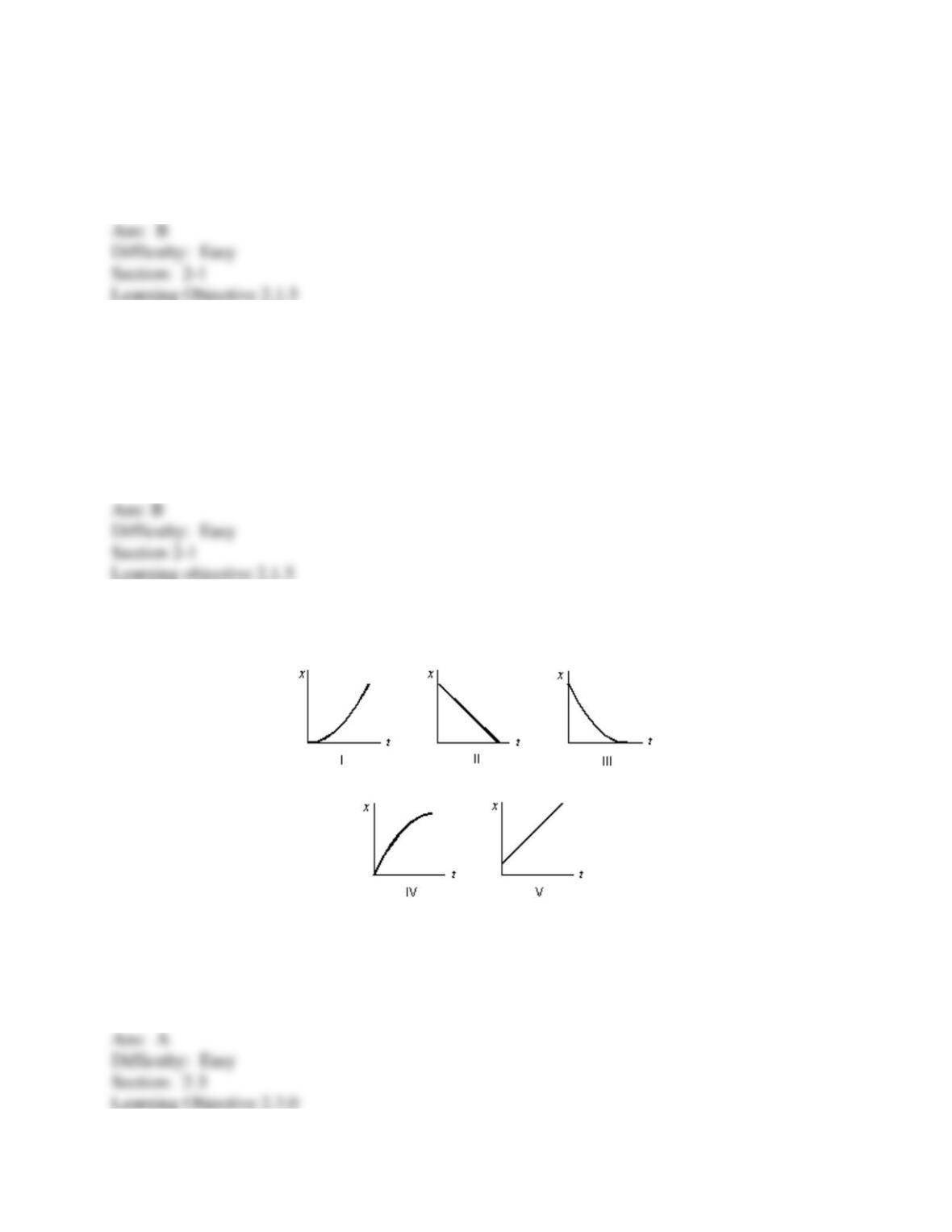
13. Which of the following five coordinate versus time graphs represents the motion of an object
whose speed is increasing?
A) I
B) II
C) III
D) IV
E) V
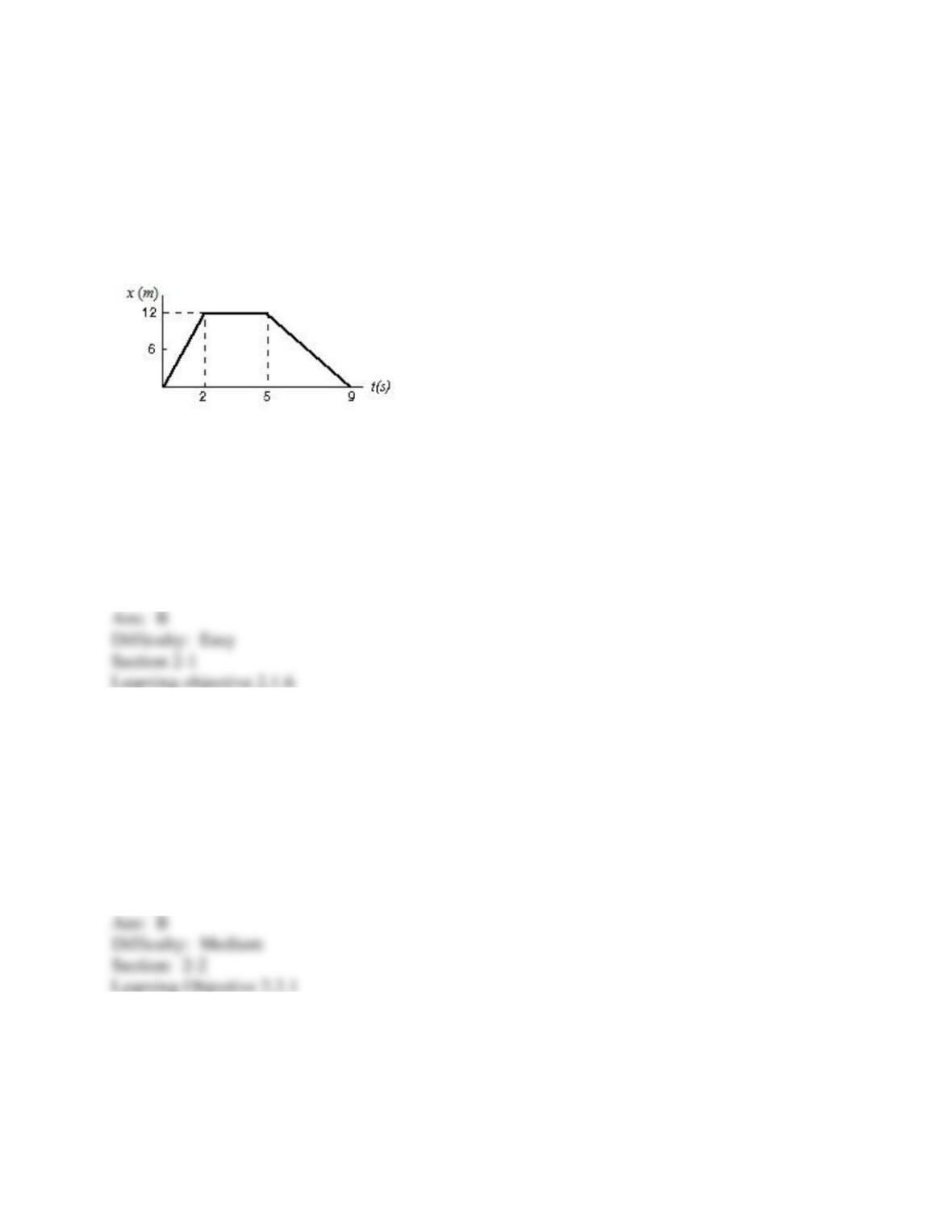
14. This graph shows the position of a particle as a function of time. What is its average velocity
between t = 5s and t = 9s?
A) 3 m/s
B) -3 m/s
C) 12 m/s
D) -12 m/s
E) Need additional information.
15. The coordinate of a particle in meters is given by x(t) = 16t – 3.0t3, where the time t is in
seconds. The particle is momentarily at rest at t =
A) 0.75 s
B) 1.3 s
C) 1.8 s
D) 5.3 s
E) 7.3 s
16. Each of four particles moves along an x axis. Their coordinates (in meters) as functions of
time (in seconds) are given by
particle 1: x(t) = 3.5 – 2.7t3
particle 2: x(t) = 3.5 + 2.7t3
particle 3: x(t) = 3.5 + 2.7t2
particle 4: x(t) = 3.5 – 3.4t – 2.7t2
For which of these particles is the velocity increasing for t > 0?
A) All four
B) Only 1
C) Only 2 and 3
D) Only 2, 3, and 4
E) None of them
17. The coordinate of an object is given as a function of time by x = 7t – 3t2, where x is in meters
and t is in seconds. Its velocity at t = 3s is:
A) -6 m/s
B) -11 m/s
C) -21 m/s
D) 9 m/s
E) 18 m/s
18. Which of the following five coordinate versus time graphs represents the motion of an object
moving with a constant nonzero speed?
A) I
B) II
C) III
D) IV
E) V
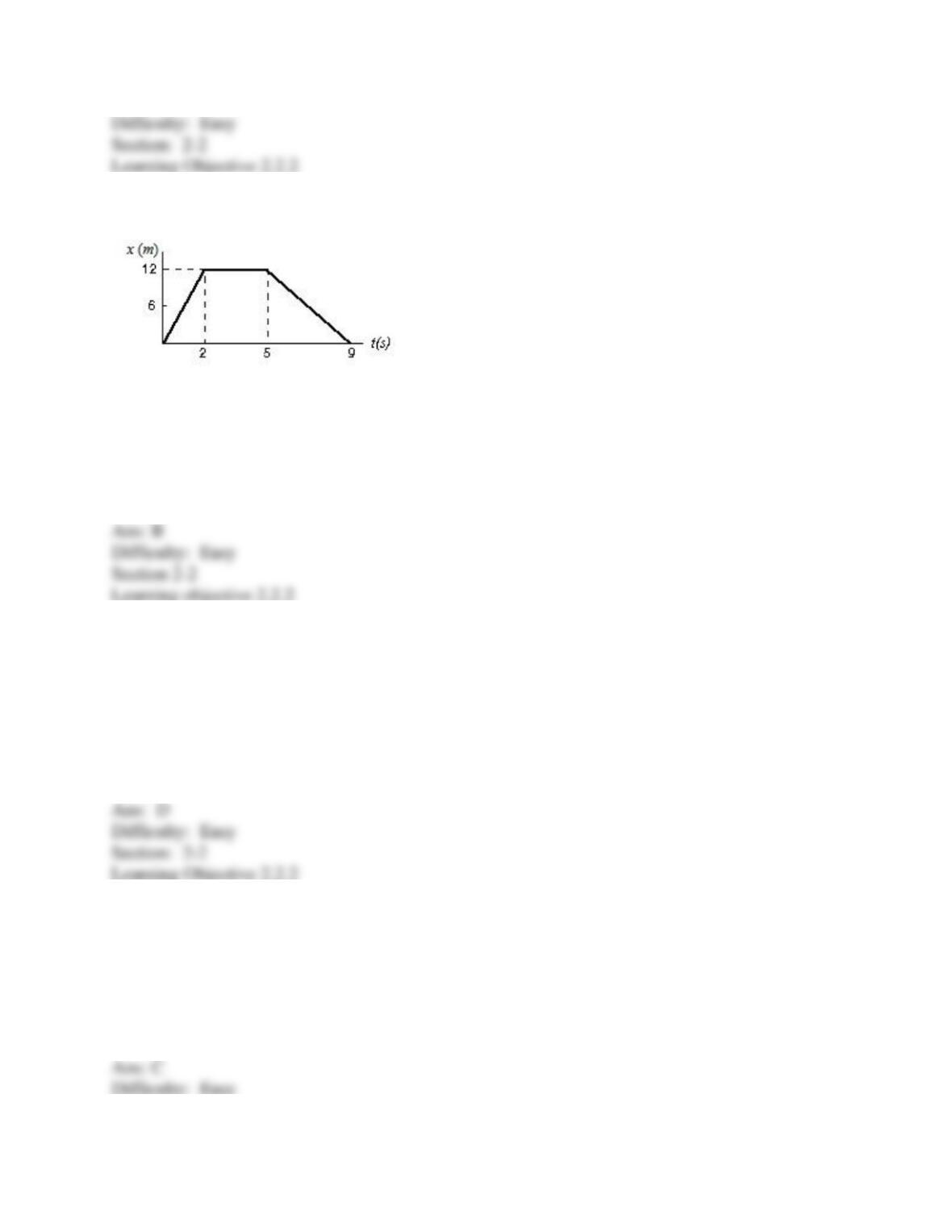
19. This graph shows the position of a particle as a function of time. What is its instantaneous
velocity at t = 7s?
A) 3 m/s
B) -3 m/s
C) 12 m/s
D) -12 m/s
E) Need additional information.
20. The coordinate-time graph of an object is a straight line with a positive slope. The object
has:
A) constant displacement
B) steadily increasing acceleration
C) steadily decreasing acceleration
D) constant velocity
E) steadily increasing velocity
21. What is the relationship between instantaneous speed and instantaneous velocity?
A) They are identical.
B) Instantaneous speed is the rate at which the instantaneous velocity is changing.
C) Instantaneous speed is the magnitude of the instantaneous velocity.
D) They are unrelated.
E) Instantaneous speed is the initial speed minus the final speed.
22. A ball rolls up a slope. At the end of three seconds its velocity is 20 cm/s; at the end of eight
seconds its velocity is 0 cm/s. What is the magnitude of its average acceleration from the third to
the eighth second?
A) 2.5 cm/s2
B) 4.0 cm/s2
C) 5.0 cm/s2
D) 6.0 cm/s2
E) 6.67 cm/s2
23. Over a short interval near time t = 0 the coordinate of an automobile in meters is given by
x(t) = 27t – 4.0t3, where t is in seconds. At the end of 1.0 s the acceleration of the auto is:
A) 23 m/s2
B) 15 m/s2
C) –4.0 m/s2
D) –12 m/s2
E) –24 m/s2
24. The coordinate of an object is given as a function of time by x = 4t2 – 3t3, where x is in
meters and t is in seconds. Its average acceleration over the interval from t = 0 to t = 2 s is:
A) –8 m/s2
B) 4 m/s2
C) –10 m/s2
D) 10 m/s2
E) –13 m/s2
25. Each of four particles moves along an x axis. Their coordinates (in meters) as functions of
time (in seconds) are given by
particle 1: x(t) = 3.5 – 2.7t3
particle 2: x(t) = 3.5 + 2.7t3
particle 3: x(t) = 3.5 + 2.7t2
particle 4: x(t) = 3.5 – 3.4t – 2.7t2
Which of these particles have constant acceleration?
A) All four
B) Only 1 and 2
C) Only 2 and 3
D) Only 3 and 4
E) None of them
26. Throughout a time interval, while the speed of a particle increases as it moves along the x
axis, its velocity and acceleration could be:
A) positive and negative, respectively
B) negative and positive, respectively
C) negative and negative, respectively
D) negative and zero, respectively
E) positive and zero, respectively
27. A particle moves on the x axis. When its acceleration is positive and increasing:
A) its velocity must be positive
B) its velocity must be negative
C) it must be slowing down
D) it must be speeding up
E) none of the above must be true
28. Of the following situations, which one is impossible?
A) A body having velocity east and acceleration east
B) A body having velocity east and acceleration west
C) A body having zero velocity and non-zero acceleration
D) A body having constant acceleration and variable velocity
E) A body having constant velocity and variable acceleration
29. Can an object have positive acceleration and decreasing speed?
A) No, this is not possible.
B) Yes, speed will always decrease if acceleration is positive.
C) Yes, this is possible if the initial velocity is zero.
D) Yes, this is possible if the initial velocity is negative.
E) Yes, this is possible but only if the object is moving in two dimensions.
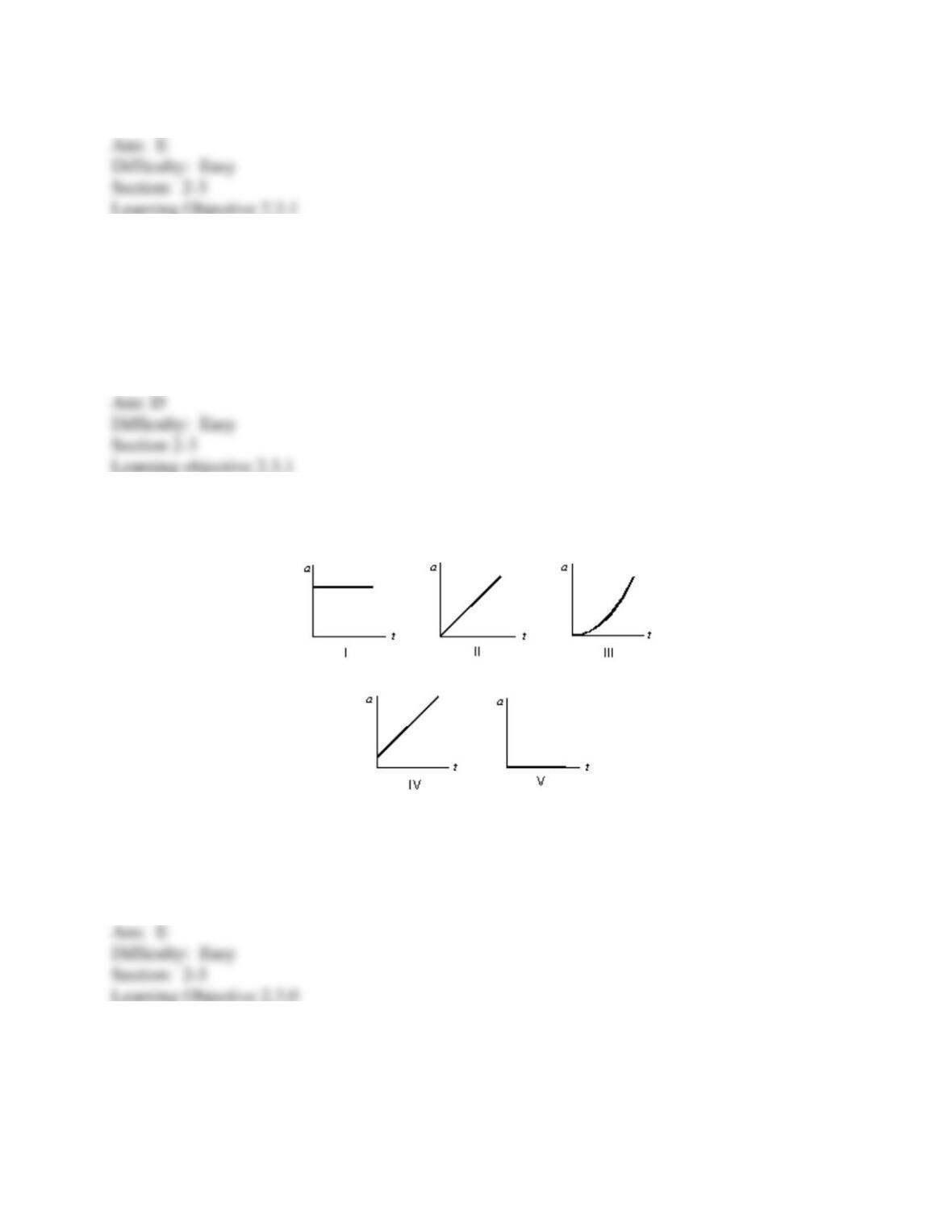
30. Which of the following five acceleration versus time graphs is correct for an object moving
in a straight line at a constant velocity of 20 m/s?
A) I
B) II
C) III
D) IV
E) V
31. All falling objects experience some air resistance, the effect of which is to decrease
acceleration. When the falling object’s acceleration reaches zero, the acceleration stops
changing. Therefore, if you drop an object and it falls far enough for this to happen,
A) its speed continues to increase all the way down.
B) its speed reaches a maximum value and then decreases.
C) its speed reaches a maximum value and then doesn’t change.
D) its speed reaches a maximum value, decreases, and then increases again.
E) Any of these things could happen.
32. Is it possible for an object to have zero velocity and constant nonzero acceleration?
A) Yes, but only if it is not moving at all.
B) No, if its velocity is zero its acceleration must also be zero.
C) Yes, all objects with zero velocity have nonzero acceleration.
D) No, if its acceleration is not zero its velocity cannot be zero.
E) Yes, but its velocity must only be zero for an instant.
33. Over a short interval, starting at time t = 0, the coordinate of an automobile in meters is
given by x(t) = 27t – 4.0t3, where t is in seconds. The magnitudes of the initial (at t = 0) velocity
and acceleration of the auto respectively are:
A) 0 m/s; 12 m/s2
B) 0 m/s; 24 m/s2
C) 27 m/s; 0 m/s2
D) 27 m/s; 12 m/s2
E) 27 m/s; 24 m/s2
34. Starting at time t = 0, an object moves along a straight line with velocity in m/s given by
v(t) = 98 – 2t2, where t is in seconds. When it momentarily stops its acceleration is:
A) 0 m/s2
B) –4.0 m/s2
C) –9.8 m/s2
D) –28 m/s2
E) 49 m/s2
35. Starting at time t = 0, an object moves along a straight line. Its coordinate in meters is given
by x(t) = 75t – 1.0t3, where t is in seconds. When it momentarily stops its acceleration is:
A) 0 m/s2
B) –73 m/s2
C) –30 m/s2
D) –9.8 m/s2
E) 9.2 x 10³ m/s2
36. A particle moves along the x axis according to the equation x = 6t2 where x is in meters and t
is in seconds. Therefore:
A) the acceleration of the particle is 6 m/s2
B) t cannot be negative
C) the particle follows a parabolic path
D) each second the velocity of the particle changes by 9.8 m/s
E) none of the above
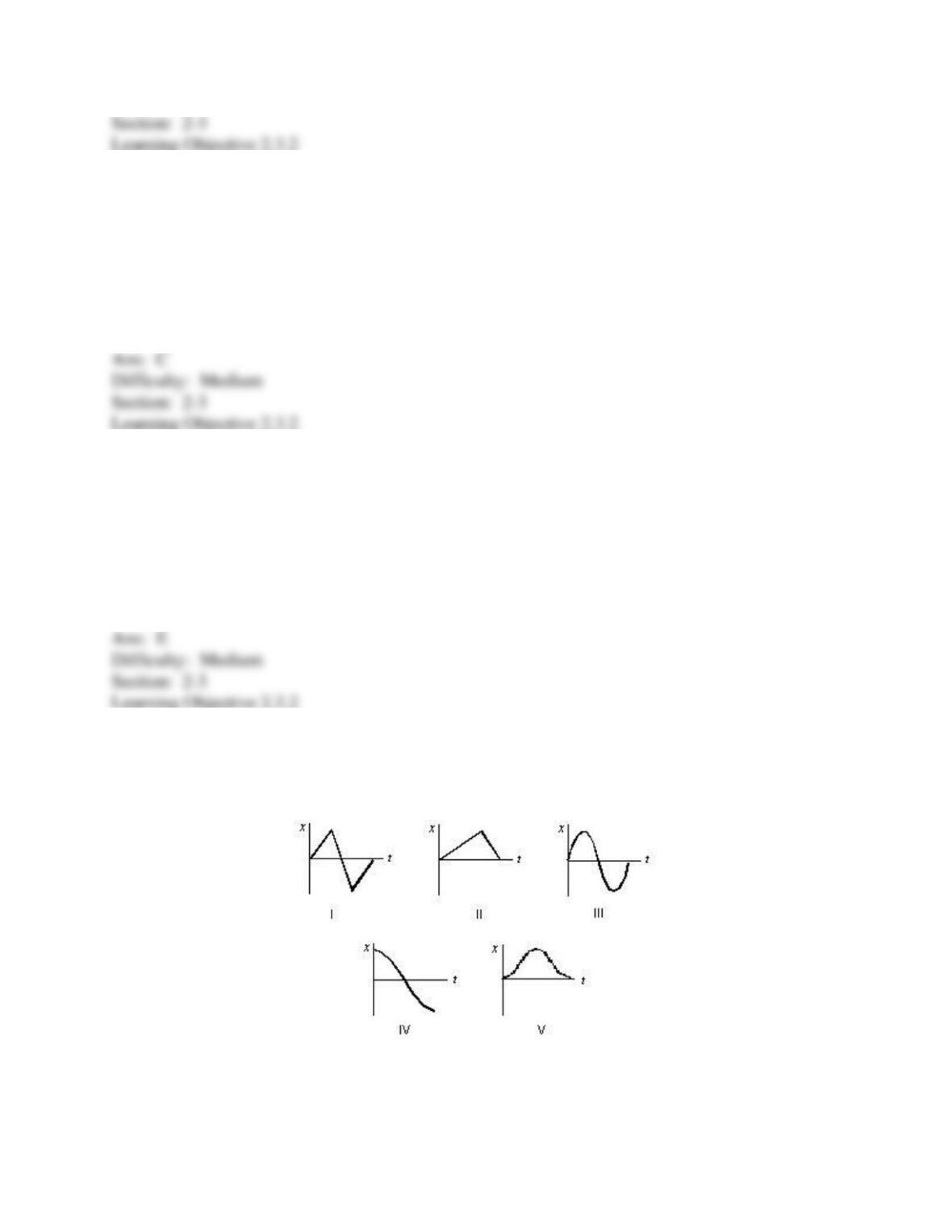
37. A car accelerates from rest on a straight road. A short time later, the car decelerates to a stop
and then returns to its original position in a similar manner, by speeding up and then slowing to a
stop. Which of the following five coordinate versus time graphs best describes the motion?
A) I
B) II
C) III
D) IV
E) V
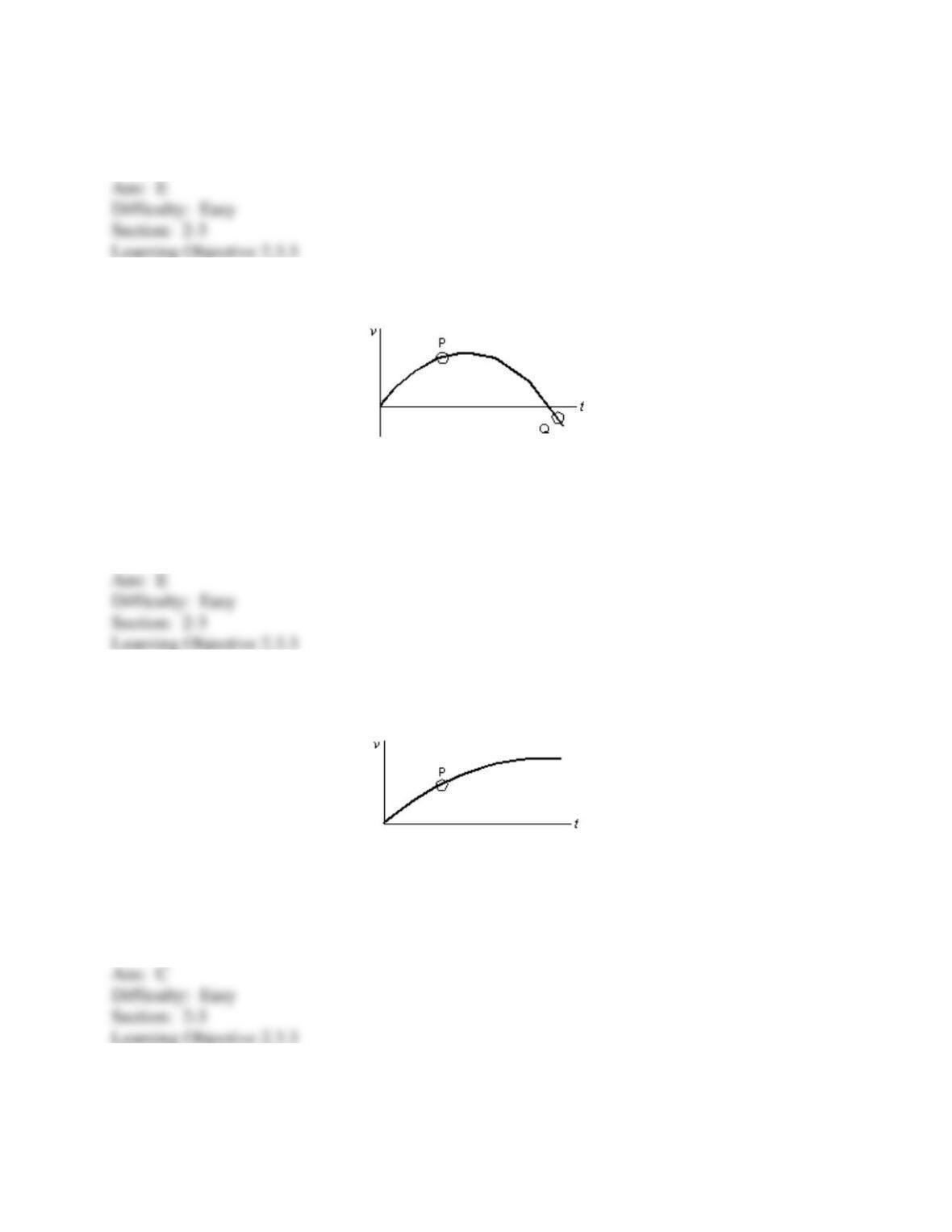
38. The diagram shows a velocity-time graph for a car moving in a straight line. At point Q the
car must be:
A) moving with zero acceleration
B) traveling downhill
C) traveling below ground-level
D) reducing speed
E) traveling in the reverse direction to that at point P
39. The diagram shows a velocity-time graph for a car moving in a straight line. At point P the
car must be:
A) moving with zero acceleration
B) climbing the hill
C) accelerating
D) stationary
E) moving at about 45° with respect to the x axis
40. The diagram represents the straight line motion of a car. Which of the following statements
is true?
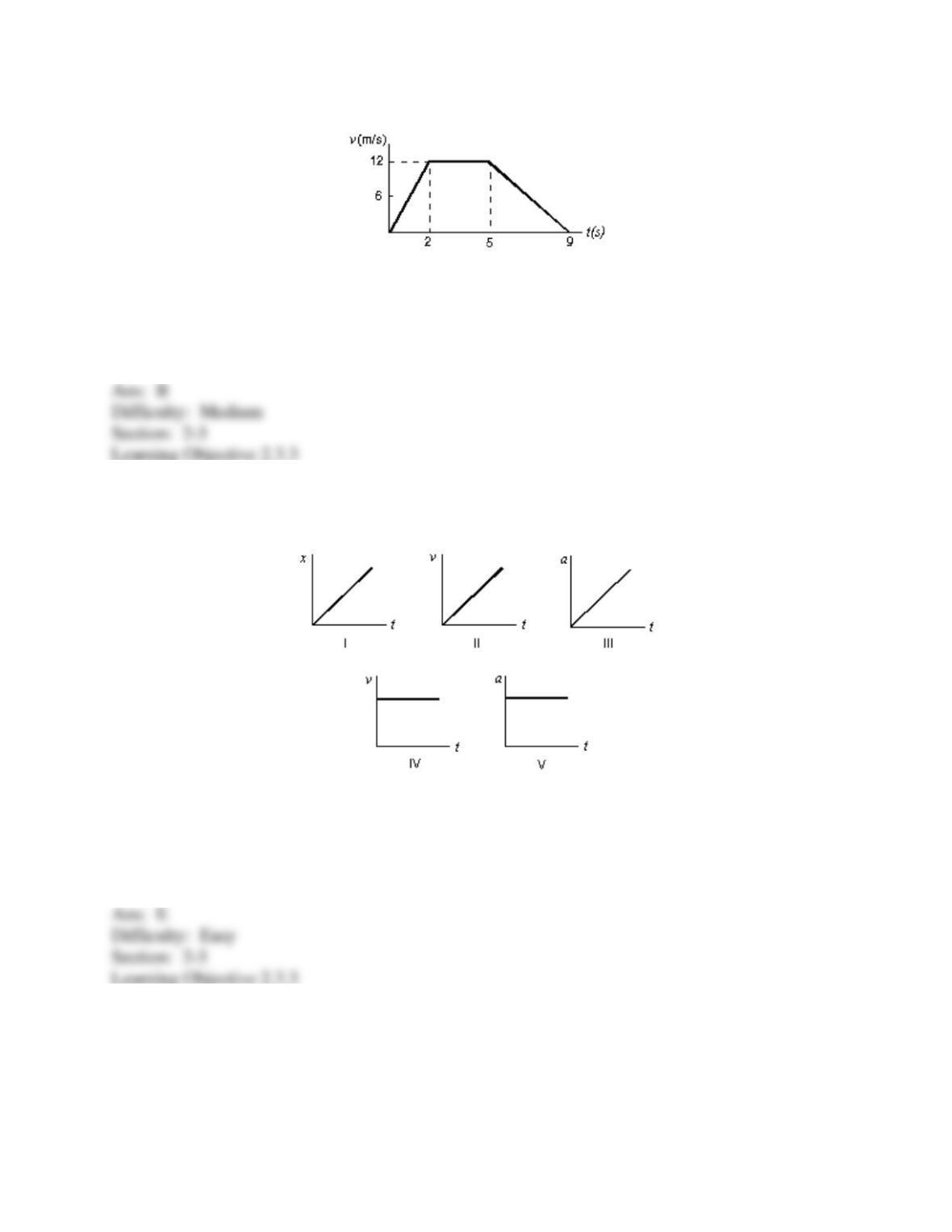
A) The car’s speed increases, then it stops, and reverses
B) The car accelerates at 6 m/s2 for the first 2 s
C) The car is moving for a total time of 12 s
D) The car accelerates at –12 m/s2 for the last 4 s
E) The car returns to its starting point when t = 9 s
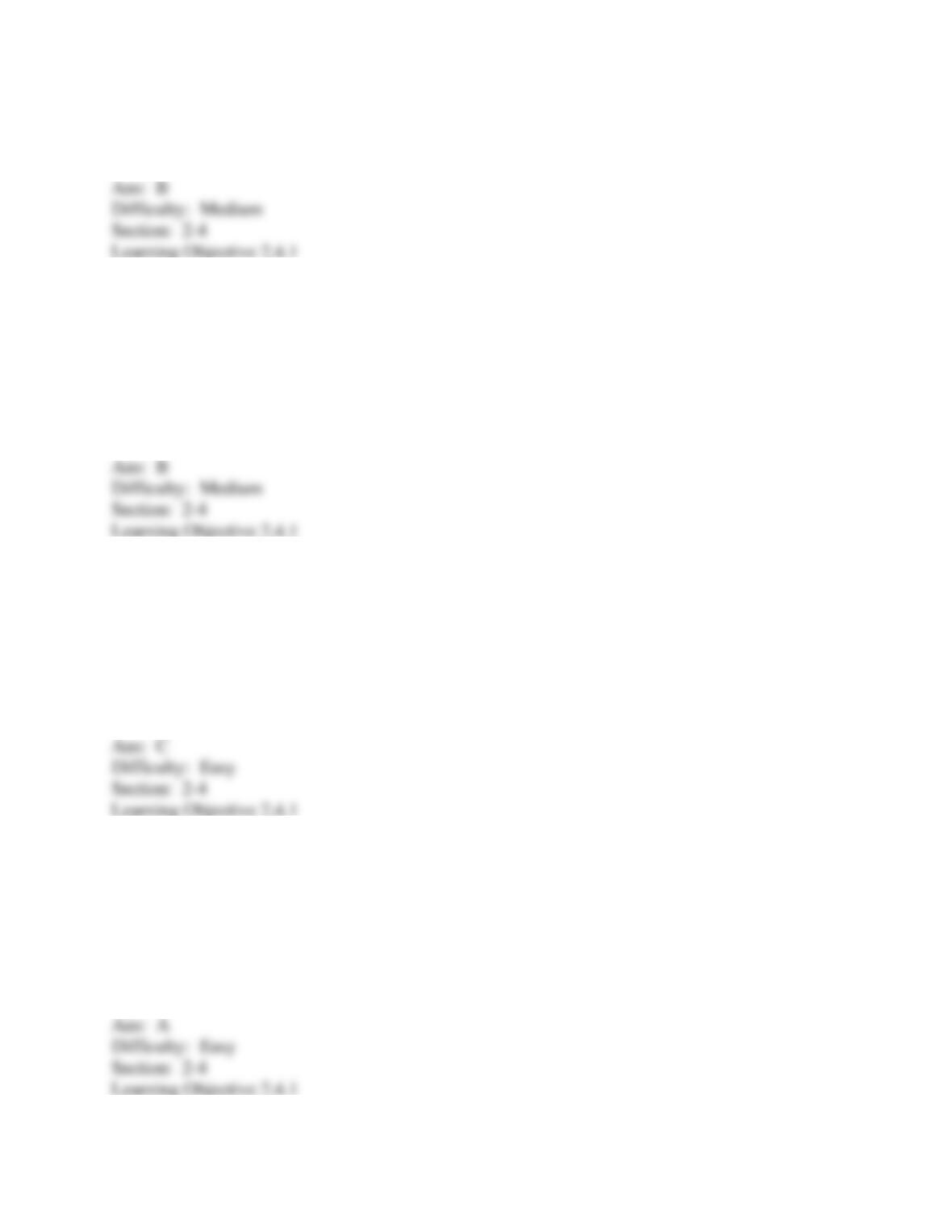
41. Consider the following five graphs (note the axes carefully). Which of these represent(s)
motion at constant speed?
A) IV only
B) IV and V only
C) I, II, and III only
D) I and II only
E) I and IV only
42. A car, initially at rest, travels 20 m in 4 s along a straight line with constant acceleration. The
acceleration of the car is:
A) 1.3 m/s2
B) 2.5 m/s2
C) 4.9 m/s2
D) 9.8 m/s2
E) There is not enough information to answer this question.
43. A racing car traveling with constant acceleration increases its speed from 10 m/s to 30 m/s
over a distance of 60 m? How long does this take?
A) 2.0 s
B) 3.0 s
C) 5.0 s
D) 6.0 s
E) The time cannot be calculated since the speed is not constant
44. A car starts from rest and goes down a slope with a constant acceleration of 5 m/s2. After 5
seconds the car reaches the bottom of the hill. What is its speed at the bottom of the hill?
A) 1 m/s
B) 12.5 m/s
C) 25 m/s
D) 50 m/s
E) 160 m/s
45. A car moving with an initial velocity of 25 m/s north has a constant acceleration of 3 m/s2
south. After 6 seconds its velocity will be:
A) 7 m/s north
B) 7 m/s south
C) 43 m/s north
D) 20 m/s north
E) 20 m/s south